
Your Telemedicine Video Must Work. Every Session. Every Time.
Trembit is a telemedicine app development company that builds secure, HIPAA-, GDPR-, and KBV-compliant video consultation platforms — with EHR/EMR integration, scheduling, e-prescribing, and remote patient monitoring — for hospitals, clinics, and digital-health startups. Over 15 years we’ve delivered 50+ video and voice implementations, and our telemedicine platforms now run across 4,000+ healthcare facilities.
Sound Familiar?
Your video drops calls — and patients drop you.
Video fails 2-3 times per week. Group sessions above 10 participants are unreliable. Your support team is fielding “the video broke again” tickets daily — and every dropped session erodes patient trust in your platform.
A compliance deadline is approaching — and your architecture won’t pass.
KBV certification in Germany. HIPAA audit in the US. GDPR assessment for EU expansion. Your team knows React and Node, but nobody can tell whether the issue is ICE connectivity, TURN relay misconfiguration, or codec negotiation failure.
The previous dev team left — and took the knowledge with them.
An outsourced team built your telehealth video layer. They’re gone. No documentation. Your internal engineers can maintain the application code but can’t diagnose problems below the API surface. Every WebRTC issue becomes an emergency.
You’re stuck in the build-vs-buy trap.
Twilio, Agora, Daily, Vonage — or custom WebRTC on LiveKit, Janus, or Mediasoup? Every option has trade-offs nobody on your team fully understands. And the wrong decision costs 12-18 months.
The board is asking why video still isn’t reliable.
Every month of instability costs users, revenue, and trust that takes quarters to rebuild. Your competitors who solved video first are winning the contracts you were counting on.
The Cost of Waiting
Every month you delay costs you: 15-20% of patients who won’t return after a failed video session. 6-12 months added to your compliance timeline. Six figures in rework when the architecture needs rebuilding.
If any of these sound familiar, you’re not alone. Most telemedicine CTOs we work with started in exactly this position.
Why Telemedicine Video Is a Different Engineering Problem
Compliance Cannot Be a Layer — It Must Be the Foundation
Building a truly HIPAA-compliant video conferencing platform requires end-to-end encryption designed into the foundation — not bolted on after launch.
KBV certification for telemedicine in Germany prohibits third-party media routing entirely — ruling out every hosted WebRTC service on the market. Companies that skip compliance architecture at the start routinely spend six figures retrofitting 12-18 months later.
Off-the-Shelf Video Breaks in Clinical Environments
Healthcare video connects an unknown patient need to an available provider and establishes a clinical-quality session in seconds — inside EHR workflows, on constrained hospital networks, with device diversity that breaks consumer platforms.
ASL interpretation requires sustained resolution that standard WebRTC compression actively degrades. A compression artifact during a clinical encounter is a patient safety risk, not a quality nuisance.
Protocol-Level Control Is Non-Negotiable
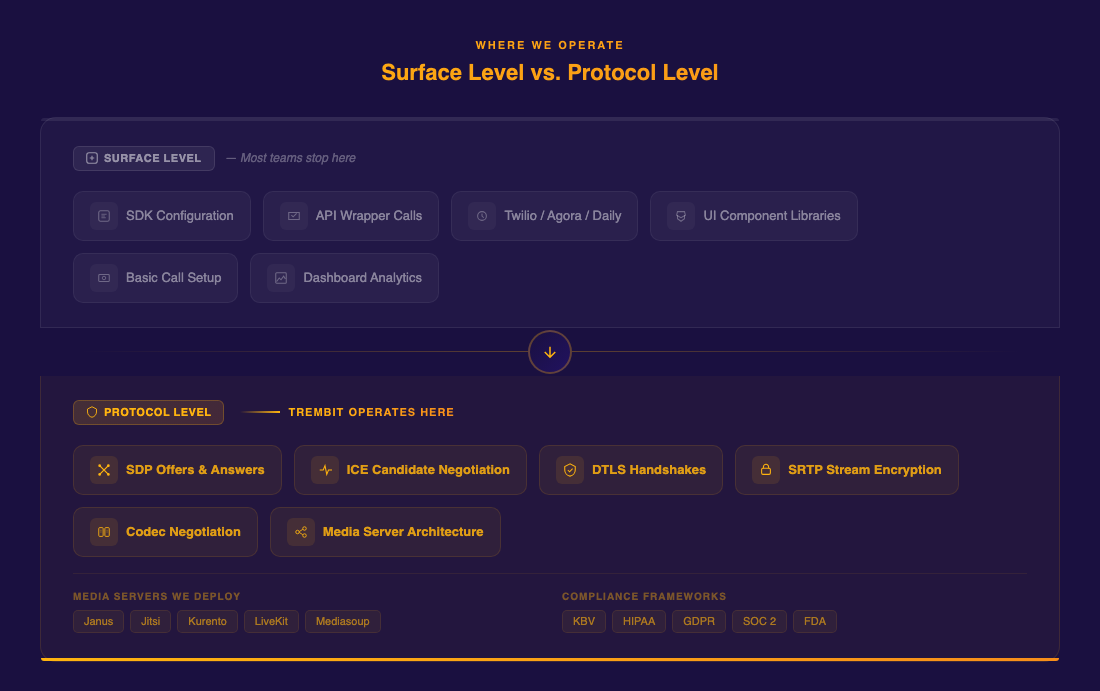
Sub-20-second connection times at scale require building the routing intelligence, the media infrastructure, and the quality assurance from the protocol level up — not configuring a wrapper SDK.
If your WebRTC engineer can’t explain the difference between an SDP offer, an ICE candidate, and a DTLS handshake, your telemedicine platform has a specialization gap — not a skills gap.
Telemedicine App Development Services
Rescue Your Failing Video
For CTOs with a live telemedicine product that's unreliable
We inherit the codebase, diagnose at the protocol level, and ship what the previous team couldn’t. No wrapper SDKs, no surface-level patches — we fix the root cause.
- Call drop rate reduced from 10-15% to under 1%
- Group therapy sessions stable at 20-50+ participants
- Root cause fixed at protocol level — not patched over
- Your internal team unblocked to build product features
They know the inner workings of the tech and were able to inherit our semi-functional code and get it to work where multiple prior teams couldn't.
— Telemedicine platform client via Clutch
Get Certified — KBV, HIPAA, GDPR
For CTOs facing a compliance deadline on their telemedicine platform
We’ve been through KBV, HIPAA, and GDPR certification — and we know exactly where other teams get stuck. From architecture redesign to certification submission, we support the entire process.
Building for psychotherapy? See teletherapy platform development →
- Architecture redesigned for compliance at the protocol level
- Certification documentation and review process supported end-to-end
- Listed on official provider registries (KBV/GKV, HIPAA audit-ready)
- Compliance becomes your competitive advantage
KBV-certified video consultation platform for psychotherapy, built by Trembit.
Build Your Custom Telemedicine Platform
For CTOs building their first telehealth app from scratch
The architecture decisions you make now determine whether you need a rescue team in 18 months. We build compliance-ready foundations, and if a white-label video layer gets you to launch sooner, our build-vs-buy assessment will say so.
- Production-ready telemedicine MVP in about one month
- Honest build vs buy assessment
- HIPAA-compliant with GDPR and KBV-ready architecture
- Knowledge transfer so you're never dependent on us
Companies that build on the wrong foundation spend 3x more to rebuild. Start right.
What does a telemedicine app development company do?
A telemedicine app development company designs, builds, and maintains the software that lets patients and clinicians consult remotely — secure video visits, appointment scheduling, EHR/EMR integration, e-prescribing, in-app payments, and remote patient monitoring — under healthcare compliance regimes such as HIPAA, GDPR, and (in Germany) KBV. The hardest part is rarely the app UI; it’s the real-time video layer, which has to stay reliable, private, and compliant on every single session. That’s the layer most teams underestimate — and the one Trembit specializes in at the WebRTC protocol level.
Deliverables a telemedicine build typically includes:
- Secure, compliant video/voice consultations (1:1 and group)
- EHR/EMR and lab/pharmacy integration
- Scheduling, waiting rooms, and e-prescribing
- Remote patient monitoring (RPM) and device data
- Identity, consent, and audit logging for HIPAA/GDPR/KBV
Healthcare Companies Trust Us With Their Video Infrastructure
These aren't hypothetical. Here's what we built.
KBV-Certified P2P Psychotherapy Platform with WebRTC
WebPRAX Face2Face Germany (KBV-certified)
Challenge: A German healthcare technology company set out to build a KBV-certified video platform dedicated to online psychotherapy. Existing telehealth tools were built for general…
- KBV Dedicated video psychotherapy platform certified for reimbursable online therapy
- True P2P WebRTC peer-to-peer with no server-side media access or storage
- GDPR Full regulatory compliance with German healthcare standards
HIPAA-Compliant WebRTC Healthcare Video Translation Platform
Cloudbreak International
Challenge: A healthcare communications company needed to add real-time multilingual translation to their telehealth video platform — not as a separate service patients dial into,…
- Sub-second Translation latency from speech to dubbed audio
- HIPAA + GDPR Zero data persistence, encrypted pipeline
- Multi-language Real-time translation across clinical language pairs
Full-Stack Telemedicine Platform with WebRTC Group Video Streaming
Stusan LTD EU (Germany)
Challenge: A telemedicine provider needed a platform that allowed distributed healthcare teams to conduct secure group video consultations — not just one-on-one calls, but multi-participant…
- Low-latency group Multi-participant calls with adaptive bitrate management
- HIPAA/GDPR/KBV End-to-end encryption, audit logging, and EU data residency
- Integrated clinical tools E-prescriptions, whiteboards, and calendars within live sessions
Rebuilding the World's Most Researched Brain Training App — From Flash to Modern Web and Mobile
Cogmed Global (20+ countries)
Challenge: Cogmed is the world's most evidence-based working memory training program — developed at the Karolinska Institute, backed by 120+ peer-reviewed publications, and used by…
- Flash/AIR to JS/React Full HTML5 web app, no installation required
- Web + iOS + Android A single modern cross-platform codebase
- 200,000+ users Maintained across 20+ countries through the transition
What Healthcare Teams Say About Working With Us
“They know the inner workings of the tech and were able to inherit our semi-functional code and get it to work where multiple prior teams couldn’t. It was a tough project and yet they breezed through it. We’d highly recommend them to anyone looking to build video tech.
“Their processing integrity was impressive. They precisely estimated the number of hours required and delivered according to promises.
“Their proactive team gets things done as if it were their own project, consistently delivering high-quality outputs. What really differentiates them is their ability to deeply understand business needs.
Due to healthcare confidentiality requirements, client names are available upon request for qualified inquiries. All testimonials verified on Clutch.
Protocol-Level WebRTC for Healthcare. Not Wrapper SDKs.
We don’t just “use” WebRTC for healthcare. We debug at the SDP, ICE, and SRTP layer. We’ve deployed every major media server architecture across 50+ video consultation software implementations.
Media Servers We Deploy
We Pick the Right Media Server for Your Use Case
Protocol-Level Debugging
When Your Video Breaks, We Find the Real Cause in Hours
Healthcare Compliance Frameworks
EHR Integration
Telehealth Platform Integrations
How We Build Telemedicine Apps: Our Process
Assessment
We read your codebase, not your slide deck. Within two weeks you know exactly what’s wrong, what needs to change for certification, or which architecture is right. All we need: codebase access, current infrastructure docs, and 2 hours with your engineering lead.
Execute
A dedicated Trembit team — 2-4 engineers plus a tech lead — builds, fixes, or certifies. Your CTO talks directly to our tech lead. No account managers. Weekly deliverables, not quarterly surprises.
Extend or Transfer
Most clients stay 1-3+ years because the foundation we build makes ongoing development efficient. If you want to bring it in-house, we document everything and transfer knowledge.
Questions CTOs Ask Before Engaging a Telemedicine App Development Company
Let’s Talk About Your Telemedicine Platform
What you’ll get from the conversation:
- Honest assessment of your current architecture
- Which compliance gaps need addressing
- Whether a CPaaS or custom WebRTC is right for your case
- Realistic timeline and budget range