The Reality of Real-Time Moderation for Dating and Social Platforms
Live video has transformed social and dating platforms, creating opportunities for authentic connection and engagement. However, it has also opened new vectors for abuse, harassment, and inappropriate content. The promise of AI-powered moderation suggests a simple solution: deploy computer vision models to automatically detect and block harmful content in real-time.
The reality is far more complex. Despite billions invested in AI moderation technology by major platforms, live video moderation remains one of the most challenging problems in content safety. False positive rates that seem acceptable on paper — 2% or 3% — translate to thousands of legitimate users wrongly disconnected from calls daily. Sampling latency means harmful content often reaches viewers before detection. And the computational cost of real-time analysis at scale can exceed the revenue generated by the feature itself.
This article examines why AI moderation consistently fails to meet expectations in live video scenarios and presents architectural patterns that work around these limitations while maintaining platform safety.
The Fundamental Problems with Real-Time AI Moderation
Sampling Latency: The Unavoidable Gap
Real-time video moderation sounds instantaneous, but the physics of video processing create unavoidable delays between capture and decision.
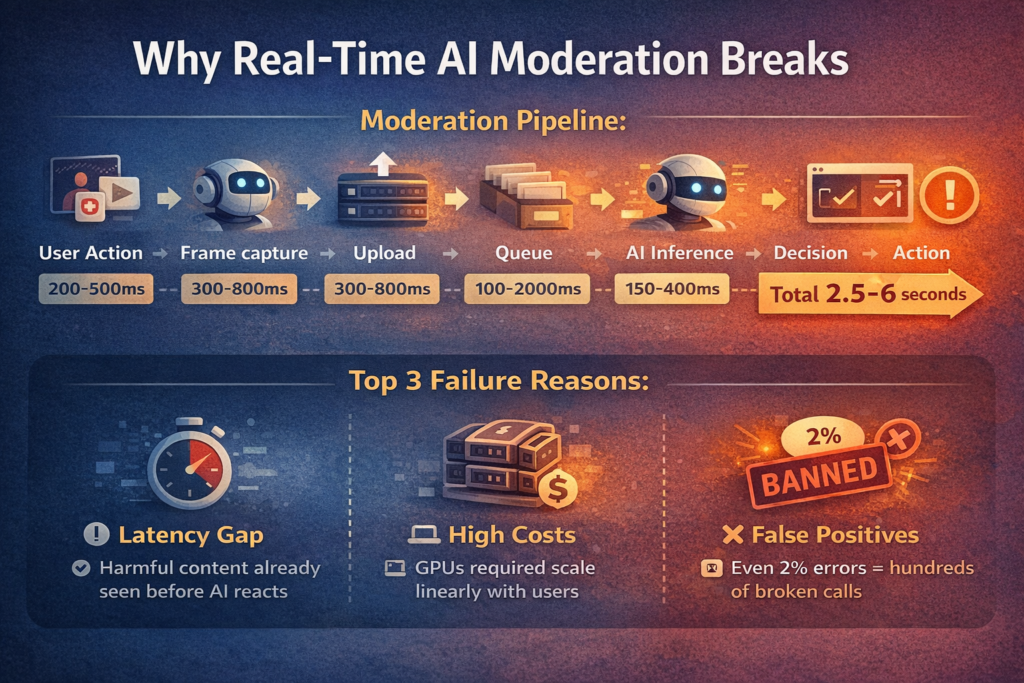
The moderation pipeline timeline:
User action occurs → Frame captured → Frame buffered →
Uploaded to server → Queue wait → Model inference →
Decision made → Action command sent → Stream interrupted
Typical total latency: 2.5-6 seconds
Breakdown of where time is lost:
| Stage | Typical Duration | Contributing Factors |
| Frame capture & buffering | 200-500ms | Video encoder frame batching |
| Upload to moderation server | 300-800ms | Network latency, upload bandwidth |
| Queue wait time | 100-2000ms | Server load, concurrent streams |
| Model inference | 150-400ms | Model complexity, GPU availability |
| Decision & action delivery | 100-300ms | System processing, network return trip |
| Total end-to-end | 850-4000ms | 2.5-6 second delay is typical |
In 3 seconds of delay, a significant amount of harmful content reaches viewers. A user exposing themselves, making violent threats, or displaying offensive symbols has already impacted other participants before the system can react. This fundamental latency makes purely reactive moderation insufficient for truly harmful content.
Computational Cost at Scale
AI moderation requires analyzing every frame (or sampled frames) from every active video stream. The computational requirements scale linearly with concurrent streams, creating massive infrastructure costs.
Resource consumption example for a dating app with 10,000 concurrent video calls:
Sampling strategy: 2 frames per second per stream
Total frames to analyze: 20,000 frames/second
GPU inference time: 50ms per frame
Required GPU capacity: 20,000 × 0.05 = 1,000 GPU-seconds/second
Minimum GPUs needed: 1,000 (with no overhead)
Realistic with overhead: 1,500-2,000 GPUs
Cost at $2.50/hour per GPU: $90,000-120,000/month
Per concurrent user: $9-12/month
For comparison, a typical dating app ARPU (Average Revenue Per User) is $5-15/month. Real-time moderation can consume 60-120% of revenue, making it economically unviable without architectural optimization.
The False Positive Problem
AI models excel at narrow, well-defined tasks but struggle with the contextual nuance required for content moderation. What appears inappropriate in isolation may be innocent in context.
Common false positive scenarios in dating apps:
- Beach/pool settings: Swimwear flagged as nudity (false positive rate: 8-15%)
- Medical contexts: Users discussing health conditions showing surgical scars or medical devices
- Intimate but appropriate: Kissing, embracing, or affectionate behavior flagged as sexual content
- Cultural differences: Clothing, gestures, or behaviors normal in one culture are flagged in another
- Artistic content: Users showing artwork, discussing films, or sharing creative content
- Movement blur: Fast motion creates artifacts that resemble inappropriate content
Impact of false positives on user experience:
Even a 2% false positive rate has severe consequences:
- 10,000 daily video calls × 2% FP rate = 200 incorrectly interrupted calls/day.
- User surveys show 68% of users wrongly flagged abandon the platform within 2 weeks.
- Support ticket volume increases 300-500% after deploying aggressive moderation.
- App store reviews and social media amplify negative experiences.
The fundamental challenge: AI cannot understand context, intent, or cultural norms. A human immediately recognizes the difference between a couple at the beach and sexual content, but teaching an AI this distinction requires massive training datasets covering every edge case — an impossible task.
Why “Just Train Better Models” Doesn’t Work
Platform teams encountering these problems often assume the solution is simply improving model accuracy. Unfortunately, the improvements required are mathematically unattainable.
The Accuracy Paradox
Consider a moderation system targeting 98% accuracy (already state-of-the-art):
Statistical reality of 98% accurate model:
Daily active users: 100,000
Average video calls per user: 2
Total daily calls: 200,000
At 98% accuracy:
– Correct decisions: 196,000
– Incorrect decisions: 4,000/day
Of those 4,000 errors:
– False positives (innocent flagged): ~2,000
– False negatives (violations missed): ~2,000
Improving from 98% to 99% accuracy requires:
- Exponentially more training data
- More complex models with higher computational costs
- Longer inference times that worsen latency
- Still results in 2,000 daily errors.
The harsh reality: Perfect accuracy is mathematically impossible with current AI techniques. Even 99.9% accuracy (far beyond current capabilities) yields 200 daily errors on this scale.
The Content Diversity Challenge
Harmful content constantly evolves. Adversarial users actively work around moderation systems by:
- Using objects or gestures to obscure prohibited content
- Employing coded language or signals
- Exploiting edge cases in model training
- Adapting to feedback about what triggers flags
Training data becomes stale within months. Models trained on 2023 data miss new harassment patterns emerging in 2024. Continuous retraining requires dedicated ML teams and creates operational complexity.
Training data requirements for comprehensive coverage:
| Content Category | Minimum Training Examples | Diversity Requirements |
| Nudity/sexual content | 50,000+ | Multiple body types, lighting, angles |
| Violence/weapons | 30,000+ | Real vs. toy weapons, context variations |
| Hate symbols | 20,000+ | Cultural variations, artistic depictions |
| Self-harm content | 15,000+ | Medical vs. self-harm context |
| Illegal substances | 25,000+ | Legitimate uses vs. abuse |
Assembling these datasets requires:
- Dedicated data collection teams
- Legal review for possession/distribution of illegal content imagery
- Psychological support for dataset reviewers
- Continuous updates as new patterns emerge
Most platforms lack the resources for this continuous investment, leaving them perpetually behind the curve.
Architectural Patterns That Actually Work
Rather than pursuing impossible perfection in real-time AI moderation, successful platforms architect around AI’s limitations using hybrid approaches.
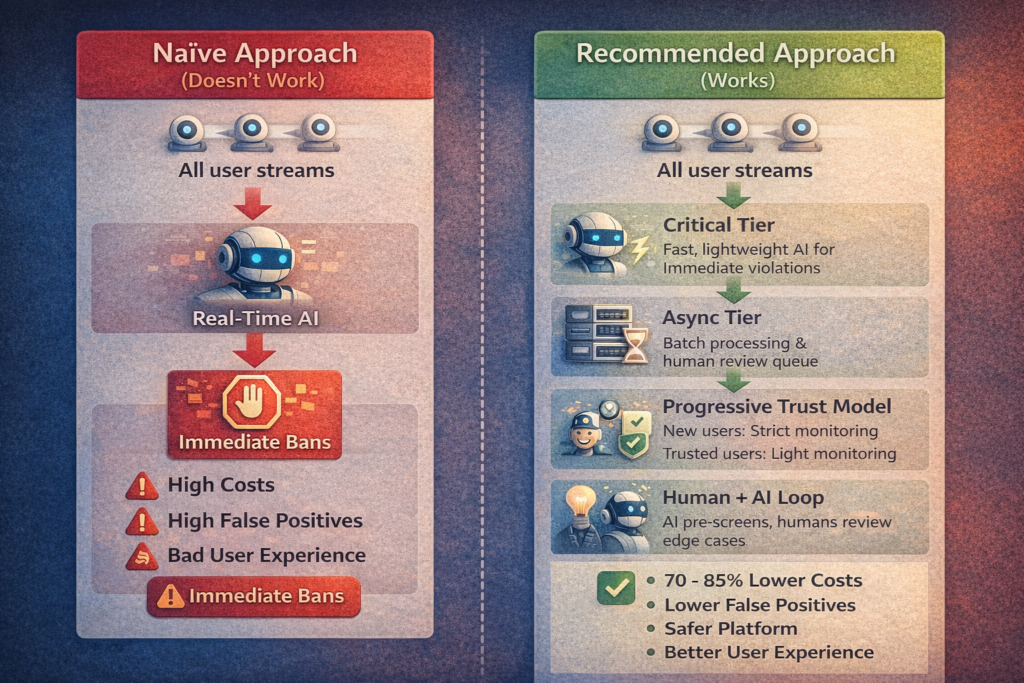
Pattern 1: Tiered Response System
Not all content violations require immediate intervention. Tiered systems match response urgency to violation severity.
Severity tiers and response strategies:
| Severity | Content Examples | Response Latency | Action |
| Critical | Sexual content, violence | <1 second | Immediate stream termination |
| High | Hate speech, harassment | 2-5 seconds | Warning + human review queue |
| Medium | Possible nudity, aggressive behavior | 5-15 seconds | Silent flagging + async review |
| Low | Ambiguous content | 30-60 seconds | Log for pattern analysis |
Implementation approach:
Critical tier (hardware acceleration):
– Deploy edge TPU/VPU for sub-second inference
– Use lightweight binary classifiers (is/isn’t sexual content)
– Accept 5-8% false positive rate for safety
– Immediate human review of all critical flags
High tier (cloud GPU):
– Standard cloud GPU inference (2-5 second latency)
– More nuanced multi-class models
– Automated warnings + review queue
– 48-hour review SLA
Medium/Low tier (batch processing):
– CPU-based inference on sampled frames
– Asynchronous processing, no immediate action
– Pattern detection over time
– Inform future user risk scores
This architecture concentrates expensive resources on the highest-risk content while handling the long tail efficiently.
Pattern 2: Async Review Pipelines
Accepting that real-time perfection is impossible, async review pipelines prioritize catching violations within minutes rather than milliseconds.
Pipeline architecture:
Live stream → Sample frames (2fps) → Buffer locally →
Upload batch every 30s → Queue for processing →
ML inference → Risk scoring → Human review if needed →
Retroactive action + pattern learning
Advantages over real-time:
- Cost reduction: Batch processing reduces GPU costs by 70-85%
- Higher accuracy: More sophisticated models are feasible with relaxed latency requirements
- Context analysis: Can analyze sequences of frames rather than individual snapshots
- Lower false positives: Human review catches context before user-facing actions
When async review works:
- Platforms with strong user reporting mechanisms
- Communities with social norms enforcement
- Lower-stakes interactions where seconds of exposure are acceptable
- Building user risk profiles over time
When async review fails:
- High-risk scenarios (minors present, live commerce)
- Platforms with harassment problems
- Legal requirements for immediate intervention
Pattern 3: Progressive Trust Model
Rather than treating all users identically, progressive trust models apply different moderation intensities based on user history and risk factors.
User risk segmentation:
| User Segment | Moderation Approach | Sampling Rate | Review Threshold |
| New users (0-7 days) | Intensive monitoring | 3 fps | 0.7 confidence |
| Established (7-90 days) | Standard monitoring | 2 fps | 0.8 confidence |
| Trusted (90+ days, no violations) | Light monitoring | 1 fps | 0.85 confidence |
| Previously flagged | Enhanced monitoring | 4 fps | 0.6 confidence |
| Repeat offenders | Pre-call review required | N/A | Manual approval |
Benefits:
- Concentrates resources on highest-risk users (typically 10-15% of base)
- Reduces false positives for trusted users
- Improves legitimate user experience
- Makes economic sense at scale
Implementation considerations:
- Avoid discriminatory risk factors (age, race, gender, and location should not influence trust scores)
- Provide transparency about how trust is earned.
- Allow appeals and manual review requests.
- Regular audits for fairness and bias
Pattern 4: Hybrid Human-AI Workflow
The most successful content moderation combines AI screening with human judgment.
Optimal division of labor:
AI handles:
- Initial frame analysis and risk scoring
- Filtering obviously safe content (90-95% of streams)
- Detecting clear violations with high confidence
- Pattern matching against known violation types
- Prioritizing the human review queue
Humans handle:
- Context-dependent decisions
- Cultural and linguistic nuance
- Appeal reviews
- Edge cases and new violation patterns
- Training data labeling and quality control
Workflow architecture:
1. AI pre-screening (eliminates 90% of content as safe)
2. Medium-confidence flags → Review queue
3. Priority queue ordering by risk + user segment
4. Human reviewers with specialized tools
5. Reviewer decisions feed back to model training
6. Quality assurance on 10% of human decisions
Economics of a hybrid approach:
100,000 daily video calls
AI screens all: 100,000 (automated, $0.02/call = $2,000)
Flags for review: 5,000 (5% flag rate)
Human review cost: 5,000 × $0.75 = $3,750
Total daily cost: $5,750
vs.
Pure human moderation: 100,000 × $0.75 = $75,000/day
Hybrid approach: 92% cost reduction
Practical Implementation Guide
Building a Minimum Viable Moderation System
For platforms starting content moderation, a phased approach minimizes risk and cost:
Phase 1: User Reporting + Manual Review (Week 1-4)
- Implement an easy in-call reporting button.
- Build a manual review queue and tools.
- Establish moderation policies and guidelines.
- Train the initial review team.
- Cost: $8,000-12,000/month for 3-4 reviewers
Phase 2: Basic AI Screening (Week 5-12)
- Deploy pre-trained models (NSFW detection, violence detection)
- Start with async batch processing only.
- Flag high-confidence violations for human review
- Collect performance data and edge cases.
- Added cost: $3,000-5,000/month for cloud inference
Phase 3: Risk-Based Optimization (Week 13-24)
- Implement the progressive trust model.
- Deploy a tiered response system.
- Add specialized models for your specific content types.
- Optimize sampling rates by user segment.
- Optimized cost: $6,000-10,000/month total (lower than Phase 2 through efficiency)
Phase 4: Continuous Improvement (Ongoing)
- Regular model retraining with your platform’s data
- A/B testing of moderation strategies
- Reviewer feedback loops
- Bias and fairness audits
Key Metrics to Monitor
Moderation effectiveness:
- True positive rate: % of actual violations caught
- False positive rate: % of innocent content flagged
- Mean time to detection: Average delay between violation and action
- Appeal overturn rate: % of flags overturned on review.
User experience impact:
- Moderation-related churn rate
- Support ticket volume
- User satisfaction scores before/after moderation changes
- Legitimate user impact (false positive affected users)
Economic efficiency:
- Cost per moderated call
- Cost per true violation caught.
- Human reviewer utilization rate
- Infrastructure costs as % of revenue
Target benchmarks:
| Metric | Minimum Acceptable | Good | Excellent |
| True positive rate | 70% | 85% | 95% |
| False positive rate | <5% | <2% | <0.5% |
| Mean time to detection | <60s | <30s | <10s |
| Cost per call | <$0.15 | <$0.08 | <$0.04 |
Trembit: Expert Guidance for Content Moderation Architecture
Building effective content moderation systems requires balancing user safety, experience, and economic viability — a challenge that requires deep expertise across AI/ML, platform architecture, and content policy.
Trembit has extensive experience implementing content moderation solutions for social and dating platforms operating at scale. Our team understands the limitations of AI moderation and designs architectures that work within those constraints while maintaining platform safety.
Trembit provides:
- Architecture design: Hybrid human-AI systems optimized for your platform’s specific risk profile and economics
- ML implementation: Deployment of pre-trained models, custom model development, and continuous improvement pipelines
- Review workflow tools: Building efficient human review interfaces and quality assurance systems.
- Cost optimization: Infrastructure design that balances safety requirements with sustainable economics
- Compliance guidance: Navigating regulatory requirements across jurisdictions
- Ongoing optimization: Continuous monitoring, testing, and refinement based on production data
Whether launching your first moderation system or scaling existing capabilities, Trembit’s expertise helps you build solutions that actually work — protecting your users while maintaining the experience and economics your platform needs.
Conclusion
The promise of fully automated, real-time AI moderation for live video remains elusive. Fundamental limitations — sampling latency, computational costs, and the false positive problem — prevent pure AI approaches from meeting platform needs.
However, acknowledging these limitations enables building systems that actually work. Tiered response systems, async review pipelines, progressive trust models, and hybrid human-AI workflows provide practical paths to effective moderation at scale.
The most successful platforms accept that moderation is an ongoing program requiring continuous investment and refinement, not a one-time technical implementation. By architecting around AI’s limitations rather than assuming they’ll be solved, teams can build moderation systems that protect users, maintain trust, and operate sustainably.
The future of content moderation isn’t perfect AI — it’s thoughtful architecture that combines AI capabilities with human judgment, economic realism, and continuous learning.
Key Takeaways
- Latency is unavoidable: Real-time AI moderation typically adds a 2.5-6 second delay, allowing harmful content to reach viewers before detection.
- Computational costs scale linearly: Real-time moderation can consume 60-120% of platform revenue per user, requiring architectural optimization
- False positives damage trust: Even 2% false positive rates create 200+ wrongly interrupted calls daily on platforms with 10,000 daily calls
- Perfect accuracy is impossible: Improving from 98% to 99% accuracy requires exponential resources while still producing thousands of daily errors.
- Tiered responses match urgency: Critical content gets immediate action, while ambiguous content receives async review
- Async pipelines reduce costs: Batch processing cuts GPU costs by 70-85% while enabling more sophisticated models.
- Progressive trust concentrates resources: Intensive monitoring of new/risky users, while trusted users receive lighter screening.
- Hybrid human-AI is optimal: AI screens 90-95% as safe, humans handle context-dependent edge cases.
- Phased implementation minimizes risk: Start with manual review, add AI screening progressively, optimize based on data.
- Economics matter: Sustainable moderation costs $0.04-0.15 per call with a hybrid approach vs. $0.75+ for pure human review
- Continuous improvement required: Content evolves, models become stale — moderation is an ongoing program, not a project