AI & Machine Learning

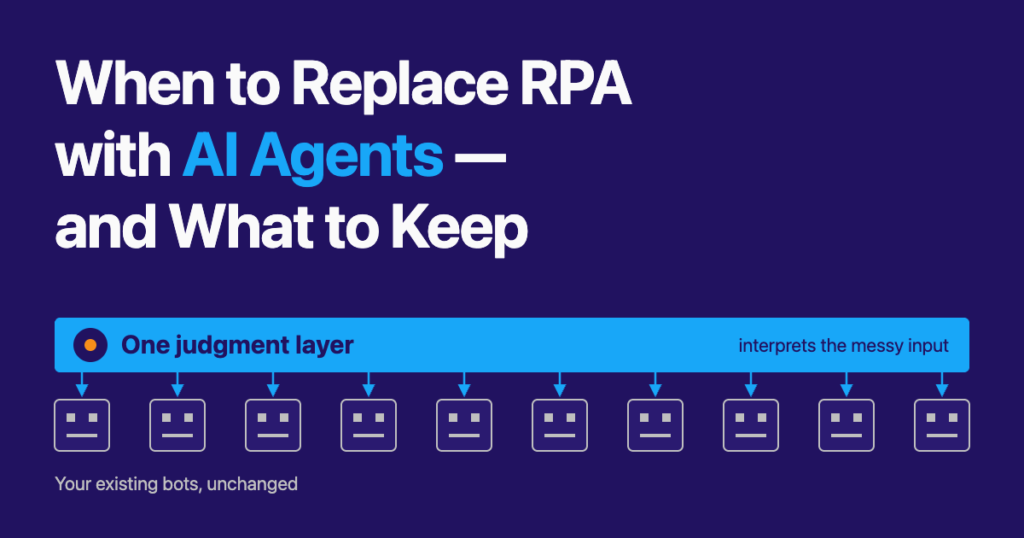
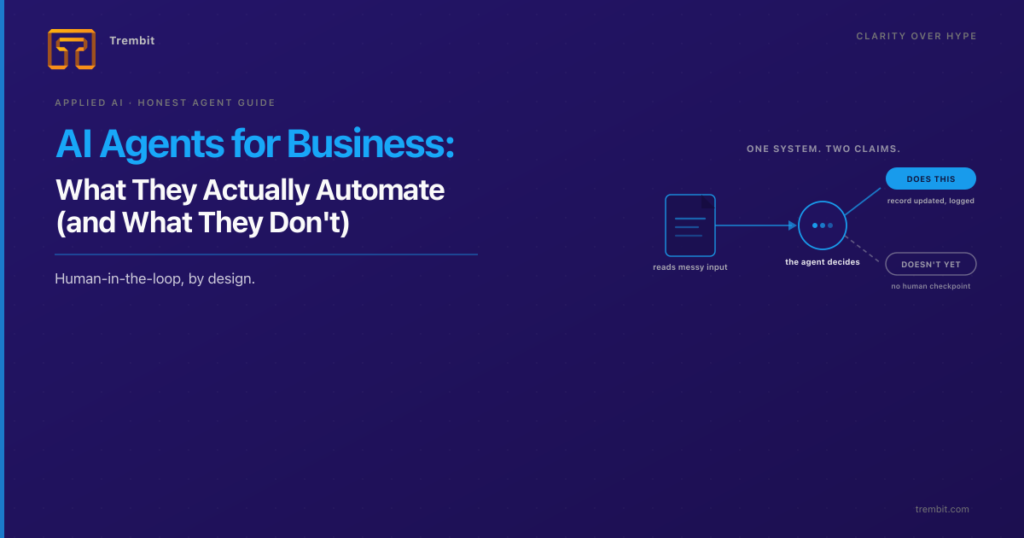
AI Agents for Business: What They Actually Automate (and What They Don’t)

AI Agents for Business: What They Actually Automate (and What They Don’t)

An honest look at what AI agents reliably automate for businesses today — and where the hype outruns reality. No vendor spin.

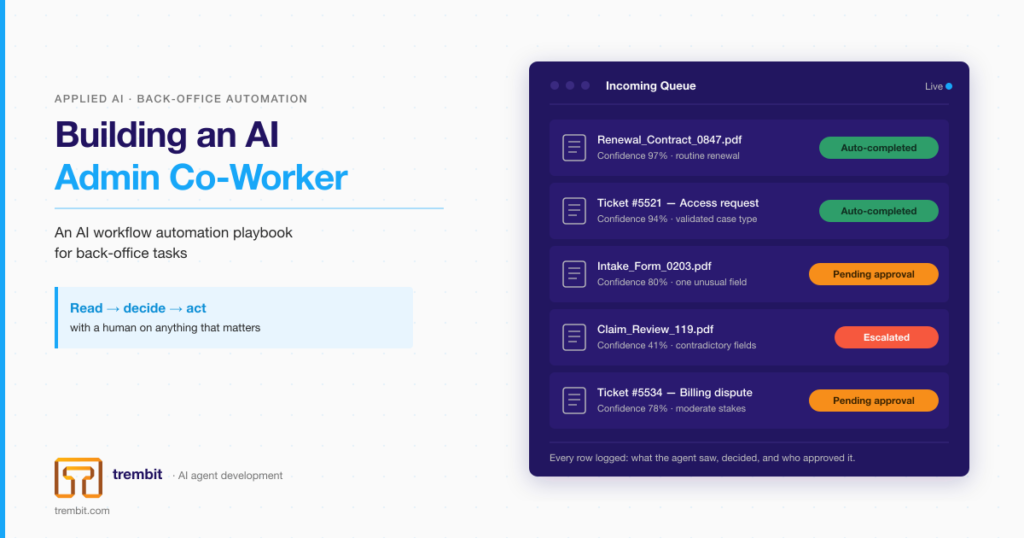
Building an AI “Admin Co-Worker”: Back-Office Automation with Human-in-the-Loop

Building an AI “Admin Co-Worker”: Back-Office Automation with Human-in-the-Loop

A step-by-step playbook for building an AI admin co-worker: automate back-office tasks with human-in-the-loop checkpoints, guardrails, and audit trails.

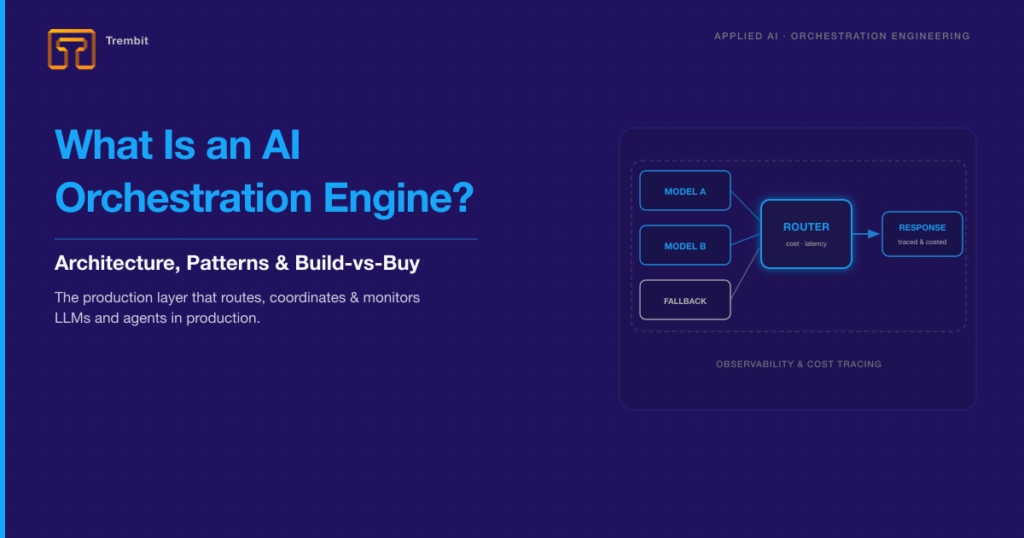
What Is an AI Orchestration Engine? Architecture, Patterns, and Build-vs-Buy

What Is an AI Orchestration Engine? Architecture, Patterns, and Build-vs-Buy

By the Trembit Engineering Team · Last updated: 2026-07-08 An AI orchestration engine is the production layer that sits between your application and its models. It routes each request to the right model, handles fallback and retries when one fails, manages the RAG and context pipeline, coordinates multi-step and multi-agent workflows, enforces guardrails, and gives […]

AI in Healthcare: Where It Actually Works in 2026

AI in Healthcare: Where It Actually Works in 2026

AI in healthcare in 2026: what’s production-ready (scribes, imaging triage, admin automation) vs. still hype, and how to integrate it safely.

How to Build a Real-Time AI Content Moderation Pipeline for Live Video

How to Build a Real-Time AI Content Moderation Pipeline for Live Video

A real-time AI content moderation pipeline is the combination of three things: extracting frames and audio from a live media stream, running AI inference on them, and returning an enforcement action — mute, kick, flag, or blur — back to the session fast enough that harmful content never reaches viewers. The central engineering decision is where […]

Why AI Moderation Fails in Live Video (and How to Architect Around It)

Why AI Moderation Fails in Live Video (and How to Architect Around It)

The Reality of Real-Time Moderation for Dating and Social Platforms Live video has transformed social and dating platforms, creating opportunities for authentic connection and engagement. However, it has also opened new vectors for abuse, harassment, and inappropriate content. The promise of AI-powered moderation suggests a simple solution: deploy computer vision models to automatically detect and […]

Generative AI in WebRTC Pipelines — Without the Latency Cost

Generative AI in WebRTC Pipelines — Without the Latency Cost

Real-time communication demands split-second responsiveness. A video call feels natural when latency stays below 300 milliseconds. Exceed 500 milliseconds, and conversations become awkward — speakers talk over each other, pauses feel unnatural, and engagement drops. These tight latency constraints created a problem when generative AI entered the picture. The OpenAI Realtime API’s WebRTC integration enables […]

Why AI Upscaling Beats Better Codecs for Live Video in 2026

Why AI Upscaling Beats Better Codecs for Live Video in 2026

The conventional wisdom in video streaming has been straightforward: better quality requires better codecs. AV1 promised 30-40% bandwidth savings over H.264, and the industry has invested billions in making it a reality. GPU manufacturers added hardware support, browsers implemented decoders, and platforms began migrations. Yet in 2026, a different approach is reshaping video optimization — […]

Why WebRTC + AI Architectures Fail at Scale (and What Actually Works)

Why WebRTC + AI Architectures Fail at Scale (and What Actually Works)

The convergence of WebRTC and AI promised revolutionary real-time experiences. Voice agents respond in milliseconds. Video streams enhanced by neural networks. Intelligent routing adapts to network conditions in real time. Yet across production deployments in 2025, engineering teams encounter the same failure patterns repeatedly. Systems that work brilliantly in demos collapse under real load. Latency […]

From Human-to-Human Calls to Human-to-AI Sessions: What Changes in Your Video Stack

From Human-to-Human Calls to Human-to-AI Sessions: What Changes in Your Video Stack

Video conferencing architecture spent a decade optimizing for one assumption: every participant is human. SFU routing, session management, and resource allocation all evolved around this human-centric model. Then AI participants arrived, and the architectural foundations cracked. AI agents don’t behave like humans. They stay connected for hours without breaks. They process audio in milliseconds. They […]

From QA to Quality Engineering: Building a Continuous Innovation Culture

From QA to Quality Engineering: Building a Continuous Innovation Culture

Every industry has a moment when the old way of doing things becomes outdated. For QA, that moment is now — and AI-powered QA testing is what’s replacing it. For years, quality assurance operated on a simple model: more testing equals more quality. Measure it in hours. Bill it in hours. Report it in hours. […]

Why Telehealth Platforms Fail at Enterprise Scale

Why Telehealth Platforms Fail at Enterprise Scale

Most telehealth platforms begin with a focused product vision, typically centered on video consultations, patient scheduling, and clinical documentation. Then reality hits. The hospital network wants FHIR-based EHR integration. The enterprise clinic operates a Practice Management System that does not allow for negotiation of its data model. The sales team needs patient interactions to flow […]

Adding AI to Live Telehealth Calls: What Actually Works in Production

Adding AI to Live Telehealth Calls: What Actually Works in Production

The pitch for AI in telehealth is compelling: real-time transcription that auto-populates clinical notes, live translation that eliminates language barriers between patients and practitioners, and ambient AI that detects medication names and flags potential interactions mid-call. Investors love it. Product roadmaps are full of it. The production reality is more complicated. Teams that have shipped […]

Telehealth Solved Video Calls — Now Voice AI Is the Real Challenge

Telehealth Solved Video Calls — Now Voice AI Is the Real Challenge

Telehealth platforms have solved the “video visit” problem. Most can reliably connect a patient and a clinician over a stable video stream. However, the industry’s next frontier isn’t about call quality — it’s about what happens during the call. Voice AI agents are now capable of joining a live telehealth session, listening in real-time, generating […]

AI Video Enhancement for Telehealth: Improving Low-Bandwidth Consultations

AI Video Enhancement for Telehealth: Improving Low-Bandwidth Consultations

Telehealth has become a cornerstone of modern healthcare delivery. Since the pandemic accelerated its adoption, millions of patients worldwide now rely on video consultations for everything from routine check-ups to specialist referrals. Yet one persistent challenge continues to undermine the quality of these interactions: poor video quality caused by low or unstable internet connections. Pixelated […]

Practical AI Use Cases Transforming Telemedicine

Practical AI Use Cases Transforming Telemedicine

Artificial intelligence has become one of the most discussed technologies in healthcare. Yet for many telemedicine providers, the real challenge is not whether to use AI — but how to apply it in ways that create measurable value for patients, clinicians, and the business itself. Successful AI adoption in telemedicine is not about futuristic promises […]

ChatGPT-Style Tutors in LMS: The Next Step in Adaptive Learning

ChatGPT-Style Tutors in LMS: The Next Step in Adaptive Learning

Adaptive learning has reshaped how education adapts to the learner’s pace and style. Now, with advancements in artificial intelligence, ChatGPT-style tutors are poised to take Learning Management Systems (LMS) to a whole new level. This article explores how integrating ChatGPT-like AI tutors within LMS platforms can transform adaptive learning, offering personalized, interactive, and highly scalable […]

From Vision to MVP: A Technical Blueprint for Launching a Successful AI-Enhanced Learning Platform

From Vision to MVP: A Technical Blueprint for Launching a Successful AI-Enhanced Learning Platform

The EdTech industry is evolving at lightning speed, driven by artificial intelligence that makes learning more personalized, adaptive, and measurable than ever before. Yet, despite the innovation, nearly 70% of early-stage EdTech products fail after the pilot phase. Why? Because visionary ideas often fall short when it comes to technical execution, scalability, and learner-centric design. […]

AI in EdTech: From Crowded Platforms to Lasting Ecosystems

AI in EdTech: From Crowded Platforms to Lasting Ecosystems

The Current Reality — An Overcrowded but Evolving EdTech Market The EdTech landscape in 2025 is defined by rapid AI adoption and an influx of new tools. While this growth opens opportunities for innovation, it also raises concerns about market saturation and user fatigue — especially as learners navigate countless “AI-enhanced” products that promise transformation […]

How to Build an E-Learning Startup: A Step-by-Step Guide

How to Build an E-Learning Startup: A Step-by-Step Guide

Why E-Learning Is at a Turning Point The maturing EdTech ecosystem: post-COVID consolidation and AI acceleration The post-pandemic surge in EdTech innovation is giving way to a phase of consolidation and maturity. What began as a rush to digitize classrooms has grown into a need for platforms that deliver measurable learning value and scalable business […]