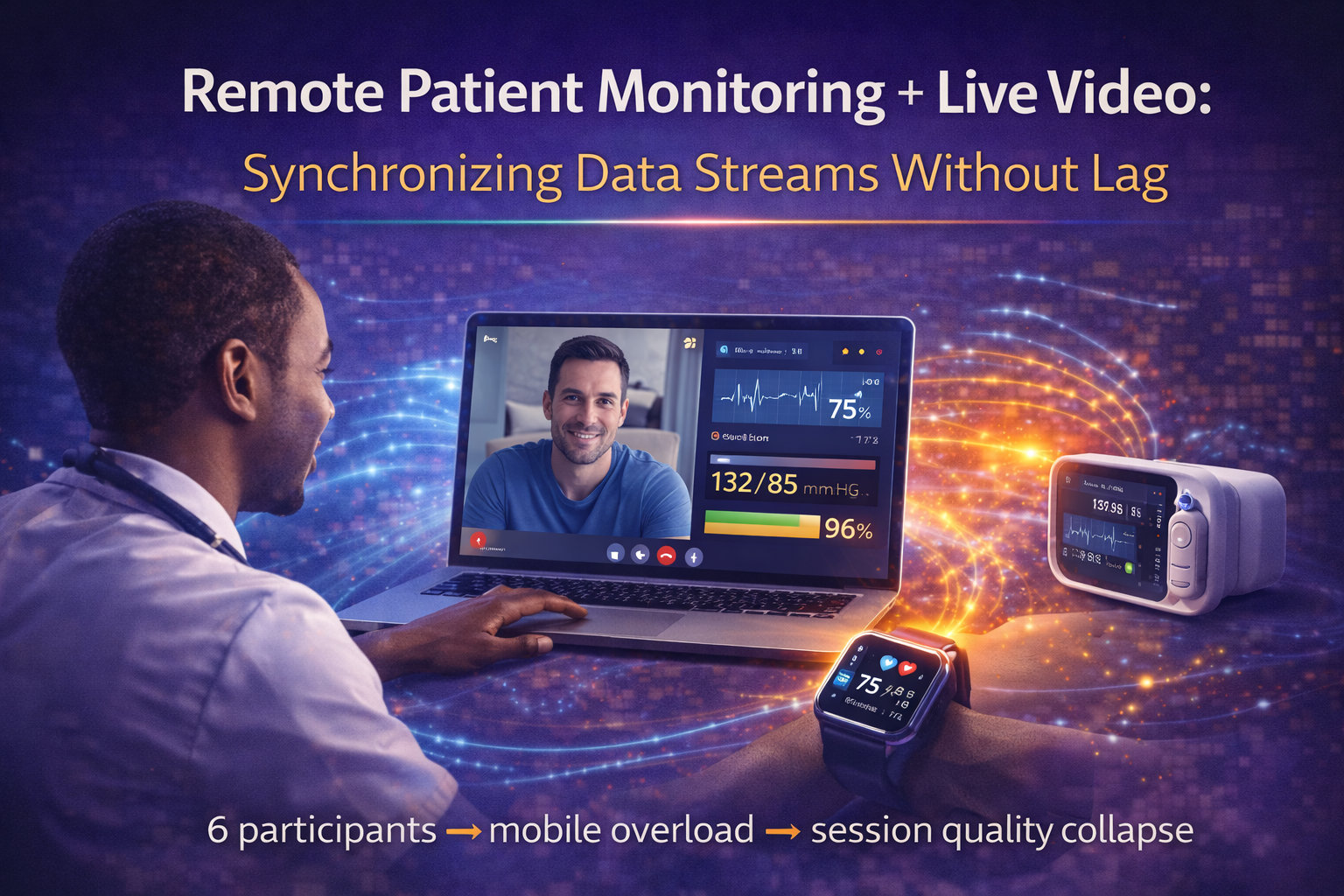
Remote patient monitoring has evolved beyond simple data collection. Modern telemedicine platforms combine live video consultations with real-time streaming of vital signs — heart rate, blood oxygen, ECG waveforms, glucose levels — creating a comprehensive view of patient health. However, achieving seamless synchronization between video feeds and sensor data streams presents significant technical challenges that can undermine clinical effectiveness if not addressed properly.
When a doctor watches a patient’s heart rate monitor during a video consultation, any misalignment between what they see and what the sensor reports creates confusion and potential diagnostic errors. A patient appears calm on video while the heart rate display shows 140 BPM from 10 seconds ago, or an ECG spike appears before the patient reports chest pain. These synchronization failures aren’t just technical annoyances — they’re clinical liabilities.
The Multi-Stream Challenge
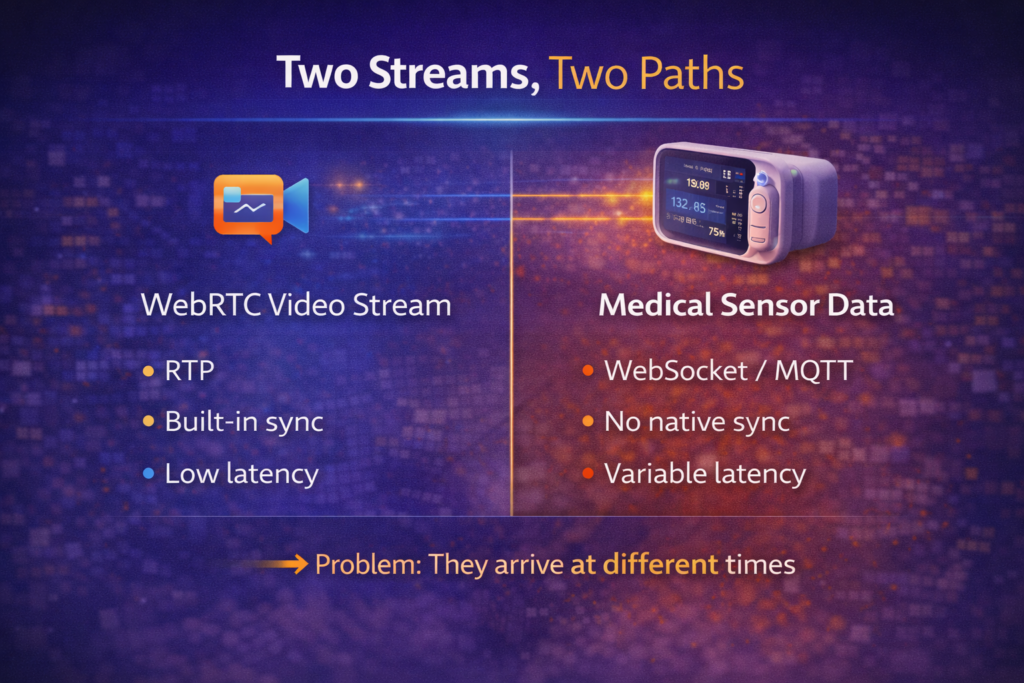
Unlike simple video calls, remote patient monitoring combines fundamentally different data transport mechanisms. Video typically flows through WebRTC using RTP (Real-time Transport Protocol) with built-in synchronization mechanisms. Medical device data, however, commonly travels via WebSocket connections, MQTT brokers, or HTTP polling, each with distinct timing characteristics and no native synchronization with video streams.
This creates a multi-stream synchronization problem where data from different sources, using different protocols, with different latency profiles, must align precisely at the receiving end. The complexity multiplies when considering that medical devices often have their own internal clocks that drift relative to the video capture device.
Clock Drift: The Silent Desynchronizer
Every device maintains its own internal clock, and no two clocks run at exactly the same rate. A heart rate monitor’s clock might run 0.01% faster than the video camera’s clock — a tiny difference that accumulates to one second of drift every 2.8 hours. For a 30-minute consultation, this drift can reach 10-15 seconds, making real-time correlation between visual observations and sensor readings impossible.
WebRTC addresses clock drift through RTCP sender reports that provide timestamp pairs mapping RTP timestamps to NTP (Network Time Protocol) wallclock time, allowing receivers to calculate clock relationships and continuously adjust playback timing. However, this mechanism only works within WebRTC streams — it doesn’t extend to medical sensor data arriving through separate channels.
The challenge intensifies with medical IoT devices. Research on remote patient monitoring systems shows that biosensors transmit data through WebSocket protocol or MQTT to handle the bulk of sensor data, but these protocols lack WebRTC’s sophisticated timestamp synchronization. Each sensor reading arrives with a timestamp from the device’s local clock, which may or may not correlate with the video stream’s timebase.
Solving Clock Drift
Several approaches can mitigate clock drift between video and sensor streams:
Common Reference Clock: Establish a single authoritative time source (typically an NTP server) that all devices synchronize against. Both the video capture device and medical sensors query this reference clock periodically, allowing timestamps from different sources to be normalized to a common timebase. This requires that all devices in the system support NTP synchronization and have network access to the time server.
Timestamp Translation Layer: Implement a server-side component that receives streams from all sources and applies timestamp translation. When sensor data arrives, the server calculates the offset between the sensor’s clock and the video stream’s clock, then rewrites sensor timestamps to align with video time. This translation must be updated continuously to track clock drift.
Periodic Synchronization Markers: Inject synchronization events into both streams at known intervals (every 5-10 seconds). These markers allow the receiving application to detect drift and apply corrections. For example, a “heartbeat” message sent simultaneously to both video and sensor channels provides alignment points.
Client-Side Clock Modeling: The receiving application maintains a model of each device’s clock drift relative to a reference. As data arrives, timestamps are adjusted based on the current drift model. This approach handles drift gracefully but requires sophisticated algorithms to distinguish genuine drift from network jitter.
| Synchronization Approach | Latency Impact | Complexity | Drift Tolerance | Best Use Case |
| NTP-based reference clock | Minimal (+5-20ms) | Medium | Excellent | Systems with NTP-capable devices |
| Server-side translation | Low (+10-30ms) | High | Very Good | Centralized architectures |
| Periodic sync markers | Moderate (+50-200ms) | Medium | Good | Systems with predictable drift |
| Client-side modeling | Minimal (+2-10ms) | Very High | Excellent | Advanced implementations |
WebRTC + WebSockets: Bridging the Gap
The most common architecture for synchronized RPM systems combines WebRTC for video with WebSockets for sensor data. This hybrid approach leverages WebRTC’s optimized media handling while using WebSocket’s bidirectional, low-overhead communication for frequent sensor updates.
However, these protocols have different latency characteristics. WebSocket provides a long-lived, full-duplex TCP connection enabling continuous streaming of vitals and alerts, but TCP’s reliability mechanisms introduce variable latency when packet loss occurs. WebRTC, conversely, prioritizes low latency over perfect reliability, accepting some packet loss to maintain real-time performance.
This latency asymmetry means sensor data and video may travel through different network paths with different delays. A heart rate reading might arrive via WebSocket 80ms after capture, while the corresponding video frame arrives via WebRTC after 150ms. Without compensation, the sensor data appears to “lead” the video by 70ms.
Alignment Strategies
Adaptive Buffering: Implement receiver-side buffers for both streams that hold data until corresponding timestamps from the other stream arrive. If the video arrives at time T but sensor data for time T hasn’t appeared yet, buffer the video until the sensor data catches up. This approach adds latency (typically 100-300ms) but ensures perfect alignment.
Stream Timestamping: Attach high-resolution timestamps to all data at the source. The receiving application uses these timestamps to align playback rather than relying on arrival time. This decouples transmission latency from synchronization.
Latency Measurement: Continuously measure round-trip latency for both channels and adjust timing accordingly. If WebSocket shows 100ms RTT while WebRTC shows 200ms RTT, offset sensor data playback by 100ms to compensate.
Priority-Based Adjustment: In scenarios where perfect synchronization isn’t achievable, decide which stream has priority. For diagnostic purposes, sensor data accuracy typically matters more than video timing, so video playback can be adjusted to match sensor timestamps rather than vice versa.
Buffering: The Latency-Accuracy Tradeoff
Jitter, variation in packet arrival times, affects both video and sensor data. WebRTC implements adaptive jitter buffering that continuously optimizes buffering delay based on network conditions, typically maintaining 20-60 milliseconds of buffering to smooth out arrival time variations while keeping latency low.
For medical sensor data, buffering requirements differ. ECG waveforms require consistent timing to detect arrhythmias, while less time-critical metrics like temperature can tolerate more buffering. The challenge is implementing per-stream buffering strategies that maintain synchronization across streams with different jitter profiles.
Buffering Strategies
- Shared Buffer Pool: Maintain a unified buffer that holds both video frames and sensor readings, sorted by timestamp. Release data from this pool at a consistent rate, ensuring temporal alignment regardless of arrival jitter.
- Hierarchical Buffering: Apply different buffer depths based on data criticality. Critical waveform data (ECG, respiratory) gets minimal buffering (20-50ms) for near-real-time display, while less critical metrics (temperature, blood pressure) can buffer longer (100-200ms) for smoother presentation.
- Predictive Buffering: Use network condition monitoring to predict future jitter and adjust buffer depth proactively. If jitter increases from 10ms to 50ms, gradually expand buffers before synchronization breaks.
- Overflow Handling: Define behavior when buffers reach capacity. For video, drop frames to catch up; for critical sensor data, maintain complete data even if it means increasing latency.
Edge Alignment: Synchronizing at the Source
The most effective synchronization strategy processes data as close to its source as possible. Edge alignment involves timestamping and synchronizing streams at the patient’s device before transmission, rather than attempting alignment at the server or clinician’s endpoint.
Modern approaches deploy edge computing components at the patient’s location. A local gateway device receives video from the camera and sensor data from medical devices, timestamps all data with a common clock, and packages it into synchronized bundles before transmission. This ensures that network transit delays affect all streams equally, preserving relative timing.
Benefits of Edge Alignment:
- Eliminates clock drift between local devices
- Reduces server-side processing complexity
- Provides consistent synchronization regardless of network conditions
- Enables offline buffering during connectivity interruptions
Implementation Considerations:
- Requires deploying gateway hardware or software at patient locations
- Gateway must have sufficient processing power for real-time synchronization
- Adds cost and complexity to deployment
- Requires remote management and updates for patient-side devices
Building Synchronized RPM Systems
Successfully implementing multi-stream synchronization requires careful architectural planning and expertise in both real-time communications and medical device integration. Key considerations include choosing appropriate protocols for each data type, implementing robust timestamp management, balancing latency requirements against synchronization accuracy, and designing fallback mechanisms for degraded network conditions.
This is where partnering with an experienced development team becomes essential. Trembit brings specialized expertise in building WebRTC-based telemedicine platforms that integrate medical device data streams. Our team understands the technical challenges of synchronizing heterogeneous data sources and has implemented synchronization architectures across multiple remote patient monitoring deployments.
We work with healthcare organizations to design solutions that balance clinical requirements with technical constraints, from timestamp management and buffering strategies through edge processing architectures and failover mechanisms. Trembit provides the depth of experience needed to build RPM platforms that deliver reliable, synchronized data to clinicians.
The Path to Synchronized Telemedicine
Synchronizing live video with real-time medical sensor data is technically demanding but clinically essential. The approaches outlined here — common reference clocks, adaptive buffering, edge alignment — provide proven patterns for achieving tight synchronization despite the inherent challenges of multi-stream, multi-protocol systems.
Success requires understanding that synchronization isn’t a feature to be added late in development — it must be a core architectural consideration from the start. Clock drift, network jitter, and protocol mismatches won’t resolve themselves; they demand deliberate engineering and continuous tuning.
Organizations building RPM platforms should prioritize synchronization testing early, using realistic network conditions and actual medical devices. Simulated environments often hide the timing subtleties that appear only in production deployments. Test with the actual latencies, jitter patterns, and clock drift rates you’ll encounter with real sensors and real networks.
The clinical value of remote patient monitoring depends on giving physicians confidence that what they observe correlates precisely with sensor readings. Achieving this confidence requires technical sophistication in stream synchronization — but the result is telemedicine that genuinely extends clinical capabilities beyond the traditional exam room.