“Should we build on WebRTC or wait for MOQ?” That’s the question we heard three times last month from startup CTOs planning their video platforms. Each time, our answer surprised them.
The short version: in 2026, you’re almost certainly building on WebRTC. But the longer answer — about when MOQ makes sense, where WebRTC breaks, and what the next three years actually look like — is more interesting than most coverage suggests.
We’ve spent the last decade building real-time video systems, and we’re watching MOQ’s development closely. Here’s what startups actually need to know about these two protocols, stripped of the hype and based on what’s shipping in production today.
Why WebRTC Still Wins for Most Startups
Let’s start with the uncomfortable truth: despite all the blog posts about “the future of streaming,” WebRTC remains the only practical choice for most real-time applications in 2026.
Here’s why.
Universal Browser Support That Actually Works
WebRTC runs natively in every major browser without plugins or special flags. Chrome, Firefox, Safari, Edge — they all support it out of the box. More importantly, they’ve supported it for years, which means the bugs are found, the edge cases are handled, and the implementations are stable.
Browser compatibility scores for WebRTC hover around 92%, with full support across Chrome, Firefox, Safari, and Edge. For a startup, that’s the difference between “your product works for everyone” and “your product works for some people, sometimes.”
MOQ’s browser story? Not quite there yet.
The Ecosystem You Can’t Replicate Overnight
When you choose WebRTC, you’re not just choosing a protocol — you’re buying into a decade of ecosystem development.
That means:
- Mature SFU (Selective Forwarding Unit) implementations from Janus, Mediasoup, and commercial vendors
- Testing tools that actually work
- Monitoring platforms that understand WebRTC metrics
- Developers who’ve debugged these problems before
- Stack Overflow answers for your weird edge case
As one platform architect told last quarter, “We looked at alternatives. Every time, we came back to WebRTC for the browser. It’s not that the new stuff is bad — it’s that WebRTC has ten years of battle-testing you can’t replicate overnight.”
Built-In NAT Traversal (Even If It’s Painful)
WebRTC’s ICE, STUN, and TURN mechanisms handle the messy reality of corporate firewalls and restrictive networks automatically. Yes, operating TURN infrastructure at scale is expensive. Yes, ICE gathering adds latency. But the alternative — telling enterprise customers “our product doesn’t work on your network” — is worse.
Where WebRTC Actually Breaks (And Why Teams Feel the Pain)
But let’s be honest — WebRTC isn’t perfect. Talk to any team running video at scale, and they’ll have stories.
The SDP Nightmare
SDP (Session Description Protocol) timing issues can take days to debug, and WebRTC’s use of SDP for negotiation creates one of the most common sources of bugs in real projects.
I’ve seen teams spend three weeks tracking down why connections randomly fail, only to discover it’s a subtle SDP timing issue during ICE restart. The problem? SDP is complex, verbose, and notoriously hard to debug. Small differences in timing or formatting can lead to one-way audio, failed renegotiations, or silent failures that leave no trace in logs.
One frustrated engineer put it this way: “I’ve debugged TCP. I’ve debugged UDP. But debugging why SDP negotiation silently fails? That’s a special kind of pain.”
The Scalability Wall for Broadcasting
WebRTC was designed for low-latency, interactive communication — video calls, pair programming, remote collaboration. It wasn’t designed for massive one-to-many broadcasts.
When you try to push WebRTC into large live streaming scenarios, you need complex architectures: cascading SFUs, custom distribution layers, and engineering effort that increases costs and fragility. This is where MOQ starts to look interesting.
Cloud-Native Workflows Are Awkward
WebRTC couples transport, encoding, encryption, and congestion control into a single stack. That’s great for getting started quickly. It’s less great when you want to:
- Process video through AI models server-side
- Dynamically switch encoding layers
- Build flexible transcoding pipelines
- Integrate with cloud-native media workflows
Teams end up building intricate bridges and custom logic just to support these use cases. It works, but it feels like fighting the protocol.
So What Is MOQ, and Why the Buzz?
Media over QUIC (MOQ) is being developed by the IETF as a simple low-latency media delivery solution for ingest and distribution, designed to scale efficiently for live streaming, gaming, and conferencing.
Instead of WebRTC’s custom stack, MOQ builds on top of QUIC (the same transport that powers HTTP/3). The promise is compelling:
- Faster handshake and connection setup
- Modern congestion control that adapts better to changing networks
- Native firewall traversal without the complexity of ICE
- No SDP negotiation headaches
- Simpler server-side architecture
Cloudflare, Meta, Google, Cisco, and other major players are building MOQ implementations, and there’s real momentum behind the standard.
Sounds great, right?
The Reality: MOQ Isn’t Ready for Most Startups Yet
Here’s where the hype meets the hard truth.
Browser Support Is the Blocker
MOQ runs over WebTransport in browsers. Safari doesn’t have fully functional WebTransport support yet, though an early implementation is available behind a feature flag as of Safari 18.4.
What does that mean in practice?
- Chrome and Edge: ✅ Full WebTransport support
- Firefox: ✅ Full WebTransport support
- Safari (macOS): ⚠️ Behind a flag, not production-ready
- Safari (iOS): ⚠️ Behind a flag, not production-ready
And here’s the kicker: on iOS, all browsers must use Safari’s WebKit engine, which means Chrome, Firefox, and Edge on iOS can’t use WebTransport either.
That’s roughly 1 billion devices where MOQ simply doesn’t work in 2026.
For a consumer-facing startup, that’s a non-starter. You can’t tell iPhone users “sorry, use a different phone.”
The Ecosystem Isn’t There Yet
Remember that WebRTC ecosystem we mentioned — the SFUs, the monitoring tools, the Stack Overflow answers? MOQ is starting from zero.
Industry experts note that MOQ isn’t ready for production use cases yet, though momentum is building. The tooling, debugging infrastructure, and production-hardened implementations are still being built.
Early adopters like Cloudflare are running MOQ experiments, but most are still in proof-of-concept territory, not powering millions of users.
Standards Are Still Moving
The MOQ Transport specification is currently at draft-15, with an expiration date of April 2026. The standard is stabilizing, but it’s not done.
For a startup, building on a moving target means:
- APIs that might change
- Bugs that turn out to be spec issues
- Integration headaches when different implementations interpret the draft differently
The Practical Comparison: What Actually Matters
So how do these stack up for real-world startup decisions? Here’s what you need to know:
Latency: Both Can Hit Sub-Second
WebRTC: Consistently delivers 100-300ms latency for peer-to-peer connections and small group calls. At scale with SFUs, expect 200-500ms depending on your architecture.
MOQ: Can deliver sub-250 millisecond latency in controlled environments. Early implementations are hitting similar numbers to WebRTC for many use cases.
Verdict: Tie in 2026. Both are fast enough for real-time applications.
Browser Support: WebRTC Dominates
WebRTC: Works everywhere, now. 92% browser compatibility including mobile.
MOQ: Works in Chrome and Firefox. Safari is behind a flag. iOS is blocked entirely.
Verdict: WebRTC wins decisively for consumer applications.
Developer Complexity: It Depends
WebRTC: You deal with SDP complexity and ICE gathering, but there are mature SDKs, clear patterns, and years of documentation.
MOQ: Simpler transport layer, no SDP headaches. But you’re building on bleeding-edge tech with limited examples and fewer people who’ve solved your problems.
Verdict: WebRTC is easier in 2026 because the ecosystem exists.
Massive Scale Broadcasting: MOQ Shows Promise
WebRTC: Hits architectural limits when you’re trying to broadcast to thousands of viewers. You end up building custom distribution layers.
MOQ: Designed explicitly for pub/sub at scale, with built-in support for CDN caching and relay networks. This is where MOQ could shine.
Verdict: MOQ’s design is better for this use case, but WebRTC is proven.
Here’s a quick comparison table:
| Requirement | WebRTC | MOQ |
| Browser support (all platforms) | ✅ Works everywhere | ⚠️ Safari/iOS blocked |
| Peer-to-peer connections | ✅ Native support | ❌ Not the focus |
| Small group video calls | ✅ Battle-tested | ⚠️ Possible but immature |
| Massive live broadcasts | ⚠️ Requires workarounds | ✅ Designed for this |
| Interactive gaming/collaboration | ✅ Proven at scale | ⚠️ Early experiments |
| AI media processing pipelines | ⚠️ Awkward but doable | ✅ More flexible |
| Production ecosystem | ✅ Mature and deep | ❌ Still building |
| Developer learning curve | ⚠️ Steep but documented | ⚠️ Bleeding edge |
When Should Startups Actually Consider MOQ?
Despite everything we’ve said about WebRTC’s dominance, there are scenarios where MOQ makes sense to explore in 2026:
You’re Building for Controlled Environments
If you control the client — native apps, internal tools, or enterprise software where you can specify browser requirements — MOQ becomes viable. You can target Chrome/Firefox and skip Safari entirely.
Your Use Case Is Massive Broadcasting
If you’re building the next Twitch, where the core problem is distributing a single stream to thousands or millions of viewers with sub-second latency, MOQ’s pub/sub model could be a better fit than WebRTC’s architecture.
You Have Resources for Experimentation
If you’re well-funded, have experienced video engineers, and can afford to build on cutting-edge technology, exploring MOQ as a future-proofing strategy might make sense. Just keep WebRTC as a fallback.
You’re Not Launching in the Next 12 Months
If you’re in early R&D and won’t ship for a year or more, MOQ might mature enough by your launch date to be production-ready.
What’s Actually Going to Happen in the Next 2-3 Years
Here’s our prediction based on conversations with platform engineers and watching the standards process:
2026: WebRTC remains dominant. MOQ deployments are mostly experiments and proofs-of-concept from well-funded companies. Safari/iOS support remains the blocker.
2027: Safari adds production-ready WebTransport support (maybe). MOQ tooling matures. A few high-profile products launch with MOQ for specific use cases like massive live events.
2028: Hybrid architectures become common — WebRTC at the edge for browser clients, MOQ in the backend for distribution and server-to-server communication. Some new products launch MOQ-first, but most still bet on WebRTC.
As one senior architect at a video platform told us recently, “We’re not replacing WebRTC wholesale. We’re getting surgical about where we use alternatives.”
The Architecture That’s Actually Winning: Hybrid Stacks
The interesting trend we see isn’t “WebRTC vs. MOQ” — it’s teams building hybrid architectures:
Browser Client → WebRTC (edge) → SFU → MOQ/QUIC (backbone) → Cloud Services → AI Processing
This approach combines:
- WebRTC’s universal browser support for the last mile
- MOQ’s scalability and flexibility for backend distribution
- The ability to adopt new technology without rewriting everything
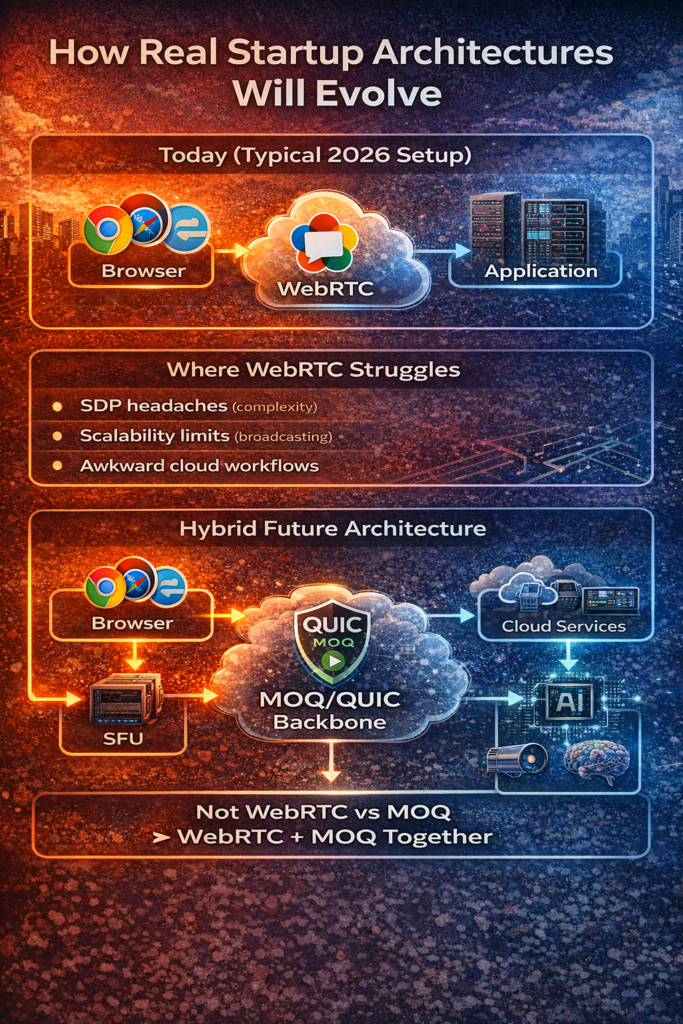
That’s the architecture startups should be thinking about: not either/or, but the right tool for each piece of the pipeline.
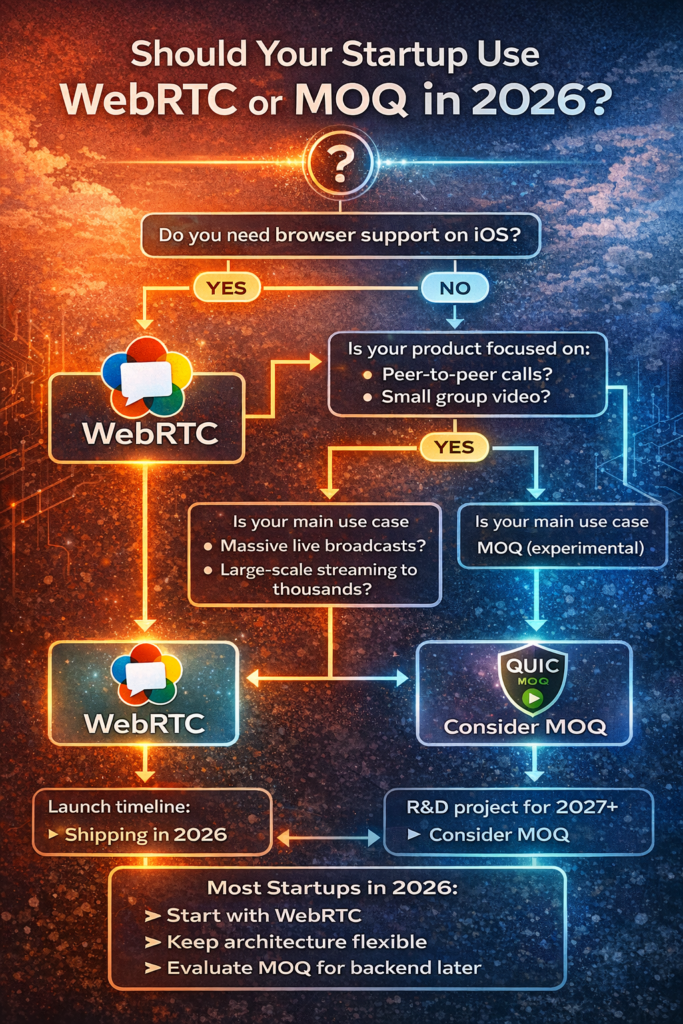
Bottom Line: What Should Your Startup Do?
Here’s the practical advice:
If you’re launching in 2026:
- Build on WebRTC. It’s the only production-ready option for browsers.
- Design your architecture to make the transport layer swappable
- Keep an eye on MOQ, but don’t bet on it yet
If you need massive broadcasting:
- Use WebRTC to get to market
- Architect your backend to support alternative protocols later
- Consider native apps where you can experiment with MOQ
If you have a 2+ year timeline:
- Start with WebRTC to validate product-market fit
- Build in flexibility to adopt MOQ for specific components
- Watch Safari’s WebTransport roadmap — that’s your signal
Don’t:
- Bet your startup on MOQ being production-ready in 2026
- Assume Safari/iOS support is coming soon
- Choose technology based on blog post hype instead of browser reality
The Real Competition Isn’t MOQ
Here’s what most coverage misses: the real question for startups isn’t “WebRTC or MOQ?”
It’s “Do we build our own real-time infrastructure, or use a CPaaS provider?”
Companies like Agora, Twilio Video, Daily.co, and Vonage have spent years building WebRTC infrastructure at scale. For most startups, buying that instead of building it is the smarter move.
MOQ won’t change that calculation in 2026.
Final Thoughts: Technology Choices in Context
WebRTC has dominated real-time communication for over a decade because it works, it’s everywhere, and the ecosystem is mature. Those advantages don’t disappear because a better protocol is on the horizon.
MOQ is exciting. The design is cleaner, the architecture is more modern, and the performance characteristics are promising. But startups die when they bet on technology that isn’t ready, not from choosing battle-tested tools.
In 2026, WebRTC is still the backbone of real-time applications because it’s the only protocol that actually works for the majority of users. MOQ will get there — but it’s not there yet.
The smartest teams aren’t choosing sides. They’re building flexible architectures that let them adopt the best technology for each component, watching the standards mature, and making pragmatic decisions based on what ships, not what sounds cool in blog posts.
At Trembit, we’ve been building real-time communication systems for years, and we understand the trade-offs between bleeding-edge technology and production reliability. Whether you’re evaluating WebRTC, considering MOQ, or trying to figure out which CPaaS provider to use, we can help you make the right architectural decisions for your specific use case.