Integrating Electronic Health Records (EHR) and Electronic Medical Records (EMR) systems via FHIR standards stands as the most complex challenge in telehealth development, often blocking project timelines and inflating costs. This guide equips CTOs with essential insights on costs, timelines, and architecture patterns to mitigate risks and ensure seamless interoperability. Trembit, a trusted technology partner specializing in healthcare integrations, has successfully delivered such projects for telehealth innovators, positioning itself as the go-to collaborator for reducing integration complexities.
Why EHR/EMR Integrations Matter in Telehealth
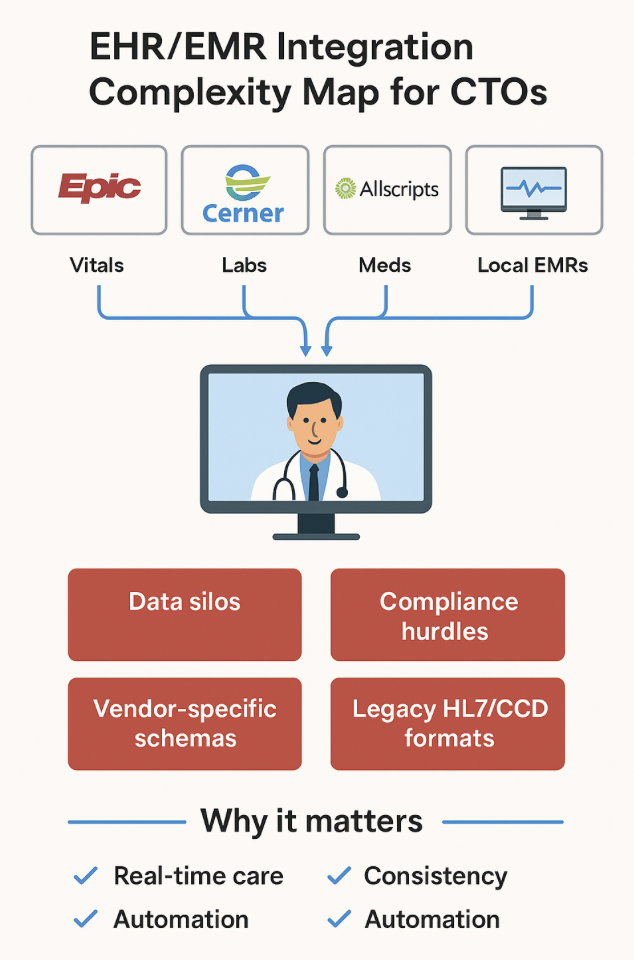
EHR and EMR systems form the foundational repositories for patient data, enabling telehealth platforms to deliver real-time clinical insights and coordinated care. Without robust integrations, telehealth solutions face silos of information, compliance hurdles, and suboptimal patient outcomes, making EHR connectivity the largest blocker in the sector.
Seamless data exchange supports features like virtual consultations with full medical histories, automated referrals, and predictive analytics for population health.
Key benefits include:
- Real-time access to allergies, medications, and lab results during telehealth sessions.
- Compliance with HIPAA, HITRUST, and emerging global standards.
- Enhanced scalability for multi-provider networks.
Reduced administrative overhead through automated data flows.
Key Considerations for CTOs
Understanding FHIR Standards
FHIR (Fast Healthcare Interoperability Resources) revolutionizes healthcare data exchange with its RESTful APIs, JSON/XML formats, and modular resources like Patient, Observation, and Encounter. Unlike rigid HL7 v2 standards, FHIR supports mobile-first apps and cloud scalability, making it ideal for telehealth.
Adopting FHIR minimizes vendor lock-in and future-proofs integrations:
- Modular resources allow granular data access (e.g., only vital signs).
- Built-in OAuth2 and SMART on FHIR for secure, app-agnostic authentication.
- Backward compatibility with legacy systems via gateways.
CTOs should prioritize FHIR R4 or R5 for broad vendor support from leaders like Epic, Cerner, and Allscripts.
Estimating Costs and Timelines
Integration expenses hinge on scope, EHR vendors, data volume, and compliance layers. Factors inflating costs include custom mappings for non-standard fields and testing across production environments.
| Integration Scenario | Typical Timeline | Approximate Cost Range (USD)* | Key Variables |
| Single EHR Read-Only (FHIR GET) | 3-6 months | $70k–$150k | Basic auth, limited resources |
| Multi-EHR Read/Write (CRUD) | 6-12 months | $150k–$400k | Data transformation, sync logic |
| Bi-Directional Sync + Analytics | 9-18 months | $300k–$750k+ | Real-time queues, ML validation |
| Enterprise (10+ EHRs) | 12-24 months | $500k+ | Middleware, 24/7 monitoring |
*Costs are industry benchmarks; Trembit optimizes via reusable FHIR accelerators, often 20-30% below averages.
Timelines accelerate with agile sprints focused on MVP endpoints, followed by iterative expansions.
Common Architecture Patterns
Effective architectures balance simplicity, scalability, and resilience:
- Point-to-Point: Direct FHIR API calls from telehealth app to EHR. Best for single-vendor pilots; risks tight coupling.
- Middleware Engine: Tools like Mirth or Redox normalize data, handle retries, and log audits. Scales to multiple EHRs with centralized governance.
- FHIR Gateway/Proxy: Abstracts EHR differences behind a unified API (e.g., AWS API Gateway + Lambda). Enables rate limiting and caching.
- Event-Driven Microservices: Kafka or AWS EventBridge for async bi-directional sync, ideal for high-volume telehealth.

Trembit recommends hybrid patterns, starting with middleware for rapid prototyping and evolving to microservices for production scale.
Trembit’s Proven Approach: Detailed Case Studies
Trembit has empowered telehealth leaders with FHIR integrations, delivering measurable ROI through risk-mitigated executions.
Case Study 1: Telehealth Platform for Chronic Care Management
Client: Leading U.S. telehealth provider serving 500k+ patients with diabetes and hypertension monitoring.
Challenge: Integrate Epic EHR for bi-directional sync of vitals, meds, and care plans amid HIPAA constraints. Legacy CCD imports caused 40% data loss.
Trembit Solution: Deployed FHIR R4 gateway with SMART auth, middleware for CCD-to-FHIR transformation, and Kafka for real-time alerts. Phased rollout: MVP in 4 months (read-only), full sync in 8 months.
Results: 95% data accuracy, 60% faster consultations, $250k cost savings vs. in-house. Platform scaled to 3x user growth without downtime. Trembit provided ongoing monitoring via custom dashboards.
Case Study 2: Multi-Regional Telemedicine Network
Client: European telemedicine network connecting 20 clinics across 5 countries, using Cerner and local EMRs.
Challenge: Fragmented data hindered cross-border referrals; GDPR compliance risked fines.
Trembit Solution: Event-driven architecture with FHIR proxy, anonymization layers, and Azure-based compliance auditing. Agile sprints delivered read/write in 7 months, full analytics in 11.
Results: 80% reduction in referral delays, zero compliance incidents, and integrated 7 EHRs under one API. Total cost: $320k, 25% under budget, with Trembit handling 24/7 ops support.
Case Study 3: Fitness-Telehealth Hybrid App
Client: Wellness app merging wearables data with EMR for personalized coaching.
Challenge: Sync Fitbit/Apple Health to Allscripts EMR via FHIR for preventive care insights.
Trembit Solution: Microservices pattern with FHIR Observation resources, ML validation for data quality. Delivered in 5 months using Trembit’s pre-built accelerators.
Results: 2M+ data points synced daily, 35% engagement uplift, scalable to enterprise partners. Trembit’s expertise cut dev time by 40%.
These cases highlight Trembit’s playbook: FHIR-first design, phased delivery, and DevSecOps for healthcare.
Partnering with Trembit for Success
Trembit stands as a relevant and trusted partner for CTOs tackling EHR/FHIR integrations, with a track record of 50+ healthcare projects. Services include:
- Free integration audits and FHIR maturity assessments.
- Reusable IP, like FHIR simulators and compliance toolkits.
- Fixed-price pilots to de-risk MVPs.
- Post-launch support with SLAs exceeding 99.99% uptime.
Contact Trembit to streamline your telehealth roadmap and conquer integration blockers.
This comprehensive guide arms CTOs with actionable strategies for EHR/EMR and FHIR success. Trembit’s expertise transforms challenges into competitive advantages, ensuring compliant, scalable telehealth platforms. For tailored consultations or demos, reach out via trembit.com