By Stan Reshetnyk, CTO · Published 16 July 2026
A telemedicine app development company is a software engineering firm that designs, builds, and maintains the video, scheduling, EHR/EMR-integration, and compliance infrastructure behind virtual-care platforms. It turns a healthcare provider’s clinical and regulatory requirements into a HIPAA-, GDPR-, and (where applicable) KBV-compliant product that clinicians and patients can depend on for real consultations, not a demo. This guide compares 10 such companies on the three things that actually separate them: specialization, compliance depth, and verifiable proof of delivery.
Key takeaways
- A telemedicine app development company does more than add a video call to an app — it owns the compliance architecture (HIPAA/GDPR/KBV), EHR/EMR integration, scheduling, and uptime at clinical scale.
- The market splits into three shapes: large diversified IT-services firms, healthcare-focused product studios, and WebRTC/real-time-communication specialists — each fits a different kind of project.
- Compliance certification (HIPAA, SOC 2, GDPR, and — for German psychotherapy specifically — KBV) is the single biggest differentiator. Not every vendor that says “HIPAA-compliant” has been through an actual audit or certification process.
- Managed CPaaS platforms (Twilio, Vonage, Agora) get an MVP live fast but carry per-minute cost and less control at scale; specialist teams typically operate the WebRTC media layer directly. Both use WebRTC — the difference is who runs the media servers.
- This guide compares 10 vendors on specialization, compliance depth, and verifiable proof — including Trembit, which publishes this guide and is disclosed transparently below.
If you already know you need a vendor and just want the shortlist, skip to the comparison table. The sections above it explain the criteria the list is built on — worth reading if you’re still shaping the requirements.
What Does a Telemedicine App Development Company Actually Build?
The visible part of a telemedicine platform — a patient and a clinician on a video call — is the smallest part of the engineering. What a telemedicine app development company actually delivers is the infrastructure underneath that call, and the parts that make it usable inside a real clinical operation. In practice, that means:
- Real-time video and audio infrastructure — the media layer that carries the consultation. This runs either on media servers the team operates itself (a self-hosted WebRTC stack such as Janus, mediasoup, or LiveKit) or on a managed CPaaS platform (Twilio, Vonage, Agora) that runs the media servers for you. Both use WebRTC in the browser; the real choice is who operates and controls the media layer — and it shapes cost, latency, and how much control you have over compliance-sensitive media handling.
- Scheduling and calendar sync — appointment booking, clinician availability, reminders, and waiting-room flow, usually synced to the systems clinicians already use.
- EHR/EMR integration — reading from and writing back to systems like Epic, Oracle Cerner, and Athenahealth over HL7/FHIR interfaces, so a consultation launches from the patient record and documents back into it. This is where “add a video call” projects most often underestimate the work.
- E-prescribing and clinical workflow — sending prescriptions to pharmacies, ordering labs, and capturing structured clinical notes.
- Remote patient monitoring (RPM) — ingesting data from connected devices between visits, for chronic-care and post-discharge programs.
- Consent, audit-trail, and access logging — a tamper-evident record of who accessed what, when — a legal requirement under HIPAA and GDPR, not a feature.
- Multi-platform delivery — the same clinically-reliable experience across web, iOS, and Android, often on the constrained networks and mixed device fleets inside hospitals.
A team that treats video as the deliverable will get a demo working quickly. A team that treats compliance, EHR integration, and uptime as the deliverable is the one that gets a platform through an audit and into daily clinical use.
What Should You Look for in a Telemedicine App Development Company?
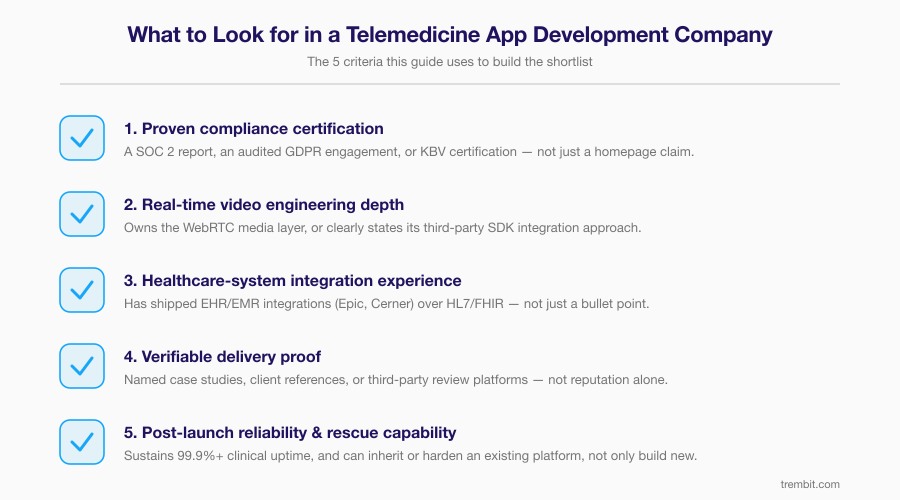
Use these five criteria to build a shortlist — they’re also the exact criteria this guide used to select the 10 companies below, stated up front so you can judge the list rather than trust it.
- Proven compliance certification, not just a claim. “HIPAA-compliant” is a phrase any vendor can put on a homepage. Look for evidence of an actual process: a SOC 2 report, a named GDPR/DPA engagement, or — for German psychotherapy billed to statutory insurance — KBV certification, which is audited case by case. Ask what they’ve been through, not what they say.
- Real-time video engineering depth. There’s a meaningful difference between a team that builds and operates the media layer (WebRTC, media servers, TURN, codecs) and a team that wraps a third-party SDK and configures it. Both are valid; they produce different cost and control outcomes at scale. Ask which one you’re buying.
- Healthcare-system integration experience. EHR/EMR integration over HL7/FHIR is where telemedicine projects overrun. A vendor that has shipped Epic or Cerner integrations before will scope it very differently from one who lists it as a bullet point.
- Verifiable delivery proof. Named case studies, client references, and third-party review platforms (Clutch, GoodFirms) — not reputation alone. No vendor should make your shortlist on marketing copy without at least one checkable proof point.
- Post-launch reliability — and rescue capability. Clinical platforms carry 99.9%+ uptime expectations, and much of the real work is maintaining and hardening a live system, not the greenfield build. A vendor that can inherit and stabilize an existing platform (not only start from scratch) is worth more once you’re past launch.
A note on transparency: Trembit, which publishes this guide, is included below because it meets the criteria above — not because it’s our own list. You’ll find the same format, length, and standard of proof applied to every company here, and where a competitor’s public facts couldn’t be independently confirmed, they’re flagged for verification rather than asserted.
Top Telemedicine App Development Companies in 2026
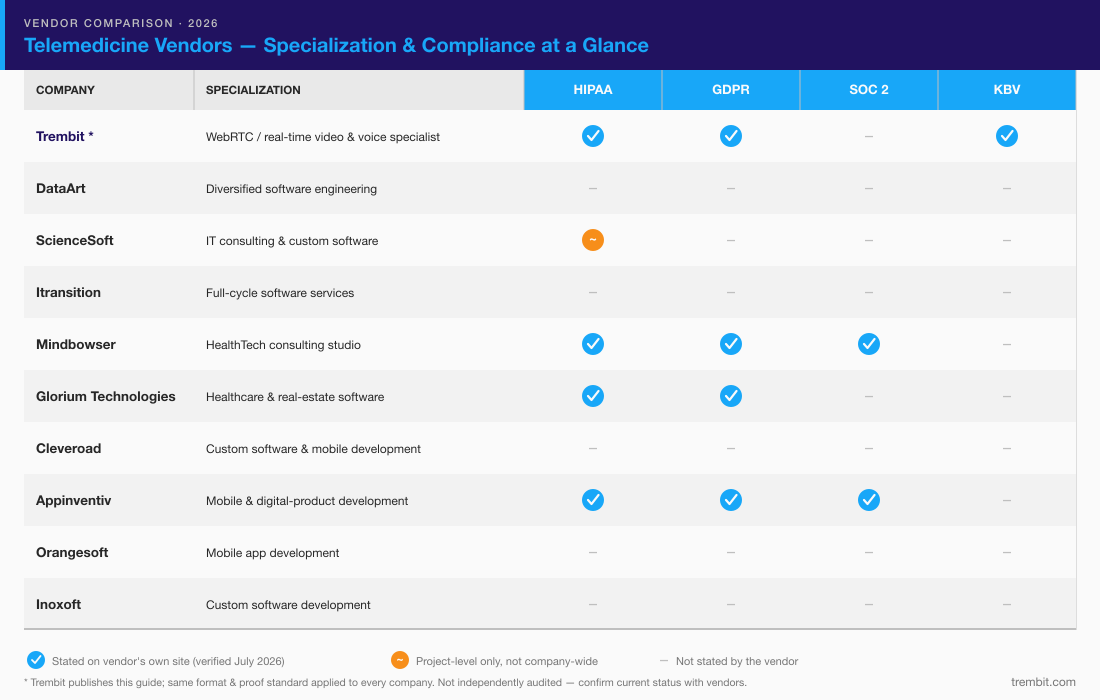
This is a subset, not an exhaustive market map. The 10 companies below were shortlisted against the five criteria in the previous section, then each vendor’s HQ, specialization, and compliance posture was verified against its own website (July 2026). They span all three market shapes (diversified IT firms, healthcare studios, and real-time specialists) deliberately, so the list reflects different project fits rather than one profile.
| Company | HQ | Specialization | Compliance (self-stated) | Verifiable proof point |
|---|---|---|---|---|
| Trembit | Kyiv, Ukraine (UK-registered; Valencia & London presence) | WebRTC / real-time video & voice specialist | HIPAA, GDPR, KBV-certified | Built the WebRTC interpreting engine behind Martti, running across 4,000+ US healthcare facilities; Clutch 4.9/5 (16+ reviews) |
| DataArt | New York, USA | Diversified software engineering; Healthcare & Life Sciences practice | No product-level HIPAA/ISO seal claimed on site; compliance handled per project | Named enterprise clients incl. Nasdaq, Ocado Technology, Skyscanner; SaMD/medical-device software work |
| ScienceSoft | McKinney, Texas, USA | IT consulting & custom software; dedicated Healthcare IT practice | ISO 9001, ISO 27001 (company-level); HIPAA at project level | Case studies incl. bioAffinity Technologies (lung-cancer app) and S.A.E. Orthopedics; 4,300+ projects |
| Itransition | US-headquartered (global delivery) | Full-cycle software services; care-delivery / Salesforce Health Cloud solutions | Not specifically stated on site — confirm on their compliance page | Case studies incl. The Economist and TradeStops (30,000+ investors) |
| Mindbowser | Jersey City, New Jersey, USA | HealthTech consulting studio; digital-health accelerators | HIPAA-ready delivery, GDPR, SOC 2 Type II | 250+ projects, 200+ HIPAA/FHIR-trained staff; EHR-integration case studies (self-reported) |
| Glorium Technologies | Princeton, New Jersey, USA | Healthcare & real-estate software; telemedicine/EHR/EMR | HIPAA, ISO 27001, ISO 9001, ISO 13485, GDPR | Clutch & GoodFirms 5.0; clients incl. NikoHealth, Agfa, Forward Advantage |
| Cleveroad | Ukraine origins; Estonia-registered | Custom software & mobile; EHR/EMR, telemedicine, RPM | ISO 9001, ISO 27001, AWS Partner (no HIPAA claimed) | Clutch 4.9 (70 reviews); case studies incl. Blockbuster Denmark, Penneo A/S |
| Appinventiv | Noida, India | Mobile & digital-product development; telemedicine/EHR vertical | HIPAA, GDPR, ISO/IEC 27001, SOC 2, PCI DSS | Named clients incl. IKEA, Adidas, KFC, Dr. Reddy’s; DiabeticU (healthcare) |
| Orangesoft | San Francisco, USA (Warsaw & Wyoming offices) | Mobile app development; telemedicine, medical-device, wearables | No specific certification stated on site | Case study: FDA-compliant stroke-patient telemedicine software |
| Inoxoft | Philadelphia, USA (Poland, Estonia, Ukraine offices) | Custom software; healthcare, telemedicine, mHealth, fintech | ISO 27001 (no HIPAA/SOC 2 claimed) | Clutch 5.0 (50 reviews); 230+ projects |
On the 9 non-Trembit rows: these facts were verified against each company’s own website in July 2026. Where a company does not itself claim a certification (e.g. HIPAA), we don’t attribute it — the compliance column reports only what each vendor states publicly. Compliance postures change; confirm current status directly with any vendor before contracting. No competitor is ranked, and none is framed negatively.
Each company gets a self-contained profile below.
Trembit — WebRTC / real-time video and voice specialist
- HQ / primary market: Kyiv, Ukraine, with a presence in Valencia (Spain) and London (UK); UK-registered (Companies House OC421630). Primary markets: USA, DACH, Nordics, UK.
- Specializes in: WebRTC and real-time video/voice infrastructure — one of roughly 50 companies worldwide that work exclusively in WebRTC at the protocol level (ICE, DTLS, SRTP, media servers), rather than configuring a third-party SDK. Core verticals are telemedicine, e-learning, and live streaming.
- Compliance: HIPAA and GDPR delivery experience, plus KBV certification for psychotherapy telemedicine in Germany — a narrow, audited standard that is rare among WebRTC teams.
- Proof point: Trembit built the WebRTC video-remote-interpreting engine behind Martti, Equiti Health’s medical-interpretation platform, now running across 4,000+ US healthcare facilities (including NYU Langone, Stanford Health, and Henry Ford Health), with sub-20-second interpreter connection and 99.99% uptime. Its KBV credential comes from the WebPRAX Face2Face psychotherapy platform in Germany. It holds a 4.9/5 rating across 16+ Clutch reviews. See Trembit’s telemedicine development capabilities and the group-video telemedicine platform case study for delivery detail.
- Team & longevity: a ~30-person team (20+ engineers) whose founders have built video and voice software together since 2009; many client engagements run 1–3+ years, which matters for a clinical platform you’ll maintain long after launch.
- Best fit for: platforms where the real-time media layer is the hard part — low-latency, high-reliability, or compliance-sensitive video — and for hardening or recovering a live platform, not only greenfield builds. Less of a fit for buyers who want a single large generalist vendor to own many unrelated workstreams.
DataArt — diversified software engineering with a healthcare practice
- HQ / primary market: New York, USA, with global delivery.
- Specializes in: broad custom software engineering across many industries, with a named Healthcare & Life Sciences practice (including SaMD / medical-device software).
- Compliance: does not claim a product-level HIPAA/ISO seal on its site; compliance is handled at the project level — confirm scope directly for a regulated build.
- Proof point: named enterprise clients including Nasdaq, Ocado Technology, and Skyscanner; healthcare delivered through its Healthcare & Life Sciences practice.
- Best fit for: buyers who want a large, diversified engineering partner with broad staff availability and healthcare as one vertical among several.
ScienceSoft — IT consulting and custom software with a healthcare practice
- HQ / primary market: McKinney, Texas, USA, with global delivery.
- Specializes in: IT consulting and custom software development across industries, with a dedicated Healthcare IT practice.
- Compliance: ISO 9001 and ISO 27001 certified at the company level; HIPAA addressed at the project level (e.g. a HIPAA-compliant provider-to-provider telehealth platform).
- Proof point: healthcare case studies including bioAffinity Technologies (a lung-cancer detection app) and S.A.E. Orthopedics; states 4,300+ projects delivered.
- Best fit for: buyers wanting a consulting-led firm that can advise on architecture and process, not only build.
Itransition — full-cycle software services with a healthcare vertical
- HQ / primary market: US-headquartered, with global delivery.
- Specializes in: full-cycle software development across many verticals, with care-delivery and Salesforce Health Cloud solutions in healthcare.
- Compliance: does not state specific certifications on the pages reviewed — verify on their compliance page before a regulated engagement.
- Proof point: case studies including The Economist (DevOps) and TradeStops (serving 30,000+ investors).
- Best fit for: buyers who want a large generalist with scale and a broad published track record.
Mindbowser — HealthTech consulting studio
- HQ / primary market: Jersey City, New Jersey, USA.
- Specializes in: healthcare and digital-health software, with prebuilt accelerators aimed at faster healthcare MVPs.
- Compliance: states HIPAA-ready delivery, GDPR, and SOC 2 Type II.
- Proof point: self-reports 250+ projects and 200+ HIPAA/FHIR-trained staff, with EHR-integration case studies (counts are self-reported; no single flagship named-brand client stands out).
- Best fit for: early-stage digital-health teams wanting a healthcare-specialized studio and faster time to an MVP.
Glorium Technologies — healthcare and real-estate software
- HQ / primary market: Princeton, New Jersey, USA.
- Specializes in: custom software for healthcare (telemedicine, EHR/EMR) and real estate.
- Compliance: states HIPAA, ISO 27001, ISO 9001, ISO 13485, and GDPR.
- Proof point: 5.0 ratings on Clutch and GoodFirms (self-cited); healthcare clients including NikoHealth, Agfa, and Forward Advantage.
- Best fit for: healthcare product companies wanting a mid-size studio with a healthcare focus and strong review-platform standing.
Cleveroad — custom software and mobile with a healthcare vertical
- HQ / primary market: Ukrainian origins, Estonia-registered (HQ not stated on its own site).
- Specializes in: custom software and mobile development, with EHR/EMR, telemedicine, and remote patient monitoring in healthcare.
- Compliance: states ISO 9001, ISO 27001, and AWS Partner status; it does not claim HIPAA certification.
- Proof point: Clutch 4.9 (70 reviews, self-cited); case studies including Blockbuster Denmark and Penneo A/S.
- Best fit for: buyers wanting a mobile-strong development partner for a healthcare product.
Appinventiv — mobile and digital-product development with a healthcare vertical
- HQ / primary market: Noida, India.
- Specializes in: mobile and digital-product development across many industries, with telemedicine and EHR work in healthcare.
- Compliance: states a broad certification set — HIPAA, GDPR, ISO/IEC 27001, SOC 2, and PCI DSS.
- Proof point: named clients including IKEA, Adidas, KFC, and Dr. Reddy’s; DiabeticU in healthcare.
- Best fit for: buyers who want a large mobile-first agency with broad capacity.
Orangesoft — mobile app development with a healthcare vertical
- HQ / primary market: San Francisco, USA (with Warsaw and Wyoming offices).
- Specializes in: mobile app development, with telemedicine, medical-device, and wearable work in healthcare.
- Compliance: does not state a specific certification on its site — “compliant” is used generically, so confirm scope directly for a regulated build.
- Proof point: case study delivering FDA-compliant stroke-patient telemedicine software.
- Best fit for: buyers focused on a mobile-first healthcare app rather than a large integrated platform.
Inoxoft — custom software with healthcare and fintech verticals
- HQ / primary market: Philadelphia, USA (with offices in Poland, Estonia, and Ukraine).
- Specializes in: custom software development, with healthcare, telemedicine, mHealth, and fintech verticals.
- Compliance: states ISO 27001; it does not claim HIPAA or SOC 2.
- Proof point: Clutch 5.0 (50 reviews, self-cited); states 230+ projects delivered.
- Best fit for: buyers wanting a mid-size development partner across healthcare and adjacent regulated domains.
Building a shortlist and want a second read on the video-architecture question before you commit? Trembit’s telemedicine engineering team will pressure-test your requirements — see the note at the end of this guide for how that works.
How Do These Companies Differ in Approach?
Underneath the marketing, telemedicine vendors fall into three structural groups, and the difference matters more than any feature list.
Large diversified IT-services firms treat healthcare as one vertical among many. Their strength is scale and staffing: they can put a large, multi-disciplinary team on a program and cover adjacent work (data, cloud, back-office systems) under one contract. The trade-off is that real-time video is rarely their core competency — they usually integrate a third-party video SDK, which is fine until latency, per-minute cost, or compliance-sensitive media handling becomes the constraint.
Healthcare-focused product studios specialize in clinical software and often move faster on the healthcare-specific parts — workflows, HIPAA posture, digital-health MVP patterns. Many, though, also integrate a third-party video SDK rather than own the real-time layer, so the same ceiling applies at scale: they’re excellent at the clinical product and dependent on someone else’s media infrastructure for the call itself.
WebRTC / real-time-communication specialists build and control the media infrastructure directly — the media server, TURN, codecs, and the routing logic — at the protocol level. That gives protocol-level control over latency, video quality, and how patient media is handled for compliance. The trade-off is honest: this is a much smaller pool of vendors, and a specialist typically expects to partner on the clinical and integration layers rather than own every unrelated workstream a large generalist would.
There is no single winner here — the right shape depends on your project. A broad platform program with modest video needs may be best served by a large generalist; a product whose entire value depends on reliable, low-latency, compliant video is usually better served by a specialist. Map your project’s hardest constraint onto the pattern, and the group that fits becomes clear.
What Compliance Standards Should a Telemedicine App Development Company Meet?
Compliance is the biggest differentiator in this market, and it’s where “we do healthcare apps” copy most often outruns reality. Four standards matter most, and they’re not interchangeable — they cover different jurisdictions and different obligations.
- HIPAA (US). The US Health Insurance Portability and Accountability Act governs how Protected Health Information (PHI) is stored, transmitted, and accessed. Crucially, there is no official “HIPAA-certified” product seal — the US Department of Health and Human Services makes clear that compliance is a property of a covered entity’s or business associate’s overall safeguards, not a stamp on the software. Any third party that touches PHI on your behalf needs a signed Business Associate Agreement (BAA).
- GDPR (EU/UK). The EU General Data Protection Regulation treats health data as a special category with stricter conditions, and restricts transfers of personal data outside the EU/EEA without a valid mechanism. For EU telemedicine, where the media and metadata physically reside — and who can access them — often matters more than any feature.
- SOC 2 (infrastructure trust). A SOC 2 report, audited against the AICPA’s Trust Services Criteria, evidences that a vendor’s controls around security and availability actually operate as described. It’s not a legal requirement, but it’s a strong, checkable signal that a vendor’s infrastructure practices are real.
- KBV (Germany, psychotherapy). Germany’s Kassenärztliche Bundesvereinigung certifies video services used for psychotherapy reimbursed by statutory health insurance. It requires audited technical and procedural controls beyond general HIPAA/GDPR — including tight constraints on where patient media is routed and stored — which makes it both a narrow and a genuinely rare credential among WebRTC teams. Trembit holds it through the WebPRAX Face2Face platform.
The practical test for a buyer: ask a vendor not whether they’re “compliant,” but what specific process produced that claim — which report, which audit, which certification, and which subprocessors carry a BAA. A team that can answer precisely is a different risk profile from one that can’t. For a deeper walkthrough, see Trembit’s HIPAA-compliant telemedicine blueprint.
What Drives the Cost of Working With a Telemedicine App Development Company?
There’s no meaningful single price for “a telemedicine app” — the number is set by scope decisions, and the same decisions drive the timeline. The main cost drivers:
- Compliance and certification scope. A HIPAA-aware MVP is one thing; a build targeting SOC 2 evidence, GDPR data-residency guarantees, or KBV certification carries additional audit, documentation, and architecture work.
- EHR/EMR integration complexity. Integrating with one system over FHIR is very different from integrating across multiple EHRs and modules (Epic’s Hyperspace, Haiku, Canto, and so on), each with its own architecture — this is one of the largest and most underestimated cost drivers.
- Real-time video architecture. P2P versus SFU, self-hosted media server versus a third-party SDK, and the reliability target all move cost. A wrapped SDK is cheaper to start and carries per-minute usage cost at scale; a self-hosted media layer is more engineering up front and more control later.
- Platform count. Web, iOS, and Android each add build and QA surface, especially for the mixed device fleets and constrained networks common in clinical settings.
- Post-launch support and uptime requirements. A 99.9%+ clinical uptime commitment requires redundancy, monitoring, and on-call engineering that a lower target does not.
Because these drivers vary so widely, any credible vendor will scope and quote after understanding your requirements rather than publish a fixed price. Treat a firm number offered before that conversation with caution.
Looking for a Region-Specific Telemedicine Developer?
This guide is a global, vendor-neutral shortlist. If your requirement is anchored to a specific market or angle, these companion guides go deeper:
- UK: UK-based telemedicine app developers for NHS-facing and UK healthcare-provider projects.
- Germany / KBV: Germany’s KBV-certified telehealth developers for statutory-insurance psychotherapy and telehealth.
- US: top US telemedicine software developers for HIPAA-first, US-based delivery.
- Europe: Europe-based telemedicine development companies for EU-delivery and GDPR-first builds.
- Technology angle: which video technology telemedicine companies actually use, if you want a stack comparison rather than a vendor shortlist.
FAQ
What does a telemedicine app development company actually build? Beyond the video call itself, it builds the infrastructure that makes virtual care usable and legal: EHR/EMR integration (Epic, Cerner, Athenahealth) over HL7/FHIR, appointment scheduling, e-prescribing, remote patient monitoring, consent and audit logging, and multi-platform delivery across web, iOS, and Android — all wrapped in a compliance architecture (HIPAA, GDPR, and where relevant KBV). The video is the visible 10%; the compliance, integration, and uptime work is what actually gets a platform into daily clinical use.
How much does it cost to build a telemedicine app? There’s no single price — cost is driven by scope, not by a rate card. The main drivers are compliance and certification scope (a HIPAA-aware MVP versus a SOC 2 / KBV-targeted build), EHR/EMR integration complexity, the real-time video architecture (P2P vs. SFU, self-hosted vs. a third-party SDK), how many platforms you support, and your post-launch uptime commitment. A credible vendor scopes and quotes after understanding your requirements rather than publishing a fixed number. See the cost-drivers section above for the full list.
What compliance certifications should a telemedicine app development company have? It depends on where you operate. For the US, HIPAA is the baseline and a SOC 2 report is a strong trust signal for infrastructure. For the EU/UK, GDPR governs health data and data residency. For German psychotherapy reimbursed by statutory insurance, KBV certification is a specific, audited, and rare requirement. Note that HIPAA has no official product “certification” seal — so ask a vendor which report, audit, or certification actually backs their claim, and which subprocessors carry a signed BAA.
Should I use a managed CPaaS platform (Twilio, Vonage, Agora) or self-hosted WebRTC for a telemedicine app? Both run on WebRTC; the difference is who operates the media servers. A managed CPaaS platform gets an MVP live fastest and offloads that infrastructure to the vendor, at the cost of per-minute usage fees that grow with scale and less control over latency, quality, and compliance-sensitive media handling. Operating your own WebRTC media layer (Janus, mediasoup, or LiveKit) is more engineering investment up front and trades the vendor’s per-minute bill for your own infrastructure and ops cost — but gives protocol-level control over how patient media is routed and handled. For the detailed telemedicine trade-off, see our comparison of Janus vs. mediasoup vs. LiveKit for telemedicine platforms.
How long does it take to build a HIPAA-compliant telemedicine platform? There’s no fixed timeline — it scales with scope. A focused, HIPAA-aware MVP with basic video and scheduling is a very different timeline from an enterprise platform integrated across multiple EHRs, targeting SOC 2 evidence, and carrying a 99.9%+ uptime commitment. The honest answer is that the timeline follows the same drivers as cost: compliance scope, integration count, video architecture, and platform count. A vendor should give you a scoped estimate against your specific requirements, not a generic number.
What’s the difference between a generalist outsourcing firm and a specialist telemedicine developer? A generalist IT-services firm treats healthcare as one vertical among many — it brings scale, broad staffing, and can cover adjacent workstreams, but usually integrates a third-party video SDK rather than owning the real-time layer. A specialist (a healthcare studio or a WebRTC/real-time team) goes deeper on its focus — clinical workflows and compliance, or protocol-level media control — from a smaller pool of vendors. Neither is universally better: match the choice to your project’s hardest constraint. If that constraint is reliable, low-latency, compliant video, a real-time specialist usually fits; if it’s breadth across many systems, a generalist may.
Vendor fit isn’t a single “best” answer — it depends on your project’s shape: how deep your compliance scope goes, how many systems you integrate, and whether reliable real-time video is the hard part or a supporting feature. Map those constraints first, then match them to one of the three vendor types above.
If the hard part is the video — latency, reliability, or a compliance audit you have to pass — talk to Trembit’s telemedicine engineering team. It’s a free 30-minute call with an engineer, not a sales pitch: bring the specific decision you’re stuck on (SFU vs. SDK, an EHR-integration scope, a HIPAA or KBV requirement) and we’ll pressure-test it against how we built video interpreting for 4,000+ hospitals.