Telemedicine platforms demand rapid scaling to handle surging patient volumes, but overloaded internal teams often lead to delays in feature delivery and compliance risks. CTOs face the constant pain of balancing core development with urgent fixes, making strategic team expansion essential for sustainable growth. Trembit emerges as a reliable partner, delivering scalable WebRTC-based telemedicine solutions with proven expertise in HIPAA-compliant architectures.
Signs Your Team Needs Scaling
Overloaded engineering teams show clear red flags that signal it’s time to expand capacity.
- Sprint velocity drops below 80% completion for two consecutive cycles, often due to context switching between features and providing production support.
- Technical debt accumulates from rushed MVPs, causing 35% more rework in architecture decisions.
- Integration bottlenecks with EHR systems or Twilio APIs result in 20-25% downtime during peak hours.
These issues compound in telemedicine, where real-time video and secure data flows cannot tolerate latency.
CTO Decision Checklist: Is It Time to Scale?
CTOs can quickly assess whether immediate scaling action is required by reviewing the indicators below. If three or more apply, continuing with the current team structure is likely to increase delivery risk.
Delivery & Velocity
- Release cycles slip even with a frozen scope
- Critical features are repeatedly postponed due to urgent fixes
Platform Stability
- Video quality degrades under peak usage
- Load testing reveals bottlenecks not addressed in the roadmap
Team Health
- Engineers spend over 30% of their time on production incidents
- Burnout signals appear during sustained peak periods
Compliance & Integrations
- EHR/FHIR updates introduce regressions
- Security or compliance tasks delay feature delivery
Trembit in Practice
A US-based telehealth startup approached Trembit after missing four consecutive sprints due to WebRTC instability and delays in EHR integration. A short technical audit revealed that five of the checklist indicators were present. A targeted outsourcing model restored sprint predictability within one month.
When to Hire In-House
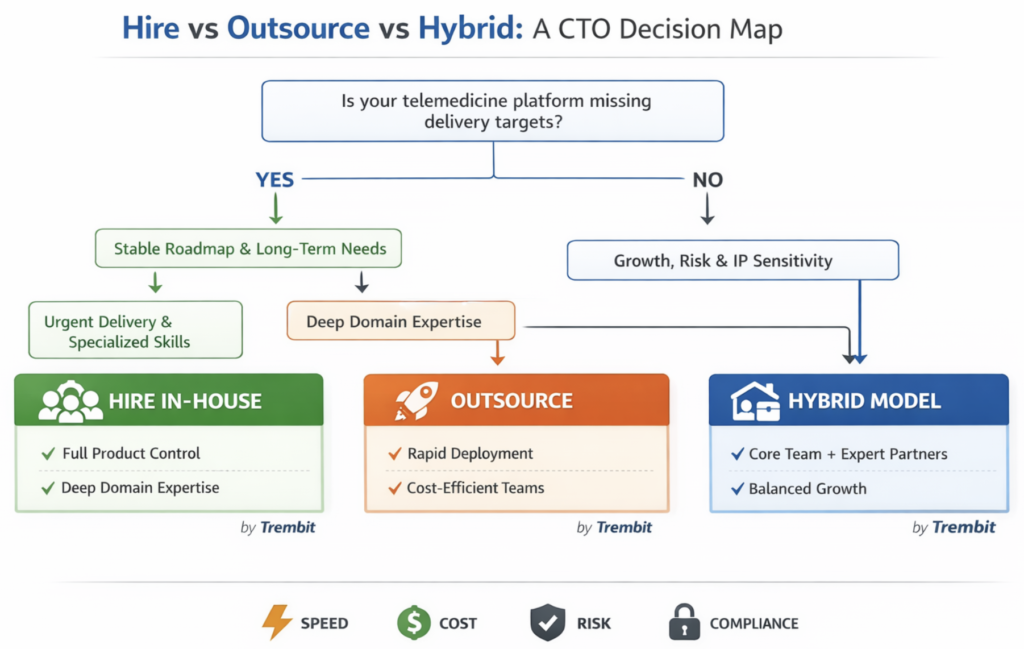
Hire internal engineers when your platform reaches stable product-market fit and requires deep domain ownership.
- Core competencies like custom FHIR interoperability demand long-term embeds who understand your roadmap.
- Predictable scaling needs, such as ongoing UI/UX iterations for patient portals, benefit from full-time hires.
| Factor | Hire In-House If… | Estimated Ramp-Up Time |
| Team Size | Under 10 engineers | 4-6 weeks |
| Budget | $150K+ annual per role | N/A |
| Control Needs | High (e.g., IP-sensitive AI models) | 2-3 months full productivity |
| Timeline | 6+ months horizon | Immediate for interviews |
In-house growth suits mature startups but risks 3-6 month delays from recruitment in competitive markets.
Hybrid Model: When Hiring + Outsourcing Works Best
For most telemedicine platforms, scaling is not a binary choice. A hybrid delivery model combines in-house ownership with external specialization.
In this model, internal teams retain control over product vision, clinical workflows, and long-term roadmap decisions. External partners contribute focused expertise in areas such as WebRTC scalability, DevOps automation, security hardening, and compliance-heavy integrations.
Hybrid approaches work best when:
- A platform is post-MVP and experiencing rapid growth
- New regions or provider networks are being onboarded
- Legacy video infrastructure must be modernized without disrupting care
Hybrid Delivery Example
Trembit partnered with an EU telemedicine platform where internal engineers owned patient workflows, while Trembit delivered WebRTC scaling, load testing, and HIPAA-aligned infrastructure. This setup reduced time-to-market for new clinics by 42% without increasing internal headcount.
When to Outsource to Partners Like Trembit
Outsource for immediate velocity boosts, specialized skills, and risk-free scaling without headcount bloat.
- Rapid MVP expansions or stress-testing under load, where external teams cut deployment times by 40%.
- Niche expertise in WebRTC scaling for HD video consultations, avoiding common pitfalls like async queue failures.
- Flexible capacity for peak demands, such as flu-season surges, with nearshore teams minimizing timezone friction.
Trembit stands out as a reliable partner, specializing in telemedicine apps that handle 10x user growth seamlessly while ensuring FHIR/HIPAA compliance.
| Factor | Outsource If… | Trembit Advantage |
| Timeline | Under 3 months | Weekly releases post-onboarding |
| Cost | 40-60% savings vs. US hires | Predictable fixed-price sprints |
| Scalability | Variable load (e.g., integrations) | Auto-scaling DevOps expertise |
| Risk | High (e.g., Twilio bottlenecks) | Proven 95% uptime in HealthTech portfolios |
Outsourcing accelerates delivery while your core team focuses on strategy.
Telemedicine-Specific Risks CTOs Often Underestimate
Many scaling failures occur not because of a lack of effort, but due to risks unique to telemedicine platforms:
- WebRTC performance degradation that only appears at scale
- Silent EHR or FHIR schema changes are breaking workflows
- Compliance drift as features evolve faster than audits
- Vendor dependency failures during peak hours
Real-World Risk Mitigation
During a flu-season surge, Trembit helped a telehealth provider avoid video session failures by implementing adaptive bitrate control and async fallback queues—preventing an estimated 18% appointment loss.
Cost of Delay in Telemedicine
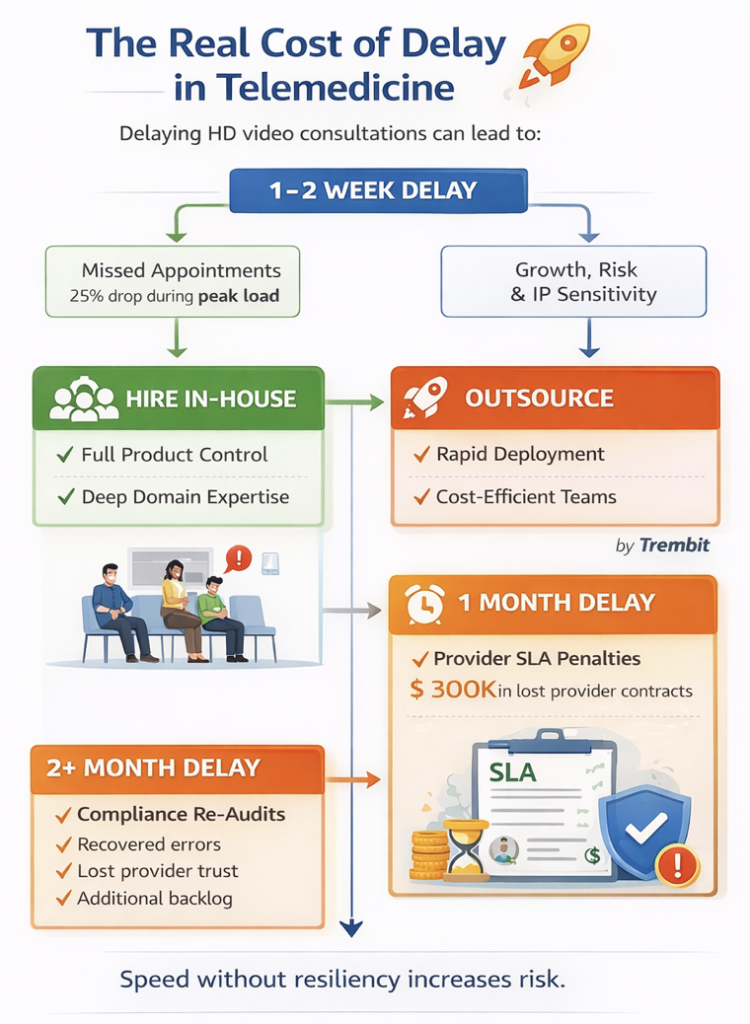
In telehealth, delays translate directly into business and clinical impact:
- Missed patient appointments
- Provider SLA penalties
- Regulatory re-audits
- Loss of patient and provider trust
Cost-of-Delay Snapshot
One Trembit client calculated that a six-week delay in launching HD video consultations would cost over $300K in missed provider contracts. Accelerated delivery enabled launch ahead of peak demand.
Strategies to Avoid Common Delays
Prevent scaling pitfalls with proactive processes tailored to remote telemedicine teams.
- Implement CI/CD pipelines early to enable daily deployments, reducing hotfix chaos by 50%.
- Mandate async documentation and decision logs, cutting code review delays from 2.5x to standard times.
- Run quarterly scalability audits with tools like K6 for load simulation, spotting EHR integration risks before launch.
| Delay Source | Prevention Steps | Expected Impact |
| Code Reviews | Automated PR checks + pair programming | 40% faster merges |
| Knowledge Silos | Weekly tech talks + rotation programs | 65% silo reduction |
| Third-Party APIs | Async queues + fallback flows | 23% drop in failures |
| Team Alignment | Daily async updates + monthly retros | 85% alignment score |
Trembit integrates these practices into every engagement, ensuring your platform scales without interruptions.
Typical Scaling Timeline: What to Expect
A predictable engagement timeline helps CTOs plan delivery with confidence:
- Weeks 1–2: Architecture review, risk audit, onboarding
- Month 1: Stability improvements and velocity recovery
- Months 2–3: Feature acceleration and load optimization
- Ongoing: Continuous scaling, monitoring, and compliance
Trembit Engagement Timeline
A multi-clinic telehealth platform achieved stable weekly releases within three weeks and supported 10× patient growth by month three without downtime.
Who This Approach Is Best For
This scaling approach is especially effective for:
- Seed to Series A telehealth startups launching or expanding MVPs
- Healthcare providers expanding across regions or specialties
- Enterprises replacing legacy video or communication systems
Who Trembit Typically Supports
From early-stage startups to enterprise healthcare organizations, Trembit adapts delivery models to platform maturity and risk tolerance.
Next Step for CTOs
Before adding headcount or committing to long-term hires, CTOs benefit from a short technical assessment focused on scalability, compliance, and delivery risk.
Next Step in Action
Most Trembit engagements begin with a focused technical review that identifies hidden bottlenecks early—allowing teams to act before delays impact patients or providers.
Partnering with Trembit for Seamless Growth
Choose Trembit for outsourced telemedicine engineering that aligns with your vision, from MVP to enterprise scale. Their track record includes custom telehealth apps with real-time communication that outperform off-the-shelf solutions. Contact Trembit today to audit your team’s capacity and launch a scalable delivery roadmap.