Artificial intelligence has become one of the most discussed technologies in healthcare. Yet for many telemedicine providers, the real challenge is not whether to use AI — but how to apply it in ways that create measurable value for patients, clinicians, and the business itself.
Successful AI adoption in telemedicine is not about futuristic promises or experimental tools. It is about solving today’s operational bottlenecks: clinician overload, long patient wait times, fragmented data, and rising care delivery costs. When implemented thoughtfully, AI enhances, but does not replace, clinical expertise, while making virtual care more scalable and sustainable.
This article examines practical AI use cases in telemedicine that are already enhancing patient experience, provider efficiency, and clinical outcomes, guiding how to approach implementation responsibly.
Why AI Matters Now in Telemedicine
Telemedicine adoption has accelerated, but growth has exposed structural weaknesses. Providers face increasing consultation volumes without proportional staff growth. Patients expect faster responses and more personalized care. Meanwhile, regulatory requirements around privacy and security remain non-negotiable.
AI addresses these pressures by acting as a force multiplier:
- It automates repetitive tasks that consume clinicians’ time.
- It analyzes real-time and historical data faster than manual workflows.
- It supports earlier interventions, reducing downstream costs.
When combined with real-time communication technologies like WebRTC, AI becomes a core enabler of modern, cloud-native telehealth platforms.
Core AI Use Cases That Improve Patient and Provider Experience
Rather than deploying AI everywhere at once, high-performing telehealth platforms focus on a few high-impact areas first.
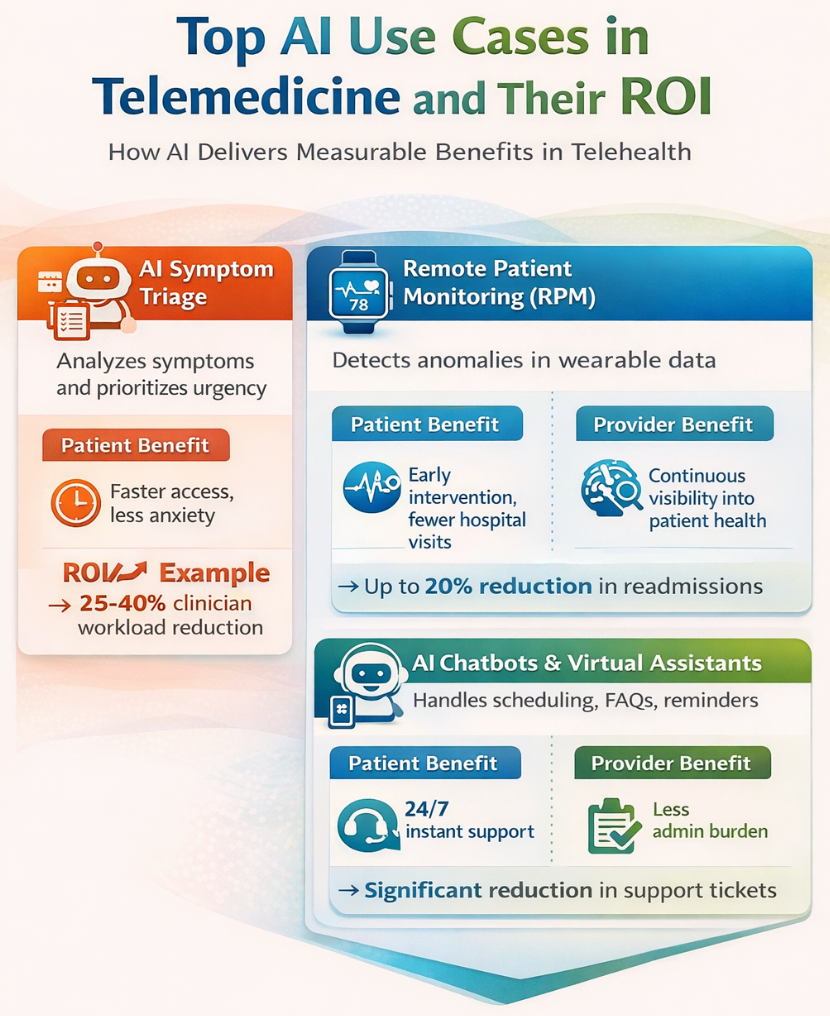
1. AI-Driven Virtual Triage
One of the most immediate pain points in telemedicine is inefficient triage. Without automation, providers must manually assess patient complaints, often leading to delays for urgent cases and unnecessary consultations for non-critical ones.
AI-powered triage systems analyze structured and unstructured inputs such as symptoms, medical history, and basic vitals. Based on this analysis, patients are:
- Prioritized by urgency
- Routed to the appropriate clinician or care path
- Given guidance for self-care when appropriate
Customer value:
- Shorter wait times for high-risk patients
- Reduced clinician workload from low-priority cases
- Better utilization of provider schedules
2. Remote Patient Monitoring with Predictive Intelligence
Remote Patient Monitoring (RPM) has evolved beyond simple data collection. AI enables continuous analysis of real-time signals from wearables and connected medical devices — such as heart rate, glucose levels, or oxygen saturation.
Instead of reacting to patient deterioration, AI models detect anomalies and trends early, triggering alerts before conditions worsen.
Customer value:
- Fewer emergency interventions and hospital readmissions
- Greater confidence for patients managing chronic conditions remotely
- Data-driven decision-making for clinicians
For healthcare operators, this translates into lower operational costs and improved long-term patient outcomes.
3. AI Chatbots and Virtual Assistants for Frontline Efficiency
Not every patient interaction requires a clinician. AI-powered chatbots and virtual assistants can handle:
- Appointment scheduling
- Medication reminders
- Common medical questions
- Pre-consultation data collection
When integrated into telehealth platforms, these tools provide 24/7 access while reducing administrative overhead.
Customer value:
- Faster patient responses without expanding staff
- More clinician time for complex cases
- Improved patient satisfaction through instant support
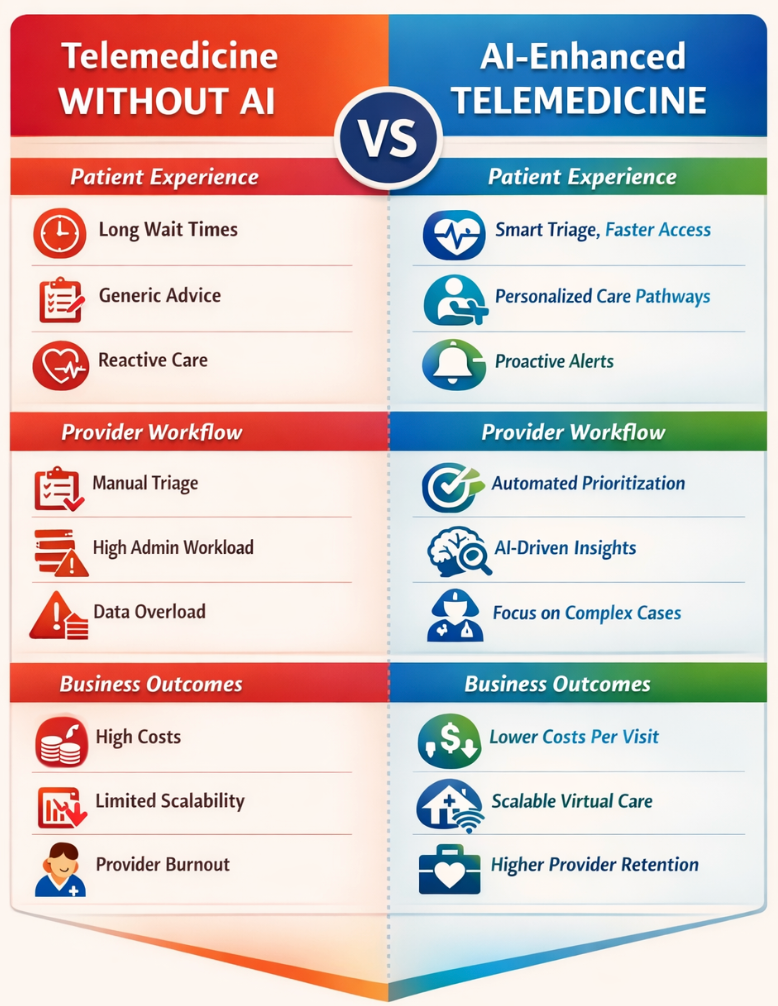
Comparing Telemedicine With and Without AI
The impact of AI becomes clearer when comparing traditional telemedicine workflows to AI-enhanced ones.
| Aspect | Without AI | With AI |
| Patient Experience | Long waits, generic guidance | Personalized pathways, proactive alerts |
| Provider Workflow | Manual triage, data overload | Automated prioritization, actionable insights |
| Clinical Outcomes | Reactive interventions | Predictive care, fewer readmissions |
AI shifts telemedicine from a reactive service model to a proactive care platform.
Advanced AI Applications Delivering Measurable ROI
As platforms mature, AI can support more specialized functions.
AI-Assisted Medical Imaging Analysis
During virtual consultations, AI tools can analyze X-rays, MRIs, or CT scans, flagging potential issues for clinician review. These systems do not replace radiologists — but significantly reduce review time and error rates.
Business impact:
- Faster diagnostic turnaround
- Higher clinician productivity
- Improved diagnostic consistency
Predictive Analytics for Provider Operations
AI models can forecast patient demand, identify peak usage times, and optimize staffing levels. By analyzing historical usage and real-time trends, telehealth providers can reduce burnout and improve service reliability.
Implementing AI in Telemedicine: A Practical Path Forward
Successful AI adoption is incremental, not disruptive.
Step 1: Identify High-Impact Use Cases
Start with areas where automation delivers immediate gains — such as triage or monitoring.
Step 2: Ensure Data Readiness
High-quality data from EHRs, wearables, and patient inputs is essential. Clean, structured data improves model accuracy and trust.
Step 3: Integrate, Don’t Isolate
AI should be embedded into existing telehealth workflows and real-time communication systems — not deployed as disconnected tools.
Step 4: Measure and Refine
Continuously monitor performance, clinical outcomes, and user feedback to improve models over time.
Security, Privacy, and Compliance: Non-Negotiable Foundations
AI in telemedicine operates on sensitive health data, making compliance essential. Regulations such as HIPAA require strict safeguards across data collection, processing, and storage.
Key principles include:
- End-to-end encryption for data in transit and at rest
- Role-based access control and audit logging
- Explicit patient consent for AI-assisted services
- Data minimization to avoid unnecessary exposure
When these measures are built into the platform architecture from day one, AI innovation and compliance can scale together.
Turning AI From Hype Into a Competitive Advantage
AI delivers value in telemedicine when it is applied with purpose, integrated into real workflows, and aligned with patient and provider needs. The most successful platforms focus on practical automation, predictive insights, and seamless real-time experiences, rather than experimental features.
For healthcare organizations, the question is no longer whether to adopt AI, but how quickly it can be implemented responsibly to improve care quality, operational efficiency, and long-term scalability.
Why Trembit
Implementing AI in telemedicine is not just a technical challenge — it requires a deep understanding of healthcare workflows, real-time communication, security, and regulatory compliance. This is where Trembit stands apart.
Trembit helps healthcare companies move beyond AI experimentation and into production-ready, compliant telehealth solutions. With strong expertise in WebRTC-based real-time communication, AI integrations, and cloud-native architectures, Trembit builds platforms that are designed for low latency, scalability, and clinical reliability from day one.
Rather than offering off-the-shelf tools, Trembit works as a technology partner—helping teams:
- Identify AI use cases with real operational and clinical impact.
- Integrate AI seamlessly into existing telehealth workflows.
- Ensure HIPAA-ready security, data protection, and auditability
- Scale platforms confidently as patient demand grows.
Whether you are launching a new telemedicine product or modernizing an existing platform, Trembit focuses on practical outcomes: better patient experience, more efficient providers, and sustainable business growth.
AI in telemedicine delivers results only when it is implemented correctly. Trembit helps turn AI from hype into a competitive advantage.