“So… are we still betting on WebRTC?”
Last month, during a discovery call with a SaaS founder, we heard that exact question. The team was planning a major upgrade of their video collaboration platform. They wanted to know whether WebRTC was still the right foundation.
They had read about MOQ and QUIC. They had seen articles predicting “the end of WebRTC.” And they were worried about choosing the wrong path.
Here’s the thing: at Trembit, we’ve been building real-time systems for years. And in 2026, WebRTC is still the safest, most practical choice for interactive communication.
Why Does WebRTC Still Dominate Real-Time Communication?
WebRTC continues to win because it solves problems developers actually have. It works natively in browsers without plugins. It handles media encryption, codecs, and network traversal automatically.
That’s why platforms like Zoom, Google Meet, and Microsoft Teams still rely on WebRTC for their browser experiences. It remains the common language of real-time communication. But here’s the catch: being dominant doesn’t mean being flawless.
Where Does WebRTC Start to Break?
Why Is Signaling Still So Complicated?
WebRTC deliberately avoids defining signaling. That gives developers freedom to design their own flows. But it also creates one of the biggest pain points in real projects.
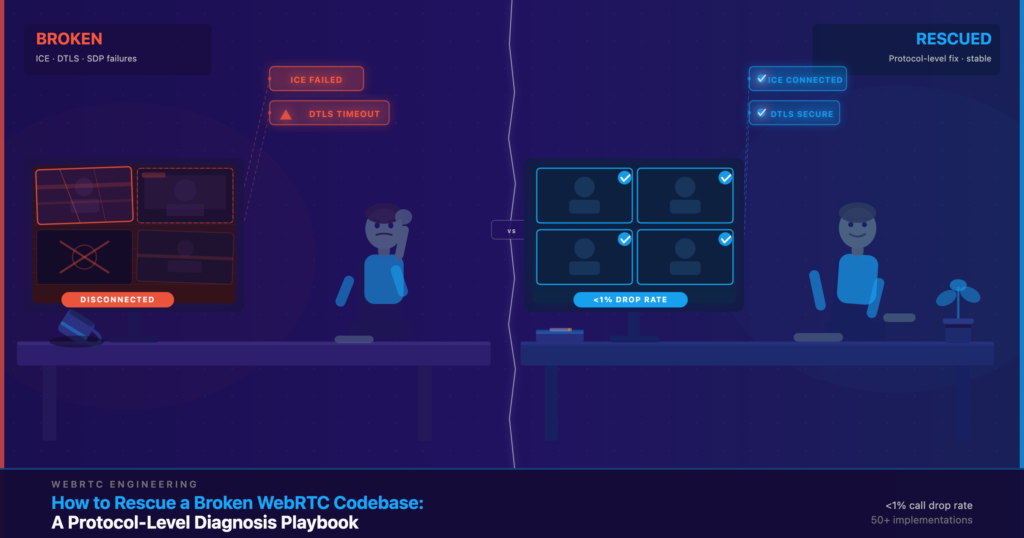
SDP, the protocol used to negotiate media, remains hard to work with. Small mistakes in formatting or timing can break entire sessions. Many teams spend more time debugging signaling than building features.
Philipp Hancke, long-time WebRTC contributor, often says:
“Most WebRTC issues aren’t media issues. They’re signaling issues.”
Is ICE Traversal a Blessing or a Burden?
ICE, STUN, and TURN are the magic that make WebRTC work across networks. Without them, peer-to-peer communication would be impossible. But running TURN infrastructure at scale is complex and expensive.
Corporate networks frequently block UDP. Mobile carriers behave unpredictably. Global TURN servers add latency and cost.
But here’s the catch: many “peer-to-peer” systems end up routing everything through servers anyway. At that point, the original promise of simplicity fades quickly.
Can WebRTC Really Scale for Massive Audiences?
WebRTC was built for conversations, not broadcasts. It shines in one-to-one and small group calls. But large events introduce serious challenges.
Platforms like Zoom Webinars and Teams Live Events rely on heavy server infrastructure to scale. Cascading SFUs and custom distribution layers become necessary.
Here’s the thing: WebRTC can scale — but it was never designed as a streaming protocol.
Why Are Cloud-Native Workflows So Awkward?
Modern real-time products need more than simple calls. They require AI transcription, real-time translation, noise suppression, and analytics.
WebRTC bundles transport, codecs, and encryption tightly together. That makes these cloud workflows harder than they should be. Developers often build complex gateways just to extract media.
But here’s the catch: today’s applications demand flexibility that WebRTC wasn’t originally designed for.
Is Debugging WebRTC Still Painful?
Yes. Even in 2026, troubleshooting WebRTC can feel like detective work. Browser internals hide many important details. Packet-level visibility is limited.
As Lorenzo Miniero, creator of the Janus media server, famously said:
“WebRTC works great—until it doesn’t. Then it gets interesting.”
What Are the Real Alternatives in 2026?
Will MOQ Replace WebRTC This Year?
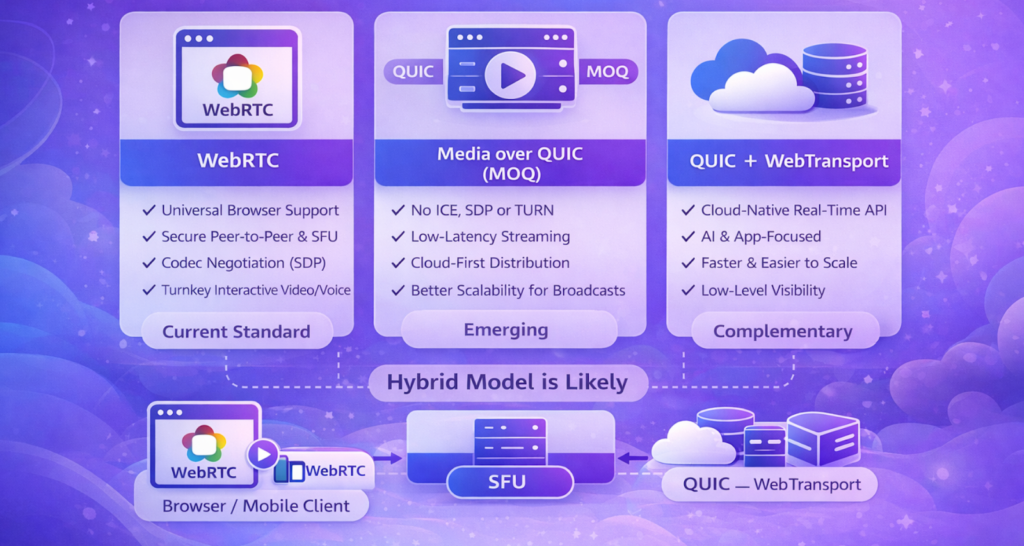
Media over QUIC (MOQ) is the most promising new protocol on the horizon. It replaces WebRTC’s custom transport with QUIC. That removes the need for SDP, ICE, and TURN entirely.
MOQ is ideal for large-scale, low-latency streaming. Companies like Cloudflare and Meta are investing heavily in it. It fits perfectly with modern, cloud-first architectures.
But here’s the catch: MOQ is still maturing. Browser support is limited. Tooling is early. Most production systems aren’t ready to depend on it.
Is QUIC and WebTransport a Simpler Path?
For many server-centric use cases, yes. QUIC combined with WebTransport offers low-latency communication without WebRTC complexity.
There’s no ICE, no SDP, no TURN. The model is much easier to reason about. It works especially well for AI-powered applications and real-time data pipelines.
But here’s the thing: it’s not peer-to-peer. Everything flows through servers. That makes it a powerful complement — but not a full replacement.
What About Proprietary Real-Time Stacks?
Large tech companies increasingly build their own protocols. Cloud gaming platforms use custom QUIC solutions. Social networks create specialized media pipelines.
These systems are optimized for very specific needs. They trade interoperability for performance and control. They can outperform WebRTC in narrow scenarios.
But here’s the catch: most companies don’t have Google-level resources. For them, standards still matter.
WebRTC vs. Alternatives: What Fits Where?
| Scenario | Best Technology |
| Browser video meetings | WebRTC |
| Telehealth platforms | WebRTC |
| Interactive classrooms | WebRTC + SFU |
| Massive live streaming | MOQ / QUIC |
| AI voice assistants | QUIC + WebTransport |
| Cloud gaming | Proprietary stacks |
Here’s the thing: there is no universal winner. Each technology solves a different problem.
What Will Real-Time Architectures Look Like?
Is WebRTC Going Away Soon?
No. Not in 2026, and likely not in 2027. WebRTC remains the only truly universal option for browser-based real-time communication.
Zoom still needs it for web access. Google Meet depends on it for interoperability. Teams relies on it to reach unmanaged devices.
But here’s the catch: WebRTC is increasingly becoming one layer in a bigger system.
Is the Future Actually Hybrid?
Absolutely. Most modern platforms are already mixing technologies.
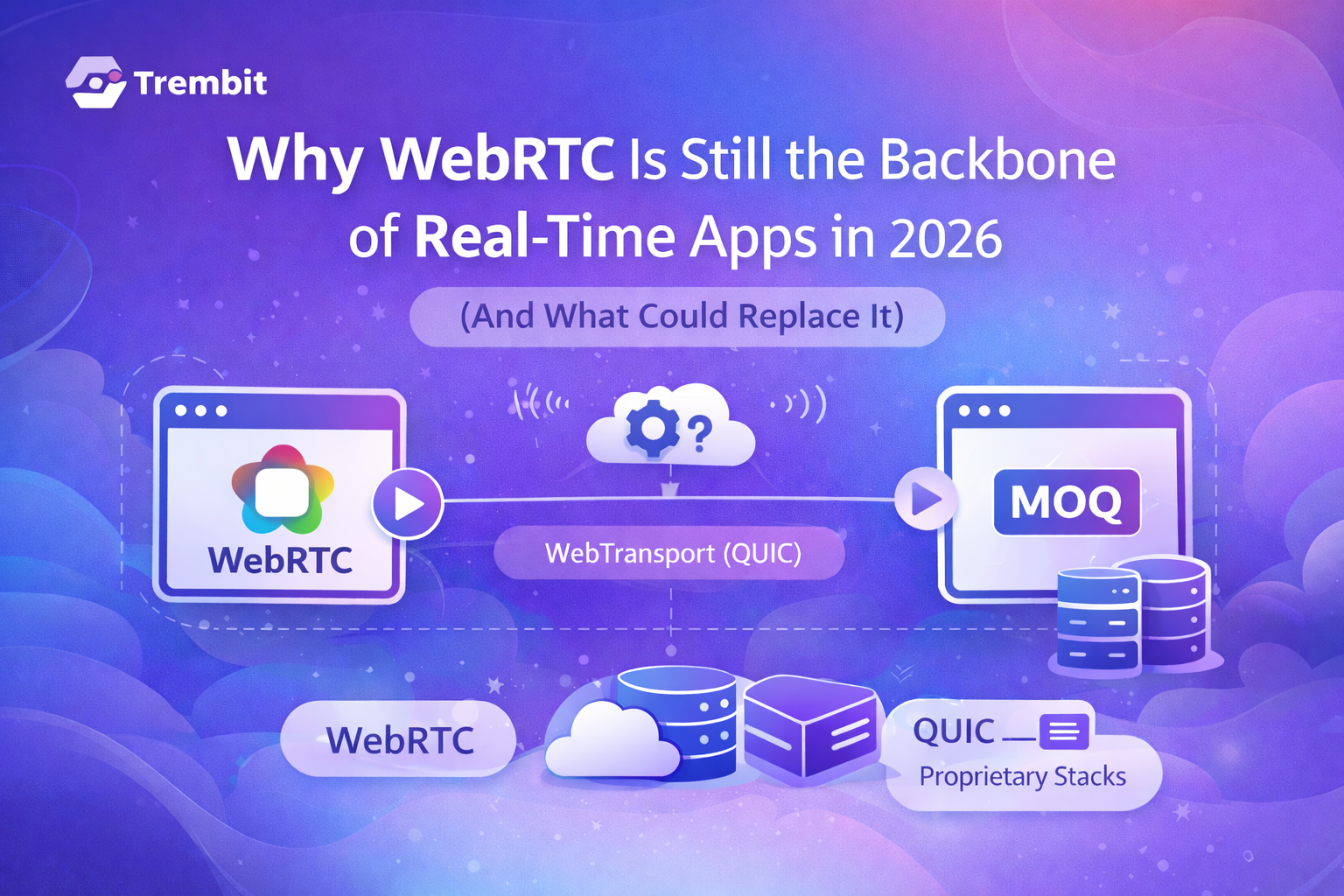
A practical 2026 architecture often looks like this:
- WebRTC at the edges
- SFUs for routing
- QUIC or MOQ in the core
- AI services connected via WebTransport
This approach combines reliability with scalability. It lets each protocol do what it does best.
So What Should You Choose Today?
If you’re building interactive real-time communication, WebRTC is still the safest foundation. It’s proven, widely supported, and predictable.
If you’re building massive streaming platforms, evaluate MOQ seriously. If AI processing is central, consider QUIC and WebTransport.
Here’s the thing: technology choices should follow product goals, not hype.
Final Thought
In 2026, WebRTC is a bit like plumbing. No one gets excited about it anymore. But almost every real-time product still depends on it.
Need Help Designing Your Real-Time Architecture?
At Trembit, real-time communication is one of our core specialties.
We help companies:
- design WebRTC architectures from scratch
- scale existing platforms with SFUs
- integrate AI pipelines into real-time media
- evaluate MOQ and QUIC strategies
- rescue struggling real-time projects
Whether you’re starting a new product or modernizing an existing one, we can help you make the right technical decisions.
👉 Talk to Trembit’s real-time experts: https://trembit.com/contacts
Let’s build your next real-time system the right way.