WebRTC

How to Build a Real-Time AI Content Moderation Pipeline for Live Video

How to Build a Real-Time AI Content Moderation Pipeline for Live Video

A real-time AI content moderation pipeline is the combination of three things: extracting frames and audio from a live media stream, running AI inference on them, and returning an enforcement action — mute, kick, flag, or blur — back to the session fast enough that harmful content never reaches viewers. The central engineering decision is where […]

How to Rescue a Broken WebRTC Codebase: A Protocol-Level Diagnosis Playbook

How to Rescue a Broken WebRTC Codebase: A Protocol-Level Diagnosis Playbook

A WebRTC rescue is what happens when a live video product is failing — calls drop, connections hang on “connecting,” audio goes one-way — and the team that owns the code can’t find the root cause. Usually the codebase was inherited or built by a team that has moved on, and the engineers left holding it are […]

WebRTC vs Media over QUIC (MOQ): What Startups Need to Know in 2026

WebRTC vs Media over QUIC (MOQ): What Startups Need to Know in 2026

“Should we build on WebRTC or wait for MOQ?” That’s the question we heard three times last month from startup CTOs planning their video platforms. Each time, our answer surprised them. The short version: in 2026, you’re almost certainly building on WebRTC. But the longer answer — about when MOQ makes sense, where WebRTC breaks, […]

Why WebRTC Is Still the Backbone of Real-Time Apps in 2026 (And What Could Replace It)

Why WebRTC Is Still the Backbone of Real-Time Apps in 2026 (And What Could Replace It)

“So… are we still betting on WebRTC?” Last month, during a discovery call with a SaaS founder, we heard that exact question. The team was planning a major upgrade of their video collaboration platform. They wanted to know whether WebRTC was still the right foundation. They had read about MOQ and QUIC. They had seen […]

AV1 in 2026: Why the ‘Next-Gen Codec’ Still Isn’t Dominant

AV1 in 2026: Why the ‘Next-Gen Codec’ Still Isn’t Dominant

“Should we switch to AV1 for our video platform?” we’ve heard this question at least a dozen times in the past six months from product managers looking to optimize their WebRTC applications. The answer keeps surprising them: probably not yet. Despite years of hype, better compression numbers that look amazing on paper, and backing from […]

Ultra-Low Latency Streaming: When WebRTC Is Mandatory (And When It’s Overkill)

Ultra-Low Latency Streaming: When WebRTC Is Mandatory (And When It’s Overkill)

“We need sub-second latency for our live streaming platform.” That’s what the founder told us last week. When we asked what they were building, they said it was a sports broadcasting app for casual viewing — not betting, not interactive, just watching games. Our next question surprised them: “Why do you need sub-second latency for […]

Why Async Video Profiles Break Less Often Than Live Video Dates

Why Async Video Profiles Break Less Often Than Live Video Dates

The Stability vs. Engagement Tradeoff in Modern Dating Apps The evolution of video features in dating applications has created a fascinating technical crossroads. While live video dates promise real-time connection and authenticity, async video profiles offer a fundamentally different infrastructure model — one that prioritizes stability, cost efficiency, and scalability over spontaneous interaction. Understanding this […]

Designing Video Dating Flows That Don’t Melt Your SFU

Designing Video Dating Flows That Don’t Melt Your SFU

Preventing Infrastructure Overload Through Smart Architecture Selective Forwarding Units (SFUs) have become the backbone of modern video dating applications, enabling real-time connections between users without the computational overhead of traditional MCU architectures. But there’s a critical paradox: the very features that make video dating appealing — spontaneity, instant connections, and simultaneous sessions — are precisely […]

Real-Time Video Matching: Why “Instant Video” Kills Conversion (and How to Fix It)

Real-Time Video Matching: Why “Instant Video” Kills Conversion (and How to Fix It)

Understanding the UX and Infrastructure Collision in Video Dating Instant video calling sounds like the ultimate feature for dating apps — the promise of immediate, authentic connection at the tap of a button. Product teams envision users swiping, matching, and jumping straight into face-to-face conversations within seconds. The reality? Instant video features consistently show 20-40% […]

Do You Really Need 4K? How AI Upscaling Is Changing Video Quality Decisions

Do You Really Need 4K? How AI Upscaling Is Changing Video Quality Decisions

“We’re thinking about upgrading to 4K for our video platform.” That’s what a startup CTO told us last month. His team was planning significant infrastructure investment to support higher resolution streams — more storage, more bandwidth, more server capacity. Our response surprised him: “What if you don’t need to send 4K at all?” In 2026, […]

Edge Video Processing in 2026: Moving AI and Media Closer to the User

Edge Video Processing in 2026: Moving AI and Media Closer to the User

A telehealth startup recently discovered that its video consultations worked beautifully in Seattle but struggled in rural Montana. Latency spiked to 800ms, doctor-patient conversations felt unnatural, and patient satisfaction scores dropped. The diagnosis? All video processing happened in a single AWS region, thousands of miles from half their users. The solution wasn’t faster internet — […]

How to Build WebRTC Dating App Video Calling That Works on Every Mobile Device

How to Build WebRTC Dating App Video Calling That Works on Every Mobile Device

Video calling has become a cornerstone feature in modern dating applications. According to recent industry reports, dating platforms with integrated video calling see 40% higher user engagement and 25% better match conversion rates. However, implementing real-time video communication at scale presents unique technical challenges, particularly when balancing bandwidth efficiency, CPU utilization, and mobile performance. While […]

Video Liveness Detection for Dating Apps: Why Most Systems Fail

Video Liveness Detection for Dating Apps: Why Most Systems Fail

Dating app fraud has evolved from simple fake profiles to sophisticated attacks using deepfakes, AI-generated images, and pre-recorded videos. Romance scams cost victims over $1.3 billion in 2022 alone, with dating platforms facing increasing pressure to verify user authenticity. Traditional photo verification is no longer sufficient — determined fraudsters easily bypass static image checks using […]

Why Hospital Networks Break WebRTC (and How to Design Around It)

Why Hospital Networks Break WebRTC (and How to Design Around It)

WebRTC has revolutionized real-time communication for healthcare applications, from telemedicine consultations to remote patient monitoring. However, enterprise healthcare networks present unique challenges that can render even the most sophisticated WebRTC implementations ineffective. Understanding these constraints and designing resilient solutions is critical for delivering reliable healthcare communication systems. The Promise and Reality of WebRTC in Healthcare […]

WebRTC in Telemedicine: When HIPAA Requirements Conflict With Video Performance

WebRTC in Telemedicine: When HIPAA Requirements Conflict With Video Performance

The promise of telemedicine is simple: deliver healthcare anywhere, at any time, with the same quality as an in-person visit. However, achieving this promise creates a fundamental tension between two critical requirements — HIPAA compliance and video performance. Healthcare organizations must simultaneously protect patient privacy through rigorous security measures while delivering the low-latency, high-quality video […]

Group Therapy Video Calls: Why 6 Participants Is a Hidden Scaling Cliff

Group Therapy Video Calls: Why 6 Participants Is a Hidden Scaling Cliff

Group therapy sessions represent one of the most challenging use cases for WebRTC video conferencing platforms. Unlike corporate meetings, where participants can tolerate occasional quality degradation, therapy sessions demand consistent audio clarity and reliable visual connection — the foundation of therapeutic rapport. However, many healthcare organizations discover too late that their video platform performs beautifully […]

How to Keep Remote Patient Monitoring Synchronization Within 50ms

How to Keep Remote Patient Monitoring Synchronization Within 50ms

Remote patient monitoring has evolved beyond simple data collection. Modern telemedicine platforms combine live video consultations with real-time streaming of vital signs — heart rate, blood oxygen, ECG waveforms, glucose levels — creating a comprehensive view of patient health. However, achieving seamless synchronization between video feeds and sensor data streams presents significant technical challenges that […]

Generative AI in WebRTC Pipelines — Without the Latency Cost

Generative AI in WebRTC Pipelines — Without the Latency Cost

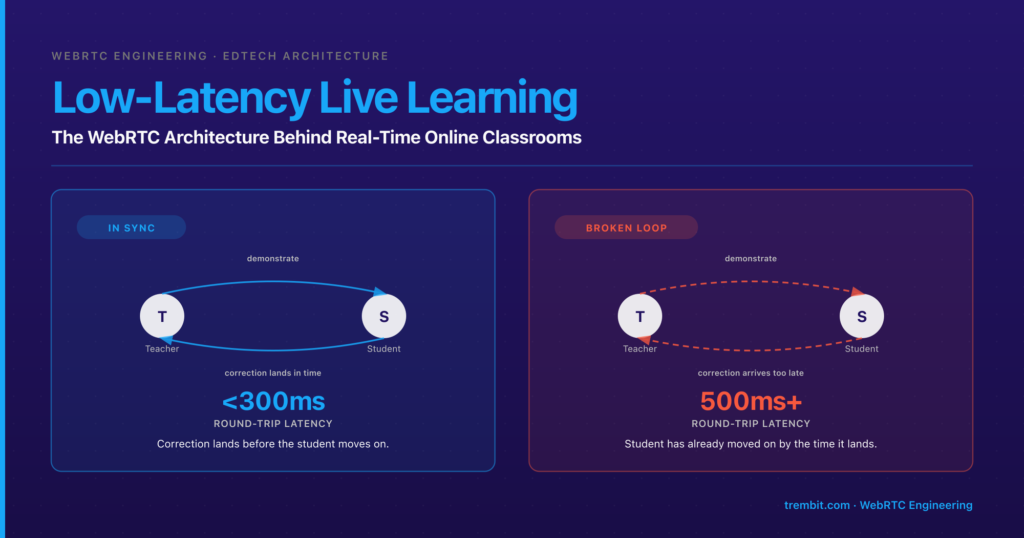
Real-time communication demands split-second responsiveness. A video call feels natural when latency stays below 300 milliseconds. Exceed 500 milliseconds, and conversations become awkward — speakers talk over each other, pauses feel unnatural, and engagement drops. These tight latency constraints created a problem when generative AI entered the picture. The OpenAI Realtime API’s WebRTC integration enables […]

Why AI Upscaling Beats Better Codecs for Live Video in 2026

Why AI Upscaling Beats Better Codecs for Live Video in 2026

The conventional wisdom in video streaming has been straightforward: better quality requires better codecs. AV1 promised 30-40% bandwidth savings over H.264, and the industry has invested billions in making it a reality. GPU manufacturers added hardware support, browsers implemented decoders, and platforms began migrations. Yet in 2026, a different approach is reshaping video optimization — […]

Why WebRTC + AI Architectures Fail at Scale (and What Actually Works)

Why WebRTC + AI Architectures Fail at Scale (and What Actually Works)

The convergence of WebRTC and AI promised revolutionary real-time experiences. Voice agents respond in milliseconds. Video streams enhanced by neural networks. Intelligent routing adapts to network conditions in real time. Yet across production deployments in 2025, engineering teams encounter the same failure patterns repeatedly. Systems that work brilliantly in demos collapse under real load. Latency […]