“We need sub-second latency for our live streaming platform.” That’s what the founder told us last week. When we asked what they were building, they said it was a sports broadcasting app for casual viewing — not betting, not interactive, just watching games.
Our next question surprised them: “Why do you need sub-second latency for that?”
The conversation that followed revealed a common pattern we see with startups: assuming that “ultra-low latency” is always better, and that WebRTC is the default choice for any live video application. The WebRTC vs LL-HLS live streaming debate is more nuanced than most founders realize — and getting it wrong can mean choosing infrastructure that’s 3-5x more expensive than necessary, or picking technology that can’t scale to your actual needs.
Here’s what founders actually need to know about choosing between WebRTC, LL-HLS, WebSockets, and hybrid approaches in 2026.
The Latency Spectrum: What Actually Matters for Different Use Cases
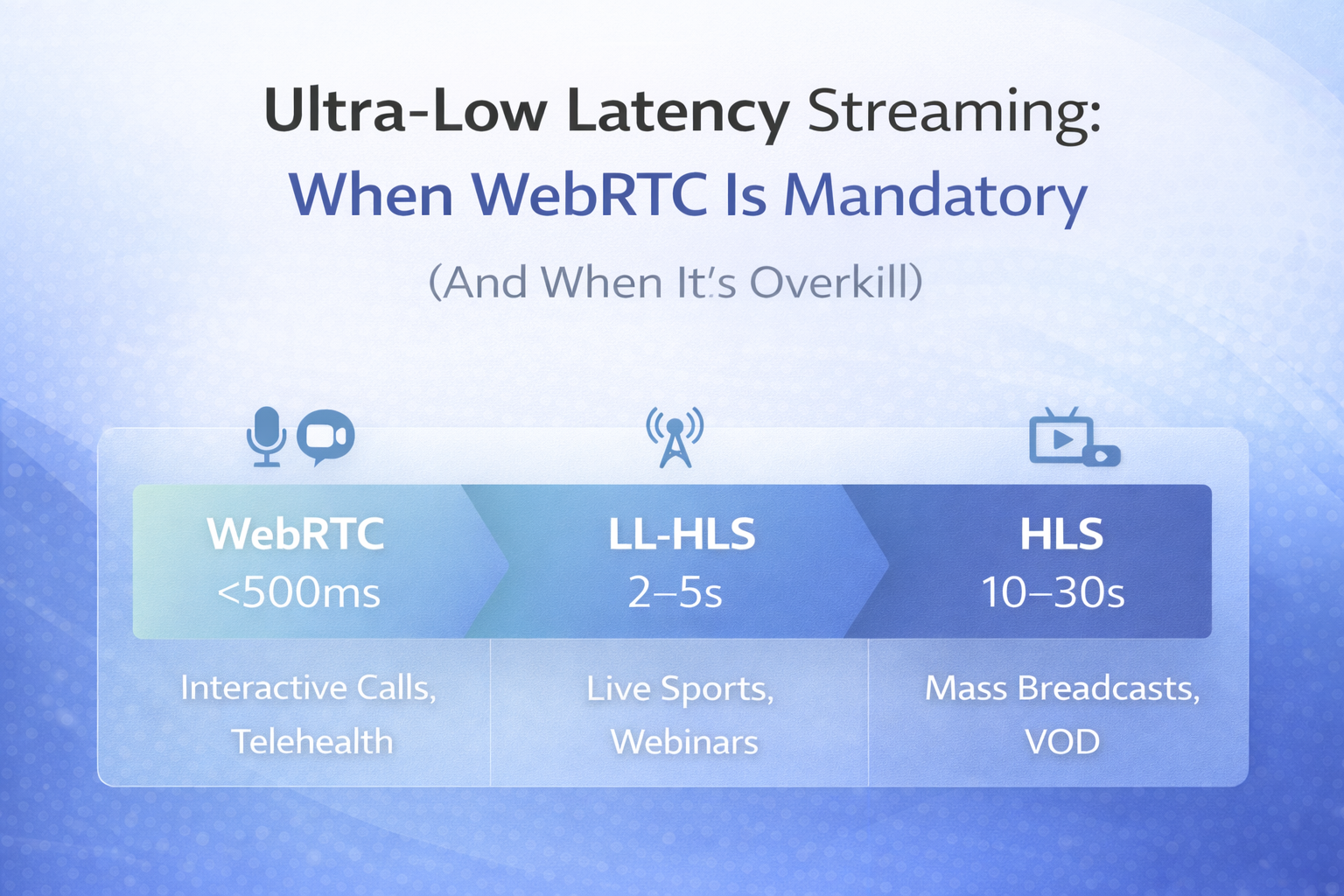
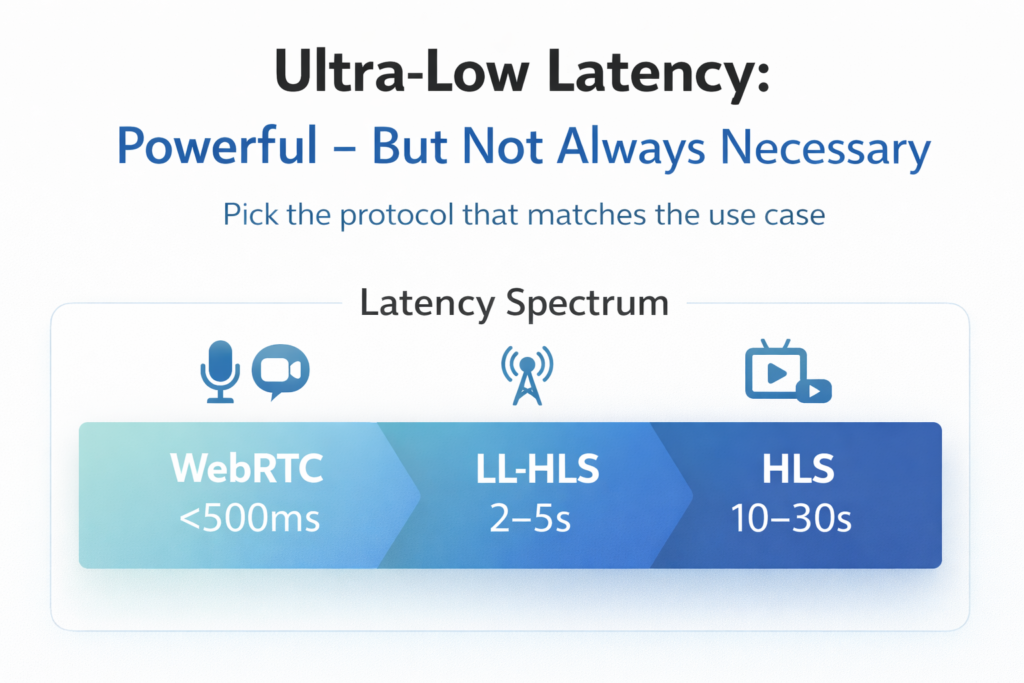
Let’s start with the uncomfortable truth: not all “real-time” applications need the same latency. The streaming industry has evolved into distinct tiers, and understanding where your application actually fits is the first decision that matters.
Ultra-Low Latency (Under 500ms): WebRTC Territory
This is true real-time communication. With under 500 milliseconds of end-to-end latency, participants can have natural conversations, react to each other immediately, and interact as if they were in the same room.
When you actually need this:
- Video conferencing and calls where people are talking to each other
- Interactive telehealth consultations
- Live betting and gambling platforms where arbitrage prevention matters.
- Remote control applications (drones, robotics, remote assistance)
- Multiplayer gaming with voice chat
- Live auctions where bidding happens in real-time
- Interactive education requires instant feedback
One platform architect described it well: “If someone speaking can reasonably expect an immediate response from someone listening, you need WebRTC latency.”
Low Latency (2-5 seconds): LL-HLS Sweet Spot
This range feels “live enough” for most viewers but doesn’t require the complexity and cost of true peer-to-peer infrastructure. For broadcast scenarios — one person streaming to many viewers — this is often the optimal trade-off.
When this works well:
- Live sports broadcasting to large audiences
- Interactive live shopping with chat
- Live events and concerts with audience Q&A
- Breaking news where minutes matter but seconds don’t
- Esports tournaments for spectators (not players)
- Webinars with occasional polls or questions
- Corporate town halls with moderated chat
As one live streaming CTO told us, “Our viewers care that they’re watching ‘live,’ not that they’re watching with sub-second accuracy. Three seconds is long enough when you’re broadcasting to 50,000 people.”
Standard Latency (10-30 seconds): Traditional HLS/DASH
This is the YouTube Live, Twitch (non-low-latency), and traditional streaming tier. It feels less “live” but scales beautifully and costs significantly less to operate.
When this is sufficient:
- Large-scale public broadcasts (thousands to millions of viewers)
- On-demand content masquerading as “live.”
- Educational content and recorded webinars
- Live streams where chat interaction is secondary
- Cost-sensitive deployments prioritizing scale over immediacy
The key insight? For most viewers watching a concert or public event, 15 seconds of latency is completely acceptable if it means smooth, buffer-free playback.
WebRTC: When It’s Mandatory (And When It Ruins Your Economics)
WebRTC offers unmatched low latency — typically 100-300ms for peer-to-peer connections and 200-500ms when using SFUs (Selective Forwarding Units) for group calls. But that performance comes with specific trade-offs.
Where WebRTC Excels (And Is Often Mandatory)
1. Bidirectional Communication
If both sides need to send and receive audio/video simultaneously, WebRTC is your only real option. Video calls, telehealth, remote collaboration — these require the full-duplex communication that WebRTC provides natively.
2. True Interactivity Requirements
When latency directly impacts the user experience or business model, WebRTC becomes mandatory:
- Live betting platforms can’t afford 3-5 second delays that enable arbitrage.
- Remote medical consultations need doctors to see patient reactions immediately.
- Interactive teaching requires instant feedback between the instructor and students.
- Live auctions need bidders to respond in real-time without delay.
3. Peer-to-Peer Use Cases
For simple 1-on-1 video calls or small group sessions, WebRTC’s peer-to-peer architecture can be more cost-effective than server-based alternatives since you’re not paying for server-side processing.
Where WebRTC Becomes Problematic
1. Massive Broadcasting (Thousands of Viewers)
WebRTC was designed for interactive communication, not one-to-many distribution. When you try to broadcast to thousands of viewers with WebRTC, you hit architectural limits.
The infrastructure requirements balloon:
- SFU infrastructure must handle connections for every viewer
- You need cascading SFUs or custom distribution layers.
- Costs scale roughly linearly with viewer count.
- Global distribution becomes complex and expensive.
One streaming platform shared its experience: “We tried WebRTC for a concert broadcast to 10,000 viewers. Our infrastructure costs were 4x what they would have been with LL-HLS, and we still had quality issues.”
2. CDN-Friendly Scaling
Traditional HLS and LL-HLS leverage standard HTTP CDN infrastructure that’s been optimized for decades. WebRTC requires specialized media servers that don’t benefit from the same economies of scale.
For broadcasts to large audiences, HLS variants can achieve 95%+ CDN cache hit rates, dramatically reducing bandwidth costs. WebRTC can’t replicate this cost efficiency.
3. Battery and CPU Constraints on Mobile
WebRTC’s real-time processing is CPU-intensive. For viewers on mobile devices, especially watching longer streams, this translates to:
- Faster battery drain
- Device heating
- Performance degradation on budget phones
- Higher data usage without built-in caching
LL-HLS: The Pragmatic Middle Ground
Low-Latency HLS (LL-HLS) emerged as Apple’s answer to the latency gap. It achieves 2-5 second latency by using partial segments and optimized manifest updates — fast enough to feel “live” without WebRTC’s complexity.
Why LL-HLS Often Wins for Founders
1. Scales Like Traditional Streaming
LL-HLS works with standard CDN infrastructure, which means:
- You can leverage existing CDN contracts and relationships.
- Caching still works effectively for popular content.
- Costs scale sublinearly as the audience grows.
- Global distribution is straightforward.
2. Better Device Compatibility
While WebRTC has excellent browser support for sending and receiving, LL-HLS offers advantages:
- Works on all modern iOS and macOS devices natively
- Compatible with Smart TVs and streaming devices
- Lower CPU and battery requirements for viewers
- Graceful degradation to standard HLS on older devices
3. Simpler Infrastructure
One founder who switched from WebRTC to LL-HLS told us: “We went from managing a fleet of custom media servers to just using our existing CDN with LL-HLS support. Our infrastructure complexity dropped 80%.”
Where LL-HLS Falls Short
Interactivity Ceiling
At 2-5 seconds of latency, LL-HLS can’t support truly interactive use cases. You can’t have natural conversations, real-time bidding, or instant reactions that feel synchronized.
Not True Peer-to-Peer
LL-HLS always requires a server in the middle. For simple 1-on-1 calls, this makes it more expensive and complex than WebRTC’s peer-to-peer approach.
WebSockets: The Misunderstood Option
WebSockets often come up in latency discussions, leading to confusion about their role. Here’s the reality: WebSockets are not a video streaming protocol — they’re a bidirectional communication channel.
What WebSockets Actually Do Well
WebSockets excel at:
- Real-time chat and messaging
- Signaling for WebRTC connections
- Live data updates (scores, notifications, dashboards)
- Application state synchronization
- Control messages and metadata
Many developers try to stream video over WebSockets because it seems simpler than WebRTC. This is generally a mistake.
Why WebSockets Don’t Replace WebRTC for Media
1. Built on TCP, Not Optimized for Media
WebSockets run over TCP, which guarantees packet delivery and ordering. For text data, this is perfect. For real-time video and audio, it causes problems:
- TCP retransmits lost packets, causing stuttering and lag spikes.
- Head-of-line blocking means one lost packet delays all subsequent data.
- Congestion control algorithms aren’t tuned for media streams.
- No built-in bandwidth adaptation
As one engineer explained: “We tried streaming audio over WebSockets. It worked fine on perfect networks and completely fell apart on real WiFi connections with any packet loss.”
2. Missing Critical Media Features
WebRTC includes features essential for media that WebSockets lack:
- Adaptive bitrate streaming based on network conditions.
- Jitter buffering to smooth out packet arrival times.
- Echo cancellation for audio calls.
- Hardware acceleration for encoding and decoding.
- Built-in STUN/TURN for NAT traversal.
You’d have to build all of this yourself on top of WebSockets.
The Right Role for WebSockets
In most modern video applications, WebSockets play a supporting role:
- WebRTC for media streams (audio, video)
- WebSockets for signaling and chat (connection setup, text messages, presence)
This hybrid architecture leverages the strengths of each technology.
The Decision Framework: Choosing Your Protocol Stack
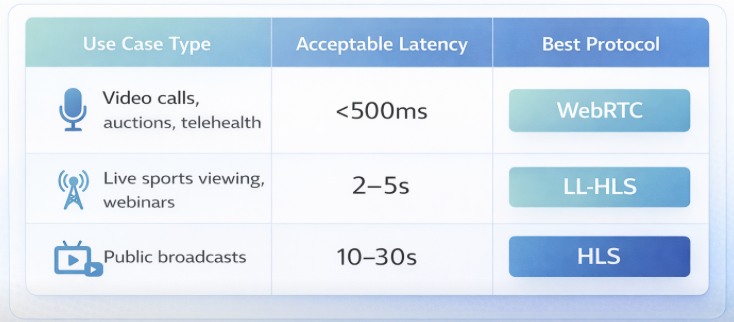
Here’s the practical decision tree founders should use:
Start with These Questions:
1. Is it bidirectional communication?
- YES → WebRTC is likely your answer
- NO → Consider LL-HLS or HLS.
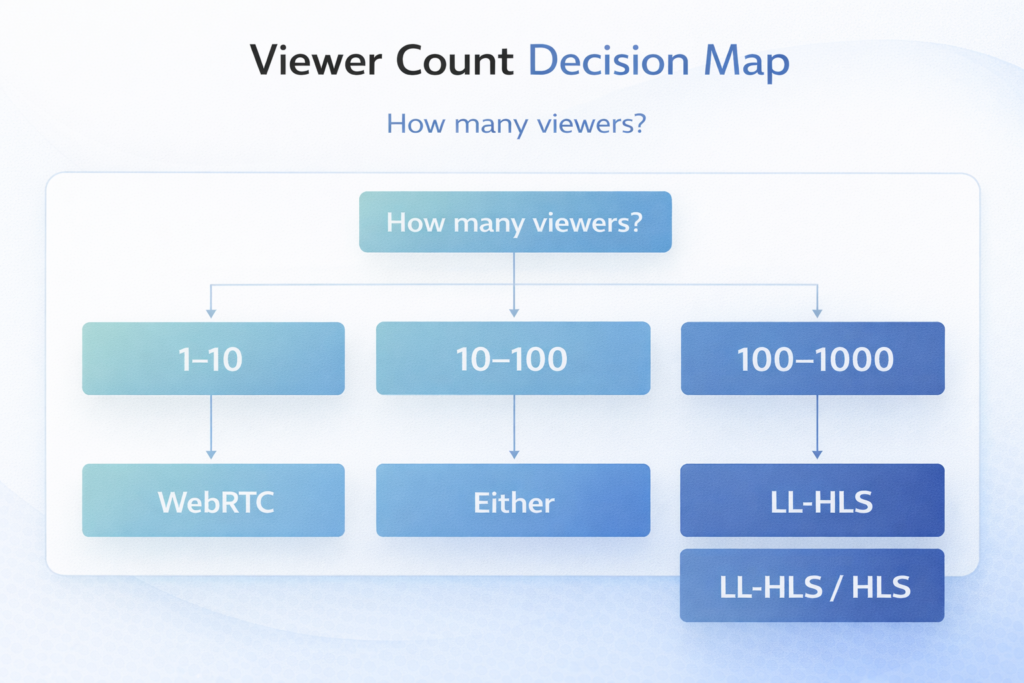
2. How many viewers per stream?
- 1-10: WebRTC is cost-effective
- 10-100: WebRTC or LL-HLS both work; it depends on latency needs
- 100-1000: LL-HLS usually wins on cost
- 1000+: LL-HLS or standard HLS strongly preferred
3. What latency do you actually need?
- <500ms required: WebRTC mandatory
- <3s acceptable: LL-HLS is optimal
- <30s acceptable: Standard HLS saves significant money
4. What’s your technical team’s experience?
- Strong WebRTC expertise: Can handle custom infrastructure
- Traditional web/video: LL-HLS is faster to implement
- Limited video experience: Consider CPaaS providers
Real-World Decision Matrix
Here’s how different application types typically map to protocols:
| Use Case | Recommended Protocol | Latency Target | Why |
| 1-on-1 video calls | WebRTC | <300ms | Bidirectional, peer-to-peer efficient |
| Group video conferencing (2-20 people) | WebRTC | <500ms | Interactive conversation needs |
| Live sports broadcast (large audience) | LL-HLS | 2-5s | Scale matters more than sub-second |
| Live betting/gambling | WebRTC | <500ms | Arbitrage prevention critical |
| Webinar with Q&A | LL-HLS | 2-5s | Mostly one-way, chat lag acceptable |
| Telehealth consultation | WebRTC | <300ms | Doctor-patient interaction |
| Live concert/event (public) | HLS or LL-HLS | 3-15s | Scale and cost vs. live feel |
| Interactive education | WebRTC | <500ms | Instant feedback matters |
| E-commerce live shopping | LL-HLS | 2-5s | Chat lag acceptable, scale important |
| Esports tournament (spectators) | LL-HLS | 2-5s | Large audience, some interactivity |
| Remote control/robotics | WebRTC | <300ms | Real-time control essential |
| Corporate town hall | LL-HLS or HLS | 5-30s | One-way, scale matters |
Hybrid Architectures: The Real-World Pattern
In 2026, most sophisticated platforms don’t choose just one protocol — they use hybrid architectures that match the right technology to each component.
Pattern 1: WebRTC + WebSockets
Common in: Video conferencing, telehealth, interactive collaboration
Architecture:
- WebRTC handles audio/video streams.
- WebSockets manage signaling, chat, presence, and screen sharing metadata.
- Application state syncs via WebSockets.
- File sharing may use WebRTC DataChannel or a separate API.
Pattern 2: WebRTC for Presenters + LL-HLS for Viewers
Common in: Webinars, live shopping, Q&A events
Architecture:
- Hosts/presenters connect via WebRTC (low latency for their interaction)
- Stream transcoded to LL-HLS for viewer distribution.
- Viewers watch via LL-HLS (scalable, cost-effective)
- Chat handled separately via WebSockets.
- Selected viewers can “join the stage” by switching to WebRTC.
One webinar platform described this: “Our hosts need WebRTC latency to interact with each other. Our viewers just need to feel ‘live,’ which 3 seconds provide. This hybrid model cut our infrastructure costs 60% while actually improving viewer experience.”
Pattern 3: Adaptive Protocol Selection
Common in: Gaming, live events with variable audience size
Architecture:
- Small sessions (<10 participants): Pure WebRTC.
- Medium sessions (10-100): WebRTC with SFU optimization.
- Large broadcasts (100+): Automatic transcoding to LL-HLS.
- System adapts based on real-time participant count.
Pattern 4: WebRTC Ingest + HLS Distribution
Common in: User-generated live streaming, broadcasting platforms
Architecture:
- Creators stream to servers via WebRTC (low-latency preview)
- Server transcodes to LL-HLS or HLS for distribution.
- Viewers consume via CDN-delivered HLS.
- Reduces client-side encoding requirements.
- Enables server-side quality enhancement and moderation.
The Cost Reality: Why Protocol Choice Impacts Your Burn Rate
One aspect founders often underestimate is how protocol choice directly impacts monthly infrastructure costs.
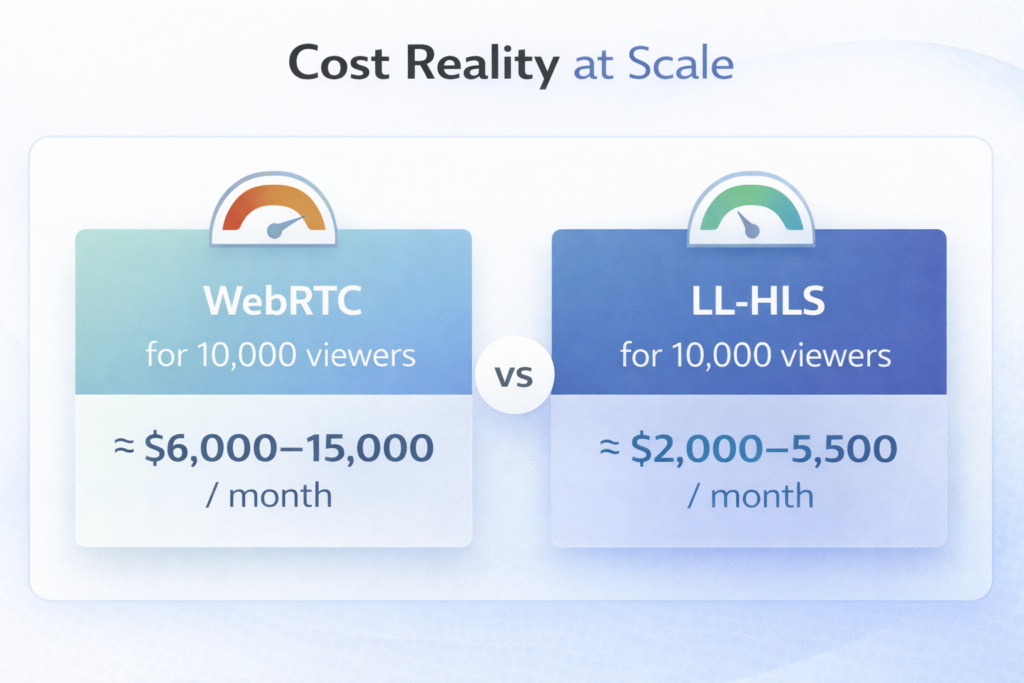
WebRTC at Scale: The Cost Structure
For a WebRTC platform serving 10,000 concurrent viewers of a live broadcast:
- SFU Infrastructure: $3,000-8,000/month, depending on configuration
- TURN Server Coverage: $1,000-3,000/month for global relay
- Bandwidth: $0.08-0.15/GB across SFU nodes
- Monitoring and Management: $500-2,000/month
- Engineering Overhead: Significant ongoing optimization required
Estimated total: $6,000-15,000/month for 10,000 viewers
LL-HLS at Scale: The Cost Structure
For the same 10,000 concurrent viewers via LL-HLS:
- Origin Server: $500-1,500/month (simpler than WebRTC SFU)
- CDN Bandwidth: $0.02-0.05/GB (better cache efficiency)
- Encoding Infrastructure: $1,000-2,000/month
- CDN Service Fees: $300-1,000/month
- Engineering Overhead: Minimal; uses standard tooling
Estimated total: $2,000-5,500/month for 10,000 viewers
The gap widens as scale increases because CDN caching becomes more effective with larger audiences.
The Crossover Point
For most applications, the economic crossover happens around 50-100 concurrent viewers:
- Below 50 viewers: WebRTC peer-to-peer or simple SFU can be cheaper.
- 50-100 viewers: Costs are comparable; other factors dominate.
- Above 100 viewers: LL-HLS economics usually wins.
- Above 1,000 viewers: LL-HLS cost advantage becomes dramatic.
What Trembit Recommends for 2026
After helping dozens of startups architect their video platforms, here’s our practical advice:
For Most Startups: Start with LL-HLS
Unless you have a clear bidirectional requirement or need sub-500ms latency, LL-HLS is the pragmatic default in 2026:
- Faster time to market with standard CDN infrastructure
- Lower engineering overhead for small teams
- Better cost efficiency at scale
- Easier to explain to investors and customers
Build your MVP on LL-HLS, validate product-market fit, then evaluate if specific use cases justify WebRTC complexity.
When to Bet on WebRTC from Day One
Choose WebRTC as your primary protocol if:
- Bidirectional communication is core to your product (conferencing, telehealth).
- Your business model requires sub-second latency (betting, live auctions).
- You’re targeting small group interactions where WebRTC’s economics work.
- You have experienced WebRTC engineers on the team.
The Hybrid Approach for Best of Both Worlds
For products with multiple interaction modes (like webinar platforms or live shopping), architect for both:
- Use WebRTC where interaction matters.
- Use LL-HLS for scale and passive viewing.
- Keep the protocols decoupled so you can evolve each independently.
Don’t Overthink It Early
One pattern we see: founders spending months debating protocol choices before validating basic product assumptions.
Our advice: pick the simpler option (usually LL-HLS), ship quickly, learn from real users, then optimize. Over-engineering your stack before product-market fit is a classic startup mistake.
As one successful founder told us: “We spent six months building a custom WebRTC infrastructure. Turns out our users were fine with 3-second latency, and we could have launched in six weeks with LL-HLS. That delay almost killed us.”
Looking Ahead: What Changes in 2026-2027
The latency landscape continues to evolve. Here’s what we’re watching:
WebRTC Getting Easier
- More CPaaS providers offering managed WebRTC (Twilio, Daily, Agora, Vonage)
- Better developer tools and debugging capabilities
- Improved browser implementations and consistency
- Lower barrier to entry for teams without deep expertise
LL-HLS Maturity and Adoption
- Wider CDN support reduces implementation friction.
- Improved Apple ecosystem integration (still the main driver).
- Better player implementations across devices.
- Industry moving toward LL-HLS as the “default live” protocol.
Hybrid Becoming Standard
- Platforms are increasingly offering both WebRTC and HLS outputs.
- Automatic protocol selection based on viewer count
- Simplified APIs that abstract protocol complexity from developers
AI and Quality Enhancement
- Client-side AI upscaling is making lower-bitrate LL-HLS more viable.
- Intelligent bandwidth prediction improves both protocols.
- Server-side enhancement reducing encoding requirements.
Bottom Line: Match Technology to Actual Requirements
The most common mistake founders make with latency isn’t choosing the wrong protocol — it’s choosing technology based on what sounds impressive rather than what their users actually need.
Ask yourself honestly:
- Do users really need sub-second latency, or does it just sound good?
- Will they notice the difference between 300ms and 3 seconds for your use case?
- Can you achieve product-market fit with simpler technology first?
- What’s the actual cost difference at your target scale?
WebRTC is an amazing technology that enables experiences impossible with other protocols. But it’s also more complex, more expensive at scale, and overkill for many use cases that LL-HLS handles beautifully.
The smartest founders in 2026 aren’t picking the “best” protocol — they’re picking the right protocol for their specific needs, with a clear understanding of the trade-offs they’re making.
At Trembit, we’ve built video platforms across the full latency spectrum, from sub-100ms WebRTC applications to global-scale HLS broadcasts. We help startups make the right architectural decisions based on their actual requirements, target audience, and business model — not just what’s technically impressive. Whether you need true real-time interaction or scalable live broadcasting, we can help you choose and implement the right protocol stack for your specific use case.