A telehealth startup recently discovered that its video consultations worked beautifully in Seattle but struggled in rural Montana. Latency spiked to 800ms, doctor-patient conversations felt unnatural, and patient satisfaction scores dropped. The diagnosis? All video processing happened in a single AWS region, thousands of miles from half their users.
The solution wasn’t faster internet — it was moving the processing closer to where patients actually lived.
Edge video processing — running AI models, media servers, and transcoding infrastructure at network locations near users rather than in centralized cloud data centers — is reshaping how real-time applications deliver quality in 2026. For applications where latency matters — telehealth, dating apps, live collaboration — the architecture shift from cloud-centric to edge-distributed is becoming mandatory.
The Problem with Centralized Cloud Processing
For years, the default architecture looked like this: User Device → Cloud Data Center (single region) → Processing/AI → Back to User.
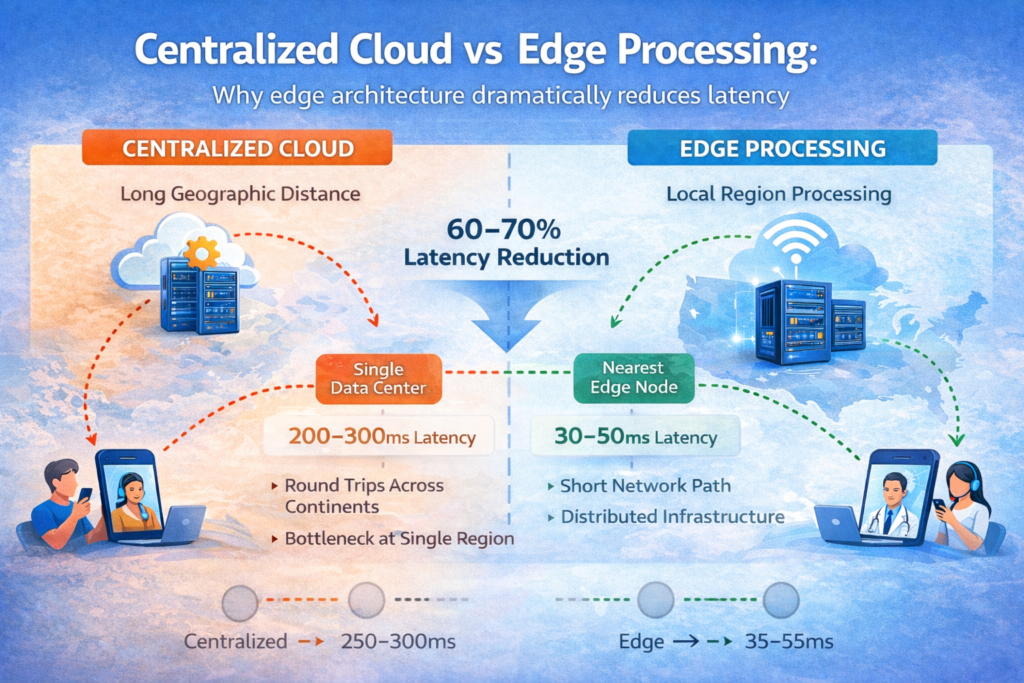
This breaks down for real-time interactive applications where users are distributed globally, and sub-500ms latency is required. The physics are unforgiving: a round trip from Singapore to Virginia takes 200-250ms under ideal conditions, before encoding, processing, or decoding adds anything.
Research on wireless networked control systems demonstrated that edge computing reduced latency by 58.16% compared to WebRTC alone in 5G environments, while transmitting only 3.42% of raw data through intelligent preprocessing.
What Edge Video Processing Actually Means
Edge computing moves computation from centralized data centers to locations closer to end users — at ISP points of presence, regional edge nodes, or even on user devices.
For video applications, this involves:
1. Distributed Media Servers – Instead of one SFU in us-east-1, deploy media servers across 15-30 global edge locations. Platforms report achieving sub-30ms regional latency compared to 200+ ms with centralized setups.
2. Edge-Based AI Processing – Run models for background removal, noise suppression, and face detection at edge locations rather than sending streams to the central cloud. Modern implementations maintain sub-300ms total latency.
3. Local Transcoding and Optimization – Perform transcoding at edge nodes to reduce bandwidth between edge and origin while distributing computational load.
Where Edge Processing Delivers Transformational Results
Telehealth: Where Latency Directly Impacts Care Quality
By 2024, 54% of Americans had experienced a telehealth visit, with 38x growth from pre-pandemic levels. Medical consultations require natural conversation flow — delays disrupt diagnostic interviews and reduce patient trust.
Edge Solutions:
Deploying regional media servers ensures video packets travel shorter distances. A patient in rural Montana connects to an edge node in the mountain west rather than Virginia, cutting latency by 60-70%.
Edge-based AI enables real-time noise suppression, automatic lighting adjustment, privacy-preserving background blur, and bandwidth-adaptive quality — all processed locally.
One telehealth platform reported that patient satisfaction scores increased by 18% by reducing latency from 500ms to under 250ms. Providers completed consultations 12% faster due to fewer conversation interruptions.
Dating and Social Apps: Where First Impressions Happen in Milliseconds
Video-first dating applications face unique challenges. First impressions happen in seconds, and technical friction kills interactions. Latency above 400ms makes conversations feel stilted.
Edge Architecture:
Deploying media servers across 20-30 global edge locations keeps latency under 150ms for same-region connections. Client-side AI processing for background effects and beauty filters happens on-device, maintaining 60fps without adding server latency.
One video dating platform reported that implementing edge infrastructure reduced first-call connection failures by 43% and increased calls lasting over 2 minutes by 31%.
Live Interaction Apps: Collaboration, Education, and Remote Work
Real-time collaboration — whiteboarding, code review, design critique — demands both low latency and processing capability. Edge transcoding ensures screen shares are optimized for each viewer without routing all traffic through a central bottleneck.
Educational platforms leveraging edge infrastructure report that student engagement increases when latency drops below 250ms — the threshold where interaction feels natural.
The Technical Architecture
Intelligent Routing Layer – Directs users to their nearest edge location based on latency measurements and geographic proximity.
Regional Edge Nodes – Each location runs WebRTC media servers, AI inference engines, local caching, and real-time transcoding.
Edge-to-Edge Mesh – For cross-region communication, nodes communicate directly rather than routing through a central hub.
Centralized Management – Control plane functions (authentication, session management, analytics) remain centralized.
Client-Side vs. Edge-Side Processing
Client-Side works best for privacy-sensitive features and GPU-accelerated effects, but faces inconsistent performance across devices.
Edge-Side ensures consistent quality and handles AI models too large for client deployment, but adds infrastructure costs.
Hybrid Approach (actual production pattern): Detect device capability, run AI client-side on high-end devices, and offload to the edge for budget devices.
The Numbers: Measuring Edge Processing Impact
Latency Reduction:
Centralized (us-east-1): Singapore users see 250-300ms latency. Distributed Edge: Singapore users see 35-55ms latency (edge in Singapore)
The improvement represents a 60-70% latency decrease for geographically distant users.
Cost Comparison for 10,000 concurrent users:
Centralized Cloud: $17,000-27,000/month Distributed Edge: $15,000-24,000/month
Edge processing costs slightly less at scale, but the primary benefit is quality and reliability, translating to higher retention.
When Edge Processing Doesn’t Make Sense
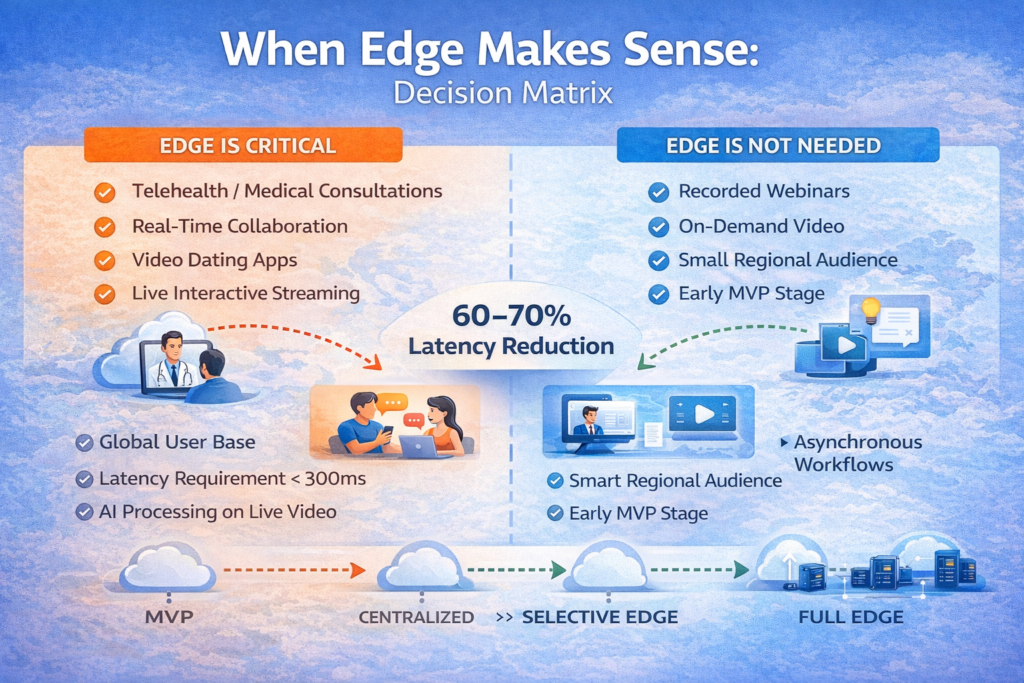
Small User Bases in Limited Geographies – If all users live in one region, a single data center suffices.
Latency-Insensitive Applications – Recorded webinars, on-demand content, asynchronous video don’t justify edge complexity.
Early-Stage Startups Pre-Product-Market-Fit – Use simple architectures or CPaaS providers before validating products.
Very High Processing Requirements – Some AI models can only run on high-end data center GPUs.
Practical Recommendations
Phase 1: Centralized (MVP Stage) – Begin with a single cloud region, use managed services (Twilio, Daily, Agora).
Phase 2: Selective Edge (Growth Stage) – Deploy edge nodes in 3-5 strategic locations serving the largest user concentrations.
Phase 3: Full Edge (Scale Stage) – Expand to 15-30 edge locations with advanced AI processing.
Choose Edge Locations Based on Data – Deploy instrumentation to measure actual user distribution. A telehealth platform might need rural edge coverage that standard CDN placements don’t provide.
Evaluate CPaaS vs. Self-Built – For most teams, providers with existing edge infrastructure deliver better ROI. Self-built makes sense for unique AI requirements, compliance demands, or 100,000+ concurrent users.
Looking Ahead: Edge Processing in 2027-2028
Hardware Acceleration – Edge nodes gaining GPUs and neural processing units enable sophisticated AI previously requiring centralized infrastructure.
5G Edge Deployment – Carriers deploying edge directly into 5G networks, enabling under 20ms latency for mobile applications.
WebAssembly and Client-Side Edge – Lightweight models running in-browser, while heavier processing happens at nearby nodes.
Standards and Interoperability – MOQ and emerging protocols designed with edge in mind, lowering adoption barriers.
Edge Processing as Competitive Advantage
In 2026, edge video processing has transitioned from “emerging technology” to “competitive requirement” for latency-sensitive applications.
The math is straightforward: applications where interaction matters require sub-300ms latency, centralized cloud can’t deliver that globally due to physics, and edge processing cuts latency by 50-70%.
For telehealth, where conversation naturalness affects care quality, dating apps, where first impressions determine engagement, or collaboration tools, where responsiveness enables productivity, edge processing isn’t optional infrastructure optimization. It’s the architecture that makes the application work.
Trembit has designed edge video systems for telehealth platforms, social applications, and collaborative tools across global user bases. Whether evaluating edge deployment, choosing between CPaaS providers with edge infrastructure, or building custom distributed systems, the team brings deep expertise in balancing latency requirements, processing needs, and infrastructure economics.