The convergence of WebRTC and AI promised revolutionary real-time experiences. Voice agents respond in milliseconds. Video streams enhanced by neural networks. Intelligent routing adapts to network conditions in real time. Yet across production deployments in 2025, engineering teams encounter the same failure patterns repeatedly. Systems that work brilliantly in demos collapse under real load. Latency spikes from 200ms to several seconds. Cost overruns force architectural rewrites.
The Hidden Complexity Behind “Real-Time AI”
WebRTC operates in the sub-second latency domain, where audio packets must arrive every 20ms and video frames render at 30-60 fps. AI models, even optimized ones, introduce variable processing delays ranging from 50ms to over a second, depending on model size, input complexity, and available compute resources.
The mismatch creates cascading failures. A voice AI agent must transcribe speech, run inference on text, generate a response, and synthesize it back to audio — all while maintaining conversational latency under 500ms. Missing this target even occasionally destroys user experience. Teams regularly report demos working fine locally but breaking down in staging or production environments.
The fundamental challenge stems from combining two systems with incompatible performance characteristics. WebRTC expects consistent, predictable timing. AI inference delivers variable, bursty computation. This impedance mismatch manifests in three critical failure modes.
Failure Mode #1: The Inference Queue Death Spiral
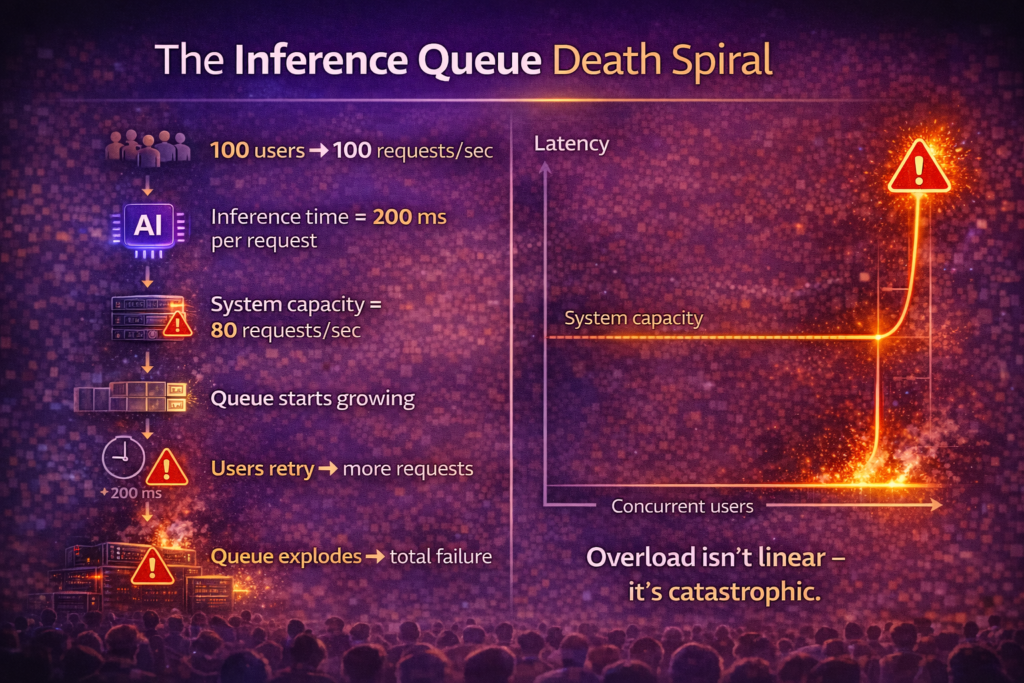
The most common failure pattern emerges when inference requests accumulate faster than they can be processed. Consider a voice AI system handling 100 concurrent calls, with each call generating audio packets every 20ms. If the inference pipeline takes 200ms to process each request, the system immediately falls behind. The queue grows. Latency increases. Users experience delays. More users retry. The queue grows faster. The system collapses.
This death spiral occurs because unbounded queues hide the problem until catastrophic failure. By the time memory exhaustion or timeout errors surface, hundreds or thousands of requests have piled up, each now hopelessly stale. Teams report systems handling 50 concurrent users perfectly, then failing completely at 75 users. The non-linear failure isn’t due to infrastructure capacity — it’s architectural.
Engineering Solution: Bounded Queues with Fast-Fail
Every queue must have a maximum size. When the inference queue reaches capacity, the system must immediately reject new requests rather than accepting them and failing slowly. A voice agent that immediately responds “I’m experiencing high load, please try again” delivers a better user experience than one that accepts the request, processes it for 30 seconds, then returns a response to a user who has already hung up.
Implementing bounded queues requires careful capacity planning. Measure inference throughput under realistic conditions and set queue limits accordingly. A reasonable starting point caps the queue at 2-3x the processing capacity, ensuring queued requests complete within acceptable timeframes while preventing runaway accumulation.
Failure Mode #2: Missing Backpressure Signals
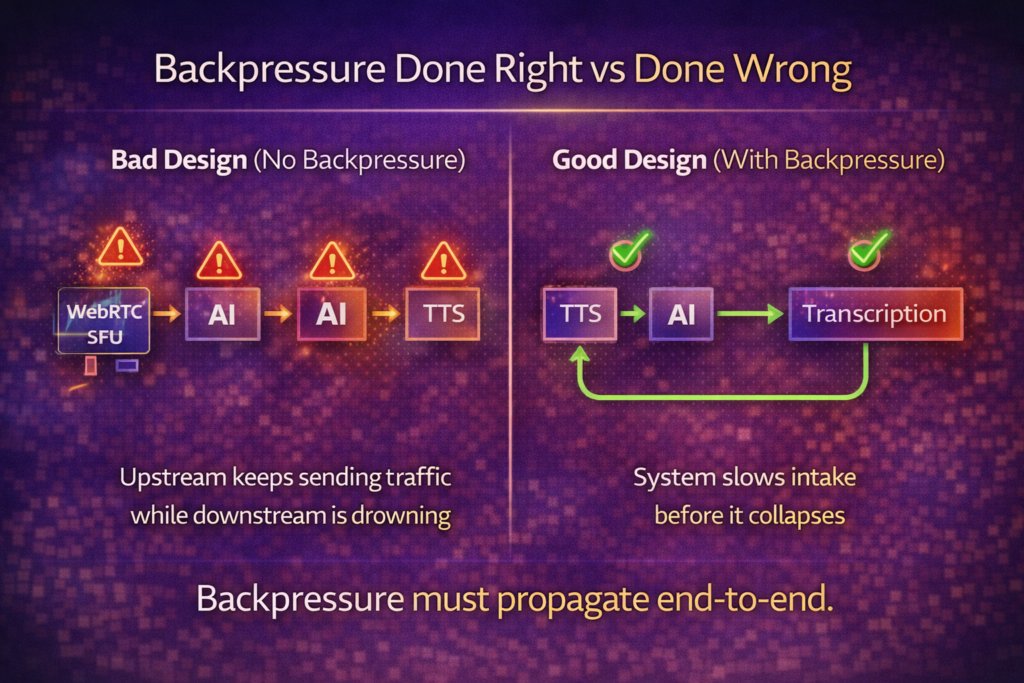
Even with bounded queues, systems fail without proper backpressure propagation. Backpressure is the mechanism by which overloaded components signal upstream services to slow down. Without it, each layer operates independently, unaware that downstream components are drowning.
Production failures occur when backpressure breaks down. A WebRTC SFU continues accepting new connections even as downstream AI services are saturated. Media streams pile up. Transcription service queues grow. By the time errors propagate back to the SFU, dozens of connections are in degraded states.
Engineering Solution: Coordinated Backpressure Chain
When the inference engine becomes overloaded, it must signal the transcription service. The transcription service signals the media server. The media server rejects new connections or throttles media streams. This cascading feedback loop prevents localized overload from spreading throughout the system.
Implement circuit breakers that reject new sessions when downstream services are slow or overloaded. Monitor queue depth at each component and expose health endpoints that upstream services can poll. When queue depth exceeds 70% capacity, begin returning backpressure signals. At 90%, enter a degraded state. At 100%, trip circuit breakers.
Failure Mode #3: Circuit Breaker Misconfiguration
Circuit breakers protect systems from cascading failures by cutting off traffic to unhealthy components. However, poorly configured circuit breakers often make situations worse. Opening too aggressively causes unnecessary service disruptions. Opening too slowly allows failures to cascade.
In WebRTC + AI architectures, failures are often transient and localized. A single expensive inference request might time out while others succeed. Global circuit breakers that open based on aggregate failure rates can incorrectly shut down healthy traffic.
Engineering Solution: Adaptive Circuit Breakers with Request Classification
Deploy multiple breakers organized by request characteristics. Voice transcription requests under 5 seconds get one circuit breaker with aggressive timeouts. Long-form transcription gets another with relaxed thresholds. Complex inference operations requiring multiple model calls get dedicated breakers with higher tolerance.
Monitor real-time concurrent calls, queue depth, average, and P95/P99 model latency, and error rates. P99 latency matters more than average latency — a system with 100ms average but 5-second P99 is failing for too many users. Implement smarter reset logic that probes with a small percentage of traffic after opening, gradually increasing allowed traffic if probe requests succeed.
AI-Specific Challenges in Production
Beyond traditional distributed systems challenges, WebRTC + AI architectures face unique problems stemming from model characteristics.
Variable Inference Time
AI inference exhibits extreme variability. A speech recognition model might process a simple greeting in 50ms but take 2 seconds for heavily accented, jargon-filled speech. This variability destroys capacity planning. Planning for P99 latency means provisioning for the worst case, which can be 20-50x the median—economically infeasible for most deployments.
Model Cold Start Latency
AI inference engines exhibit significant cold start delays. Loading model weights into GPU memory, compiling computational graphs, and warming up batch processing pipelines can take 5-30 seconds. When load increases, and new inference workers spin up, they’re useless for 10-20 seconds while models initialize. The system must survive the gap between detecting overload and new capacity becoming available.
Solutions involve maintaining warm inference pools — keeping additional capacity initialized and ready, even when unused. This comes at increased cost but enables predictable performance.
Batch Size Optimization
Many AI models achieve optimal throughput through batching — processing multiple requests together. However, batching directly conflicts with latency requirements. Voice AI applications can’t wait to accumulate a full batch. Dynamic batching provides a middle ground, accumulating requests for a bounded time (e.g., 50ms) before processing, automatically optimizing for current load patterns.
Production Architecture Patterns That Work
Several designs have proven reliable across multiple deployments at scale.
Pattern 1: Request-Level Resource Budgets
Assign budgets to individual requests. Each incoming request receives a time budget (e.g., 500ms) and resource budget (e.g., 0.1 GPU-seconds). As the request flows through transcription, inference, and synthesis, each component consumes budget. When the budget exhausts, the request fails fast with a clear error. This prevents expensive requests from consuming disproportionate resources.
Pattern 2: Multi-Tier Processing Queues
Implement multiple priority tiers. Real-time interactive requests enter a high-priority queue with aggressive SLAs and circuit breakers. Batch processing enters a low-priority queue with relaxed constraints. The system processes high-priority queues first, only touching low-priority work when excess capacity exists.
| Queue Tier | Max Latency | Timeout | Use Case |
| Critical | 200ms | 500ms | Voice AI, real-time video analysis |
| Interactive | 1s | 3s | Enhanced video processing, batch transcription |
| Batch | 60s | 300s | Long-form analysis, training data processing |
| Background | Best effort | None | Analytics, model evaluation |
Pattern 3: Geographic Distribution with Edge Inference
Edge computing deployments slash cloud roundtrips from 200ms to 8ms, with 73% of Fortune 500 companies now deploying WebRTC-enabled edge nodes for AI inference. Distributing inference close to users dramatically improves responsiveness. Smaller, faster models run at the edge for latency-critical operations while larger, more accurate models run in centralized data centers for quality-critical operations.
Monitoring and Observability Requirements
Production systems require specialized instrumentation beyond basic metrics.
Critical Metrics to Track
Request Age Distribution: Track P50, P90, P99, and P99.9 of queue wait times. A growing P99 signals approaching overload even when averages remain healthy.
Queue Depth by Component: Monitor every queue in the pipeline. Alert on rate of change — a rapidly growing queue, even from a low baseline, indicates developing problems.
Circuit Breaker State: Track open/closed state and transition frequency. Frequent oscillation indicates misconfiguration.
Model-Specific Latency: Break down inference time by model, input size, and request complexity to reveal which models or input patterns cause problems.
Distributed Tracing for Diagnosis
Traditional logs prove inadequate for debugging WebRTC + AI issues. A single voice call generates dozens of service interactions. Correlating logs, distributed traces, and recordings helps understand where latency or errors occur — whether in telephony, media processing, or model inference. Modern tracing tools (OpenTelemetry, Jaeger, Zipkin) capture timing and context for each operation, visualizing the complete request path.
When to Partner with Specialists
Building WebRTC + AI systems in-house requires expertise across multiple domains, like real-time media processing, distributed systems architecture, machine learning operations, and network engineering. Few organizations maintain all these competencies internally.
Trembit has supported numerous engineering teams navigating these architectural challenges. As a development partner with deep expertise in real-time communication systems, Trembit helps organizations design, implement, and scale WebRTC + AI architectures that perform reliably under production load. Rather than learning these hard lessons through expensive production failures, partnering with experienced teams provides access to proven patterns and proactive guidance.
The decision to partner often comes at inflection points — scaling from hundreds to thousands of users, adding new AI capabilities to existing WebRTC infrastructure, or migrating legacy systems to modern architectures. These transitions expose architectural weaknesses that weren’t apparent at a smaller scale.
The Economics of Production Readiness
Understanding the true cost of WebRTC + AI systems requires accounting for more than infrastructure:
- Infrastructure: Servers, GPUs, bandwidth, storage — the visible cost most teams budget for
- Engineering Time: Building, debugging, optimizing, and maintaining the system — production readiness often requires 3-5x the effort of initial development
- Operational Overhead: Monitoring, responding to incidents, tuning performance, managing capacity
- Opportunity Cost: Engineering resources devoted to infrastructure can’t work on differentiating features
The economics shift dramatically with scale. A system supporting 100 concurrent users might run on a few servers with minimal optimization. The same system supporting 10,000 concurrent users requires sophisticated architecture, dedicated infrastructure teams, and continuous optimization.
This scaling challenge explains why many organizations choose managed platforms or partnership models. The economic calculation often favors partnership — paying for expertise and proven solutions costs less than the engineering time, failed experiments, and production incidents that come with building from scratch.
Future-Proofing the Architecture
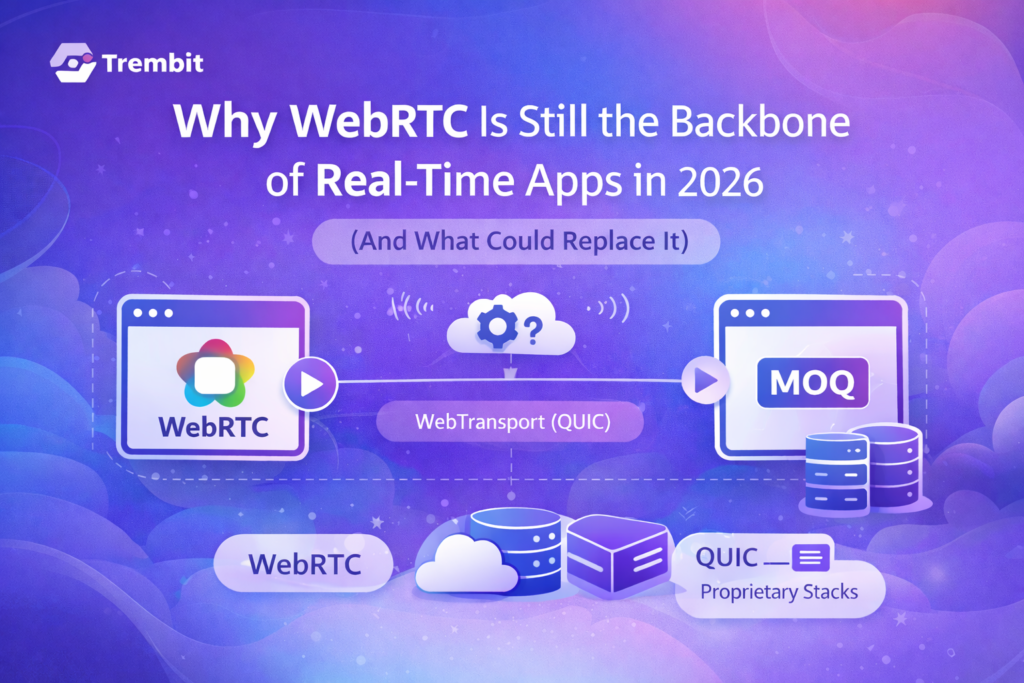
WebRTC and AI are both rapidly evolving technologies. MOQ plus WebCodecs, WebTransport, and WebAssembly represents a dark horse stack that could disrupt traditional WebRTC in the longer term, enabling developers to build media pipelines that don’t follow the full WebRTC model. Simulcast overuse and SVC hype may turn into recognized anti-patterns, especially as AI upscaling changes how we think about resolution and codecs.
Building for evolution means maintaining service abstractions, configurable trade-offs, support for incremental migration, and comprehensive testing. Teams often skip these practices under deadline pressure, accruing technical debt that makes future changes expensive.
Conclusion: Engineering Reality vs. Demo Reality
The gap between successful demos and production-ready systems explains most WebRTC + AI project failures. Demos operate under controlled conditions — small user counts, predictable inputs, unlimited resources. Production faces adversarial conditions — variable load, malicious inputs, tight budgets, cascading failures.
Closing this gap requires embracing the architectural patterns that production systems demand: bounded queues with fast-fail semantics, comprehensive backpressure propagation, properly tuned circuit breakers, and observability that illuminates problems before they become catastrophes.
Teams that succeed recognize these realities early and design accordingly. They deploy sophisticated monitoring before experiencing failures. They implement circuit breakers before the overload crashes the system. They establish partnerships with experts who have navigated these challenges before.
For organizations building these systems, the path forward combines internal expertise with strategic partnerships. Trembit brings specialized knowledge that transforms architectural designs from theoretical to production-ready, helping teams avoid the common pitfalls while focusing engineering effort on differentiating features rather than infrastructure challenges.
The future of real-time AI is not in question — the applications are too compelling, the user experience too transformative. Choosing to learn from production experience, rather than recreating it, separates successful deployments from expensive failures.