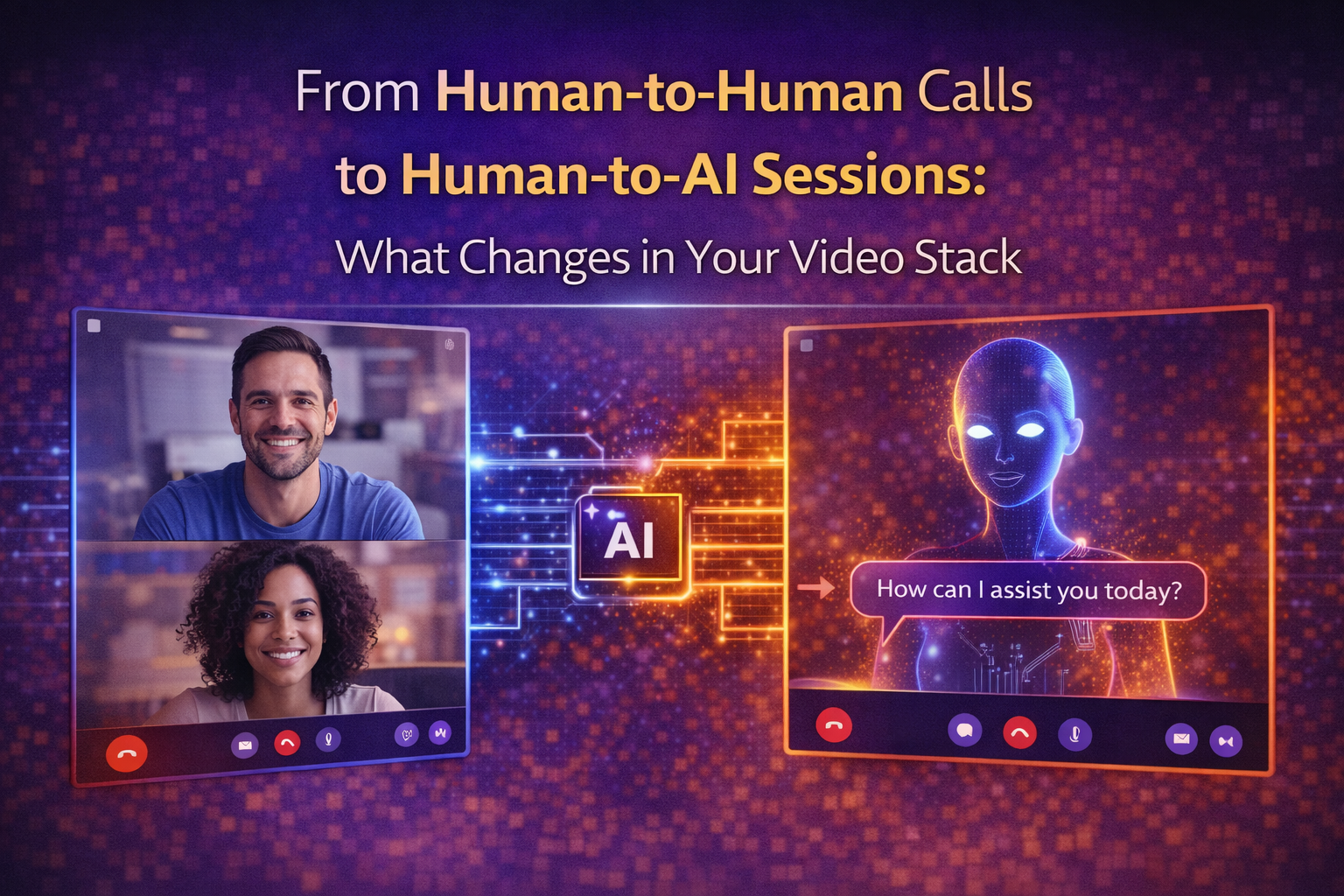
Video conferencing architecture spent a decade optimizing for one assumption: every participant is human. SFU routing, session management, and resource allocation all evolved around this human-centric model. Then AI participants arrived, and the architectural foundations cracked.
AI agents don’t behave like humans. They stay connected for hours without breaks. They process audio in milliseconds. They generate responses that interrupt human speech mid-sentence. Most critically, they exist simultaneously as both participant and infrastructure — a duality that breaks traditional WebRTC design patterns. Production deployments reveal that treating AI as “just another participant” leads to cascading failures.
The Participant Model Breaks Down
Traditional WebRTC architecture treats all participants symmetrically. Each connects to the SFU, publishes media streams, subscribes to others’ streams, and exists as an independent entity. This peer-oriented model works when all participants are humans operating browsers or mobile apps.
AI participants violate every assumption underlying this symmetry. Consider OpenAI’s Realtime API integration with WebRTC, enabling sub-300ms latency voice conversations. The AI appears as a WebRTC peer connection, but behind that interface runs speech-to-text transcription, large language model inference, and text-to-speech synthesis — all server-side operations consuming GPU resources measured in seconds of compute time.
This creates an architectural contradiction. The AI participant simultaneously exists as a peer in the WebRTC session and as backend infrastructure processing that session’s data. Should the SFU forward raw audio streams to the AI backend? Should the AI backend connect as a regular participant? How should session state be managed when one “participant” is actually a distributed system spanning transcription services, inference engines, and synthesis pipelines?
Session management designed for human participants expects connections to be relatively stable, with occasional reconnections due to network issues. AI backends may need to restart components, swap model versions, or scale inference capacity — all while maintaining the appearance of continuous participant presence. The mismatch between stateless AI processing and stateful WebRTC sessions creates race conditions that are nearly impossible to debug.
Stream Routing Requires Complete Rethinking
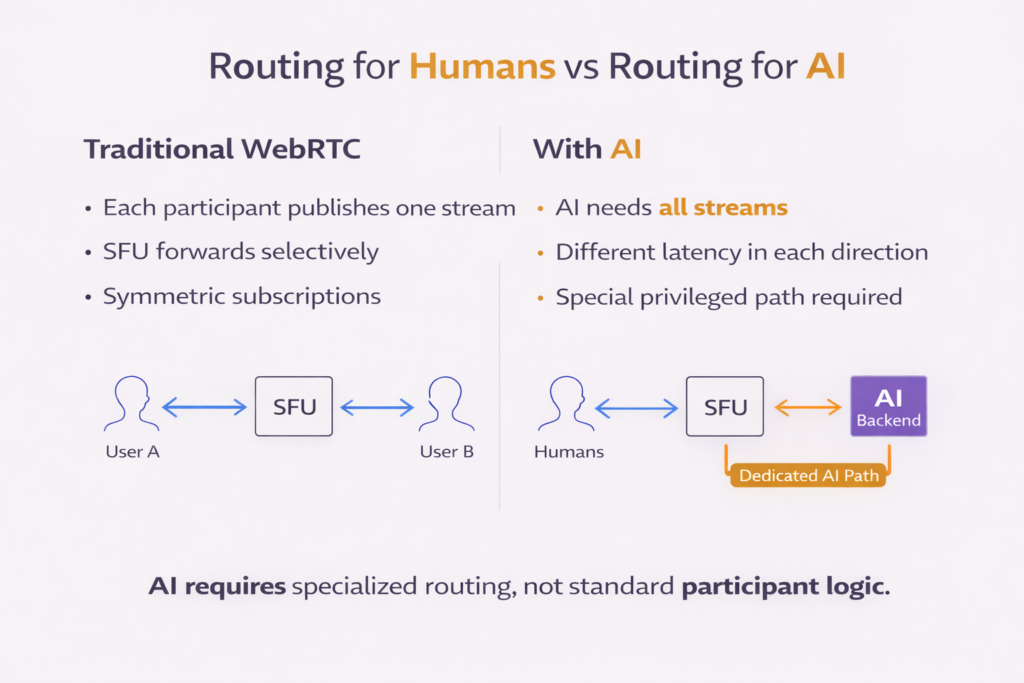
The Selective Forwarding Unit architecture was optimized for efficient human-to-human communication. Each participant sends one media stream to the SFU, which intelligently forwards it to others based on bandwidth, layout, and subscription preferences.
AI participants break this model in multiple ways:
Asymmetric Bidirectional Streams: Audio flowing from human to AI needs minimal latency — every millisecond matters. Audio flowing from AI to humans can tolerate slightly higher latency if it allows better quality or lower cost. Traditional SFU routing treats both directions identically, missing optimization opportunities.
Universal Stream Access: A voice agent moderating a meeting must hear every speaker. A transcription AI must capture all dialogue. But in standard SFU architecture, participants explicitly subscribe to specific streams. Granting an AI participant access to all streams requires either treating it as a special privileged participant (breaking symmetry) or having it subscribe to every stream (consuming unnecessary bandwidth).
Different Stream Characteristics: Human speech has natural pauses and turn-taking. AI synthesis can generate continuous speech for minutes or deliver extremely short responses. The bursty nature of AI-generated audio creates different congestion patterns. SFUs using bandwidth estimation algorithms tuned for human conversation may misclassify AI traffic.
Dedicated AI Routing Paths
Production deployments increasingly abandon symmetric participant routing when AI is involved. Instead of having the AI connect as a standard WebRTC peer, systems create specialized connections optimized for AI processing characteristics.
One effective pattern separates AI media ingestion from participant media distribution. Human participants connect to the SFU normally. The SFU forwards a mixed or multi-stream feed to the AI processing backend through a separate, optimized connection. The AI backend processes audio, generates responses, and publishes synthesized speech back to the SFU, which distributes it to human participants as if it came from a regular peer.
This architecture acknowledges that AI participants are fundamentally different. The routing logic explicitly handles their unique requirements: continuous stream access, asymmetric latency tolerance, variable output characteristics, and tight coupling to backend processing infrastructure.
Session Lifecycle Redesign for Mixed Participants
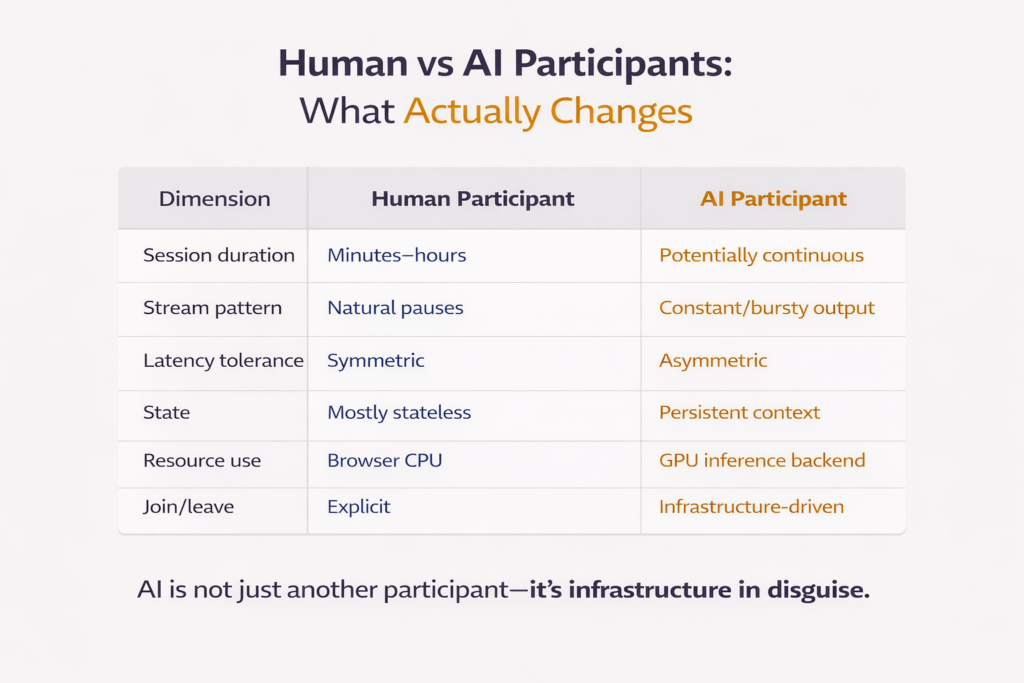
WebRTC session lifecycles evolved around human behavior patterns. Sessions begin when participants join, continue as participants remain connected, and end when the last participant leaves. AI participants operate on completely different lifecycle expectations.
A voice assistant doesn’t “join” a call the way a human does — it exists as infrastructure that should be available whenever needed. AI transcription services may need to persist across session boundaries to maintain conversation context.
Persistent State Across Reconnections
Traditional WebRTC session management treats participants as stateless between sessions. If a participant leaves and rejoins, they’re treated as new with a fresh connection. This works for humans who don’t need session continuity beyond basic room persistence.
AI participants require persistent state across much longer timescales. A voice agent that has conversed with a user for 20 minutes carries valuable context — conversation history, user preferences, and established rapport. If network issues cause reconnection, losing that context destroys the user experience.
| Session Aspect | Human Participants | AI Participants |
| Connection Duration | Minutes to hours | Potentially continuous (8+ hours) |
| Reconnection Handling | New participant, minimal context | Must preserve full conversation state |
| Session Boundaries | Clear join/leave events | May span multiple WebRTC sessions |
| State Requirements | Connection status, media streams | Context window, model state, processing queue |
| Lifecycle Coupling | Tied to user presence | Tied to service availability |
Production systems handle this by implementing AI-specific session management layers that sit above WebRTC session state. These layers maintain AI agent instances with persistent identifiers, conversation state, and configuration. When WebRTC sessions start, the system instantiates or resumes the appropriate AI agent and establishes the binding between the WebRTC peer and AI instance.
AI as Infrastructure vs AI as Participant
The fundamental tension is whether to treat AI as a participant in the session or as infrastructure supporting the session. This architectural decision cascades through the entire stack.
Most production systems end up with a hybrid model. The AI exists as a visible participant for user experience purposes; users see an AI moderator in the participant list, but the backend implements it as infrastructure with special handling. This preserves the user-facing participant abstraction while enabling the operational flexibility needed to run AI services reliably.
Practical Architecture Patterns for Mixed Sessions
Three architectural patterns have emerged from production deployments handling both human and AI participants.
Pattern 1: AI Sidecar Architecture
AI services run as “sidecars” attached to individual sessions. When a session starts and requires AI capabilities, the system spins up dedicated AI processing for that session. The AI sidecar connects to the session’s media streams through a privileged interface, processes audio, and publishes responses. When the session ends, the sidecar terminates.
This provides strong isolation between sessions and straightforward resource allocation. The drawback is inefficiency — AI models have significant initialization overhead (10-20 seconds), and sidecars may sit idle waiting for human speech.
Pattern 2: Shared AI Pool Architecture
This pattern maintains a pool of warm AI workers that serve multiple sessions. When a session needs AI processing, it requests capacity from the pool. Workers return to the pool when processing completes, ready to serve the next request.
This optimizes resource utilization and eliminates cold start latency. The challenge is session state management — since workers serve multiple sessions, session context must be externalized to fast storage (Redis, Memcached) and loaded/saved on each request.
Pattern 3: Hybrid Persistent AI Agents
This combines elements of both approaches. Long-lived AI agents maintain persistent connections to active sessions, while a shared pool handles burst capacity and new session initialization. An AI agent connects to a session and remains attached while the conversation is active. If the session goes idle, the agent can detach and return to the pool.
The hybrid model balances efficiency with responsiveness. Persistent agents provide optimal experience for active conversations — no initialization delay, full context preservation, immediate response. The shared pool ensures efficient resource use during idle periods.
The Impact on Media Server Selection
The shift to mixed human-AI sessions dramatically changes media server requirements:
Privileged Participant Support: Media servers must support participants with special privileges — access to all streams, permission to publish without subscription limits, ability to receive mixed audio feeds.
DataChannel Sophistication: Real-time text exchange between humans and AI flows through WebRTC DataChannels. Features like ordered delivery, message size limits, and backpressure handling become critical when AI agents stream structured data alongside media.
Custom Signaling Integration: AI participants require tighter integration between media server signaling and application logic. The application needs to inject AI-specific metadata into session signaling and control AI participant creation/destruction through APIs.
Metrics and Observability: Debugging mixed sessions requires detailed visibility into both human and AI participant behavior. Media servers that expose granular per-participant metrics and separate human and AI participants in dashboards become essential.
Trembit’s Experience with Mixed Architecture Deployments
As organizations navigate this architectural paradigm shift, many discover that internal teams lack the specific expertise needed to design and implement mixed human-AI video systems. The knowledge required spans WebRTC internals, AI infrastructure operations, and the unique integration challenges where these domains meet.
Trembit has been working with engineering teams to architect and deploy these next-generation systems. Rather than treating AI integration as a simple add-on to existing WebRTC infrastructure, Trembit approaches it as a fundamental architectural rethinking. The partnership model provides access to teams who have already navigated the difficult decisions around participant modeling, stream routing, and session lifecycle management in production environments.
Teams building their first AI-enabled video application face dozens of architectural decisions where the wrong choice leads to months of rework. Should the AI connect as a participant or as infrastructure? How should session state persist across reconnections? What’s the right balance between dedicated and pooled AI resources?
Working with specialists who have production experience means learning from their previous deployments rather than recreating the same learning curve. Trembit brings architectural patterns proven across multiple implementations, helping teams avoid common pitfalls while adapting solutions to specific requirements.
Technical Debt from Symmetric Assumptions
Organizations with existing WebRTC infrastructure face a particularly challenging problem. Their current architecture likely embeds the assumption of symmetric human participants throughout the codebase. Retrofitting AI support means identifying and refactoring all the places where these assumptions hide.
Participant Capacity Limits: Systems often have hardcoded participant limits based on human conversation patterns — “maximum 50 participants per room.” These break down when some “participants” are AI services that need continuous presence across hundreds of rooms.
Media Stream Assumptions: Code that assumes “one video stream and one audio stream per participant” fails when AI participants publish only audio, need to publish multiple streams, or consume all streams but publish none.
State Model Rigidity: Session state models designed for human participants track connection status and media subscriptions. AI participants need additional state: processing queue depth, model version, capability flags, and conversation context references.
Authentication and Authorization: Permission systems designed for humans use constructs like “users can join if they have the room link.” AI participants need service authentication (API keys, mTLS certificates) and programmatic authorization.
Addressing this technical debt requires systematic refactoring. Teams often underestimate the scope, expecting to add “AI participant support” in a single sprint. In reality, making the architecture truly support mixed participants touches most system components.
The Future: Natively Hybrid Architectures
Systems being designed today for real-time communication start with the assumption that participants will be mixed human and AI. Rather than bolting AI onto human-centric architectures, these systems are natively hybrid from the ground up.
Participant Type as First-Class Concept: New architectures model participant type explicitly, distinguishing humans, AI agents, recording bots, and transcription services. Each type gets appropriate handling for routing, state management, and lifecycle.
Asymmetric Routing by Default: Stream routing logic assumes asymmetric requirements. Different participant types have different latency sensitivities, bandwidth constraints, and access patterns.
Decoupled Session Lifecycles: Session management separates the WebRTC session lifecycle from the logical conversation lifecycle. A conversation may span multiple WebRTC sessions as participants reconnect or infrastructure scales.
AI-Aware Resource Management: Resource allocation, scheduling, and capacity planning recognize that AI participants consume different resources than human participants.
Conclusion: Embracing Architectural Evolution
The paradigm shift from human-to-human calls to human-to-AI sessions is not a minor feature addition. It’s a fundamental rethinking of WebRTC architecture that touches every layer of the stack — from stream routing and session management to capacity planning and observability.
Organizations face a choice: continue patching existing architectures with AI-specific workarounds, or embrace the architectural evolution, redesigning systems around the reality of mixed human-AI participants from the foundation up.
The second path requires more upfront investment but delivers sustainable architecture that can evolve with rapidly advancing AI capabilities. This transition period offers a significant competitive advantage to organizations that move decisively. Teams that develop deep expertise in mixed participant systems, whether by building internally or partnering with specialists, can deliver capabilities competitors still struggle to implement.
For many organizations, partnership accelerates this transition. Rather than building expertise through trial and error in production, working with Trembit provides access to proven architectural patterns and operational experience. The complexity of mixed human-AI sessions spans too many domains for most teams to master all aspects internally.
The future of real-time communication is clear. Every video application will incorporate AI participants in some form — voice agents, transcription bots, moderation services, or capabilities not yet imagined. Organizations addressing this paradigm shift now build the foundation for the next decade of real-time communication innovation.