Choosing the right mobile framework for a healthcare video application is one of the most consequential technical decisions your product team will make. Get it right, and you have a stable, performant foundation that can support live video consultations, real-time diagnostics, and strict compliance requirements for years. Get it wrong, and you face costly rewrites, performance bottlenecks at the worst possible moments, and compliance gaps that put your users — and your organization — at risk.
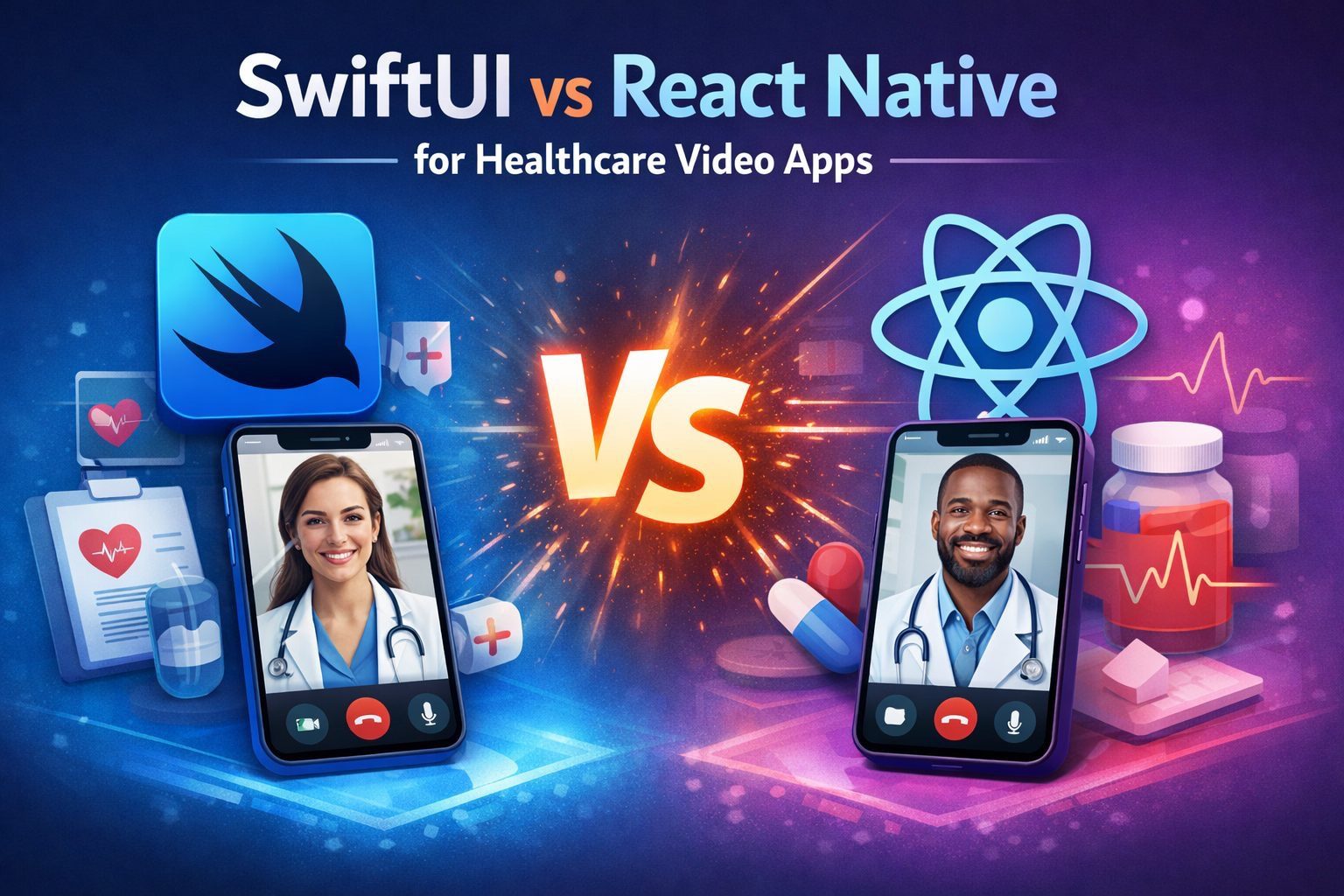
Two frameworks dominate the conversation for clinical mobile apps today: Apple’s SwiftUI and Meta’s React Native. Both are mature, well-supported, and capable of producing high-quality applications. However, each approach introduces distinct trade-offs, and in healthcare video delivery, those differences can have substantial clinical and operational consequences.
This article breaks down the comparison across the dimensions that matter most: video performance, platform reach, HIPAA compliance architecture, development speed, and long-term maintainability. By the end, you will have a clear framework for making the right choice for your specific product.
The Stakes Are Higher in Healthcare Video
Most framework comparisons focus on developer experience and time-to-market. For consumer apps, those factors are often decisive. Healthcare video apps face an entirely different set of priorities:
- Clinical reliability: A dropped video frame during a teleconsultation is not just a UX issue — it can affect clinical judgment.
- Security and compliance: HIPAA, HITECH, and GDPR impose strict requirements on how patient data is handled, transmitted, and stored. The framework you choose directly affects how easily you can meet those requirements.
- Device access: Healthcare apps frequently need access to hardware, such as cameras, microphones, accelerometers, and sometimes Bluetooth medical devices. Native hardware access is non-negotiable.
- Long-term stability: Healthcare software products have long lifespans. A framework that degrades or fragments over time creates serious operational risk.
These factors should anchor every dimension of the comparison that follows.
Platform Coverage: iOS-First vs. Cross-Platform
The most fundamental difference between SwiftUI and React Native is their platform scope.
SwiftUI is Apple’s native declarative UI framework, introduced in 2019. It runs exclusively on Apple platforms: iOS, iPadOS, macOS, watchOS, and tvOS. If your patient population is primarily iPhone users — which in the US represents roughly 57% of smartphone users as of 2024 — SwiftUI gives you deep, friction-free access to everything Apple’s ecosystem offers.
React Native, developed by Meta and now maintained as an open-source project, compiles to native UI components on both iOS and Android. A single JavaScript codebase can reach both platforms, typically sharing 70–90% of code between iOS and Android versions.
For healthcare apps, this distinction is significant. Telehealth platforms that serve broad populations — including underserved communities where Android is often more prevalent — cannot afford to ignore Android. React Native provides a credible path to supporting both platforms without the overhead of maintaining two fully separate codebases.
However, if your product targets a specific professional user base (clinicians, hospital staff) and your organization has standardized on iOS, SwiftUI’s depth and quality may outweigh the cross-platform advantage.
Video Performance: Where the Technical Rubber Meets the Road
Live video in a clinical environment is demanding. You need low latency, stable frame rates, responsive camera controls, and the ability to handle network degradation gracefully. Here is how each framework performs across these requirements.
Camera and Media API Access
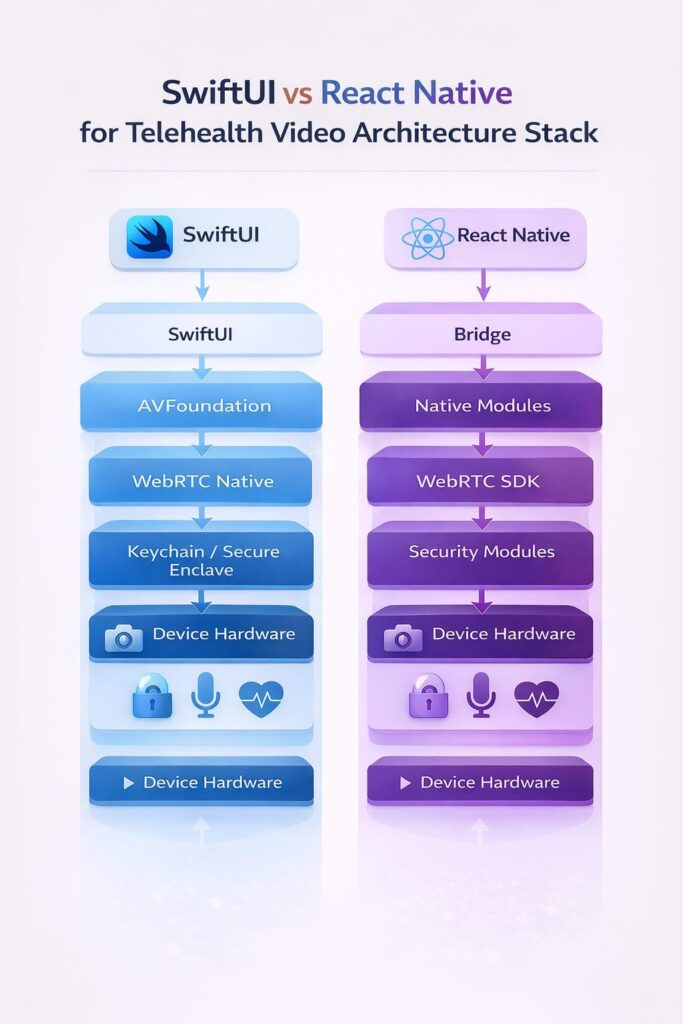
SwiftUI integrates natively with AVFoundation, Apple’s comprehensive media framework. You get direct, low-level access to camera hardware, microphone arrays, video encoding pipelines, and real-time processing APIs. SwiftUI’s integration with AVFoundation is seamless — there is no abstraction layer between your code and the hardware.
React Native accesses native camera APIs through bridge modules, most commonly react-native-vision-camera (the current standard) or WebRTC libraries. The JavaScript bridge adds a measurable latency overhead for interactions that require communication between the JavaScript runtime and native modules. For most video applications, this is imperceptible, but in high-frequency processing scenarios — such as real-time AI-based video enhancement — it can become a constraint.
WebRTC Integration
WebRTC is the dominant protocol for real-time video communication in telehealth. Both frameworks support it, but with different integration profiles.
In SwiftUI, WebRTC integration is handled through native Swift WebRTC libraries (Google’s WebRTC.xcframework being the standard). Integration is straightforward and performs at the native layer throughout.
In React Native, WebRTC is available via react-native-webrtc, a well-maintained bridge library. Performance is generally excellent for standard telehealth use cases. Organizations using managed telehealth SDKs such as Twilio Video, Daily.co, or Amazon Chime can use their official React Native SDKs, which abstract much of this complexity.
Background Processing and Multitasking
Healthcare video apps commonly need background execution — for instance, keeping a call active while clinicians use other apps. SwiftUI offers direct, reliable access to iOS background modes via native APIs, whereas React Native typically relies on carefully implemented native modules to prevent suspension of the JavaScript runtime.
Head-to-Head: SwiftUI vs. React Native for Healthcare Video
The following table summarizes the key dimensions across the two frameworks:
| Dimension | SwiftUI | React Native |
| Platform Support | iOS, iPadOS, macOS, watchOS only | iOS and Android (single codebase) |
| Video Performance | Native AVFoundation — maximum performance | Bridge-based; excellent for standard video use cases |
| Camera/Hardware Access | Direct, full-depth access to all Apple hardware APIs | Via native modules; solid but one abstraction layer removed |
| WebRTC Integration | Native Swift WebRTC libraries; seamless | react-native-webrtc; well-supported, performant |
| HIPAA Data Layer | Native Keychain, Secure Enclave, CryptoKit | Requires native modules for equivalent security depth |
| Development Language | Swift — strongly typed, modern, safe | JavaScript / TypeScript — flexible, broad talent pool |
| Time to Market | Longer for iOS-only; no Android coverage | Faster for cross-platform products |
| Team Talent Pool | iOS/Swift specialists required | Web developers can contribute; broader hiring pool |
| Long-Term Maintenance | Stable, Apple-backed, predictable updates | Open-source; historically experienced breaking changes |
| Third-Party SDK Support | Native SDKs from Twilio, Daily, Chime, Zoom | Official RN SDKs from major telehealth providers |

HIPAA Compliance Architecture
Compliance is not a checkbox — it is a design principle that must be baked into your architecture from day one. Both frameworks can support HIPAA-compliant applications, but they require different approaches.
Data Security
SwiftUI applications have native access to the iOS Keychain (for credential storage), the Secure Enclave (for biometric-protected keys), and Apple’s CryptoKit framework for cryptographic operations. These are hardware-backed security features with no third-party dependencies. For storing protected health information (PHI) at rest, this is a powerful foundation.
React Native applications can access these same iOS features through native modules, but doing so requires writing or integrating native Swift/Kotlin code. Libraries such as react-native-keychain and react-native-sensitive-info provide this access, but they add dependency surface area that must be audited and maintained.
Network Security and Certificate Pinning
Certificate pinning — ensuring the app only communicates with servers presenting known certificates, defending against man-in-the-middle attacks — is straightforward to implement in SwiftUI via URLSession’s delegate methods. In React Native, it requires native module implementation or the use of libraries such as react-native-ssl-pinning.
Audit Logging
HIPAA requires comprehensive audit trails for PHI access. Although both frameworks are capable of supporting the underlying logging mechanisms, neither delivers this functionality natively, making compliant audit logging an application-level obligation independent of framework selection.
Development Speed and Team Considerations
Time to market and ongoing development velocity are real business concerns, especially for startups and growth-stage healthtech companies.
React Native offers a faster path to a cross-platform product. A skilled JavaScript or TypeScript team can be productive quickly. The ecosystem of third-party libraries is large. Hot reload significantly accelerates the development loop. If you need to ship on both iOS and Android within a constrained timeline and budget, React Native is a serious advantage.
SwiftUI requires iOS-specialized engineers. The talent pool is smaller and generally commands a higher market rate. However, SwiftUI’s declarative syntax has significantly reduced the complexity of iOS development compared to the UIKit era. For teams already invested in the Apple ecosystem, SwiftUI is genuinely productive.
One underappreciated factor is organizational knowledge. If your engineering team already has strong JavaScript expertise, onboarding them to React Native is significantly cheaper than hiring or retraining for Swift. Conversely, teams with iOS heritage will find SwiftUI’s mental model familiar.
Which Framework Is Right for You?
There is no universally correct answer. The right choice depends on your product context. Use the guide below to orient your decision:
| Choose SwiftUI if… | Choose React Native if.. |
| Your users are exclusively on iOS | You need to support both iOS and Android |
| You require maximum native video performance | Your team has strong JavaScript/TypeScript expertise |
| You are building advanced AR/camera features (ARKit) | Time to market on two platforms is a priority |
| Your org has existing iOS engineering investment | Budget favors a shared codebase over two native teams |
| Deep Apple hardware integration is a core feature | You are using a managed video SDK (Twilio, Daily, Chime) |
| Long-term stability with minimal framework churn is critical | Your product roadmap includes web alongside mobile |
A Note on Hybrid Architectures
Some healthcare organizations choose a hybrid approach: a React Native application for the general patient-facing interface, with native Swift modules written for performance-critical video and media components. This architecture is entirely valid and used in production by several mature telehealth platforms.
The trade-off is complexity: you now have two codebases to maintain and a bridge layer to manage carefully. For teams with the right expertise, the benefits — cross-platform reach combined with native video performance — are worth it. For smaller teams, the operational overhead may outweigh the gains.
How Trembit Approaches This Decision with Clients
At Trembit, we have built healthcare video applications on both SwiftUI and React Native, and we have helped clients navigate this exact decision dozens of times. Our position is that the right answer is always context-dependent — and that getting the context right is itself a critical engineering and product exercise.
When a healthcare organization comes to us with a video app to build, we start with a structured discovery process that covers:
- Patient and clinician device demographics — Android vs. iOS split, device generations in use
- Compliance requirements — HIPAA baseline, state-specific rules, any international obligations
- Video feature depth — standard consultation video vs. AI enhancement, annotation, recording, or specialist analysis
- Team composition and existing technology investments
- Timeline and budget realities — including the ongoing cost of maintenance, not just initial build
Only after that context is clear do we make a framework recommendation. We do not have a default answer, because there should not be one.
What we bring to every project is the engineering depth to implement either framework at production quality: native Swift and React Native developers, deep WebRTC expertise, HIPAA compliance architecture experience, and a track record of delivering healthcare video products that clinicians and patients actually rely on.
If you are evaluating this decision and want an expert perspective grounded in real-world healthcare product development, Trembit is ready to help.
Conclusion
SwiftUI and React Native are both capable foundations for a healthcare video application. SwiftUI wins on raw native depth, Apple ecosystem integration, and long-term iOS stability. React Native wins on cross-platform reach, development speed, and a broader developer talent pool.
For most healthcare video products, the decision comes down to two questions: Who are your users, and what does your team look like? If your users are iOS-dominant and your team is iOS-native, SwiftUI is the natural choice. If you need to reach Android users, ship quickly on two platforms, or leverage an existing JavaScript team, React Native is a credible and proven path.
What neither framework can substitute for is expert implementation. A well-built React Native healthcare video app will outperform a poorly built SwiftUI one every time — and vice versa. The framework choice matters, but the engineering quality matters more.