“We’re HIPAA compliant.” Every telehealth platform says it. Investors hear it. Customers read it on landing pages. Regulators hear it right before they start asking questions nobody can answer.
The telehealth market has exploded — and so has compliance theater. By 2026, the difference between HIPAA audit ready telehealth platforms and those merely claiming compliance has never been more consequential. When the Office for Civil Rights comes knocking, or a breach forces you to reconstruct every PHI access event from the last six months, checkbox compliance collapses instantly.
For healthcare technology leaders and compliance teams, the question isn’t whether your platform handles PHI. It’s whether you can prove it, defend it, and survive scrutiny when the stakes are highest. This distinction separates platforms that merely process protected health information from systems architectured for genuine HIPAA-grade operations.
The Compliance Spectrum: Understanding Where Your Platform Really Stands
HIPAA compliance exists on a spectrum. At one end sits the MVP that encrypts data in transit and slaps a privacy policy on its website. At the other end lives the audit-ready platform that can reconstruct every PHI access event, demonstrate technical safeguards at the architectural level, and produce documentation that satisfies both OCR investigators and cyber insurance underwriters.
Most platforms cluster somewhere in the middle, unknowingly vulnerable. They’ve implemented obvious controls but missed the architectural decisions that determine whether they can actually prove compliance under scrutiny. The difference isn’t about working harder; it’s about building differently from day one.
PHI Data Flow Mapping: The Foundation of Audit Readiness
Audit readiness begins with knowing where PHI lives, moves, and transforms across your entire infrastructure. This isn’t a network diagram exercise. It’s a comprehensive mapping of every system boundary PHI crosses, from patient input through processing pipelines to archival storage and deletion.
What True PHI Mapping Encompasses
- Ingestion Points: Document every interface where PHI enters your system — web forms, mobile apps, API endpoints, third-party integrations, file uploads. Each entry point requires its own security controls and monitoring.
- Processing Pipelines: Map how PHI flows through your application logic, background jobs, analytics engines, and AI processing. Identify where data transforms, aggregates, or derives new information. Each transformation represents a potential compliance risk point.
- Storage Layers: Document primary databases, caching layers, backup systems, log aggregation, and disaster recovery sites. Include both structured databases and unstructured blob storage. Each storage layer needs encryption at rest and access controls.
- External Boundaries: Track every point where PHI leaves your controlled infrastructure — third-party APIs, vendor integrations, email notifications, SMS alerts, PDF generation services, analytics platforms. These boundaries require Business Associate Agreements and their own audit trails.
- Ephemeral Locations: Don’t overlook temporary storage that seems innocuous — session caches, Redis queues, message brokers, CDN edges, lambda function memory, container logs. PHI in these locations requires the same protections as your primary database.
Audit-ready platforms maintain living documentation of these flows. When an auditor asks ‘show me everywhere patient diagnosis codes are stored,’ you produce a diagram and supporting architecture documentation within minutes, not days. When a breach occurs, your PHI flow map tells you exactly which data stores were potentially compromised.
The Data Classification Matrix
Not all health data carries equal compliance weight. Audit-ready platforms implement a classification system that distinguishes between PHI types and applies appropriate controls. This goes beyond ‘PHI’ versus ‘non-PHI’ into a granular understanding of data sensitivity and regulatory requirements.
| Data Category | Examples | Compliance Requirement |
| Direct Identifiers | Name, SSN, medical record number, email address | Maximum protection; cannot be used in analytics without explicit consent |
| Quasi-Identifiers | ZIP code, birth date, diagnosis dates, appointment times | Protected but may be used in limited aggregations |
| Clinical Data | Lab results, prescriptions, diagnoses, treatment plans | Core PHI; requires comprehensive audit logs |
| Metadata | Session timestamps, file sizes, system events | Protected if linkable to individual; otherwise may have reduced controls |
| Derived Data | Risk scores, aggregated statistics, anonymized datasets | Varies; depends on re-identification risk |
This classification drives access controls, retention policies, and breach notification procedures. When your analytics team wants to train a machine learning model, the classification matrix tells you precisely which data elements require de-identification and which can be used with appropriate safeguards.
Role-Based Access Control: Beyond Basic Authentication
Most telehealth platforms implement authentication and call it access control. They verify who you are, then grant broad permissions based on crude roles like ‘provider’ or ‘patient.’ Audit-ready platforms implement attribute-based access control that considers context, data sensitivity, purpose of access, and time-based restrictions.
Multi-Dimensional Access Control
True HIPAA-grade RBAC operates on multiple dimensions simultaneously:
- Role-Based Permissions: The foundation layer. Physician, nurse, administrator, billing specialist — each role has a baseline permission set. But this is just the starting point, not the complete picture.
- Relationship-Based Access: A cardiologist can access records for patients under their care, but not arbitrary patient files. Access rights derive from clinical relationships documented in your system. Break the glass procedures exist for emergencies, but trigger immediate audit alerts.
- Contextual Restrictions: Access varies by location, device security posture, time of day, and purpose. A provider accessing records from their clinic on a managed device gets full access. The same provider on a personal device from a coffee shop faces additional authentication requirements and restricted functionality.
- Data-Level Security: Within a single patient record, different fields have different sensitivity. Mental health notes, HIV status, substance abuse history, and reproductive health information may require additional access controls beyond the base patient record.
- Purpose-Based Filtering: Access granted for treatment purposes differs from access for billing or quality improvement. The same user might have different permissions depending on why they’re accessing data. Your system enforces these distinctions automatically.
Implementing this requires architecture that evaluates policies in real-time, not just at login. Every data access decision considers the full context. When auditors ask ‘how do you prevent unauthorized access to sensitive diagnoses,’ you demonstrate policy enforcement at the data layer, not just at the application boundary.
The Principle of Least Privilege in Practice
Least privilege isn’t about being stingy with permissions. It’s about granting the minimum access required for each specific task, then removing it immediately when the task completes. Audit-ready platforms implement this through:
- Just-In-Time Access: Administrative privileges elevate on demand for specific operations, then automatically expire. Database administrators don’t maintain standing access to production PHI; they request time-limited credentials justified by a specific maintenance ticket.
- Automated Permission Reviews: The system flags access that hasn’t been used in 90 days. Quarterly reviews identify permissions that can be revoked. Machine learning models detect anomalous access patterns that suggest over-privileged accounts.
- Default-Deny Architecture: Every access is denied unless explicitly permitted. New features launch with zero permissions; teams must justify and document each access grant. This reverses the dangerous default of granting broad access and trying to restrict it later.
- Separation of Duties: No single individual can create users, assign permissions, and access PHI. Critical operations require multi-party approval. The engineer deploying code cannot approve their own changes to access control policies.
When the Office for Civil Rights investigates a breach, they examine whether you enforced least privilege. They look at the compromised account’s permissions and ask why it needed access to the data that was exposed. ‘Everyone had access to everything’ is the answer that generates the largest fines.
Audit Logs and Breach Traceability: Evidence That Stands Up to Scrutiny
When a breach occurs — and you must assume it will — your audit logs determine whether you face a minor incident report or a catastrophic regulatory investigation with seven-figure fines. The difference lies not in whether you log events, but in whether your logs can answer the hard questions regulators ask.
What Audit-Ready Logging Captures
Comprehensive audit logs record every security-relevant event in your system:
- Authentication Events: Every login, logout, failed authentication attempt, password change, MFA enrollment, and session timeout. Include the device fingerprint, IP address, geolocation, and whether the authentication used single sign-on or direct credentials.
- Authorization Decisions: Every access control evaluation — granted or denied. When Dr. Smith views patient records, log not just the access but also which policy rules permitted it. When access is denied, log why. Include the full policy context that drove the decision.
- Data Operations: Create, read, update, delete operations on PHI. Don’t just log ‘patient record accessed’ — log which specific fields were viewed, what changed, and the before/after values for updates. Include query patterns that might indicate bulk data exfiltration.
- System Configuration Changes: Modifications to security policies, user permissions, encryption keys, network rules, backup configurations. These changes represent attack vectors that must be traceable to specific authorized individuals.
- Administrative Actions: Account creation, permission assignment, role changes, access reviews. When you must explain to auditors who granted the compromised account its excessive permissions, you need this trail.
- Data Export and Transmission: Reports generated, files downloaded, API calls made, emails sent containing PHI. Any operation that moves PHI out of your primary security boundary requires comprehensive logging with payload hashing.
Critical requirement: logs must be tamper-evident and stored in write-once locations. An attacker who gains system access will attempt to erase evidence. If they succeed, you cannot prove what was compromised. Audit-ready platforms forward logs to immutable storage in real-time, cryptographically sign log entries, and maintain chain-of-custody documentation.
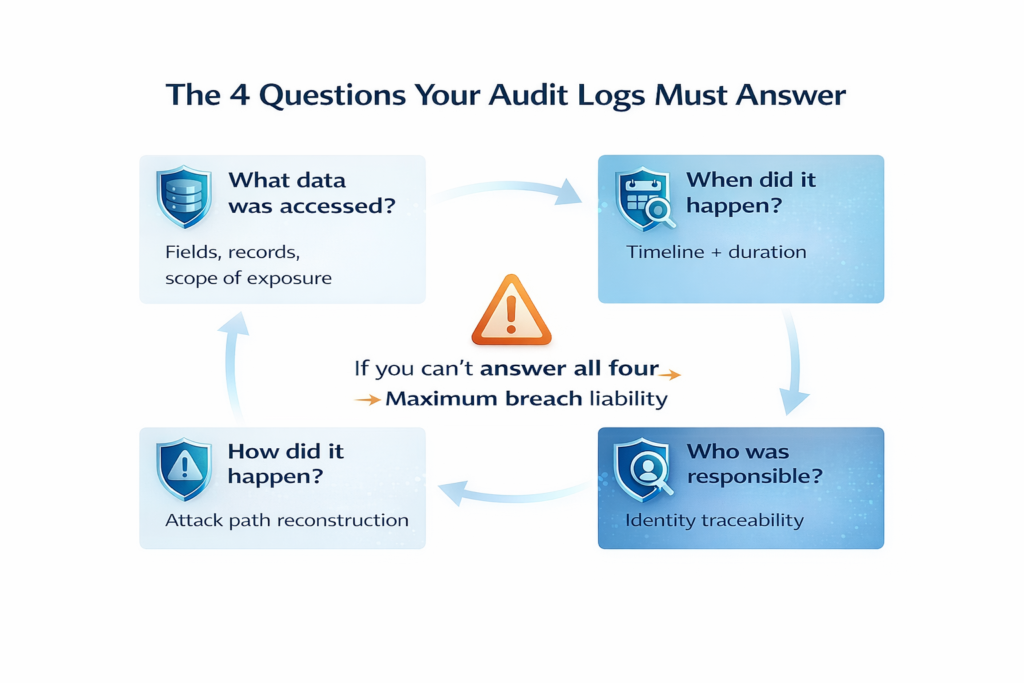
The Four Questions Your Logs Must Answer
When breach notification becomes necessary, OCR and affected individuals ask specific questions. Your logs either answer them definitively or leave you guessing:
- What data was accessed or exfiltrated? You must identify specific patient records, fields within those records, and whether the access was read-only or included modification. ‘We don’t know’ is not acceptable and dramatically increases breach notification obligations.
- When did the breach occur? Pinpoint the initial unauthorized access and the end of exposure. The duration between these timestamps affects notification requirements and demonstrates your detection capabilities. A breach that continued undetected for months signals systematic security failures.
- Who was responsible? Trace the compromised credentials or exploited vulnerability to its source. Was it an external attacker, malicious insider, or negligent employee? Different breach types trigger different regulatory responses and legal obligations.
- How did it happen? Reconstruct the attack path or policy failure. This demonstrates you understand the root cause and can prevent recurrence. Vague explanations suggest inadequate security controls and immature security practices.
Platforms that cannot answer these questions face maximum breach notification requirements — notify all affected individuals even if you cannot prove their specific data was accessed. They face presumption of worst-case scenarios in regulatory investigations. And they face impossibly expensive cyber insurance premiums because insurers cannot assess their actual risk exposure.
Business Associate Agreement Implications in Vendor Selection
Your compliance posture is only as strong as your weakest vendor. Every third-party service that touches PHI extends your attack surface and regulatory liability. Audit-ready platforms treat vendor selection as a security architecture decision, not a procurement checkbox.
BAA Due Diligence Beyond the Signature
Obtaining a signed Business Associate Agreement is the beginning of vendor risk management, not the end. Audit-ready platforms conduct comprehensive due diligence:
- Security Architecture Review: Understand how the vendor stores and processes PHI at the infrastructure level. Do they use shared tenancy or dedicated instances? How is your data isolated from other customers? What encryption algorithms and key management practices do they employ? Generic security questionnaires hide architectural weaknesses.
- Audit Rights and SOC 2 Verification: Require current SOC 2 Type II reports covering the specific services you use. Generic compliance certifications for unrelated products don’t protect you. Verify the audit scope includes HIPAA-relevant controls. Insist on audit rights that let you verify controls during your relationship.
- Subcontractor Transparency: Vendors rarely operate in isolation. Your cloud hosting provider uses infrastructure from other vendors. Your analytics platform sends data to their AI processing pipeline. Each layer requires its own BAA. Audit-ready platforms maintain a complete inventory of all subcontractors who might access PHI.
- Breach Notification Procedures: The BAA must specify how and when the vendor notifies you of breaches. ‘Within 60 days’ is inadequate when HIPAA requires notification within 60 days of your discovery. You need real-time or near-real-time breach notification to meet your own regulatory obligations.
- Data Destruction Guarantees: When you terminate the relationship, how does the vendor prove complete data deletion? Retention policies must align with your obligations. Vendors who cannot cryptographically verify data destruction represent ongoing liability even after contract termination.
The hard truth: popular SaaS vendors often resist these requirements because they complicate their standard offerings. But your regulatory liability doesn’t care about their business model. Audit-ready platforms choose vendors who treat HIPAA compliance as a first-class requirement, not an optional add-on.
The Hidden PHI Processors
Some PHI processors hide in plain sight, never identified as business associates during procurement:
| Service Category | Hidden Risk | Mitigation Requirement |
| Error Monitoring | Stack traces containing PHI sent to third-party logging platforms | Filter PHI from error reports; BAA with monitoring vendor |
| Customer Support Tools | Support tickets with patient details stored in ticketing systems | Dedicated HIPAA-compliant support platform; strict data handling procedures |
| Analytics Platforms | User behavior tracking that captures PHI in URLs or form fields | Aggressive PII scrubbing; analytics-specific BAA |
| Email Service Providers | Patient appointment reminders and clinical summaries sent via transactional email | BAA with email provider; encrypted email options |
| CDN and Edge Networks | Cached API responses or static assets containing patient data | Private CDN configuration; encryption in transit; BAA |
| Payment Processors | Billing transactions linked to clinical encounters and diagnoses | Healthcare-specific payment processor; proper BAA scope |
Discovery exercise: trace one patient encounter through your entire technical stack. You’ll likely find PHI in systems you never classified as business associates. Each one represents a compliance gap and potential breach vector. Audit-ready platforms conduct this exercise quarterly and update their BAA portfolio accordingly.
Architecture Differences: HIPAA-Ready vs. HIPAA-Hardened
The terminology matters. ‘HIPAA-ready’ suggests a platform capable of compliance if properly configured. ‘HIPAA-hardened’ signals a system architected from inception around regulatory requirements, where compliance emerges from structural decisions rather than bolted-on security features.
Fundamental Architectural Distinctions
| Aspect | HIPAA-Ready Architecture | HIPAA-Hardened Architecture |
| Data Encryption | Encrypted at rest and in transit using industry standards | Encryption with customer-managed keys; field-level encryption for sensitive data; envelope encryption with regular key rotation; hardware security modules for key storage |
| Access Control | Username/password with MFA; basic role-based permissions | Zero-trust architecture; continuous authentication; device posture checks; relationship-based access control; purpose-driven permissions with automatic expiration |
| Audit Logging | Application-level logs of major user actions | Comprehensive system-level logging including database operations; immutable log storage; real-time SIEM integration; log retention for 6+ years; cryptographic log signing |
| Network Security | Firewall rules; TLS everywhere; VPN access | Network segmentation with micro-perimeters; data flow firewalls; intrusion detection; honeypots; dedicated security VPC for PHI processing; zero-trust networking |
| Data Residency | Cloud provider guarantees data stays in specified region | Geographic isolation with private cloud regions; edge processing avoided for PHI; explicit data sovereignty controls; no multi-region replication without encryption |
| Disaster Recovery | Regular backups; tested restore procedures | Geo-redundant encrypted backups; immutable backup storage; tested recovery with compliance verification; point-in-time recovery for breach scenarios; backup encryption key segregation |
| Development Practices | Security testing in QA; code reviews include security | Security by design from requirements phase; threat modeling mandatory; automated security scanning in CI/CD; isolated development environments with synthetic data; no production PHI in non-production |
| Vendor Management | Signed BAAs with major vendors | Comprehensive vendor risk assessment; ongoing vendor audits; subcontractor mapping; vendor data flow documentation; vendor breach response testing; exit procedures verified |
The gap between these approaches manifests during incidents. A HIPAA-ready platform discovers a breach and begins investigating. A HIPAA-hardened platform detects anomalous access patterns before data exfiltration occurs, automatically revokes suspicious sessions, and generates a complete incident report with evidence for regulators.
The Cost-Security Tradeoff Reality
Building HIPAA-hardened infrastructure costs more upfront. Significantly more. But the cost structure favors long-term thinking. Consider the total cost over five years:
- HIPAA-Ready Approach: Lower initial development costs. Security features added as needed. Compliance achieved through process and documentation. But ongoing costs include: expensive security retrofits when vulnerabilities emerge, compliance consultant fees for each new feature, cyber insurance premium increases after incidents, potential breach notification costs, regulatory fine risk, customer churn following security issues.
- HIPAA-Hardened Approach: Higher initial architecture investment. Longer time to MVP. More expensive infrastructure choices. But long-term costs include: minimal security debt requiring remediation, compliance that extends to new features automatically, reduced cyber insurance premiums, smaller breach impact if incidents occur, competitive advantage in enterprise sales, engineering efficiency from automated security controls.
The crossover point typically occurs between 18 and 24 months. After that, the hardened approach costs less while providing superior protection. But many platforms never survive long enough to reach that crossover because a breach or failed audit destroys credibility first.
Engineering Culture as Architecture
The deepest architectural difference isn’t technical — it’s cultural. HIPAA-hardened platforms embed security thinking in every engineering decision:
- Design Reviews Include Compliance: Before writing code, teams map data flows, identify PHI, and document access control requirements. The compliance team reviews architecture, not just finished features. Compliance happens at design time, not audit time.
- Security Stories Are Not Optional: Every feature backlog includes security requirements with the same priority as functional requirements. ‘Ship first, secure later’ never happens because security criteria block deployment.
- Production Access Is Rare and Justified: Engineers don’t routinely access production databases. Debug tooling works with synthetic data. When production access becomes necessary, it requires approval, generates alerts, and expires automatically. This isn’t distrust — it’s defense in depth.
- Incident Response Is Practiced: Regular tabletop exercises simulate breaches. Teams practice evidence collection, containment, and regulatory notification. When real incidents occur, muscle memory takes over. Response becomes systematic rather than chaotic.
This culture cannot be retrofitted. You either build it from day one or spend years overcoming technical debt and organizational resistance. Platforms that defer security culture work discover that cultural transformation costs more than rebuilding the entire technical infrastructure.
The Compliance Documentation Gap
Technical controls mean nothing if you cannot demonstrate them. OCR audits and customer security assessments demand documentation that proves your controls exist and function correctly. The gap between what you’ve built and what you can prove often determines audit outcomes.
The Audit-Ready Documentation Stack
Complete compliance documentation requires multiple layers:
- Policies and Procedures: Written security policies covering all HIPAA administrative, physical, and technical safeguards. These are not boilerplate templates — they describe your actual practices, reference your specific systems, and get updated when practices change.
- Risk Assessments: Annual risk assessments that identify threats, evaluate vulnerabilities, and document mitigation strategies. Each risk ties to specific controls in your architecture. When auditors ask how you prioritized security investments, you show the risk assessment that drove decisions.
- System Security Plans: Technical documentation of your architecture with security control mapping. For each HIPAA requirement, identify which system components provide compliance. This bridges policy documents and actual infrastructure.
- Training Records: Proof that all workforce members received HIPAA training appropriate to their roles. Not just new hire orientation — ongoing training, specialized training for privileged users, and refresher training after policy changes.
- Incident Response Documentation: Records of security incidents, your investigation and response, and lessons learned. Even if no breach notification was required, you document that you made that determination and why.
- Vendor Agreements and Audits: All BAAs, vendor security documentation, and ongoing vendor risk assessments. When auditors ask about a specific vendor, you produce their BAA, their latest SOC 2 report, and notes from your last vendor review meeting.
Audit-ready platforms treat documentation as a first-class deliverable, not an afterthought. Technical features ship with corresponding policy updates and architectural documentation. This practice eliminates the scramble when audit notices arrive.
The Path Forward: Building Audit Readiness Into Your Roadmap
Moving from HIPAA-ready to HIPAA-hardened requires deliberate architectural evolution. You cannot flip a switch. But you can establish a systematic approach that progressively strengthens your compliance posture without halting feature development.
A Phased Approach to Hardening
Phase 1: Assessment and Baseline (1-2 months)
- Complete PHI data flow mapping across your entire infrastructure
- Inventory all vendors and determine BAA status and coverage
- Audit existing access controls and identify over-privileged accounts
- Review audit logging coverage and identify gaps
- Document current state architecture with security controls marked
Phase 2: Critical Gaps (2-3 months)
- Implement comprehensive audit logging with immutable storage
- Deploy automated access reviews and least privilege enforcement
- Establish vendor management processes and obtain missing BAAs
- Implement field-level encryption for most sensitive PHI elements
- Create incident response playbooks and conduct first tabletop exercise
Phase 3: Architectural Hardening (3-6 months)
- Implement context-aware access controls with device posture checking
- Deploy network segmentation and micro-perimeters
- Establish automated security testing in CI/CD pipeline
- Implement real-time security monitoring and anomaly detection
- Migrate to customer-managed encryption keys with regular rotation
Phase 4: Operational Excellence (Ongoing)
- Quarterly security architecture reviews for new features
- Regular penetration testing and vulnerability assessments
- Continuous compliance monitoring with automated evidence collection
- Annual third-party security audits and SOC 2 attestation
- Ongoing security training and phishing simulations
This roadmap balances immediate risk reduction with sustainable long-term hardening. Early phases address vulnerabilities that would cause audit failures or expand breach impact. Later phases build the architectural sophistication that distinguishes truly audit-ready platforms.
Conclusion: Compliance as Competitive Advantage
In 2026, HIPAA compliance has evolved from regulatory checkbox to market differentiator. Enterprise healthcare buyers conduct sophisticated security reviews. Cyber insurance underwriters demand evidence of mature security practices. Investors evaluate compliance architecture as part of technical due diligence.
Platforms that claim compliance but cannot demonstrate audit readiness face mounting pressure. Customer acquisition costs rise as security reviews stall. Insurance premiums increase as carriers recognize immature security practices. Development velocity suffers when security becomes a bottleneck rather than a framework.
The alternative — building HIPAA-hardened infrastructure from architectural foundations — requires greater initial investment but generates compounding returns. Compliance that emerges naturally from system design rather than bolted-on processes scales efficiently. Security controls that automate evidence collection reduce audit preparation from months to weeks. Engineering teams that embed compliance thinking ship features faster because security reviews happen at design time, not deployment gates.
The question facing telehealth platforms isn’t whether to achieve HIPAA compliance. It’s whether to build systems that survive regulatory scrutiny, customer security reviews, and inevitable security incidents with reputation intact. The difference between these approaches determines whether compliance represents existential risk or sustainable competitive advantage.
About Trembit
Trembit specializes in architecting and building HIPAA-hardened telehealth platforms that withstand regulatory scrutiny. Our compliance-aware system architects understand the difference between meeting minimum requirements and building infrastructure that scales securely.
We map PHI data flows, implement defense-in-depth access controls, design audit-ready logging infrastructure, and establish vendor management frameworks that satisfy both regulators and enterprise security teams. When you need to transform HIPAA-ready code into audit-ready architecture, we provide the expertise and engineering discipline to get there.