By Stanislav Zayarsky, CEO at Trembit — a WebRTC and video infrastructure studio with 50+ video/voice platforms shipped. · Last updated July 2026.
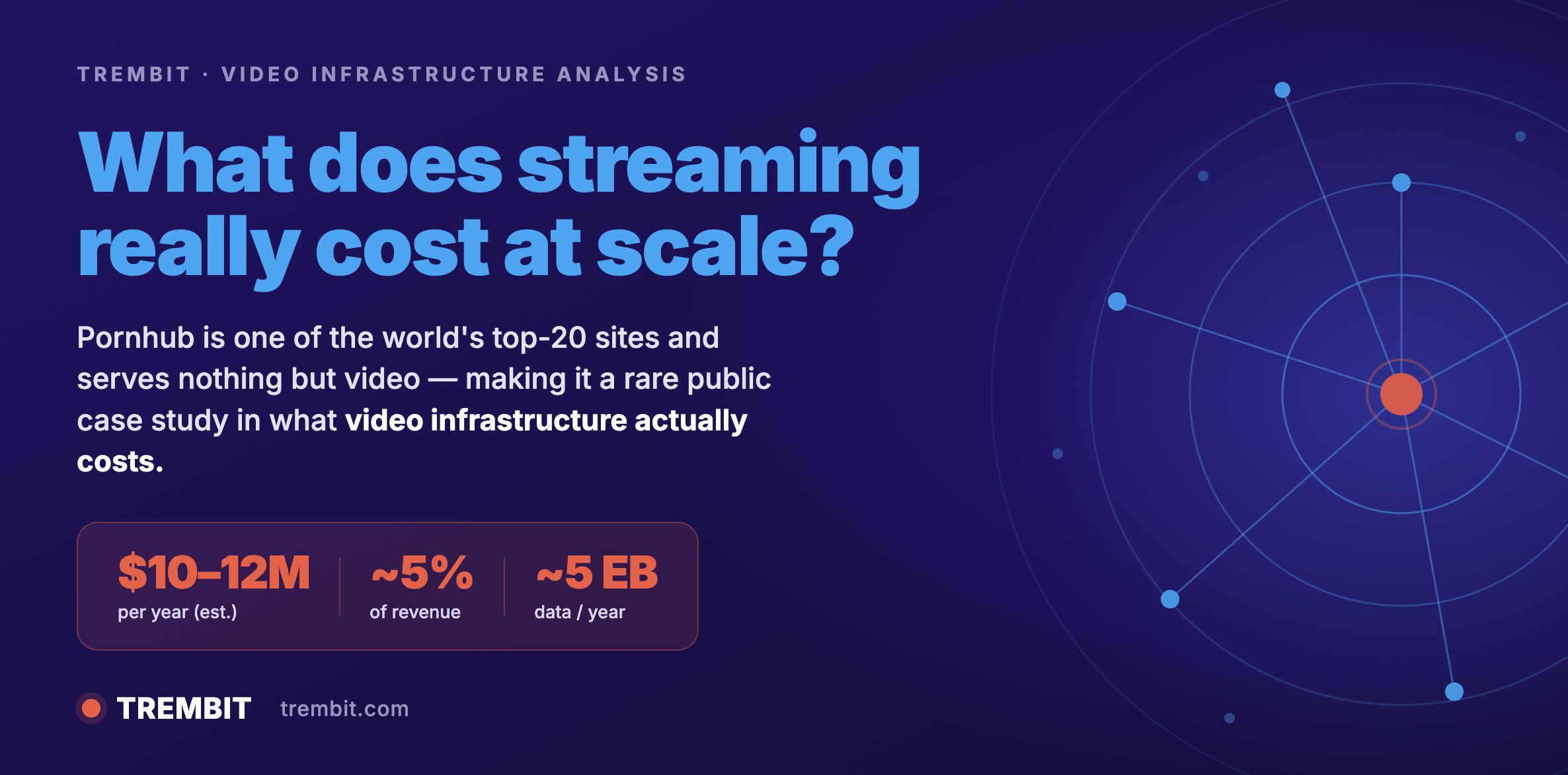
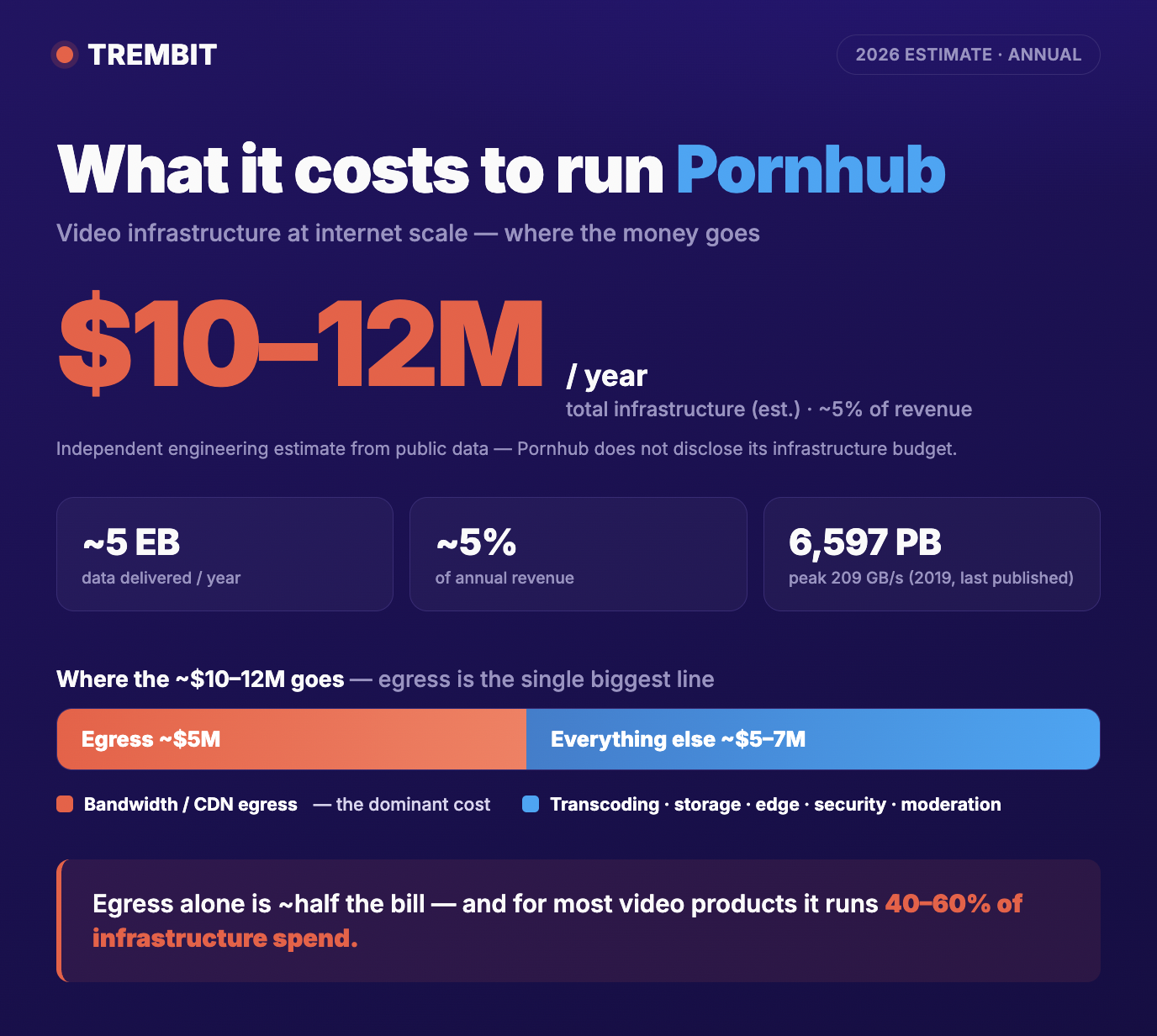
The short answer: Pornhub spends an estimated $10–12 million a year on server and infrastructure costs — approximately 5% of its annual revenue — to deliver around 5 exabytes of video data to more than one billion monthly visits. Raw bandwidth (CDN egress) accounts for roughly $5 million of that; transcoding, storage, edge compute, security, and content moderation make up the rest.
Key takeaways
- Pornhub’s total infrastructure spend is an estimated $10–12M/year — only ~5% of revenue. That ratio is the real headline: at scale, with the right architecture, infrastructure becomes a small slice of the P&L.
- Egress (bandwidth) is the dominant cost — ~$5M/year on its own. For most video products it runs 40–60% of total infrastructure spend.
- The other big lines are transcoding, storage tiering, CDN architecture, and moderation/security — the same five levers that decide your product’s economics.
- The figures are an independent engineering estimate from public data; Pornhub does not disclose its infrastructure budget.
- Architecture is the lever. Teams that hit a 5%-of-revenue ratio designed for it from day one. The ones that didn’t are usually the ones who call us to rescue a cash-burning video product.
One of the most-asked questions about Pornhub — the world’s largest adult-video site — has nothing to do with its content: how much does it actually cost to keep Pornhub online? It’s a fair question. Pornhub consistently ranks among the top ~20 most-visited websites on the planet — ahead of most of the household-name tech products you use daily — and it serves nothing but video, the single most expensive thing to deliver over the internet.
So the site is, accidentally, one of the best public case studies in what video infrastructure costs at scale. Let’s do the math.
Estimating Pornhub’s data transfer today
Pornhub stopped publishing detailed bandwidth figures in its annual “Year in Review” after 2019 — but the last numbers it did release are staggering, and they anchor the estimate:
| Year (last published) | Data transferred | Peak throughput |
|---|---|---|
| 2018 | 4,403 petabytes | 147 GB/s |
| 2019 | 6,597 petabytes | 209 GB/s |
To put 209 GB/s in perspective: that’s the equivalent of streaming tens of thousands of HD videos simultaneously, every second of every day.
Since 2019, two forces pull in opposite directions. Traffic has softened somewhat (the site reported well over a billion visits a month through 2024–2025, down from its peak), but average video resolution and session quality have climbed — and most of those visits are now on mobile, where adaptive bitrate streaming generates multiple encoded renditions of every file. Netting those out, a reasonable 2025 estimate lands at 5.0–5.5 exabytes of data transferred per year (5,000–5,500 petabytes) — squarely in line with the 2019 trajectory.
Estimating the cost of that transfer
The dominant cost in delivering video isn’t storage or servers — it’s egress: the price of pushing bytes out of the network to the viewer.
At enterprise CDN rates of roughly $0.0009 per GB (high-volume, heavily negotiated pricing — far below list price), moving ~5 exabytes a year works out to:
- ~$416,500 per month, or
- ~$5 million per year — for bandwidth alone.
A critical caveat before you reuse that number. The ~$0.0009/GB rate is what you get at exabyte scale, with multi-year commits and direct peering. A normal product pays far more per GB — and if you model your costs off Pornhub’s rate you’ll underestimate egress by 5–15×.
| Monthly egress volume | Typical effective rate | What it looks like |
|---|---|---|
| 50–500 TB/mo (early startup) | $0.02–$0.085 / GB | standard cloud CDN list pricing (CloudFront, Fastly, etc.) |
| 1–10 PB/mo (scaling product) | $0.004–$0.02 / GB | committed-use + multi-CDN discounts kick in |
| Exabyte-scale (Pornhub tier) | ~$0.0009 / GB | direct peering, private CDN, custom contracts |
The lesson isn’t “we’ll get Pornhub’s rate.” It’s that egress pricing is brutally non-linear in your favour as you scale — and that a deliberate CDN strategy is what moves you down the table.
Bandwidth is only one line item. Add the rest of the stack:
- Transcoding — every upload is re-encoded into multiple resolutions and codecs (typically H.264, with H.265/AV1 where device support allows) for adaptive streaming. At Pornhub’s upload volume this is a continuous, compute-heavy workload — and for many non-adult platforms (e-learning, telehealth, live commerce) it’s actually the single largest cost after egress.
- Storage — a library self-reported at ~11 petabytes back in 2020 and certainly larger now, spread across hot, warm, and cold tiers.
- Edge & origin servers — the compute that sits behind the CDN.
- Security & DDoS protection — a site this prominent is under constant attack.
- Content moderation — for a user-generated adult platform specifically, this is one of the fastest-growing cost lines, blending AI classification with human review. (For B2B platforms it’s usually smaller — but rarely zero.)
Stack it all together and total infrastructure spend lands at an estimated $10–12 million a year — which, against estimated annual revenue north of $200 million, is only about 5% of revenue. That ratio is the real headline: at true scale, with the right architecture, infrastructure becomes a remarkably small slice of the P&L. Getting to that ratio is the hard part.
💡 Building something with video in it? The same five cost lines below will define your economics too. Get a 30-min scoping call and we’ll map them for your use case.
What this means if you’re building a video platform
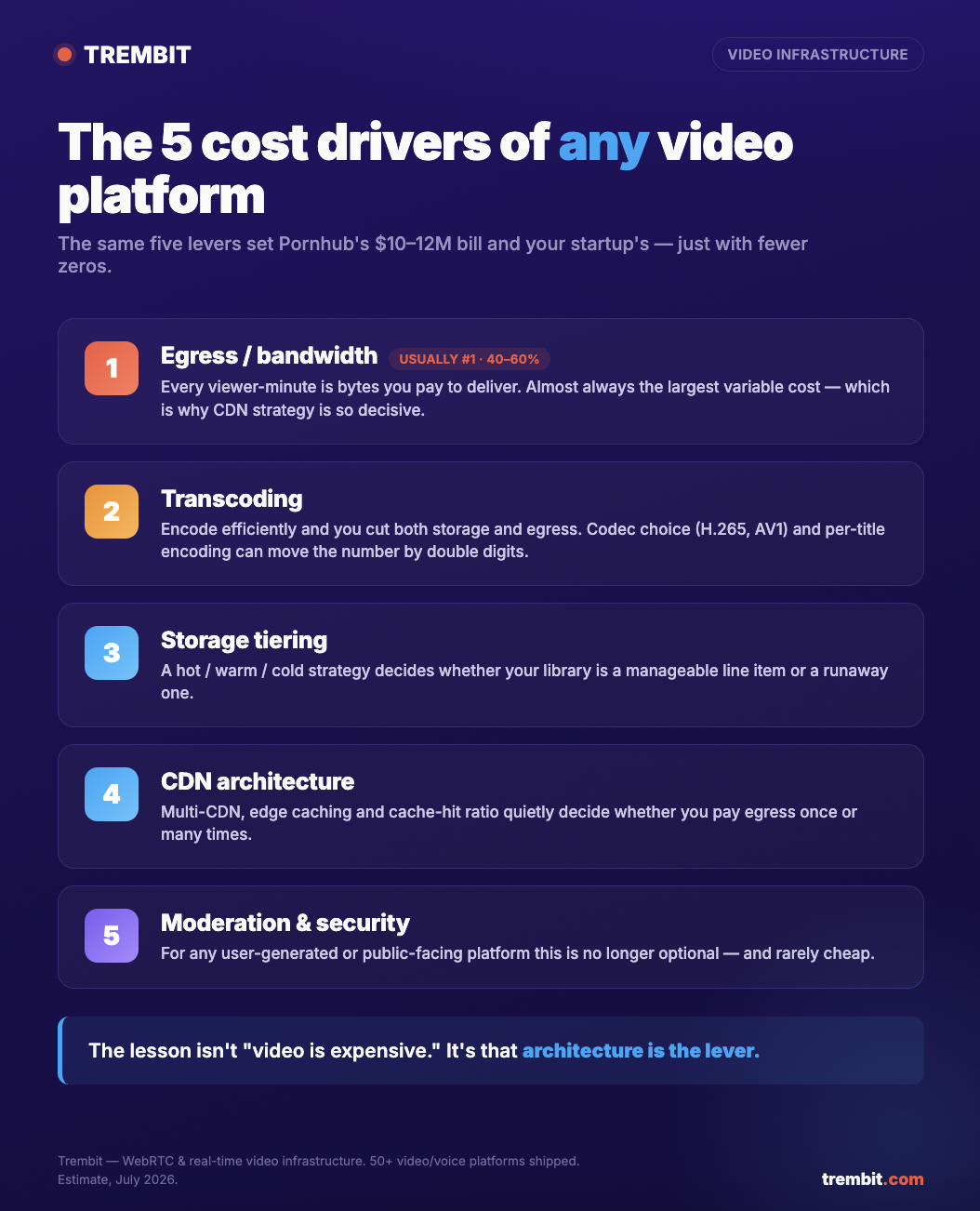
Here’s where the curiosity becomes useful. Video egress typically accounts for 40–60% of a streaming platform’s total infrastructure spend — and the exact same cost lines that add up to Pornhub’s $10–12M bill are the ones that will define your streaming product’s economics, just with fewer zeros. Whether you’re building telehealth video, a live-commerce app, an e-learning platform, or the next creator network, your infrastructure cost is driven by the same five levers:
- Egress / bandwidth — almost always your #1 variable cost. Every viewer-minute is bytes you pay to deliver, which is why CDN strategy is so decisive.
- Transcoding — encode efficiently and you cut both storage and egress; encode badly and both balloon. Codec choice (H.265, and AV1 where device support allows) and per-title encoding can move this number by double digits.
- Storage tiering — hot/warm/cold strategy decides whether your library is a manageable line item or a runaway one.
- CDN architecture — multi-CDN, edge caching, and cache-hit ratio quietly determine whether you pay egress once or many times.
- Moderation & security — for any user-generated or public-facing platform, this is no longer optional and rarely cheap.
One distinction that changes the whole cost model: VOD vs. real-time
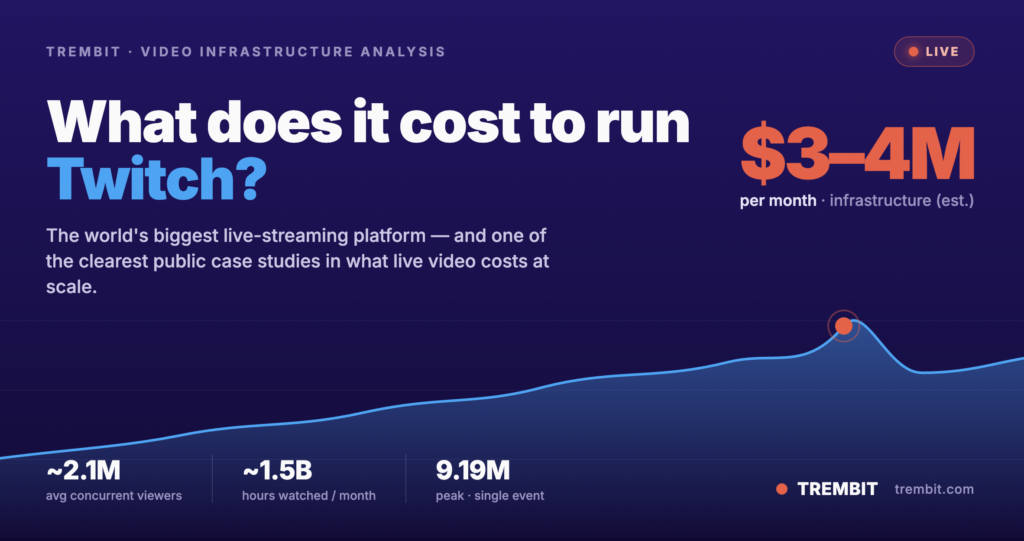
Pornhub is a VOD (video-on-demand) platform — files are uploaded once, encoded, and served from a CDN. That’s why egress and cache-hit ratio dominate its economics: the same file is delivered millions of times, and a good CDN strategy means you pay to push it out of origin once. A live platform like Twitch can’t lean on caching the same way — which is why its egress runs into the millions of dollars per month, not per year.
If your product is real-time — telehealth consultations, live auctions, interactive classrooms — the cost model is completely different, and this is where teams get burned by copying VOD math. Real-time video over WebRTC largely bypasses the traditional CDN: there’s no file to cache. Your cost drivers become TURN/relay bandwidth and media-server (SFU) compute, which scale with concurrent live participants, not with views of a stored file. Choosing HLS/DASH when you needed WebRTC (or the reverse) is one of the most expensive architecture mistakes we see — it can mean over-paying on the wrong cost line by an order of magnitude.
The lesson from the Pornhub math isn’t “video is expensive.” It’s that architecture is the lever. The companies that hit a 5%-of-revenue infrastructure ratio designed for it from day one — picked the right protocol, tuned their encoding ladder, and didn’t over-provision.
And the ones that didn’t? They’re the teams who call us when a video product is quietly burning cash on cloud bills. We inherit the codebase, find the wrong protocol or an un-tuned encoding ladder or single-CDN egress with a poor cache-hit ratio, and re-architect it.
In the rescues we scope, the pattern repeats: a mid-scale VOD product burning ~$40,000/month on single-CDN egress at a ~75% cache-hit ratio can typically get to ~$15,000–18,000/month — a 50–60% cut — by moving to multi-CDN with committed rates, lifting cache-hit into the 90s, and tuning the encoding ladder. That’s usually a single quarter of work.
Book a 30-minute scoping call → leave with a rough architecture sketch you can take to your engineering team. Tell us your use case (VOD, live, or real-time) and rough scale, and we’ll map your actual cost drivers — protocol, egress, encoding, CDN — and where the money will go. Book your scoping call — no obligation.
How we help teams build (and fix) video at scale
If this article is research for a project you’re scoping, these are the most relevant places to go next:
- VOD app development — if you’re building an on-demand video library and want the encode/storage/CDN economics right from the start.
- Live streaming app development — for real-time, low-latency delivery (auctions, events, live commerce).
- WebRTC engineering — when you need sub-second, peer-to-peer or SFU-based real-time video (telehealth, live auctions, interactive classrooms) where the cost model is compute, not CDN egress.
- AI content moderation — how we approach automated NSFW/illegal-content detection, the cost line that’s growing fastest for UGC platforms.
Related reading: What is VOD streaming?, our deep-dive on trimming transcode cost with the FFmpeg mpdecimate filter, and the same cost math for other platforms — Twitch, Zoom, and TikTok.
Frequently Asked Questions
How much does it cost to stream video at scale?
It depends almost entirely on egress (bandwidth). As a benchmark, a top-20 global video site like Pornhub spends an estimated $10–12 million a year on total infrastructure — around 5% of revenue — to move ~5 exabytes of data. For most products the dominant cost is the per-GB price of CDN egress, typically $0.0009–$0.08 per GB depending on volume and provider.
What is the biggest cost driver in video streaming?
Egress — the cost of delivering bytes from your CDN to viewers. It scales directly with viewer-minutes and video bitrate, so it’s the line item that grows fastest as you add users. Transcoding and storage matter, but bandwidth is almost always #1.
How much bandwidth does a high-traffic streaming site use?
At its last published figures (2019), Pornhub transferred 6,597 petabytes of data in a year, peaking at 209 GB/s. Current estimates put it around 5.0–5.5 exabytes per year. For comparison, a mid-sized streaming startup typically operates in the terabytes-to-low-petabytes range.
Can you reduce streaming costs with better architecture?
Yes — significantly. The biggest levers are codec efficiency (H.265/AV1, per-title encoding), CDN strategy (multi-CDN and high cache-hit ratios so you don’t pay egress repeatedly), storage tiering, and choosing the right delivery protocol for your latency needs. Architecture decisions made early are what separate a 5%-of-revenue infrastructure bill from a runaway one.
How much does it cost to build a video streaming platform?
Build cost and running cost are two different things. A custom video platform’s build typically ranges from tens of thousands of dollars for a focused MVP to several hundred thousand for a production system with adaptive streaming, recording, and compliance. The running cost is dominated by the five levers above — egress, transcoding, storage, CDN, and moderation — and is what compounds as you grow. The biggest savings come from getting the architecture and protocol right before launch, not after.
Does a better CDN architecture really lower streaming costs?
Yes — it’s often the single largest lever after protocol choice. A high cache-hit ratio means you pay to push a file out of origin once instead of repeatedly; multi-CDN routing lets you arbitrage rates and absorb regional spikes; edge caching cuts both latency and egress. For a VOD library, moving cache-hit ratio from ~80% to ~95% can cut origin egress dramatically. For real-time/WebRTC, by contrast, traditional CDN caching doesn’t apply — cost lives in TURN relay and SFU compute instead.
How is Pornhub’s $10–12M server cost estimated?
It’s an independent estimate, not a disclosed figure. It combines Pornhub’s last-published data-transfer numbers (6,597 PB in 2019), current traffic estimates (~5 exabytes/year), enterprise CDN egress pricing (~$0.0009/GB ≈ $5M/year for bandwidth), and standard add-ons for transcoding, storage, edge compute, security, and moderation — totaling roughly $10–12M, or ~5% of estimated $200M+ revenue.