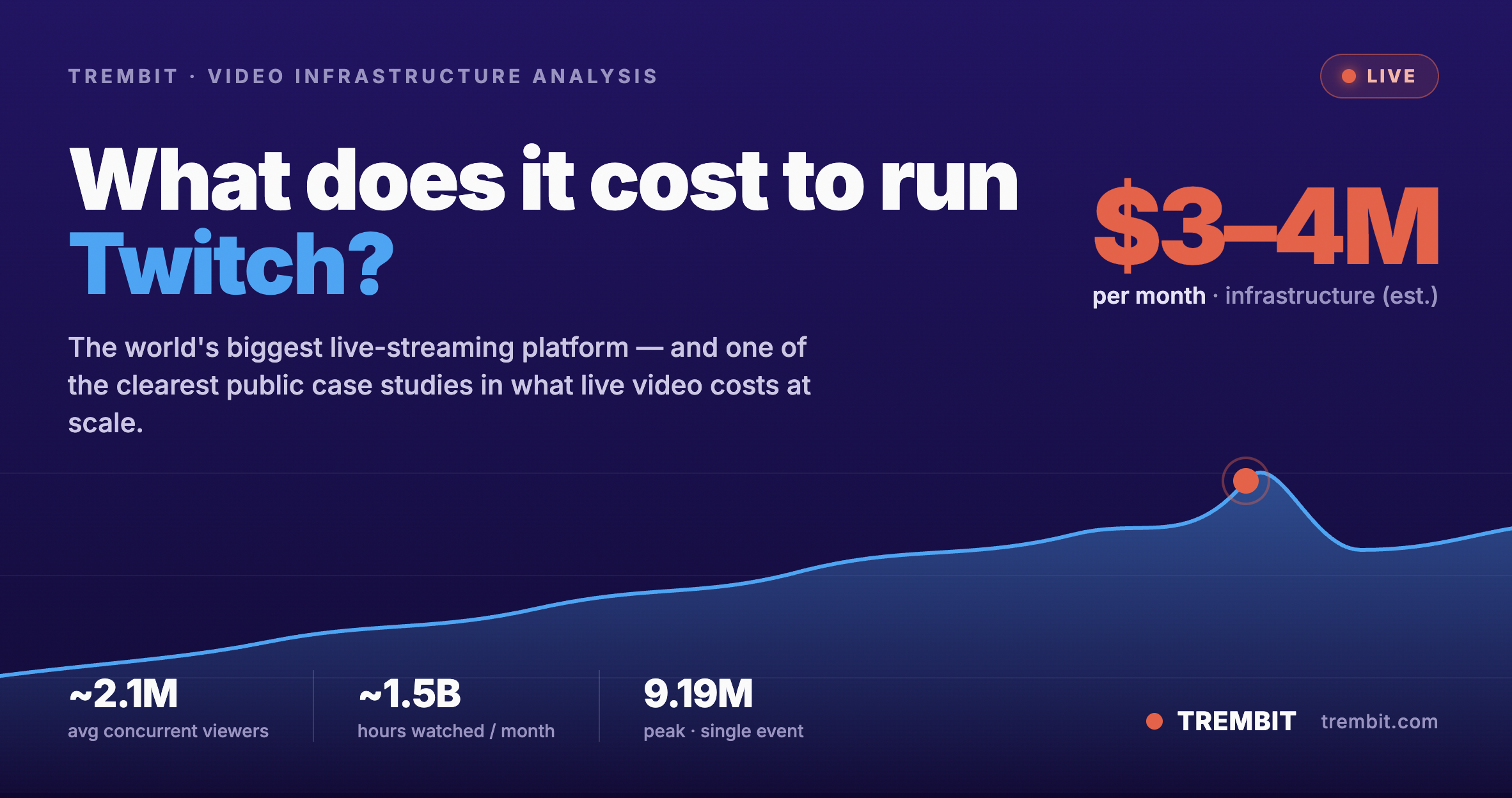
Running live-streaming infrastructure at Twitch’s scale costs an estimated $3–4 million per month (2026). At roughly 2.1 million average concurrent viewers and ~1.5 billion hours watched per month, data delivery (CDN/egress) is the dominant line at ~$1.5–2M/month, and server compute — driven mostly by live video transcoding — adds ~$1–1.5M/month. At this scale, bandwidth, not compute, is the biggest cost driver — which is why Amazon runs Twitch on its own global backbone and custom transcoding hardware instead of paying retail cloud rates.
Last updated: July 2026. Figures are engineering estimates derived from public TwitchTracker viewership data and current AWS/CDN pricing — not Twitch’s disclosed financials.
Twitch infrastructure cost breakdown (2026)
| Line item | Est. monthly cost | Primary driver |
|---|---|---|
| Data delivery (CDN / egress) | ~$1.5–2M | Streaming ~1.5B hours to ~2.1M concurrent viewers |
| Server compute (transcoding + origin/edge) | ~$1–1.5M | Live transcoding of ~90K channels into ~5 renditions |
| Storage (VODs, clips, highlights) | ~$100–300K | Retained past broadcasts + clips |
| Total (estimate) | ~$3–4M / month | Bandwidth-dominated |
Almost every gamer loves to watch how others play — which is a big part of why Twitch is still one of the most popular live-streaming platforms on the planet. But running it is not cheap. Let’s estimate what it actually costs, from the outside, using public numbers and normal cloud pricing.
According to TwitchTracker, in 2025–26 Twitch averaged around 2.1 million concurrent viewers and roughly 1.5 billion hours of watched content per month (about 19 billion hours a year). For context: when I first wrote this in 2019, those numbers were ~1.34M concurrent viewers and ~999M hours/month — so Twitch has grown ~50–60% on both, and the cost has scaled with it. Single-event peaks now reach far higher — La Velada del Año 5 hit 9.19 million concurrent viewers in July 2025.
How much does Twitch spend on bandwidth?
Twitch takes video from the broadcaster, transcodes it into HLS, and pushes it out to viewers through a global network of servers — a CDN (Content Delivery Network). Twitch can own those servers or rent them from a cloud provider; we can estimate either way. But first we need the amount of data moving to all those viewers.
Twitch allows a maximum bitrate of 6000 kbps, but plenty of streamers send less, and most viewers are served lower adaptive-bitrate renditions anyway. So I’ll use 3000 kbps (3 Mbps) as a blended average across all viewers — the same conservative assumption I used in 2019, and still reasonable.
- 3 Mbps ÷ 8 = 384 KB per second
- 384 KB × 60 × 60 = 1,350 MB per hour of viewing
- 1.5 billion hours × 1,350 MB = 2,025,000,000,000 MB of monthly traffic
- Convert it: ≈ 1.98 billion GB, or ≈ 1,886 Petabytes a month
Now dollars. At Twitch’s scale nobody pays retail CDN rates — Amazon’s list price for CloudFront egress runs $0.02–$0.085 per GB, which at ~1.98 billion GB would be an absurd $40M+/month. That’s precisely why Amazon (which owns Twitch) runs it on its own backbone. Hyperscale delivery lands closer to one-tenth of a cent per GB ($0.001) — the same effective rate I landed on in 2019.
- 1.98 billion GB × $0.001 = ≈ $2.0 million per month, just for data delivery.
Cross-check: independent live-streaming cost breakdowns put delivery to 1 million concurrent viewers at roughly $800/hour at typical CDN rates — so ~2.1M viewers ≈ $1,680/hour ≈ ~$1.2M/month. Same order of magnitude. Call bandwidth ~$1.5–2M/month.
How much does Twitch spend on servers and transcoding?
Data delivery is one thing; Twitch also needs compute to run the show. Two parts here: distribution servers and transcoding.
Distribution. Some vendors claim one server can serve 50,000 HLS viewers — but at 3 Mbps per stream you hit the network ceiling first. Amazon offers up to 20 Gbps per server on the right plans, and 20 Gbps ÷ 3 Mbps ≈ ~7,000 viewers per server. So:
- 2.1M viewers ÷ 7,000 = ~300 servers in the ideal case
- ×3 for redundancy and stable delivery = ~900 servers
- At ~$1.75/hour for a network-optimized instance, 900 × $1.75 × 730 hours ≈ ~$1.15M/month
Transcoding is the real compute cost. Every incoming stream is transcoded into several adaptive-bitrate renditions (source, 1080p, 720p, 480p, 360p…). With ~90,000 concurrent channels, that’s hundreds of thousands of transcode jobs running continuously — and per stream, delivery costs roughly 4× transcoding, which is another reason bandwidth dominates. Cloud transcoding at this scale is brutally expensive, so Twitch built custom in-house FPGA transcoders (see Twitch’s own engineering write-ups and its AMD VP9 hardware partnership) to bring the cost of transcoding every stream down to something sustainable.
Put together — distribution fleet plus a hardware-accelerated transcoding tier — server compute lands around ~$1–1.5M/month.
Why is bandwidth Twitch’s biggest cost?
Because it scales with every viewer, while transcoding scales with every stream — and there are far more viewers than streams. Delivery runs several times the cost of transcoding per stream, storage is comparatively small, and servers are network-bound long before they’re CPU-bound. The single biggest lever on a live platform’s bill is almost always egress bandwidth — your CDN and peering strategy — not how many boxes you run.
How much would it cost to build a Twitch-like platform?
Here’s the honest answer from someone who builds these systems: you are not going to pay Twitch’s bill, and you shouldn’t architect like Twitch until you’re forced to. A few things we tell clients:
- Egress is the cost, not the build. The one-time engineering to ship a solid live platform is a rounding error next to the monthly bandwidth once you have real viewers. Model your unit economics around cost per concurrent-viewer-hour from day one.
- You’ll pay retail CDN rates — so architecture swings your bill 5–10×. Twitch pays ~$0.001/GB because Amazon owns the pipes. You’ll pay $0.02–0.085/GB unless you negotiate commits, use multi-CDN, or add edge caching and smart peering.
- Don’t hand-roll transcoding. Twitch needed custom silicon; you almost certainly want a managed transcoding pipeline and a lean ABR ladder (don’t transcode six renditions for a 12-viewer stream).
- Pick the right protocol for your latency target. HLS is fine for one-to-many broadcast; if you need sub-second interactivity (auctions, betting, telemedicine, live shopping), that’s WebRTC territory — a different architecture with different costs.
This is the part most cost articles skip, and it’s exactly where the money is made or lost. Trembit builds and scales this kind of WebRTC and real-time streaming infrastructure — from architecture and cost modelling through to production — so you get Twitch-class reliability without Twitch-class waste. You’ll see the same cost pattern in our breakdowns of Zoom and TikTok infrastructure too.
The bottom line
By these estimates, Twitch spends on the order of $3–4 million a month to keep the lights on: roughly $1.5–2M on bandwidth, $1–1.5M on servers and transcoding, and $100–300K on storage. And that’s just infrastructure — it doesn’t include the SRE/DevOps team keeping it all alive 24/7, nor product, moderation, or content.
These are outside-in estimates from public viewership data and normal cloud pricing — not Twitch’s audited books. But the shape is the point: at scale, live streaming is a bandwidth business first, a compute business second.
Trembit is a WebRTC and real-time video/voice specialist — one of ~50 firms worldwide working exclusively in WebRTC — with 50+ video platforms shipped across healthcare, e-learning, and enterprise. Building something that needs to stream reliably at scale? We build and scale this kind of streaming infrastructure — let’s talk.
Frequently Asked Questions
How many concurrent viewers does Twitch have?
Around 2.1 million on average in 2025–26, with routine daily peaks well above that and single-event records up to 9.19 million (La Velada del Año 5, July 2025).
How much does Twitch spend on servers per month?
An estimated ~$1–1.5 million/month for server compute (2026), dominated by live video transcoding. Twitch built custom FPGA-based transcoding hardware in-house specifically to keep this cost down. Compute is the second-largest line — bandwidth is larger.
How much does Twitch spend on bandwidth and data delivery?
Bandwidth is the biggest line item — an estimated ~$1.5–2 million/month to deliver ~1.5 billion hours of live video to ~2.1 million concurrent viewers. Because Amazon owns the CDN and backbone, Twitch pays far below retail cloud egress rates (which would push this above $20M/month).
What does it cost to build a Twitch-like streaming platform?
It scales with concurrent viewers and features. The dominant ongoing costs are egress bandwidth, live transcoding, and storage — not the initial build. A smaller platform runs at a fraction of Twitch’s cost. Trembit builds and scales this WebRTC/streaming infrastructure for live platforms.
What drives streaming infrastructure cost at scale?
Egress bandwidth (CDN delivery) and live transcoding dominate; server compute is secondary and storage is comparatively small.