A real-time AI development company builds AI systems that run inside a live, low-latency media stream — a voice agent that holds a phone call, AI analysis of a live video feed, on-the-fly translation of a video consultation — as opposed to AI that processes data asynchronously, like a chatbot answering typed text, an offline document pipeline, or a batch image generator. The distinction is not cosmetic. Real-time AI inherits every constraint of live media transport — jitter, packet loss, sub-second latency budgets, barge-in and turn-taking — on top of the AI model’s own inference latency. That combined constraint is one most general AI development companies have never engineered around, because a chatbot that answers in two seconds feels fine while a voice agent that answers in two seconds feels broken. This guide compares nine companies that build in that intersection as they stand in 2026, and gives you the criteria to shortlist against your own latency and compliance budget rather than a generic “top AI companies” ranking.
Key takeaways
- Real-time AI is a distinct discipline from “AI in general” and from “WebRTC in general.” It sits at the intersection: AI models running inside a live media transport layer, where the transport’s latency budget and the model’s inference cost have to be solved together. A team strong at one and weak at the other ships a voice agent that transcribes perfectly but feels robotic — or a slick media pipeline with a model that hallucinates.
- Transport-layer latency engineering — not model choice — is usually what decides whether a voice agent feels human. The difference between a 300 ms and a 1,200 ms response is rarely the LLM; it’s jitter-buffer tuning, endpointing, turn-taking, and where in the pipeline you interrupt. Ask a vendor how they measure and cut end-to-end latency, not just which model they call.
- Regulated real-time AI is a different compliance problem from batch AI compliance. Audio and live video are protected health information the instant they leave the device; a managed API that is fine for text may have no Business Associate Agreement covering its audio modality. Compliance for streaming data is architected in, not added at the end.
- Build-vs-buy is the first fork. Below modest call volumes, a managed voice-AI platform (Vapi, Retell, LiveKit Cloud) usually wins on speed and cost; past a crossover point, or when you need on-prem/VPC deployment or behavior the platform won’t expose, a custom build wins. Most buyers start managed and migrate.
- This list spans boutique real-time specialists to enterprise-scale generalists with a real-time vertical, grouped by specialization lane rather than a numbered ranking — so you can match a company to whether you’re building a voice agent, live video AI, real-time translation, or all three.
Already know you need a custom build and here for the shortlist? Skip to the comparison table and company profiles. Scoping the category for the first time? Read what a real-time AI company actually is and how to evaluate one first — that’s the part that stops a bad hire.
What Is a Real-Time AI Development Company?
A real-time AI development company builds AI that operates within a live media stream under a sub-second latency budget: voice AI agents that listen and respond on a call, computer vision that analyzes a live video feed as it’s broadcast, and speech pipelines that transcribe or translate speech while a conversation is still happening. The defining constraint is that the AI can’t take its time. A batch model can spend thirty seconds producing a better answer; a real-time model competes with human conversational reflexes, where anything past roughly a second of silence reads as a glitch. Building for that means engineering the AI and the media transport as one system — the WebRTC or streaming layer that carries the audio and video, the endpointing that decides when a speaker has finished, the buffering that absorbs network jitter, and the model inference itself all share a single latency budget measured in milliseconds (RFC 8825 is the WebRTC protocol overview).
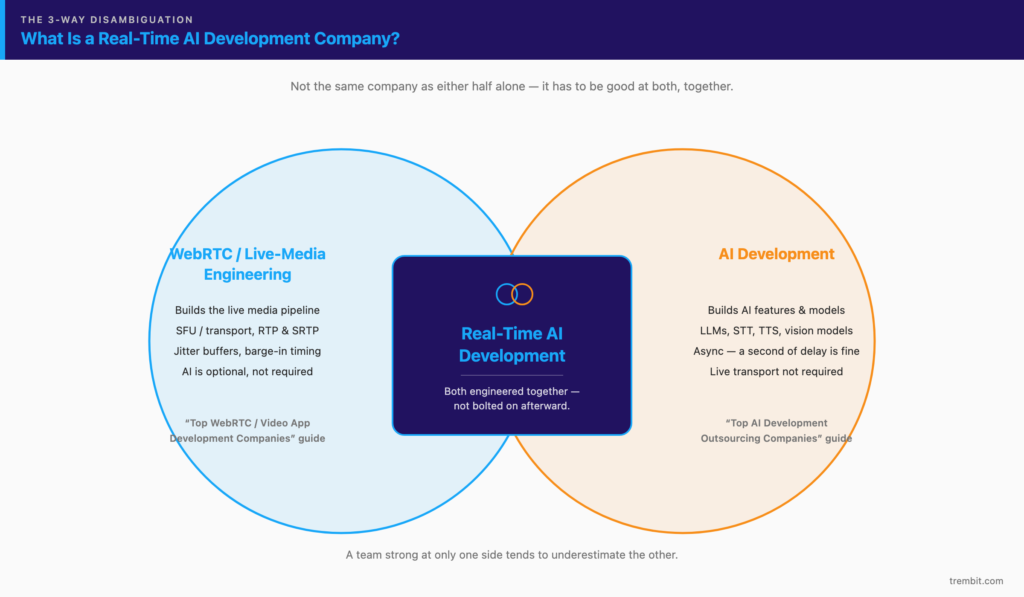
This is where most buyers get the category wrong — so here is the three-way distinction that matters. A real-time AI development company is not the same as a general WebRTC/video development company, which builds the live media pipeline itself, with or without any AI in it (if that’s your need — a video calling app, a streaming platform, an SFU build — see our guide to the top WebRTC and video app development companies). And it is not the same as a general AI development company, which builds AI features — chatbots, document processing, recommendation engines, batch computer vision — that never have to survive a live transport layer (if that’s your need, see our guide to the top AI development outsourcing companies for SaaS and media startups). A real-time AI company sits at the intersection of those two: it has to be good at the media transport and good at the AI, because the hard problems only appear where the two meet. A team that has only ever done one side will tend to underestimate the other.
Why does that intersection produce hard problems a specialist in either half wouldn’t hit? Because the failure modes are cross-layer. A voice agent that “feels laggy” is often not a slow model at all — it’s an endpointing threshold set too conservatively, or a jitter buffer tuned for a network the agent never runs on, or a barge-in handler that can’t interrupt the text-to-speech fast enough when the user starts talking. Diagnosing that requires reading both the model traces and the RTP timing, and a team organized around only one of those will keep optimizing the wrong layer. That is the specific competence this category is about.
How Do You Evaluate a Real-Time AI Development Company?
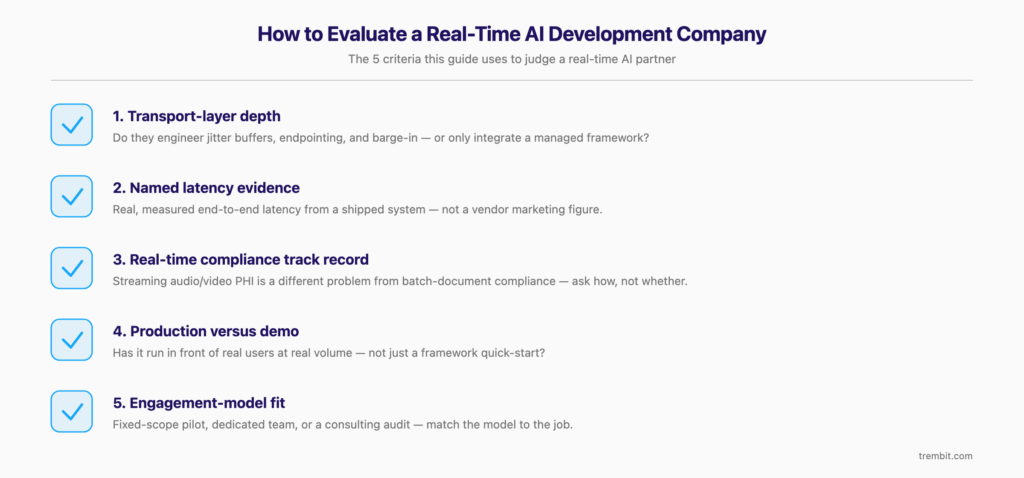
Judge a real-time AI partner on five criteria, roughly in priority order. This is what separates a team that has shipped production real-time AI from one that has wired a managed framework to an LLM and called it a voice agent.
1. Transport-layer depth. Has the team actually engineered around jitter buffers, endpointing, and barge-in — and, for multi-party or live-video use cases, SFU topology — or do they only integrate a managed framework (LiveKit Agents, Pipecat, Daily) at the application layer and inherit whatever latency behavior it ships with? Both can produce a demo. Only the first can fix the demo when it stutters on a real mobile network. Ask where in the stack they debug when a call feels slow: a team that answers “we tune the endpointing and the jitter buffer, and we measure RTP timing” is engineering the transport; a team that answers “we switch to a faster model” is not. This is the exact gap our own real-time AI and WebRTC engineering work exists to close, and it’s the single strongest predictor of whether a voice agent will feel human in production rather than in a controlled demo.
2. Named latency evidence. Ask for real, measured end-to-end latency numbers from a system that has run in front of users — mouth-to-mouth or speech-to-first-response in milliseconds, and how it was measured — not a vendor marketing figure. A team that has shipped will talk about their latency budget in specifics (how many milliseconds go to STT, to the LLM, to TTS, to network) because they’ve had to defend it. A team that hasn’t will quote the model provider’s benchmark. Turn-taking is usually the hidden cost: in one production voice-agent deployment we’ve seen, the thing that determined whether calls completed wasn’t transcription accuracy at all — it was the turn-taking model deciding when to speak, because a bot that talks over people or leaves awkward silences gets hung up on regardless of how well it understands the words. The mechanics of that are worth understanding before you evaluate anyone; our breakdown of voice AI agents on WebRTC covers the latency, barge-in, and turn-taking layer in depth.
3. Regulatory track record for real-time data specifically. Compliance for streaming audio and live video is a different problem from compliance for a batch document pipeline, and a vendor’s experience with the latter does not transfer automatically. The moment audio or video leaves a patient’s device it is protected health information, and the entire real-time path — speech-to-text, the model, text-to-speech, any buffering — has to stay inside the compliant boundary with no persistence where the regime forbids it. A concrete, live example: a managed API can be fine for text and still lack a Business Associate Agreement that covers its audio modality, which quietly disqualifies it for healthcare voice (HHS guidance is explicit that there’s no “HIPAA-compliant” product seal — it’s a property of the deployment). We wrote up that specific trap in our guide to the OpenAI Realtime API, WebRTC, and the HIPAA audio gap. Ask a vendor to explain how they keep streaming PHI compliant, not whether they have a badge.
4. Production versus demo. Ask to see something that has run in front of real users at real volume, not a framework quick-start or a scripted demo. Real-time AI demos beautifully and breaks in production, because the demo runs on a clean network with a cooperative speaker and the production system runs on a phone in a moving car with a toddler in the background. The questions that separate the two: what happened to latency and accuracy under a bad network; how the system handles a user who interrupts; what the fallback is when the model returns low confidence; and what broke the first time it met real users. A team that can answer those has shipped; a team that only has a demo has not yet met the hard part.
5. Engagement-model fit. Match the model to the job. A fixed-scope project suits a well-defined pilot — one voice agent, one language, one workflow. A dedicated team suits a real-time product where the AI is the core value and you need the same engineers for years as the model landscape shifts underneath you. And if you already have engineers and need a latency audit, an architecture review, or a compliance assessment rather than a full build, that’s a consulting-shaped engagement — a sharper, cheaper way to de-risk a decision before you commit to a build.
Top Real-Time AI Development Companies in 2026
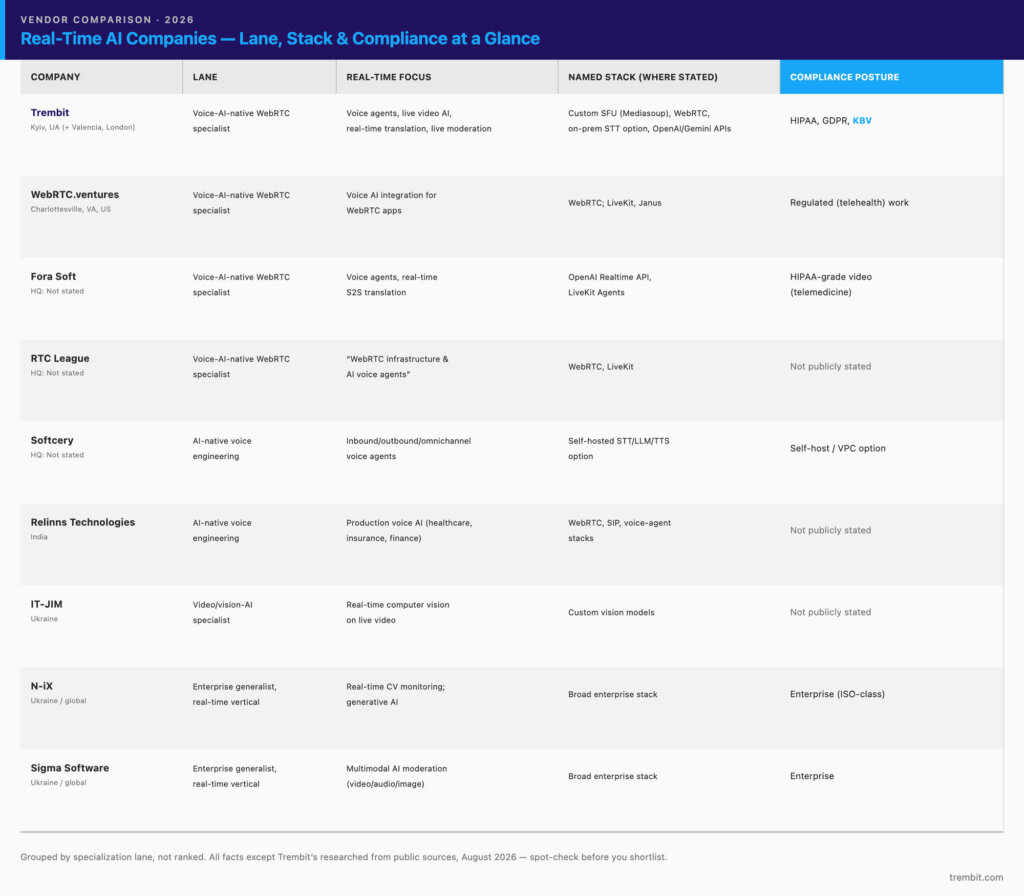
The nine companies below are grouped by specialization lane — voice-AI-native WebRTC specialists, AI-native voice engineering teams, video/vision-AI specialists, and enterprise generalists with a real-time vertical — not ranked by a numbered “best” score. Lanes are more useful to a buyer than a leaderboard: they tell you what kind of real-time AI each company is actually built to ship, which is what you’re matching against your own project. Trembit is included on the same terms as everyone else, with the same profile format.
A note on sourcing: every company here except Trembit was researched from public web sources in August 2026, not a first-party directory pull, so each non-Trembit entry is reported as likely rather than verified — team sizes, HQ precision, client lists, and any metric drift, so spot-check anything that matters to your decision against the company’s current site or Clutch profile before you shortlist. No pricing appears anywhere; see what it costs to build or run real-time AI for the cost drivers instead of stale bands.
| Company | HQ | Lane | Real-time focus | Named stack (where stated) | Compliance posture |
|---|---|---|---|---|---|
| Trembit | Kyiv, UA (+ Valencia, London) | Voice-AI-native WebRTC specialist | Voice agents, live video AI, real-time translation, live moderation | Custom SFU (Mediasoup), WebRTC, on-prem STT option, OpenAI/Gemini APIs | HIPAA, GDPR, KBV |
| WebRTC.ventures | Charlottesville, VA, US | Voice-AI-native WebRTC specialist | Voice AI integration for WebRTC apps | WebRTC; LiveKit, Janus | Regulated (telehealth) work |
| Fora Soft | Not stated | Voice-AI-native WebRTC specialist | Voice agents, real-time S2S translation | OpenAI Realtime API, LiveKit Agents | HIPAA-grade video (telemedicine) |
| RTC League | Not stated | Voice-AI-native WebRTC specialist | “WebRTC infrastructure & AI voice agents” | WebRTC, LiveKit | Not publicly stated |
| Softcery | Not stated | AI-native voice engineering | Inbound/outbound/omnichannel voice agents | Self-hosted STT/LLM/TTS option | Self-host / VPC option |
| Relinns Technologies | India | AI-native voice engineering | Production voice AI (healthcare, insurance, finance) | WebRTC, SIP, voice-agent stacks | Not publicly stated |
| IT-JIM | Ukraine | Video/vision-AI specialist | Real-time computer vision on live video | Custom vision models | Not publicly stated |
| N-iX | Ukraine / global | Enterprise generalist, real-time vertical | Real-time CV monitoring; generative AI | Broad enterprise stack | Enterprise (ISO-class) |
| Sigma Software | Ukraine / global | Enterprise generalist, real-time vertical | Multimodal AI moderation (video/audio/image) | Broad enterprise stack | Enterprise |
All company facts except Trembit’s were researched from public sources in August 2026 and are reported as the company states them; treat sizes, certifications, and client claims as likely-not-verified and re-check before you shortlist. Compliance is reported only where a firm states or implies it; several need verification.
Trembit — voice-AI-native WebRTC specialist (Kyiv, Ukraine)
Lane: Voice-AI-native WebRTC specialist. HQ: Kyiv, Ukraine, with presence in Valencia and London.
Trembit builds real-time AI at the WebRTC transport layer as its core business — a specialist that has worked in real-time video and voice since 2009, across 50+ projects, and one of roughly 50 firms worldwide that work exclusively in real-time video and voice rather than treating it as one AI service among many. The distinguishing choice is that the AI and the media pipeline are engineered together: engineers debug at the SDP, ICE, RTP, and SRTP layer, which is what lets them attack a “laggy agent” as a transport problem when that’s what it actually is, rather than only swapping models. The real-time AI work spans four lanes of this query family — voice AI agents (latency, barge-in, and turn-taking engineering), live video analytics, AI content moderation on live streams, and real-time in-call translation.
Verticals: healthcare/telemedicine, e-learning, live commerce, HR/staffing. Compliance: HIPAA, GDPR, and KBV — the German statutory-telemedicine standard, rare among real-time AI teams, earned by taking a psychotherapy video platform through Germany’s two-part IT-security-and-data-protection certification.
Proof points (each from a single production engagement, not a standing metric):
- Voice AI, measured. An autonomous phone-screening voice bot for a staffing company (built on OpenAI/Gemini APIs) delivered 10× screening throughput and same-day turnaround in that one deployment — and the engineering lesson from it is the one that matters for evaluating any voice vendor: turn-taking, not transcription accuracy, was what determined whether candidates stayed on the call, so the team built a multi-signal turn-taking model rather than relying on a framework default.
- Real-time translation, in-call, compliant. A real-time in-call translation layer for a healthcare video platform (anonymized), built on a custom Mediasoup SFU with RTP-level audio interception (ASR → NMT → TTS), delivered sub-second dubbed translation inside an encrypted, HIPAA/GDPR-compliant session with zero audio persistence.
- Real-time transcription, on-prem. A context-aware streaming speech-to-text system for a media production company runs at 1–2 second latency on the client’s own GPU infrastructure, with no audio sent to external services — a data-residency proof point for teams that can’t ship audio to a cloud API.
- Live video moderation. A real-time NSFW/illegal-content detection pipeline for a social platform classifies uploaded images and live-stream frames within the streaming latency budget, on the platform’s own infrastructure.
You can see the scope of this work on our real-time AI and WebRTC engineering services page.
WebRTC.ventures — voice-AI-native WebRTC specialist (Charlottesville, VA, USA)
Lane: Voice-AI-native WebRTC specialist. HQ: Charlottesville, Virginia, USA.
WebRTC.ventures is a WebRTC-exclusive agency that has moved hard into voice AI — it published a sustained run of dedicated voice-AI production articles through the first half of 2026 and runs a dedicated “Voice AI Integration Services for WebRTC Applications” offering. On this specific term it is the most direct positioning competitor: a US-based specialist that, like Trembit, comes at voice AI from the WebRTC transport side rather than the model side. It does regulated (telehealth-type) work; confirm explicit compliance certifications for a compliance-critical build.
Fora Soft — video/RTC specialist since 2005 (voice AI + real-time translation)
Lane: Voice-AI-native WebRTC specialist. Operating since: 2005 (HQ not publicly stated).
Fora Soft has focused on video, real-time, and (more recently) AI software since 2005. On real-time AI specifically it publishes detailed OpenAI Realtime API production guides, a LiveKit AI-agents guide, and real-time speech-to-speech translation vendor benchmarks — strong on the API and framework specifics. Per the demand-signals research behind this piece, its public material is thinner on transport-layer mechanics (jitter, endpointing, SFU-level work) than on API integration, so probe that layer if it’s central to your build. A candidate for buyers who want a long-tenured specialist fluent in the current real-time AI API landscape.
RTC League — WebRTC infrastructure + AI voice agents
Lane: Voice-AI-native WebRTC specialist. HQ: not publicly stated.
RTC League markets itself directly at this intersection: “WebRTC infrastructure & AI voice agents,” combining WebRTC engineering, AI agents, and LiveKit expertise under one roof. That is the closest one-line positioning match to the category this guide describes. It is also the entrant with the thinnest public track record of the nine here, so treat the positioning claim as a starting point and ask for concrete client evidence and team size before you weight it equally with the more established specialists.
Softcery — AI-native voice-agent engineering (self-hosted option)
Lane: AI-native voice engineering. HQ: not publicly stated.
Softcery approaches real-time AI from the AI-engineering side rather than the WebRTC side: it specializes in production voice agents — inbound, outbound, and omnichannel — and states it has delivered 20+ voice-AI systems across legal, hospitality, e-commerce, and insurance. The differentiator worth noting is that it offers self-hosted STT/LLM/TTS for teams that need on-prem or VPC deployment, which matters when data can’t leave your environment. A fit for buyers who want a voice-agent-focused team and value a self-hosting path.
Relinns Technologies — production voice AI with a WebRTC specialization (India)
Lane: AI-native voice engineering. HQ: India.
Relinns Technologies is a general AI development company with a genuine WebRTC voice-AI specialization — it has published extensively on the “WebRTC vs. SIP for AI voice agents” transport question, which is the right question, and builds production voice AI for healthcare, insurance, and finance clients. A candidate where you want a larger AI shop that has nonetheless engaged with the real-time transport layer rather than treating voice as a pure API call. Confirm the depth of the WebRTC work relative to the broader AI practice for a transport-critical build.
IT-JIM — real-time computer vision / live-video analytics (Ukraine)
Lane: Video/vision-AI specialist. HQ: Ukraine.
IT-JIM represents the video-AI, not voice-AI, side of this query family: a computer-vision specialist working on real-time analysis of live video streams — motion detection, activity tracking, and behavior recognition on live feeds. If your real-time AI problem is vision rather than voice (analyzing what’s happening in a live stream in real time rather than conversing with a caller), this is the lane, and IT-JIM is a specialist example of it.
N-iX — enterprise generalist with a real-time vertical (Ukraine / global)
Lane: Enterprise generalist with a real-time vertical. HQ: Ukraine / global; large-scale (1,000+ engineers).
N-iX is a large outsourcing firm included here as the enterprise-scale contrast to the boutiques above it. Its relevant real-time work is in computer vision and real-time monitoring — for example, a real-time package-tracking and damage-detection system for a Fortune 100 client — alongside broader generative-AI delivery in banking. It is the option for buyers who need enterprise scale, procurement maturity, and a real-time computer-vision capability inside a much larger engagement, rather than a focused real-time AI specialist. Match it to scale needs, not to depth of real-time specialization.
Sigma Software — multimodal AI moderation and clinical CV (Ukraine / global)
Lane: Enterprise generalist with a real-time vertical. HQ: Ukraine / global.
Sigma Software is included for the moderation and multimodal angle: it does multimodal AI moderation across video, audio, and images, plus computer-vision and BI work in clinical imaging. That overlaps the live-moderation and healthcare-AI lanes, which makes it a relevant enterprise-tier comparison for buyers whose real-time AI need is content safety across mixed media at scale. As with N-iX, weigh it as a large generalist with a relevant vertical rather than a real-time-first specialist.
Real-Time AI Agency or a Managed Voice AI Platform (Vapi, Retell, LiveKit Cloud)? Which Do You Need?
Buy a managed voice-AI platform when you’re validating a use case or running modest volume, and speed to launch matters more than control or per-call economics; hire a real-time AI development company to build custom when volume makes the per-minute bill hurt, when you need on-prem or VPC deployment for compliance, or when you need behavior the platform won’t expose. It is not a religious choice — most teams start on a managed platform and migrate once one of those thresholds is crossed, and a good agency will tell you when the platform is genuinely the right call for your stage.
The shape of the crossover, from the demand-signals research behind this piece: below roughly 10,000 minutes/month, managed platforms tend to win on total cost and time-to-launch; well above it, a custom build can undercut per-call platform pricing substantially at scale. Treat that as the order of magnitude to model, not a precise line — your real crossover depends on your call length, your concurrency, and how much of the stack you self-host.
What a custom build actually buys you, concretely, is control over the layers a platform hides. In one production voice-AI deployment — an autonomous phone-screening bot for a staffing company — the feature that determined success wasn’t the model or the transcription; it was turn-taking, engineered from a multi-signal model (audio energy, speech cadence, syntactic completeness, prosody) rather than a framework’s default endpointing. That deployment reached 10× screening throughput and same-day turnaround, but the transferable point is architectural: the thing that made it work was a piece of real-time behavior a managed platform doesn’t let you tune. If the behavior that makes or breaks your product lives in a layer the platform owns, that’s the signal to build.
The stack itself is not the vendor decision. Managed platforms (Vapi, Retell, LiveKit Cloud), open frameworks (LiveKit Agents, Pipecat), and managed model APIs (the OpenAI Realtime API) are the tools a build sits on — a development company will use them where they fit and replace them where they don’t. The question this section answers is whether you buy the finished product or hire someone to build one; the framework names are downstream of that.
Weighing build-vs-buy for a specific product and want a second opinion before you commit? That’s the kind of decision our real-time AI team pressure-tests — no pitch, just the trade-offs against your call volume and compliance scope.
What Does It Cost to Build or Run Real-Time AI Infrastructure?
There’s no honest single price for real-time AI — the cost is driven by a handful of variables, and any firm quoting a flat number before understanding them is guessing. The drivers that actually move the budget:
- Model and API choice. A managed model API (OpenAI Realtime, others) priced per minute or per token is cheap to start and scales with usage; self-hosted open models cost more up front and less per call at volume. The choice of STT, LLM, and TTS each carries its own latency and cost profile, and they compound.
- Self-hosted vs. managed STT/LLM/TTS. Running the speech and language stack on your own infrastructure buys data residency and unit economics at scale at the cost of MLOps burden; using managed services buys speed at a recurring per-use cost. This is often the single largest lever.
- Transport and hosting. A custom real-time build carries SFU/media-server hosting, TURN relay, and the compute for real-time inference — a cost a managed platform folds into its per-minute price and a custom build makes explicit.
- Compliance scope. HIPAA, GDPR, and especially data-residency or KBV-class requirements add architecture, audit, and documentation work, and for streaming PHI they shape the build from the first sprint rather than bolting on at the end.
- Custom vs. platform. The build-vs-buy fork above is also the biggest cost fork: platform speed and low up-front cost versus custom control and lower marginal cost at scale.
For a full component-by-component breakdown of what it actually costs to run a voice-AI system — model, transport, STT/TTS, and the costs that surface late — see our guide to the cost of running a voice AI platform. On public pages we describe drivers rather than dollar figures, then quote against your specific scope after a call.
Voice AI, Video AI, or Both? Matching a Vendor to Your Real-Time AI Use Case
This guide is deliberately a vendor comparison. If you’d rather have the deep technical or compliance guide for a specific real-time AI problem than a company list, these are the focused walkthroughs behind each lane:
- Voice AI agents — latency, barge-in, turn-taking. The mechanics that decide whether a voice agent feels human: voice AI agents on WebRTC.
- OpenAI Realtime API in production + the HIPAA audio gap. Using the managed API in a live pipeline, and the compliance trap in its audio modality: OpenAI Realtime API, WebRTC, and HIPAA.
- Real-time video analytics and auto-highlights. AI reading a live stream as it’s broadcast: real-time video analytics on a live stream.
- AI content moderation on live video. Detecting prohibited content within the streaming latency budget: the AI content moderation pipeline.
- AI clinical scribe inside a telemedicine call. Real-time documentation inside a compliant clinical video session: AI clinical scribe for telemedicine under HIPAA.
- Real-time translation architecture — STT→MT→TTS vs. end-to-end speech-to-speech. How the two translation architectures trade off latency and quality: real-time translation architecture.