By Eugenia Nemkova, Marketing Director at Trembit · Last updated: 30 September 2026
A live streaming app development company is a software engineering firm that builds the infrastructure and applications behind real-time video broadcasting, from sub-second WebRTC delivery for interactive use cases to broadcast-scale HLS for large watch-only audiences. Buyers hire these firms for three things: the delivery pipeline, the broadcaster and viewer apps on web, iOS, and Android, and the interaction layer (chat, bidding, shoppable overlays, leaderboards) that has to stay in sync with the video.
What this means for your product: the partner you choose decides whether your viewers can act on the stream (bid, buy, trade, bet) or only watch it, what each viewer costs you to serve, and whether the platform holds when one stream suddenly draws a crowd. Get the latency tier or the interaction layer wrong and the usual outcome is a rebuild, not a patch. This 2026 guide compares nine companies across the US, Europe, and Asia against the criteria that predict those outcomes.
Short on time? Jump to the comparison table, or go straight to a free architecture call if you already have a decision to pressure-test. Choosing your first streaming vendor? Read how to evaluate one first.
Key takeaways
- Latency tier is the first architectural decision, not a vendor default. Real-time (under 1 second, WebRTC), low-latency (roughly 2–5 seconds, LL-HLS/CMAF), and broadcast (roughly 5–30 seconds, HLS/DASH) have different costs and different ceilings on what viewers can do. A firm that pushes one tier for every use case is selling its stack, not solving your problem.
- Interactive specialists and broadcast shops are different vendors. Delivering sub-second video to thousands of viewers who bid, trade, or buy is a different engineering problem from shipping an OTT app to millions who only watch. Ask which one a firm has actually put into production.
- The interaction layer is where most streaming products break, and most lists ignore it. When a bid, a product card, or a chat message lands out of step with the video, the product feels broken even if the stream is fine.
- Custom build and managed platforms are not either/or. Managed platforms (Red5 Cloud, Dolby OptiView, Agora, Wowza) get you to market fast; custom and self-hosted infrastructure usually wins on cost and control at predictable scale. Many strong builds start on one and migrate.
- Companies are grouped by specialization depth, not ranked. Streaming platforms, including our long-standing partner Red5, sit in a separate section because they are a different purchase.
What Does a Live Streaming App Development Company Do?
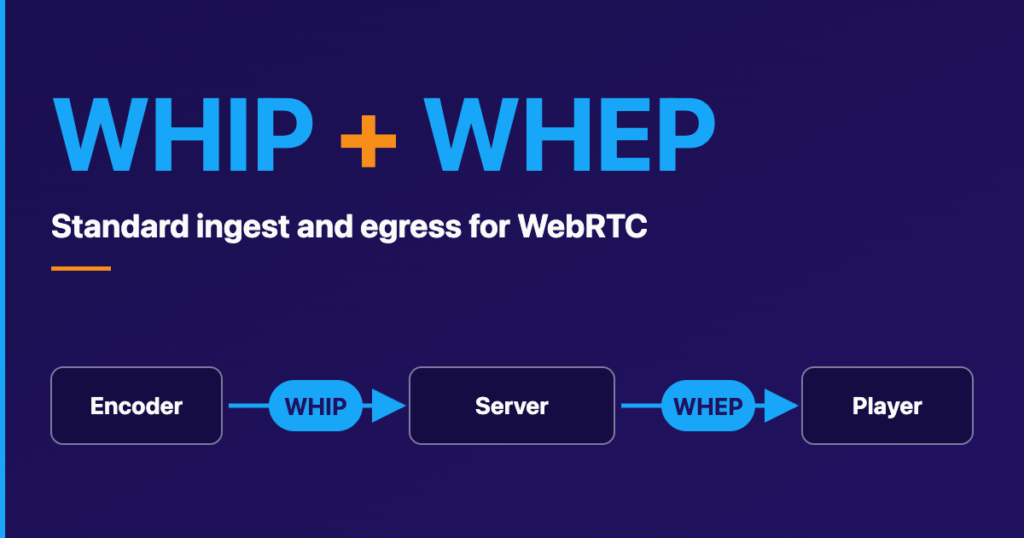
A live streaming app development company designs, builds, and often operates the software that captures video from a broadcaster and delivers it to an audience as it happens. The player is the visible part. The engineering is the delivery layer underneath it: ingest (RTMP, SRT, or WebRTC via WHIP, standardized as IETF RFC 9725), transcoding into an adaptive bitrate ladder, and distribution over one of two very different transports. For large watch-only audiences that transport is segment-based HTTP streaming (HLS, IETF RFC 8216, or its Low-Latency HLS extension). For interactive audiences it is WebRTC, the W3C/IETF real-time media standard.
What buyers are really choosing between is three delivery modes:
- Custom build. The firm architects the pipeline end to end, on self-hosted media servers (Janus, mediasoup, LiveKit, Red5 Pro, Wowza Streaming Engine) or cloud media services you own. This gives you the most control over latency, unit cost, and data handling.
- Managed-platform integration. The firm builds your apps and interaction layer on a hosted real-time platform such as Red5 Cloud, Dolby OptiView, or Agora, which runs the media edge for you.
- SDK wrapping. The firm drops a CPaaS SDK into an app with minimal custom work. It is fine for a prototype, and it is where most “we need to rebuild” conversations start.
If your need is general video calling or conferencing rather than streaming to an audience, our guide to WebRTC and video app development companies is the better starting point.
How Do You Evaluate a Live Streaming Development Company?
Judge a streaming partner on five criteria, roughly in priority order. Each one is something a firm can prove, not just claim.
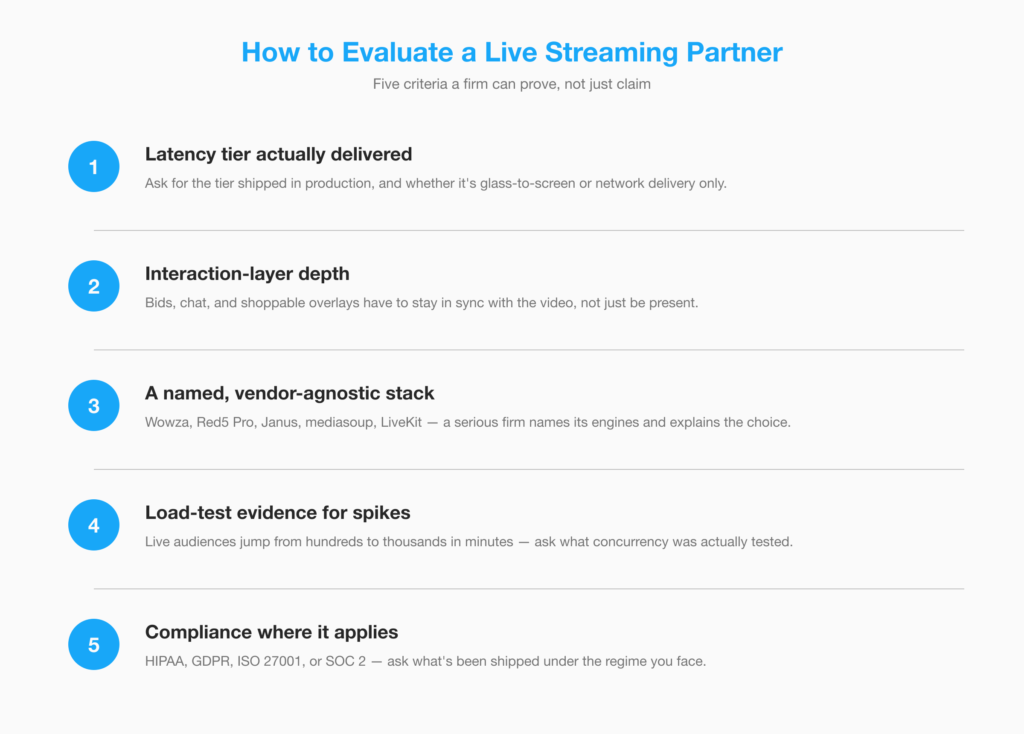
1. The latency tier they have actually delivered. “Low latency” means anything from 200 milliseconds to 5 seconds, depending on who is writing the page. Ask for the tier they shipped in production, the protocol behind it, and whether the number is glass-to-screen (camera to viewer display, which includes capture and encoding) or network delivery only. The two differ, and vendors rarely say which one they are quoting. A firm that has only shipped HLS will describe sub-second WebRTC as easy. A firm that has shipped it will tell you what it costs per viewer.
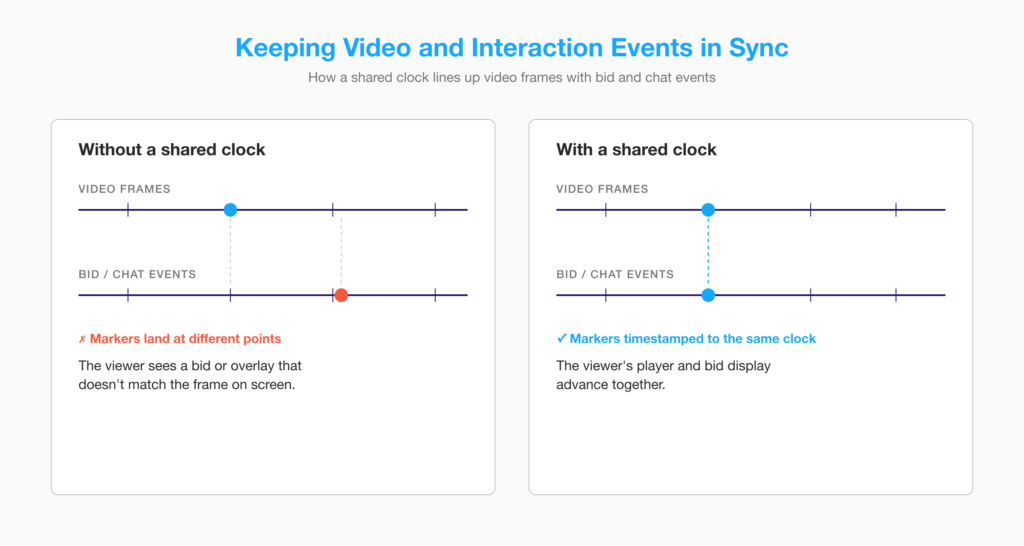
2. Interaction-layer depth. This is the criterion most streaming shops treat as an afterthought, and the one that decides whether auctions, live commerce, trading, and interactive fitness work. The video and the transactional state travel on different paths with different latencies, so keeping them aligned is its own engineering problem. On a live horse auction Trembit built, the fix was a synchronization layer that timestamps video frames and bid events against a shared clock, so each viewer’s player and bid display advance together. On a live-shopping platform, it was timestamp markers embedded in the stream metadata, so product overlays appear on the frame where the seller shows the product rather than two seconds later. Ask a vendor how they solved that problem, not whether they “support chat.”
3. A named, vendor-agnostic stack. A serious firm names the engines it runs (Wowza, Red5 Pro, Janus, mediasoup, LiveKit, Dolby OptiView, Agora) and explains why it would pick one for your case. Newer protocol support is a useful signal: WHIP/WHEP for WebRTC ingest and playback, and SRT for contribution from unreliable networks. A firm locked to a single platform will recommend that platform whatever your use case is.
4. Load-test evidence for audience spikes. Live audiences don’t grow gradually. A seller or streamer can jump from hundreds to tens of thousands of viewers in minutes. Ask what concurrency was load-tested before launch, including bursts of chat and bids, not just steady-state video. Most firms don’t publish load-test numbers, so expect to ask for the test setup and results directly.
5. Compliance where it applies. Trading and betting streams raise data-handling and audit questions, and healthcare-adjacent streaming raises HIPAA and GDPR ones. Ask what a firm has shipped under the regime you face, and what certification (ISO 27001, SOC 2) backs the claim.
These are the same criteria we use when scoping our own live streaming app development work, and they are what the list below was built against.
Top Live Streaming App Development Companies in 2026
The nine companies below fall into three groups: real-time and WebRTC specialists, video and streaming practices inside larger engineering firms, and broad app studios with a streaming line. The group tells you more than a leaderboard position would: it predicts who ends up working on your latency and interaction problems.
Disclosure: Trembit publishes this guide and is included on the same terms as everyone else, with the same profile format and standard of proof. Every competitor fact was checked on the company’s own website in September 2026 and is reported as the company states it. Where a firm publishes no latency figure or certification, we say so. Directory ratings drift, so recheck any figure that matters to your decision.
| Company | HQ | Tier | Latency tier (as stated or shown) | Named stack / protocols | Streaming proof on its site |
|---|---|---|---|---|---|
| Trembit | Kyiv, UA (+ Valencia, London) | Real-time / WebRTC specialist | Sub-second (WebRTC); <2 s glass-to-screen auction; low-latency live commerce | WebRTC, Janus, mediasoup, LiveKit, Red5 Pro, Wowza, Millicast, Agora | Live auction, trading streams, live shopping, sports audio |
| RTC League | New York, US + Lahore, PK | Real-time / WebRTC specialist | “Sub 500 millisecond” ultra-low; LL-HLS 1–3 s | WebRTC, WHIP/WHEP, SRT, RTMP, HLS, LL-HLS, DASH; LiveKit focus | Use cases listed (auctions, betting, shopping); no named streaming case on the page |
| Fora Soft | Hong Kong | Real-time / video specialist (since 2005) | “Sub-second” | WebRTC, LiveKit, Agora, Twilio, Wowza, FFmpeg | Sprii live commerce, StreamLayer interactive sports |
| Oxagile | New York, US (Warsaw, Riga, Vilnius delivery) | Video practice in a large engineering firm | Not quantified on streaming pages | Red5 Pro, Wowza, Kurento, GStreamer, THEO | “100,000+ simultaneous participants” conferencing; sports streaming |
| Softjourn | Fremont, CA, US | Media practice in a ticketing/fintech/media firm | Not quantified | Wowza and Brightcove integration; C#/.NET | ClipSync synchronized watch-together |
| Andersen | Warsaw, PL (Munich, Kraków, London) | OTT/broadcast practice in a large IT firm | “Low latency” (not quantified) | Brightcove, Kaltura, THEOplayer, AWS Elemental, Akamai, DRM | OTT/broadcast; no named streaming case on the page |
| RaftLabs | Dublin, IE + Ahmedabad, IN | Broad studio with a streaming line | “Sub-200ms” WebRTC; 1–3 s LL-HLS; HLS broadcast | WebRTC, RTMP, HLS, MPEG-DASH, SRT, CMAF; Agora, Twilio, Daily, self-hosted | OTT set-top-box app; Agora audio product |
| Concetto Labs | Ahmedabad, IN (+ US, UK, NO, SA, AU offices) | Broad app studio with a streaming line | Not quantified | WebRTC, RTMP, HLS, Agora, Amazon IVS, Wowza, ZEGO, Jitsi | Stream IT social live app (PK battles, gifting) |
| iTechNotion | Ahmedabad, IN | Broad studio with a streaming line | HLS ~8–15 s, LL-HLS ~2 s, WebRTC sub-second | HLS, DASH, LL-HLS, WebRTC, SRT; Cloudflare Stream, AWS MediaPackage | Newnorm virtual events, Book An Artist |
Latency figures are vendor claims as stated on each firm’s site in September 2026, not independent measurements.
Trembit — real-time / WebRTC specialist (Kyiv, Ukraine)
Tier: Real-time / WebRTC specialist. HQ: Kyiv, Ukraine, with presence in Valencia and London; UK-registered LLP.
Trembit works only on video and voice. It is one of roughly 50 firms worldwide focused exclusively on WebRTC, and real-time interactive streaming is a core practice rather than a bolt-on. It picks the delivery tier per use case and has shipped production streams on self-hosted media servers (Janus, mediasoup, LiveKit, Wowza) and on managed platforms (Millicast, Agora). It is also a long-standing partner of Red5.
Proof points: for an international equestrian auction operator, a live horse auction platform with under 2 seconds glass-to-screen over WebRTC and sub-second bid propagation, load-tested with hundreds of concurrent bidders across simultaneous video feeds; folding post-sale logistics into the same platform cut coordination from days to hours. For an investor-community startup, Bullpit, a Twitch-style platform for traders, delivering sub-second WebRTC broadcast to thousands of concurrent viewers during volatile market sessions. For a Middle East live-commerce startup, Livebazaar, on Wowza, with shoppable overlays synced to the stream, an Arabic-first app, cash-on-delivery checkout, and load tests at thousands of concurrent viewers. For a sports-audio product, HearSports, fan-selectable live commentary on Janus: dozens of simultaneous commentary tracks per match, sub-second audio to thousands of concurrent listeners. The team also takes over stalled streaming builds that other teams left behind. Clutch: 4.9 across 16 reviews. Best fit: products where the audience has to act on what it sees.
RTC League — LiveKit-focused real-time shop (New York + Lahore)
Tier: Real-time / WebRTC specialist. HQ: New York and Lahore, Pakistan, per its live-streaming page; its own AI-agent brief names Lahore as headquarters and the US as its primary market.
RTC League has a dedicated live-streaming service page with one of the more complete protocol lists in this group (WebRTC, HLS, LL-HLS, DASH, RTMP, SRT, WHIP, WHEP). It claims “sub 500 millisecond delivery” for ultra-low-latency cases and 1–3 seconds for LL-HLS. The page names live auctions, live betting, sports, and live shopping as use cases but no named streaming client, and the firm’s wider positioning leans toward LiveKit and voice AI. Clutch lists it as founded in 2021, with a 5.0 rating from one review. Best fit: LiveKit-centred builds where WebRTC ingest standards matter.
Fora Soft — video and real-time specialist since 2005 (Hong Kong)
Tier: Real-time / video specialist. HQ: Hong Kong, with offices in Ajman (UAE) and Astana (Kazakhstan).
Fora Soft has built video, real-time, and AI software since 2005 and states 250+ video projects with 50 in-house engineers. Its streaming service page claims sub-second latency and names two strong interactive references: Sprii, a live-commerce platform it credits with “€365M+ cumulative sales” across “72K+ live events,” and StreamLayer, interactive sports streaming. Its stack is vendor-agnostic (WebRTC, LiveKit, Agora, Twilio, Wowza, FFmpeg). It holds no formal certifications and describes itself as “HIPAA-aligned.” Clutch: 5.0 across 31 reviews. Best fit: buyers who want a long-tenured video specialist across both commerce and sports.
Oxagile — video and OTT engineering at scale (New York)
Tier: Video practice in a large engineering firm. HQ: New York, with delivery centres in Warsaw, Riga, and Vilnius.
Oxagile has worked in video since 2005 and covers OTT, smart TV, and sports alongside a WebRTC broadcasting practice. That practice cites a conferencing platform “handling 100,000+ simultaneous participants” and names Red5 Pro, Wowza, Kurento, and GStreamer in its stack. Its live-streaming page is sports-first, covering multi-camera streaming, second-screen engagement, and AI-generated highlights. It holds ISO/IEC 27001:2022 and a 4.9 Clutch rating across 15 reviews (per the Clutch widget on Oxagile’s own site, checked September 2026). Auctions and live commerce are not a dedicated offer. Best fit: large-audience sports and broadcast streaming where scale matters more than bidding-grade interaction.
Softjourn — media practice inside a ticketing and fintech firm (Fremont, California)
Tier: Media practice in a broader engineering firm. HQ: Fremont, California, with offices in Wrocław (Poland), Ivano-Frankivsk (Ukraine), and São Paulo (Brazil).
Softjourn was founded in 2001, has 200+ employees, and specializes in event ticketing, fintech, and media and entertainment. Its live-streaming page covers building from scratch, extending existing services, and integrating platforms such as Wowza and Brightcove. The most relevant proof is ClipSync, a synchronized watch-together platform with real-time chat. Softjourn’s case page gives no concurrency figure. The firm doesn’t publish a latency figure. Best fit: event and entertainment businesses where streaming sits next to ticketing and payments.
Andersen — OTT and broadcast practice in a large IT firm (Warsaw)
Tier: OTT/broadcast practice in a large IT services firm. HQ: Warsaw, Poland, with development centres in Munich and Kraków and an office in London.
Andersen’s live-streaming page claims “19 years of Live Video Streaming Development,” “110+ experts on board,” and “99.95% service availability each month.” The stack it names is broadcast-grade OTT: Brightcove, Kaltura, and THEOplayer players; AWS Elemental processing; Akamai, Fastly, and CloudFront CDNs; FairPlay, PlayReady, and Widevine DRM; and apps across smart-TV platforms and consoles. “Low latency” is offered but not quantified, and the page names no streaming case. Best fit: OTT and broadcast programmes that need many devices, DRM, and ad monetization.
RaftLabs — custom-software studio with a streaming line (Dublin + Ahmedabad)
Tier: Broad studio with a streaming line. HQ: Dublin, Ireland, and Ahmedabad, India.
RaftLabs is a custom-software and AI studio founded in 2015, with a dedicated live-streaming industry page. The page describes “WebRTC apps for sub-200ms interactive video,” 1–3-second LL-HLS for gaming, and HLS for large audiences, and it recommends Agora, Twilio, Daily, or self-hosted WebRTC depending on your cost model. It is one of the few firms here that publishes pricing and timelines (see the cost FAQ below). Its streaming case evidence is lighter than its breadth: an OTT set-top-box app and an Agora-based audio product. Clutch: 4.9 across 20 reviews. Best fit: founders who want fixed-scope, fixed-price delivery of a v1.
Concetto Labs — mobile app studio with a social-streaming line (Ahmedabad)
Tier: Broad app studio with a streaming line. HQ: Ahmedabad, India, with offices listed in the US (Atlanta, Chicago), UK, Norway, Saudi Arabia, and Australia.
Concetto Labs states “10+ years of live streaming & OTT app development experience,” “130+ technology experts,” and “350+ mobile apps delivered.” Its live-streaming page names a platform-integration stack (Agora, Amazon IVS, Wowza, Dacast, ZEGO, Jitsi) over WebRTC, RTMP, and HLS. Its streaming case is Stream IT, a social live app with PK battles and gifting monetization. It lists ISO certifications and Microsoft partnership but no latency figure. Best fit: consumer social-streaming apps built on a managed platform.
iTechNotion — software and AI studio with a streaming practice (Ahmedabad)
Tier: Broad studio with a streaming line. HQ: Ahmedabad, India (listed as its engineering HQ).
iTechNotion now positions itself mainly around AI agents, but keeps a video and live streaming page with unusually explicit latency targets by protocol: standard HLS “~8–15s,” LL-HLS “~2s,” and sub-second WebRTC. It names Cloudflare Stream, AWS MediaPackage, and Bunny.net as delivery infrastructure, supports SRT and multi-DRM, and offers a “50k concurrent viewer benchmark on request.” Its named streaming cases are Newnorm (virtual events) and Book An Artist. It dates its first shipped stream to 2016. Best fit: event and creator platforms built on cloud streaming services.
Shortlisting and want a second opinion on the latency or interaction layer before you commit? That is exactly what our free architecture call is for. Details at the end of this guide.
Streaming Platforms and Managed Infrastructure — Not the Same as a Development Company
Some teams need a company to build their product. Others need infrastructure to build it on. The companies below are platforms, not agencies. Choosing one doesn’t replace choosing a development partner, and they are deliberately not ranked or scored against the firms above.
Red5 (Red5 Pro and Red5 Cloud). Red5 is a real-time streaming platform and a long-standing Trembit partner. It offers Red5 Pro as a self-hosted ultra-low-latency server and Red5 Cloud as a fully managed option. Red5 advertises “sub-250 ms latency” at audience scale and supports WebRTC, SRT, RTMP, RTSP, HLS, WHIP/WHEP, and MoQ. That combination makes it a strong fit when you want real-time interactivity without operating every edge node yourself.
Other managed options buyers usually evaluate:
- Dolby OptiView Real-time Streaming (formerly Millicast) is managed WebRTC broadcast. As of September 2026 it sits inside Dolby’s OptiView suite alongside the former THEOlive. Millicast originated the WHIP ingest protocol. Trembit built Bullpit on it.
- Wowza is a streaming engine and cloud service with a long broadcast track record, strong on RTMP/SRT ingest and HLS delivery. Trembit built Livebazaar on it.
- Agora is a real-time engagement SDK and global network, often chosen for social and interactive apps.
If you are comparing ready-made live-shopping products rather than infrastructure or build partners, that is a third category again. Our roundup of live stream shopping platforms covers the products you rent and configure.
Which Latency Tier Does Your Live Streaming Product Actually Need?
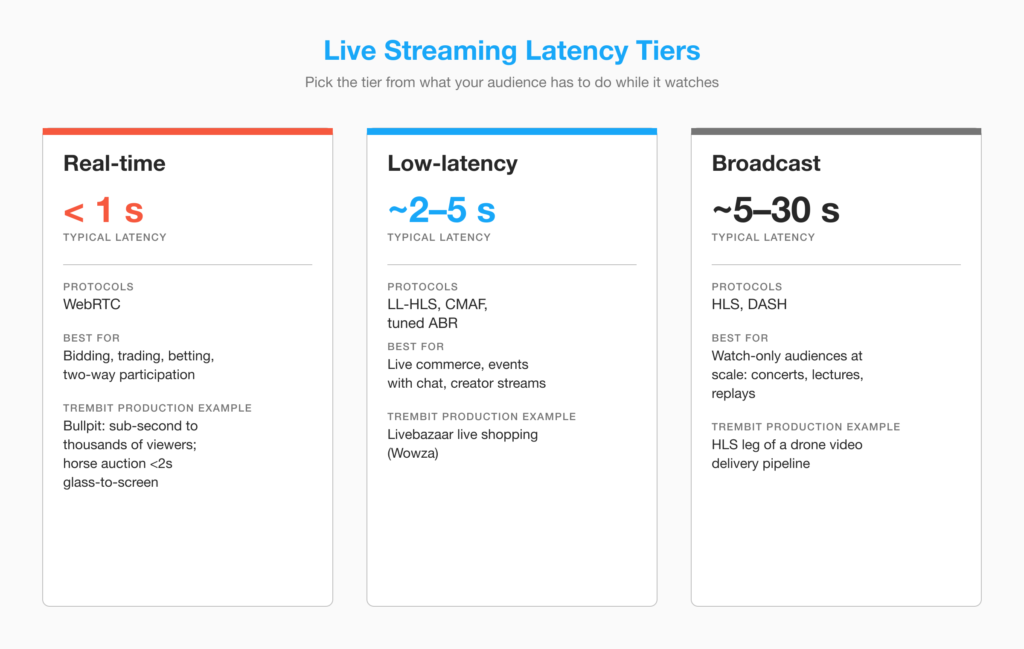
Pick the tier from what your audience has to do while it watches. If viewers only watch, broadcast HLS is cheapest at scale. If they chat or buy on impulse, low-latency HLS is usually enough. If they have to act on the moment (bid, trade, bet, ride against a leaderboard), you need real-time WebRTC delivery, and you pay more per viewer for it.
| Tier | Typical latency | Protocols | Best for | Trembit production example |
|---|---|---|---|---|
| Broadcast | ~5–30 s | HLS, DASH | Watch-only audiences at scale: concerts, lectures, replays | HLS leg of a drone video delivery pipeline |
| Low latency | ~2–5 s | LL-HLS, CMAF, tuned ABR | Live commerce, events with chat, creator streams | Livebazaar live shopping (Wowza) |
| Real-time | < 1 s | WebRTC | Bidding, trading, betting, two-way participation | Bullpit (sub-second to thousands), horse auction (<2 s glass-to-screen) |
Two things the table doesn’t show, but that come up in almost every scoping call:
- Vendors draw the tier boundaries differently. In this very list, RTC League puts LL-HLS at 1–3 seconds, iTechNotion at about 2, and RaftLabs at 1–3 for gaming, while standard HLS is quoted anywhere from about 6 to 30 seconds, and iTechNotion puts it at ~8–15, depending on who is counting. Treat any single number as a claim. The only figure that matters is glass-to-screen, measured on your broadcasters’ real networks during a proof of concept.
- Latency is only half the problem. A sub-second stream with an out-of-sync bid display loses more trust than a 2-second stream where every participant sees the same state. That is why the auction platform above aligns video and bids against a shared clock.
The tier logic, with the matching services, is laid out on our live streaming development page.
Custom Build vs. Managed Streaming Platform — Which Do You Need?
Start on a managed platform when speed to market matters more than unit cost and your audience size is still unknown. Move to a custom or self-hosted build when viewership is large or predictable, when per-minute or per-viewer pricing has become a major infrastructure line, or when you need control the platform doesn’t expose. A good development partner will tell you honestly which stage you are at.
The trade-offs in plain terms:
- Control. A managed platform hides the media path behind its SDK and roadmap. Custom infrastructure lets you own recording, transcoding, the sync logic between video and interaction events, and exactly what gets logged.
- Cost shape. Managed real-time delivery is operating expense that grows with minutes and viewers. Self-hosted is up-front engineering plus your own infrastructure and operations cost, which turns into lower marginal cost at scale. Model the crossover at your peak audience, not your average.
- Reach and reliability. A managed platform gives you a global edge on day one. A custom build has to earn it through multi-region deployment and load testing.
- Migration risk. Moving from one to the other is an engineering project, not a configuration change. The hard part is carrying over what the platform quietly handled (reconnection, adaptive bitrate on bad mobile uplinks, broadcaster tooling) without degrading the viewer experience.
FAQ
What’s the difference between a live streaming development company and a streaming platform like Wowza or Agora? A streaming platform sells infrastructure: a media server, SDK, or managed network you build on and usually pay for by usage. A live streaming development company is a team you hire to build your product, meaning the broadcaster and viewer apps, the backend, and the interaction layer, either on a platform or on self-hosted media servers. A platform is something you buy; a development company is someone you hire. Most serious products use both.
How much does live streaming app development cost? Cost follows five drivers: the latency tier (WebRTC costs more per viewer than CDN-delivered HLS), expected peak concurrency, managed platform versus self-hosted infrastructure, the depth of the interaction layer (bidding, commerce, two-way video), and the number of platforms (web, iOS, Android, smart TV). For public reference points, RaftLabs publishes USD 30,000–60,000 for a validated v1 and USD 60,000–120,000 for a full-featured platform, with a 12–16-week v1 timeline. Clutch lists hourly rates for firms in this guide from USD 25–49 (RaftLabs, Fora Soft) to USD 50–99 (RTC League). Treat these as market signals, not a quote. Trembit quotes after a technical call rather than publishing a rate card: new builds run as a dedicated team or a fixed-price engagement scoped to a defined MVP, rescue and scaling work is usually time and materials, and a streaming proof of concept runs in weeks 1–3 before the sprint-based build. Running costs for streaming infrastructure come on top of build cost and scale with your audience.
What latency can a live streaming app actually achieve, and does my product need sub-second delivery? Standard HLS and DASH typically run about 5–30 seconds behind live, low-latency HLS and CMAF about 2–5 seconds, and WebRTC-based delivery under a second. You need sub-second delivery only when viewers act on what they see: auctions, trading, live betting, interactive fitness, or two-way participation. For watch-only audiences, paying the per-viewer cost of WebRTC buys nothing. Trembit’s trading-community platform delivers sub-second WebRTC to thousands of concurrent viewers, and its live-shopping platform runs on low-latency Wowza delivery, because the use cases differ.
Which companies build real-time interactive streaming, such as bidding or live commerce, rather than just broadcast? In this guide, the firms with published interactive streaming proof are Trembit (live horse auction with sub-second bid propagation, Livebazaar live commerce, Bullpit trading streams) and Fora Soft (Sprii live commerce, StreamLayer interactive sports). RTC League lists auctions, betting, and live shopping as use cases without a named case on its streaming page. Oxagile and Andersen lean toward large-scale broadcast and OTT. Whoever you shortlist, ask how they keep bids, overlays, or chat in sync with each viewer’s video.
Should I use a white-label live streaming platform or build custom infrastructure? A white-label platform gets a branded product live fastest and suits validating demand. Its limits are the vendor’s feature ceiling, per-usage pricing, and a roadmap you don’t control. Build custom, or custom on top of a managed media platform, when streaming is the product itself, when you need interaction features the white-label product can’t do, or when its pricing no longer works at your audience size. Our guide to what to expect from a white-label video platform covers the trade-offs in more depth.
Can a live streaming development company fix or scale an existing platform that won’t handle audience spikes? Yes, if it can diagnose at the delivery layer rather than only at the app layer. The usual culprits are infrastructure sized for average rather than peak audiences, no load testing of chat and bid bursts, a latency tier that doesn’t match the use case, or managed-platform pricing that outgrew the business. A capable team audits latency and scalability first, then decides whether the fix is tuning, a migration between managed and self-hosted infrastructure, or a partial rebuild. Taking over stalled or unstable streaming codebases is part of Trembit’s track record.
Planning a Live Streaming Product?
If your audience has to react to the stream (bid, trade, buy, ride, or talk back), book a free 30-minute architecture call with a Trembit engineer. Bring the specific decision you’re stuck on: the latency tier, managed platform versus self-hosted, how to keep bids or overlays in sync with the video, or a platform that falls over at peak. We’ll pressure-test it against what we’ve shipped in auctions, trading, live commerce, and sports. No deck and no sales pitch. You leave with a recommended tier, an architecture direction, and an honest view of where the cost and risk sit. Request the call on our contact page, see what we build on our live streaming app development page, or email welcome@trembit.com.