In the rapidly evolving world of remote healthcare, a stable and scalable video core isn’t just a technical feature — it’s the foundation of the entire telemedicine experience. From initial proof-of-concept (PoC) prototypes to full-scale production systems, the video core determines whether virtual care feels effortless or frustrating.
At Trembit, we help telehealth innovators build and scale robust video cores tailored for remote care applications — combining high performance, robust security, and a seamless user experience. Our mission is to ensure that healthcare teams can focus on patients, not on the technical complexities of video infrastructure.
Why a Stable Video Core Is Critical in Remote Care
When it comes to telemedicine, video conferencing serves as the lifeline connecting patients and healthcare providers. Unlike traditional video calls, remote care consultations must handle complex medical interactions where every visual and audio cue matters.
Studies consistently highlight that high-quality video and audio are essential for patient satisfaction and clinical accuracy. When communication lags or image quality drops, it becomes harder for clinicians to assess visual symptoms and for patients to feel confident in the care they receive. In healthcare, even subtle reductions in clarity can erode trust and affect the overall quality of the interaction.
That’s why stability and quality aren’t optional — they’re essential. A reliable video core ensures:
- Low latency for real-time doctor-patient communication.
- High-resolution video to accurately capture visual symptoms.
- Data security and compliance with HIPAA and GDPR standards to safeguard patient privacy.
In short, a well-engineered video core transforms digital consultations from “just another video call” into a trusted medical experience.
From PoC to Production: Navigating the Technical Challenges
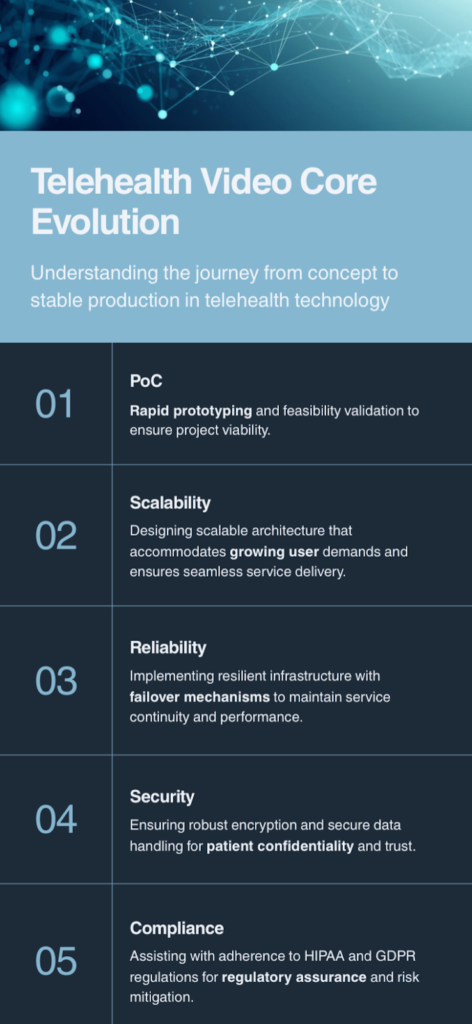
Transitioning from an experimental telehealth app to a production-ready platform is a journey full of technical decisions. Each phase introduces new demands: more users, higher reliability, and stricter security standards. Let’s explore the core challenges every growing telemedicine platform must solve.
1. Scalability
A PoC often supports a handful of test users, but real-world deployments need to scale to thousands or even millions of concurrent sessions. Achieving this means adopting horizontally scalable architectures that use WebRTC, SFUs (Selective Forwarding Units), and cloud-based CDNs to distribute traffic intelligently.
2. Reliability
In remote care, downtime is not an option. Systems must provide consistent uptime through redundant servers, load balancing, and failover mechanisms that ensure consultations continue even during partial outages or poor network conditions.
3. Security & Compliance
Since telemedicine deals with sensitive patient data, compliance must be built in, not added later. End-to-end encryption, secure authentication, and full HIPAA/GDPR adherence ensure confidentiality at every stage of the video session.
4. Adaptive Video Quality
Bandwidth fluctuations are inevitable. With adaptive bitrate streaming (ABR), video quality automatically adjusts to network conditions, maintaining smooth experiences for both patients and clinicians.
5. Seamless Integration with Healthcare Systems
Beyond the video layer, telehealth platforms depend on efficient integration with EHR systems, scheduling tools, and session recording. A well-designed video core must provide flexible APIs for easy backend connectivity.
6. Developer Efficiency
As telemedicine evolves quickly, teams need the ability to iterate fast and release safely. Modular architecture, strong documentation, and CI/CD pipelines make it possible to ship updates without disrupting patient care.
Together, these challenges shape the roadmap from PoC to production, and overcoming them separates a prototype from a dependable clinical platform.
Emerging Technologies Shaping the Future of Remote Care Video Systems
As telehealth adoption accelerates, new technologies continue to redefine what’s possible for virtual care delivery.
For instance, WebRTC remains the leading standard for real-time communication, offering browser-native support and sub-second latency. At the same time, AI-driven optimization enhances video quality and reduces bandwidth usage in real time.
Additionally, hybrid cloud-edge architectures are gaining traction, processing video closer to users to minimize latency and improve resilience. End-to-end encryption (E2EE) is also becoming a must-have, extending beyond in-transit protection to safeguard data at every point in the video pipeline.
Even features like spatial audio and multi-party video layouts are elevating the telehealth experience — allowing for more natural and collaborative consultations, especially in multi-disciplinary care teams.
Recommended Technology Stack for a Production-Ready Video Core
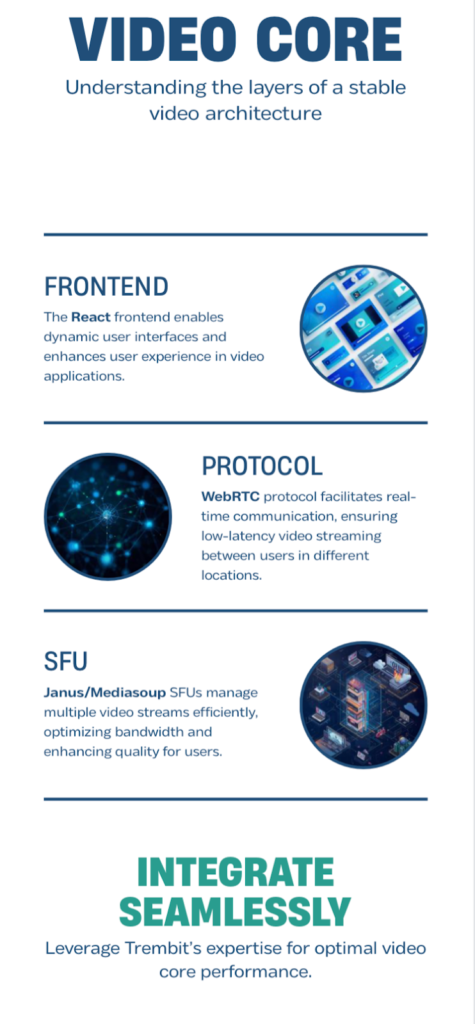
To achieve long-term success, your telehealth app needs a technology foundation built for reliability, compliance, and growth. Trembit recommends the following stack as a strong baseline:
| Layer | Recommended Technologies | Notes |
| Frontend | React | Responsive UI, seamless SDK integration |
| Video Protocol | WebRTC | Real-time communication with sub-second latency |
| Media Server | SFU (Janus, Mediasoup) | Scalable multi-user video conferencing |
| Backend | Node.js, PHP Symfony | Session control, user management, integrations |
| Database | PostgreSQL, MongoDB | Stores structured and unstructured patient data |
| Cloud Storage | AWS S3, Google Cloud Storage | Secure, compliant video recording storage |
| Security Layer | AES-256, OAuth 2.0, HIPAA/GDPR compliance | Protects data at rest and in transit |
This technology stack ensures scalability and compliance while supporting the flexibility developers need to continuously improve telehealth solutions.
Comparing WebRTC, RTMP, and Third-Party SDKs for Telehealth Platforms
Choosing the right video technology is one of the most impactful decisions for a remote care product. Below is a comparison highlighting how WebRTC, RTMP, and third-party SDKs differ in terms of suitability for telehealth use cases:
| Feature | WebRTC | RTMP | Third-Party SDKs (Agora, Twilio) |
| Latency | Ultra-low (<1s), real-time | Low (2–5s) | Low latency, optimized for telehealth |
| Browser Support | Native in modern browsers | Requires Flash (deprecated) | SDK abstracts protocol; supports all major platforms |
| Mobile Support | Excellent native support | Limited; requires custom players | Full SDKs for iOS & Android |
| Scalability | Peer-to-peer or SFU-based | Ideal for one-to-many broadcasts | Highly scalable with managed infrastructure |
| Security | Encrypted (SRTP, E2EE optional) | Can use RTMPS but less secure by default | Built-in encryption and access control |
| Complexity | Moderate; setup needed for signaling & TURN/STUN | Simple but aging technology | Minimal; SDK handles setup and scaling |
| Adaptability | Dynamic bitrate adjustment | Limited adaptability | AI-based adaptive streaming |
| Cost | Open source; infrastructure costs only | Free protocol; infra costs apply | Subscription-based or usage pricing |
| Best Fit | Real-time patient-doctor consultations | Broadcast-style health events | Turnkey telehealth platforms |
In summary:
- WebRTC is the gold standard for real-time, interactive telemedicine consultations.
- RTMP remains suitable for streaming and broadcasting but lacks interactivity.
- Third-party SDKs simplify deployment and scaling — ideal for startups and fast-moving enterprise teams seeking rapid go-live.
Trembit: Your Trusted Partner for Building Scalable Remote Care Video Systems
At Trembit, we combine deep video engineering expertise with a practical understanding of healthcare requirements. Our team helps clients move from experimental prototypes to production-ready telehealth platforms that deliver reliability, compliance, and superior user experience.
We achieve this through:
- Scalable architectures that grow alongside your user base.
- Adaptive AI-enhanced streaming for consistent video quality.
- Comprehensive HIPAA/GDPR compliance is built into every component.
- Backend integration for scheduling, EHRs, and analytics.
- Continuous delivery pipelines for stable, incremental releases.
Our approach ensures that healthcare innovators can confidently scale without compromising performance or patient trust.
Ready to Build or Optimize Your Remote Care Platform?
Partner with Trembit to design and scale your video core — from proof-of-concept to full production. Get in touch today to unlock reliable, scalable, and secure telehealth experiences for your team and your patients.
Contact Trembit now to accelerate your telehealth innovation and ensure your solution leads in quality, security, and patient experience.