The Stability vs. Engagement Tradeoff in Modern Dating Apps
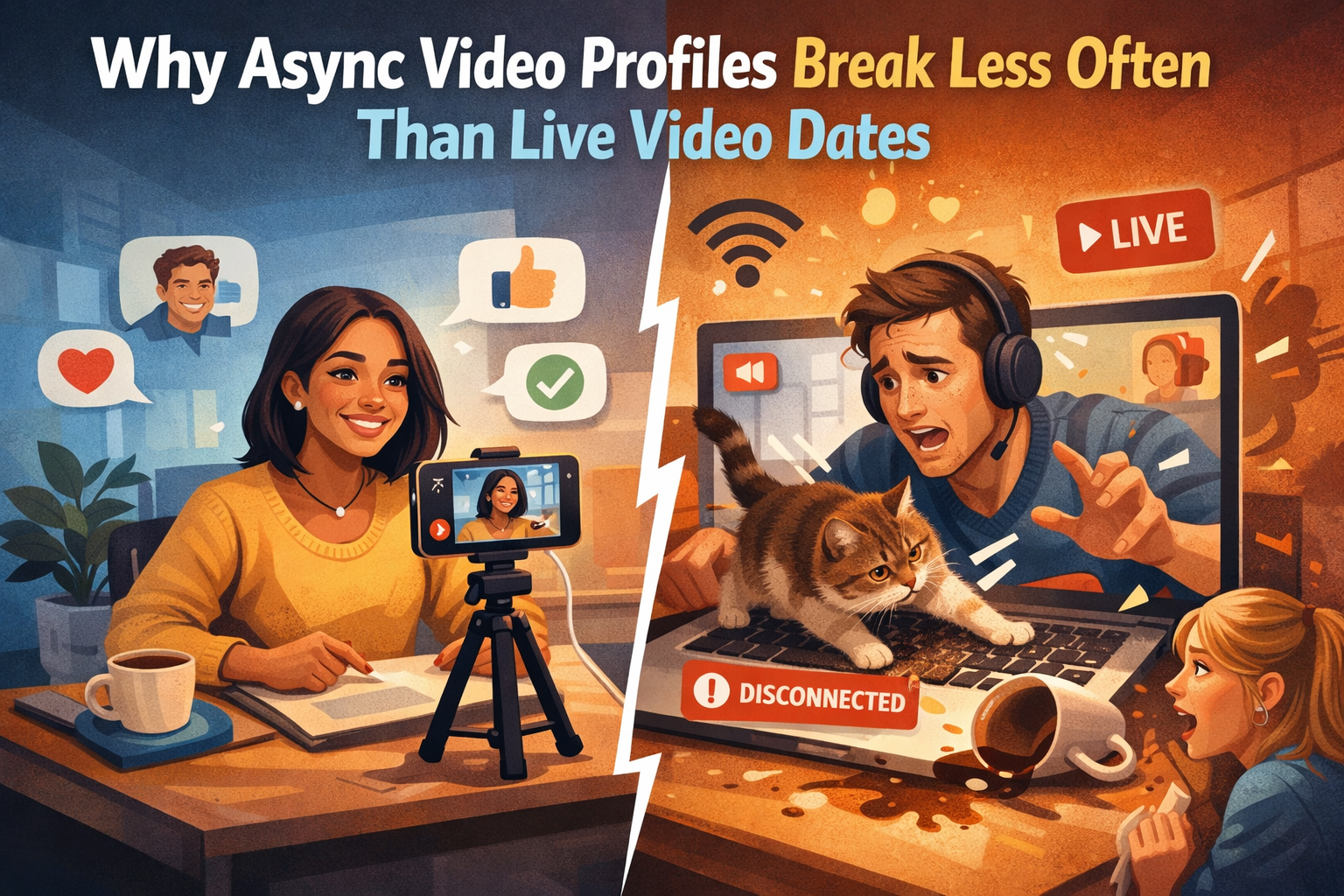
The evolution of video features in dating applications has created a fascinating technical crossroads. While live video dates promise real-time connection and authenticity, async video profiles offer a fundamentally different infrastructure model — one that prioritizes stability, cost efficiency, and scalability over spontaneous interaction. Understanding this tradeoff is essential for product teams building the next generation of dating platforms.
This article explores the technical reasons why asynchronous video architectures experience fewer failures than their live counterparts, examining everything from bandwidth requirements to moderation pipelines and infrastructure costs.
The Fundamental Architecture Difference
At their core, async and live video features operate on entirely different technical foundations. These architectural differences have cascading effects on reliability, cost, and user experience. Let’s break down what makes each approach distinct.
Storage vs. Bandwidth: The Core Tradeoff
Asynchronous video profiles are fundamentally storage problems. Users record a video once, which is then uploaded to cloud storage, such as AWS S3 or Google Cloud Storage, and subsequently served on demand to viewers. The infrastructure cost is predictable: you pay for storage space (approximately $0.02-0.023 per GB per month for standard storage) and for data transfer when users view the profile.
Live video dates, however, are bandwidth-intensive. Every second of a 720p video call requires approximately 2 Mbps of bandwidth per participant—that’s roughly 900 MB of data transferred per hour per user. With WebRTC infrastructure, you’re not just paying for storage; you’re paying for real-time data routing, TURN servers when peer-to-peer connections fail, and the computational overhead of encoding, decoding, and managing live streams.
This fundamental difference in architecture creates a ripple effect across the entire technology stack. When async video fails, it’s typically a simple fetch error—the video file couldn’t be retrieved from storage. When live video fails, it could be due to any of dozens of failure points in a complex real-time communication pipeline.
Why Live Video Breaks: The Technical Reality
Live video streaming through WebRTC introduces numerous points of potential failure that simply don’t exist in asynchronous architectures. Understanding these failure modes is crucial for engineering teams evaluating which approach to implement.
Network Variability and Packet Loss
Live video streaming is unforgiving of network instability. Under typical network conditions with 3-5% packet loss, WebRTC implementations require an additional 10-15% bandwidth overhead just to handle retransmissions through NACK (Negative Acknowledgement) and PLI (Picture Loss Indication) mechanisms. A 1080p stream generating 2.25 times more packets than 720p needs proportionally more time to recover from packet loss, creating a cascading effect where quality degrades, or connections drop entirely.
Async video sidesteps this entirely. The video is encoded once under optimal conditions, uploaded when bandwidth is available, and served via CDN with standard HTTP caching. If a packet is lost during playback, the client simply requests it again — there’s no real-time deadline pressure.
Infrastructure Complexity
The infrastructure requirements for live video are substantially more complex:
TURN Servers: When direct peer-to-peer connections fail (due to firewalls or restrictive NAT), TURN servers must relay all media traffic. A single 720p call can consume 150GB of bandwidth monthly through TURN infrastructure alone.
SFU/MCU Requirements: For group video or broadcasting scenarios, Selective Forwarding Units (SFUs) or Multipoint Control Units (MCUs) are required, demanding substantial server resources and continuous CPU usage for video transcoding.
Real-time Signaling: WebSocket connections must remain open for the duration of calls, managing session state, connection quality monitoring, and failover logic.
Geographic Distribution: Low-latency requirements necessitate edge servers in multiple regions, multiplying infrastructure costs and complexity.
Compare this to async video: upload to S3, serve via CloudFront or another CDN. The architecture is comparatively simple, battle-tested, and leverages the same infrastructure that powers major streaming platforms.
Infrastructure Cost Comparison
The financial implications of choosing between async and live video are substantial. Here’s a breakdown of the typical costs for a dating app with moderate usage:
| Component | Async Video Profile | Live Video Date |
| Storage Cost | $0.02/GB/month (S3 Standard) | Minimal (session metadata only) |
| Bandwidth | Pay-per-view (CDN egress) | ~900MB/hour per user |
| Server Infrastructure | Low (static file serving) | High (TURN servers, SFUs) |
| Failure Rate | 1-2% (network/storage errors) | 8-15% (multi-factor failures) |
| Scalability | Near-infinite (CDN-backed) | Complex (requires load balancing) |
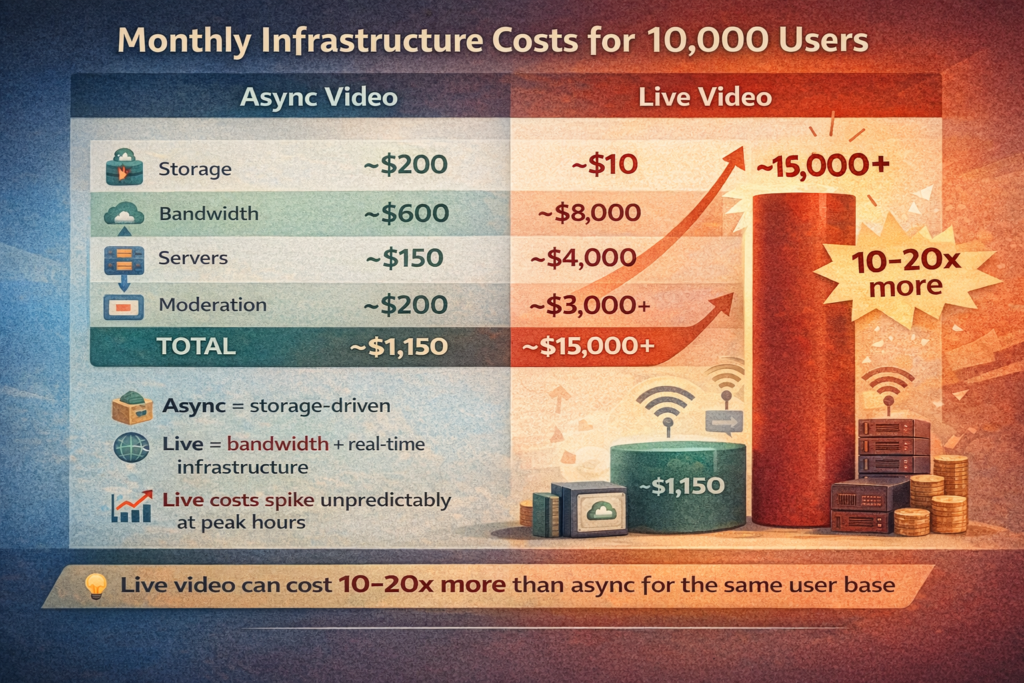
For a dating app serving 10,000 active users with moderate video usage, async video profiles might cost $500-1,000 monthly in infrastructure, while live video dating features could easily reach $5,000-15,000 monthly, with costs scaling unpredictably during peak usage hours.
Async Moderation Pipelines: The Hidden Advantage
Content moderation is non-negotiable for dating platforms, but the operational models differ dramatically between async and live video. This distinction has major implications for both safety and cost.
Batch Processing vs. Real-Time Moderation
Asynchronous video profiles enable batch moderation pipelines. When a user uploads a profile video, it enters a processing queue where AI-powered content moderation APIs, such as Amazon Rekognition, Google Cloud Vision, or specialized services like Clarifai, analyze the video frame-by-frame for inappropriate content. This typically costs $0.001-0.004 per video, depending on length and detection complexity.
The video doesn’t go live until it passes automated checks and, when necessary, human review. This creates a safety buffer: problematic content never reaches other users. The entire moderation process happens offline, allowing for thorough analysis without time pressure.
Live video moderation, conversely, must happen in real-time. This requires either continuous AI monitoring of active streams (computationally expensive and prone to false positives) or reactive systems where users report problems after they occur. Real-time moderation typically costs 10-100x more than async moderation due to the computational resources required and the need for immediate human escalation for edge cases.
Furthermore, async moderation enables sophisticated multi-pass analysis. A video can be checked for explicit content, hate speech markers, underage users, and brand safety compliance in sequence or parallel, with each layer adding minimal marginal cost. Live moderation must make split-second decisions with limited context.
Consistent Quality vs. Unpredictable Performance
User experience quality is predictable with async video and variable with live video. This isn’t just about preventing failures—it’s about creating reliable, repeatable experiences.
Encoding Quality Control
Async video allows for optimal encoding conditions. Videos can be transcoded server-side into multiple bitrates and formats (360p, 720p, 1080p) using high-quality encoders like FFmpeg with careful parameter tuning. The result is delivered via adaptive bitrate streaming, ensuring every user gets the best quality their connection can handle.
Live video encoding happens under real-time constraints on user devices with varying capabilities. A high-end smartphone might send crisp 1080p, while an older device struggles to maintain stable 480p. WebRTC’s adaptive bitrate algorithms help, but they’re reactive — quality drops after problems occur, not before.
The Engineering Tradeoff: When Does Live Video Make Sense?
Despite async video’s technical advantages, live video remains valuable for specific use cases. The decision isn’t binary — it’s about matching technical approaches to product goals.
Live video excels when:
- Real-time interaction is the core value proposition (virtual speed dating, immediate verification calls)
- Two-way communication is essential to the experience
- Spontaneity and authenticity outweigh technical stability concerns
- You have engineering resources to build and maintain complex WebRTC infrastructure
Async video excels when:
- The goal is profile enrichment and initial impression-making
- Content quality and moderation are critical for platform safety
- Cost predictability and infrastructure simplicity matter
- You want near-perfect reliability and a consistent user experience
Many successful dating platforms use hybrid approaches: async video profiles for initial discovery, with live video available for users who match and want to escalate their connection. This strategy captures the reliability benefits of async video while preserving live video for high-intent interactions where users tolerate occasional technical issues.
Building Reliable Video Experiences with Trembit
Implementing video features, whether async, live, or hybrid, requires deep technical expertise across multiple domains: video encoding pipelines, cloud infrastructure architecture, content moderation integration, and real-time communication protocols. The complexity compounds when you factor in mobile app optimization, backend scalability, and cost management.
Trembit brings extensive experience building video-enabled applications for clients across industries. Our engineering teams understand the nuances of both async and live video architectures, helping clients make informed tradeoffs between features, costs, and reliability. Whether you’re building your first video feature or scaling an existing implementation, Trembit provides the technical partnership needed to navigate these complex decisions.
Our approach emphasizes pragmatic architecture: choosing the right tools for your specific use case, designing for cost efficiency without sacrificing user experience, and building systems that scale gracefully as your user base grows. When it comes to video features in dating apps — or any consumer application—the difference between a reliable system and a frustrating one often comes down to architectural choices made early in development.
Conclusion: Stability Through Simplicity
The fundamental reason async video profiles break less often than live video dates comes down to architectural simplicity. Async video is a solved problem: upload, encode, store, serve. The technology stack is mature, the failure modes are well-understood, and the costs are predictable.
Live video, while technically impressive and valuable for specific use cases, operates at the bleeding edge of complexity. Real-time communication across diverse networks, devices, and geographic regions introduces dozens of potential failure points. The infrastructure costs scale unpredictably, moderation happens reactively rather than proactively, and quality varies based on factors outside your control.
For product teams building dating applications, the lesson is clear: don’t default to live video just because it seems more innovative. Consider your actual user needs, your infrastructure budget, your moderation requirements, and your engineering capacity. Often, async video profiles provide 90% of the value at 10% of the cost and complexity.
The most successful video features aren’t the most technically ambitious — they’re the ones that reliably work every time a user needs them. In the competitive landscape of dating apps, reliability isn’t just a technical metric; it’s a core product differentiator.
Key Takeaways
- Async video profiles are fundamentally storage problems; live video dates are bandwidth problems with 8-15x higher failure rates.
- Infrastructure costs for live video can be 10-20x higher than async video for equivalent user bases.
- Async moderation pipelines enable proactive content filtering at 1-10% the cost of real-time monitoring.
- WebRTC’s complexity introduces multiple failure points: TURN servers, packet loss recovery, network variability, and encoding quality.
- Hybrid approaches (async for discovery, live for matched users) capture the benefits of both while minimizing infrastructure complexity.
- Architectural simplicity directly correlates with reliability — async video’s mature, battle-tested stack breaks less often.
The question for dating app developers isn’t whether video features are valuable — they clearly are. The question is which video architecture aligns with your product strategy, technical capabilities, and user expectations. By understanding the stability-engagement tradeoff, teams can make informed decisions that balance innovation with reliability.