Dating app fraud has evolved from simple fake profiles to sophisticated attacks using deepfakes, AI-generated images, and pre-recorded videos. Romance scams cost victims over $1.3 billion in 2022 alone, with dating platforms facing increasing pressure to verify user authenticity. Traditional photo verification is no longer sufficient — determined fraudsters easily bypass static image checks using stolen photos or AI-generated faces.
Video liveness detection verifies that a real human is present during verification, rather than a photo, video replay, or digital mask. However, implementing effective liveness checks at scale presents significant challenges: balancing security with user experience, processing millions of verification attempts cost-effectively, and staying ahead of evolving attack vectors.
This article explores production-ready architecture patterns for video liveness verification in dating applications, focusing on face movement detection, intelligent frame sampling, and replay attack prevention.
Understanding the Fraud Landscape
Common Attack Vectors
Dating app fraudsters employ increasingly sophisticated techniques:
Photo-based attacks present printed photos or high-resolution images on another device to the camera. While rudimentary, these succeed against basic face detection systems.
Video replay attacks use pre-recorded video of a real person played back during verification. These defeat simple motion detection by showing natural facial movements and head rotation.
Deepfake and face swap attacks leverage AI to generate realistic videos of non-existent people or map one person’s face onto another in real-time.
3D mask attacks employ physical or digital masks with the target’s facial features. While less common due to cost, sophisticated fraud operations targeting high-value accounts occasionally deploy these.
The Cost of Inadequate Verification
Platforms that fail to implement robust liveness checks face multiple consequences:
- User trust erosion: 67% of dating app users have encountered fake profiles, and 42% cite safety concerns as their primary platform complaint
- Revenue impact: Legitimate users abandon platforms with high fraud rates, with average customer lifetime value dropping 30-40%
- Legal liability: Platforms may face lawsuits from users victimized by fraudsters
- Brand damage: High-profile fraud cases generate negative media coverage
- Platform manipulation: Bot networks artificially inflate engagement metrics and conduct scams
Core Liveness Detection Techniques
Effective video liveness systems combine multiple detection techniques into a layered defense. No single method provides perfect security, but combining several creates significant barriers.
Passive Liveness Detection
Passive methods analyze video frames without requiring specific user actions, making them ideal for seamless experiences.
Texture analysis examines subtle differences between real skin and photos or screens. Living skin exhibits micro-textures and slight color variations that printed materials cannot replicate.
Optical flow detection tracks subtle, involuntary facial movements that occur even when a person tries to remain still. Micro-expressions and minute muscle movements create patterns impossible to replicate with static images.
Moiré pattern detection identifies interference patterns that appear when a camera captures another screen or printed photo. Modern algorithms detect even subtle moiré effects invisible to human observers.
Active Liveness Detection
Active methods require user interaction, providing stronger security at the cost of additional friction.
Challenge-response verification asks users to perform specific actions like smiling, turning their head, or blinking. Implementation requires:
- Random challenge selection from a pool of 8-12 possible actions
- Timing variation to prevent predictable patterns
- Multiple sequential challenges to increase replay attack difficulty
3D head pose estimation tracks facial landmarks across frames to verify that the user can rotate their head through specific angles:
| Parameter | Recommended Value | Rationale |
| Minimum rotation angle | 20-25 degrees | Detectable on mobile cameras without excessive effort |
| Maximum rotation angle | 35-40 degrees | Comfortable without neck strain |
| Challenge time limit | 5-8 seconds | Prevents delays while allowing natural movement |
Architecture Patterns for Scale
Edge-Cloud Hybrid Processing
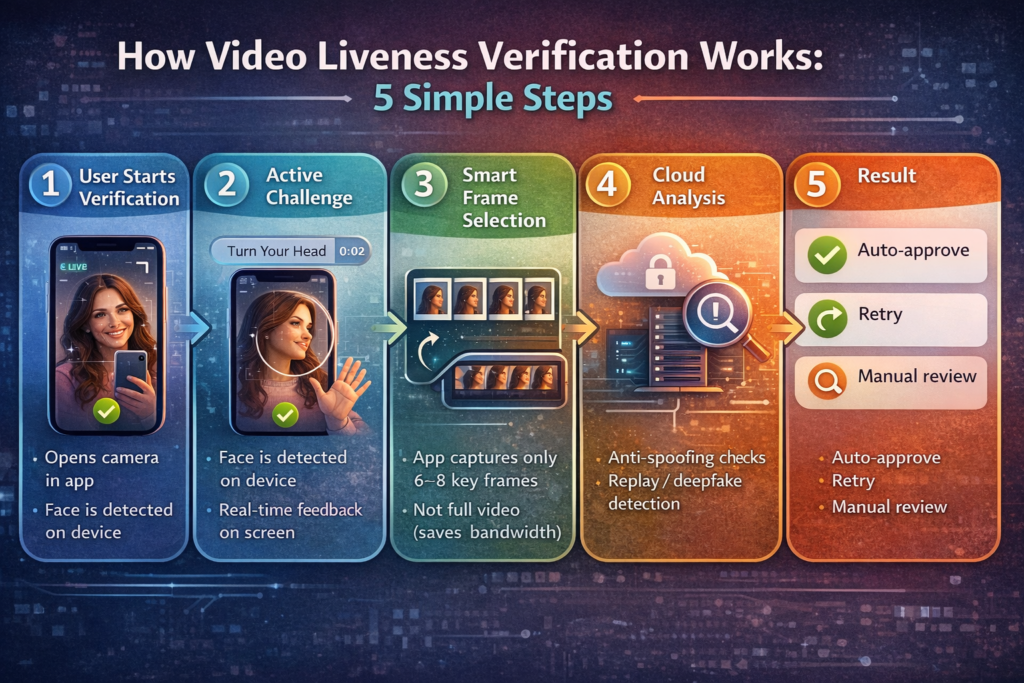
Optimal liveness verification distributes processing between mobile devices and cloud infrastructure.
On-device processing handles:
- Initial face detection using mobile ML frameworks (Core ML, ML Kit)
- Real-time user feedback during verification
- Basic quality checks before uploading
- Frame pre-processing and compression
Cloud processing handles:
- Sophisticated anti-spoofing analysis
- Cross-reference checks against fraud databases
- Model updates without app releases
- Forensic analysis of flagged accounts
Communication optimization:
- Upload 8-12 key frames rather than full video (reduces bandwidth by 85-90%)
- Use efficient image encoding (WebP at 80% quality)
- Implement progressive verification from early frames
Frame Sampling Strategy
Intelligent frame selection dramatically reduces processing costs while maintaining accuracy.
Frame selection pattern for 5-second challenge:
– Initial frame (t=0s): Baseline facial position
– Challenge start (t=0.5s): User begins movement
– Mid-challenge (t=1.5-3s): 3-5 frames during active movement
– Challenge completion (t=4.5s): Final position verification
– Post-challenge (t=5s): Confirmation frame
Total: 6-8 frames vs. 150 full frames = 95% processing reduction
Quality-based sampling selects frames with:
- High sharpness scores using Laplacian variance
- Proper illumination and exposure
- Optimal face size (30-50% of frame area)
Replay Attack Prevention
Screen detection algorithms identify video played on digital displays:
- Refresh rate patterns (60Hz, 120Hz creating detectable patterns)
- Color temperature anomalies
- Luminance flickering from LED/LCD screens
- Moiré interference patterns
Temporal consistency analysis examines movement patterns:
- Acceleration profiles: Human movements follow smooth curves, not linear velocity
- Micro-jitter: Real humans exhibit slight involuntary movements
- Breathing patterns: Subtle chest and shoulder movement
Challenge timing verification ensures biologically plausible reaction times:
| Challenge Type | Expected Reaction | Suspicious Range | Red Flag |
| Begin head turn | 200-600ms | <150ms or >1000ms | <100ms or >1500ms |
| Smile on command | 300-800ms | <200ms or >1200ms | <150ms or >1800ms |
| Blink intentionally | 150-400ms | <100ms or >600ms | <80ms or >1000ms |
Implementation Considerations
Mobile Performance Optimization
Computational budgets by device tier:
| Device Category | CPU Budget | Frame Processing Rate |
| Flagship (2023-2024) | 40-50% | 30fps face tracking |
| Mid-range (2021-2023) | 25-35% | 20fps face tracking |
| Budget (<2021) | 15-25% | 10-15fps face tracking |
Optimization strategies:
- Model quantization: 8-bit models reduce size by 75% and inference time by 2-3x
- Resolution scaling: Process 480p instead of 1080p with 80% less computation
- Selective processing: Run expensive models only on key frames
- Thermal management: Monitor device temperature and reduce processing if overheating
User Experience Design
Well-implemented liveness verification should achieve:
- First-attempt success rate: 75-85%
- Success within 2 attempts: 92-96%
- Ultimate abandonment rate: <3%
- Average completion time: 12-18 seconds
Best practices:
- Clear 30-second tutorial before starting
- Real-time visual feedback with overlay graphics
- Immediate error recovery without restart
- Progress indicators to maintain engagement
Privacy and Data Handling
Recommended retention policy:
– Verification video frames: Delete after processing (0-5 minutes)
– Facial landmarks/embeddings: Delete after verification (0-5 minutes)
– Verification result (pass/fail): Retain indefinitely
– Flagged suspicious verifications: Retain 90 days for investigation
Security measures:
- Encrypt frames in transit using TLS 1.3
- Encrypt at rest using AES-256
- Process in memory, avoid persistent storage
- Audit logging of all data access
Advanced Anti-Spoofing Techniques
Deepfake Detection
AI-generated faces require analyzing artifacts from generative models:
- Temporal inconsistency: Micro-inconsistencies between frames where features slightly morph
- Frequency domain analysis: High-frequency artifacts are detectable in the Fourier transform
- Physiological signals: Extract pulse from facial video and verify real blood flow characteristics
Detection accuracy benchmarks:
- 92-96% detection on common deepfake methods (FaceSwap, DeepFaceLab)
- 85-90% detection on cutting-edge methods (StyleGAN3)
- 5-8% false positive rate on genuine users
Ensemble Verification
Multi-model ensemble architecture:
| Detection Method | Weight | False Positive | False Negative | Processing Time |
| Texture analysis | 0.20 | 2% | 12% | 50ms |
| Face movement | 0.30 | 1% | 8% | 150ms |
| Challenge-response | 0.25 | 0.5% | 6% | 200ms |
| Replay detection | 0.15 | 3% | 10% | 100ms |
| Deepfake detection | 0.10 | 5% | 7% | 800ms |
Decision thresholds:
- Score ≥ 0.85: Auto-approve
- Score 0.70-0.84: Manual review
- Score < 0.70: Auto-reject, allow retry
This approach reduces the overall false positive rate to <0.5% while maintaining a false negative rate below 4%.
Infrastructure Architecture
Processing Pipeline
Stage 1: Ingestion – Receive frames, validate format, check for manipulation
Stage 2: Quality Assessment – Analyze sharpness, lighting, face size; reject low-quality immediately
Stage 3: Liveness Detection – Run parallel detection methods, execute deepfake detection on flagged cases
Stage 4: Decision – Apply thresholds, route to auto-approve/review/rejection
Stage 5: Cleanup – Delete biometric data, store verification result, update fraud databases
Cloud Infrastructure Scaling
Infrastructure components:
- API Gateway for request routing
- Kubernetes cluster with auto-scaling (CPU-optimized + GPU-accelerated nodes)
- S3-compatible storage for temporary frames
- PostgreSQL for verification results
- Redis/RabbitMQ for job queues
Cost benchmarks for 100,000 verifications/day:
- Infrastructure costs: $2,500-4,000/month
- Per-verification cost: $0.025-0.040
- Manual review costs: $0.50-1.00 per flagged verification
- Total program cost: ~$6,000-9,000/month
Manual Review Workflow
Automated systems achieve 95-96% accuracy, meaning 4-5% require human review.
Review Queue Prioritization
Priority scoring factors:
- Risk level: Near-threshold vs. clearly suspicious
- User account value: New accounts vs. established users
- Fraud signals: Multiple failed attempts, device matches known fraudsters
- Time sensitivity: Premium users get faster review
- Geographic risk: Higher scrutiny for high-fraud regions
Reviewer Tools
Essential capabilities:
- Side-by-side comparison of verification video and profile photos
- Playback controls (frame-by-frame, slow motion, zoom)
- Display of automated scores and the methods that flagged the verification
- Historical context (previous attempts, account activity)
- One-click decision options
Quality assurance:
- 10% of decisions are randomly reviewed by a second reviewer
- Inter-rater reliability target: >92%
- Weekly calibration sessions on edge cases
Trembit: Your Partner in Anti-Fraud Technology
Implementing production-ready video liveness verification requires expertise across computer vision, mobile development, cloud infrastructure, and fraud prevention. Trembit brings extensive experience in developing anti-fraud solutions for dating and social platforms, with systems processing millions of verifications monthly.
Trembit delivers:
- End-to-end liveness implementation from mobile SDK through cloud infrastructure
- Computer vision expertise in face detection, landmark tracking, and movement analysis
- Custom ML model development for deepfake detection and replay prevention
- Scalable cloud architectures that handle variable load while controlling costs
- GDPR, CCPA, and biometric privacy compliance for global deployment
- Continuous improvement based on production data and emerging fraud patterns
Whether implementing your first verification system or upgrading existing fraud prevention, Trembit’s expertise ensures your dating platform maintains trust and safety at scale.
Conclusion
Video liveness verification has become essential for dating platforms serious about user safety and fraud prevention. Effective implementation requires balancing security, user experience, and infrastructure efficiency.
The architecture patterns explored — edge-cloud hybrid processing, intelligent frame sampling, multi-method ensemble verification, and continuous learning — provide a foundation for production systems that actually work at scale. Platforms that invest in robust video liveness verification see measurable improvements in fraud reduction, user trust, and platform quality.
As fraud techniques evolve, liveness detection systems must incorporate continuous learning and adaptation. The most successful implementations treat anti-fraud as an ongoing program, constantly analyzing new attack patterns and updating detection methods.
Key Takeaways
- Layered defense: Ensemble approaches combining passive detection, active challenges, and ML-based analysis provide robust security
- Intelligent sampling: Processing 6-8 key frames instead of full video reduces costs by 95% while maintaining accuracy
- Replay prevention: Temporal consistency analysis, screen detection, and challenge timing effectively counter video replay attacks
- Mobile optimization: Model quantization and resolution scaling enable real-time detection on budget devices
- User experience: Well-designed flows achieve 75-85% first-attempt success and <3% abandonment
- Privacy-first: Immediate deletion of biometric data after verification ensures compliance
- Deepfake detection: Frequency domain analysis detects AI-generated faces with 92-96% accuracy
- Ensemble scoring: Weighted combination reduces false positives to <0.5% while maintaining <4% false negatives
- Scalable infrastructure: Auto-scaling cloud architecture handles variable loads at $0.025-0.040 per verification
- Manual review essential: 4-5% of verifications require human review with efficient workflows
- Continuous learning: Feedback loops enable systems to evolve with attack techniques