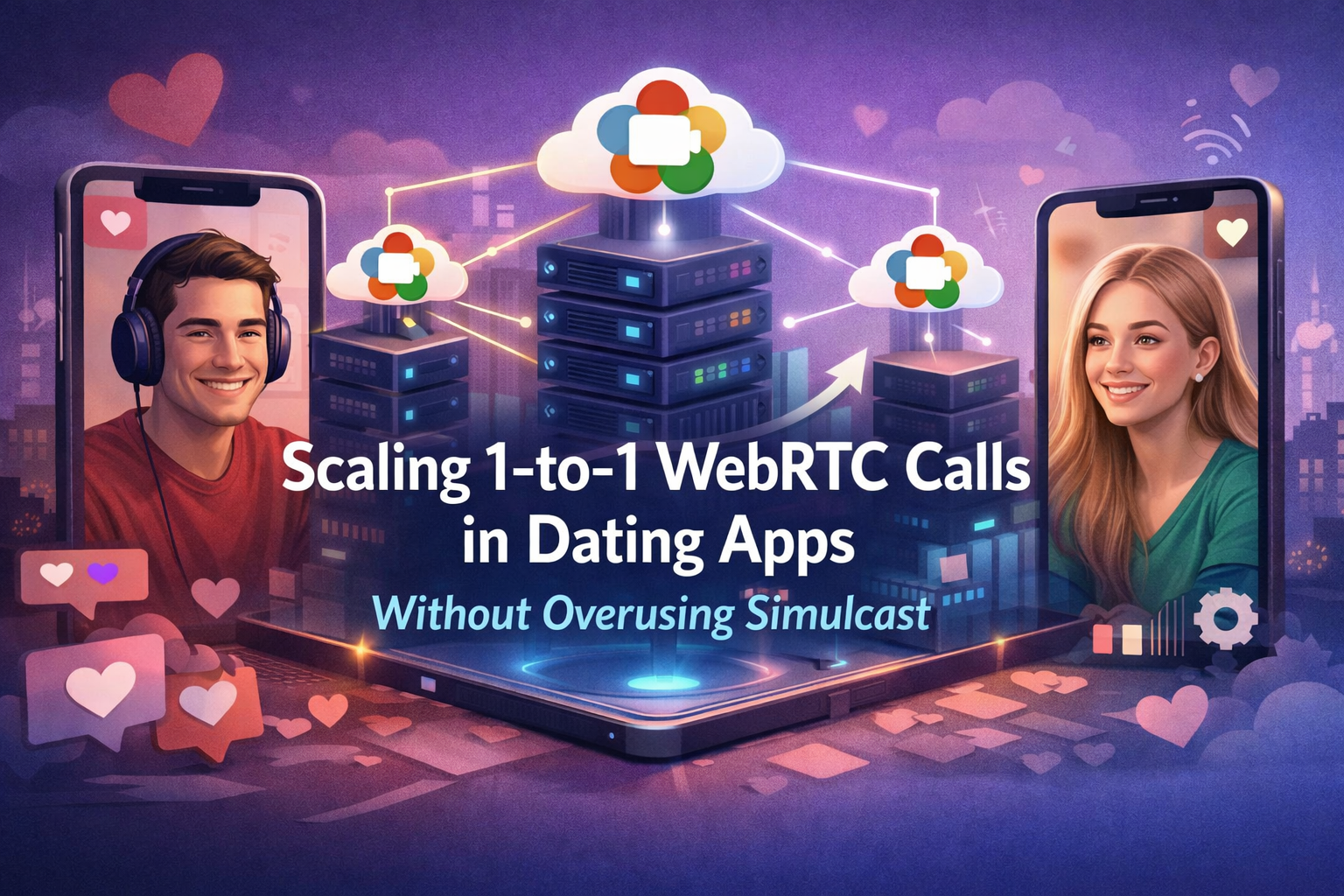
Video calling has become a cornerstone feature in modern dating applications. According to recent industry reports, dating platforms with integrated video calling see 40% higher user engagement and 25% better match conversion rates. However, implementing real-time video communication at scale presents unique technical challenges, particularly when balancing bandwidth efficiency, CPU utilization, and mobile performance.
While WebRTC simulcast has gained popularity as a solution for multi-party video conferencing, its application in 1-to-1 dating app scenarios often introduces unnecessary complexity and overhead. This article examines the development of efficient and scalable peer-to-peer video calling systems for dating platforms, while avoiding common simulcast pitfalls and optimizing for mobile device constraints.
Understanding WebRTC Architecture for Dating Applications
WebRTC (Web Real-Time Communication) enables direct, peer-to-peer media streaming between browsers and mobile applications without the need for plugins. For dating apps, this translates to sub-500 millisecond latency video calls that feel natural and immediate — critical for building authentic connections between users.
The Peer-to-Peer Advantage
In traditional 1-to-1 dating app scenarios, peer-to-peer (P2P) WebRTC connections offer significant advantages over server-mediated architectures. Media streams flow directly between two users’ devices, bypassing centralized infrastructure. This approach delivers three critical benefits for dating platforms:
- Lower latency: Direct connections typically achieve 50-150ms glass-to-glass latency compared to 200-500ms for server-relayed streams, creating more natural conversation flow
- Reduced infrastructure costs: No need for expensive media relay servers (SFUs) or compute-intensive media mixers (MCUs) for 1-to-1 calls
- Better privacy: Media streams never pass through your servers, reducing regulatory compliance concerns and enhancing user trust
However, P2P connections require signaling servers for initial connection establishment and STUN/TURN servers for NAT traversal. Research indicates that approximately 15-25% of connections require TURN relay due to restrictive NAT or firewall configurations, particularly on mobile networks.
The Simulcast Misconception: When Less is More
Simulcast — the technique of encoding and transmitting multiple quality layers of the same video stream simultaneously — has become synonymous with WebRTC scalability. However, its widespread association with WebRTC has led to a common misconception: that simulcast is necessary or beneficial for all WebRTC implementations, including 1-to-1 calls.
What Simulcast Actually Solves
Simulcast was designed specifically for multi-party conferencing scenarios where a Selective Forwarding Unit (SFU) routes video to multiple recipients with heterogeneous network conditions and display requirements. In these scenarios, simulcast allows the SFU to forward an appropriate quality layer to each participant without transcoding.
A typical simulcast configuration produces three simultaneous encodings:
| Layer | Resolution | Bitrate | Frame Rate |
| High | 1280×720 | 1.5-2.5 Mbps | 30 fps |
| Medium | 640×360 | 300-500 kbps | 30 fps |
| Low | 320×180 | 100-150 kbps | 15 fps |
The Hidden Cost of Simulcast in 1-to-1 Scenarios
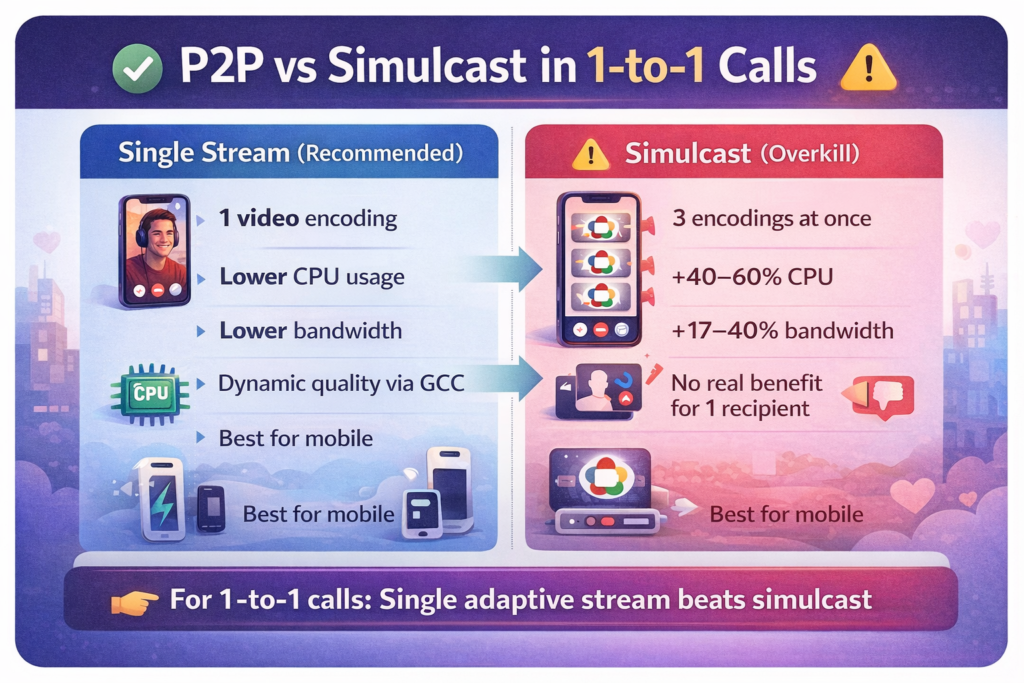
In peer-to-peer 1-to-1 dating app calls, simulcast introduces significant overhead with minimal benefit. Research from WebRTC optimization studies indicates that simulcast typically adds 17% bandwidth overhead for the sender, though this can reach 30-40% in suboptimal configurations. More critically, encoding multiple layers simultaneously can increase CPU utilization by 40-60% on mobile devices.
Consider the resource impact on a typical dating app user on a smartphone:
| Configuration | CPU Impact | Bandwidth Impact |
| Single stream (720p) | Baseline (100%) | 1.5 Mbps upload |
| Simulcast (3 layers) | 140-160% | 1.75-2.0 Mbps upload |
The fundamental issue is that in a 1-to-1 connection, only one recipient exists. The sender device works harder to produce multiple encodings, but the SFU (if used) or the peer connection will only forward or receive one stream. This creates waste at multiple levels: increased battery drain, unnecessary network utilization, and potential quality degradation due to CPU throttling on mobile devices.
Dynamic Adaptation: The Right Solution for 1-to-1 Calls
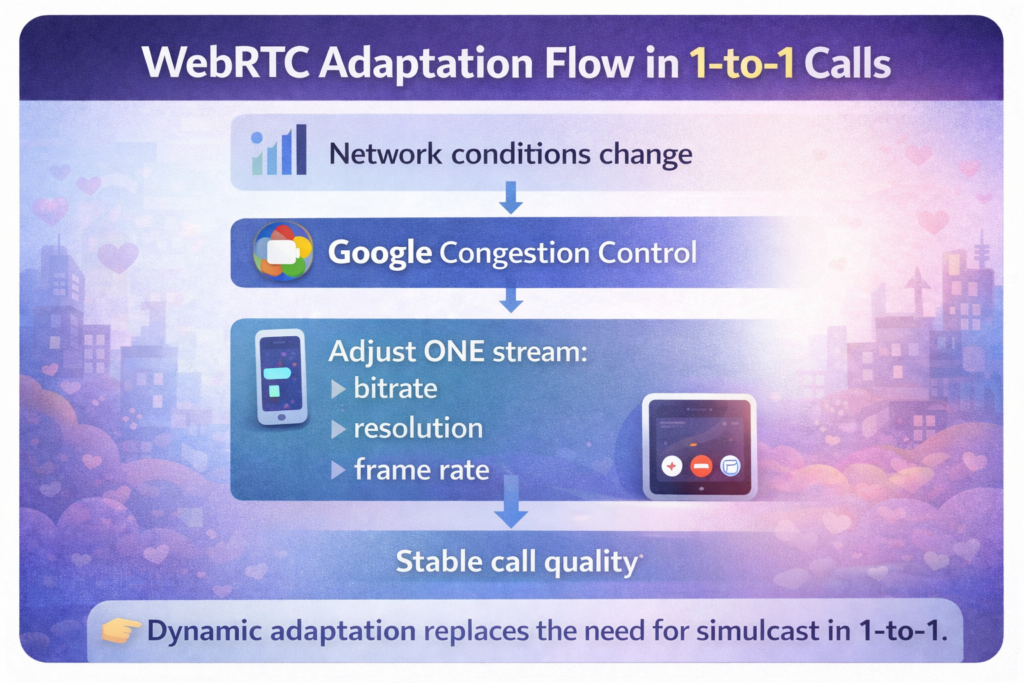
Instead of simulcast, efficient 1-to-1 dating app video calls should leverage WebRTC’s built-in bandwidth estimation and dynamic quality adaptation mechanisms. This approach adjusts a single stream’s quality in real-time based on network conditions, delivering optimal results without simulcast’s overhead.
Google Congestion Control (GCC)
WebRTC implements Google Congestion Control (GCC), a sophisticated bandwidth estimation algorithm that combines delay-based and loss-based measurements. GCC continuously monitors network conditions through RTCP feedback and adjusts encoding parameters dynamically.
The adaptation process operates on multiple parameters:
- Bitrate adjustment: The encoder reduces or increases the target bitrate based on available bandwidth estimates
- Resolution scaling: The encoder can dynamically reduce resolution to maintain frame rate during bandwidth constraints
- Frame rate adjustment: Reducing frame rate from 30fps to 24fps or 15fps preserves visual quality while lowering bandwidth requirements
- Temporal scalability: Using temporal layers within a single stream allows dropping frames intelligently without full resolution changes
Bandwidth Probing Strategy
WebRTC employs bandwidth probing to quickly discover available network capacity. At call initialization, the system starts with a conservative 300 kbps estimate, then sends exponential probes targeting 900 kbps and 1.8 Mbps to rapidly ramp up to optimal quality.
For dating applications, this approach provides several advantages:
- Fast convergence: Users see high-quality video within 2-4 seconds of call start, critical for first impressions
- Network resilience: Continuous probing detects network improvements and automatically upgrades quality
- Graceful degradation: When network conditions worsen, the system smoothly reduces quality rather than experiencing sudden freezes
Mobile Performance Optimization
Mobile devices present unique challenges for WebRTC video calling in dating applications. Battery life, thermal management, and variable network conditions require careful optimization strategies that go beyond simple configuration choices.
Hardware Acceleration
Modern mobile devices include dedicated video encoding and decoding hardware. Properly leveraging these accelerators can reduce CPU utilization by 60-80% compared to software encoding. For dating apps, this translates directly to longer call durations and better device thermal management.
Key codec considerations for mobile dating apps:
- H.264: Universal hardware support on iOS and Android, reliable baseline for all users
- VP8/VP9: Software fallback with good compression, but may trigger CPU throttling on budget devices
- Opus audio codec: Essential for high-quality voice with minimal bandwidth (24-32 kbps typical)
Adaptive Quality Constraints
Implementing smart quality constraints prevents mobile devices from attempting configurations they cannot sustain. A tiered approach based on device capabilities ensures optimal performance across the user base.
| Device Tier | Max Resolution | Target Bitrate | Frame Rate |
| High-end (flagship) | 1280×720 | 1.5 Mbps | 30 fps |
| Mid-range | 960×540 | 800 kbps | 30 fps |
| Budget/older | 640×360 | 400 kbps | 24 fps |
Network-Aware Streaming
Dating app users frequently move between WiFi and cellular networks during calls. Implementing proactive network quality detection and smooth transitions prevents jarring quality drops or connection failures.
Recommended strategies for network adaptation:
- Network type detection: Automatically constrain quality on metered cellular connections to prevent unexpected data charges
- Bandwidth estimation feedback: Display subtle quality indicators so users understand when network limitations affect their experience
- Hysteresis in quality switching: Implement 20% thresholds for quality upgrades and downgrades to prevent oscillation
- ICE candidate prioritization: Prefer IPv4 candidates and local network paths to minimize connection time
Implementation Architecture for Dating Apps
Building a scalable WebRTC infrastructure for dating applications requires careful consideration of both peer-to-peer scenarios and edge cases where server relay becomes necessary.
Hybrid Architecture Approach
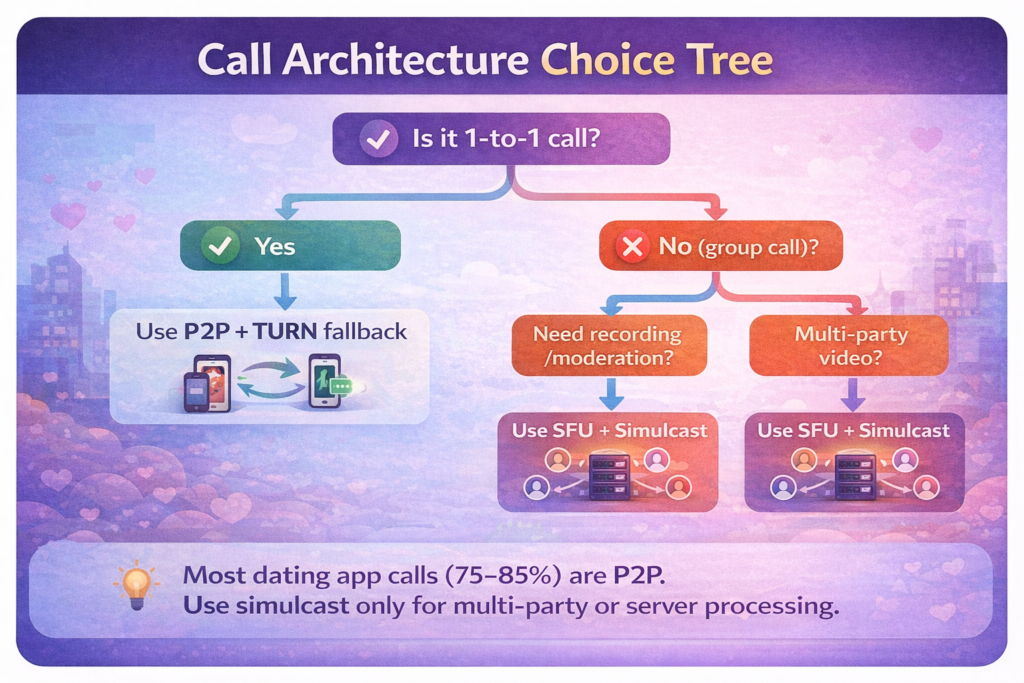
While P2P connections should be the primary path, a robust dating platform requires fallback mechanisms for situations where direct connections fail. A hybrid architecture delivers optimal cost-performance characteristics:
- Primary path: Peer-to-peer with STUN for NAT traversal (covers 75-85% of connections)
- Secondary path: TURN relay for restrictive NAT scenarios (15-25% of connections)
- Tertiary path: Lightweight SFU for calls requiring recording, moderation, or content filtering
TURN servers represent the primary infrastructure cost in this architecture. Published measurements indicate TURN relay connections can consume up to 25× more bandwidth per connection relative to P2P. Strategic placement of TURN servers near user populations and efficient connection management are critical for controlling costs.
Signaling Infrastructure
The signaling server coordinates connection establishment, but doesn’t handle media. A well-architected signaling system for dating apps should provide:
- WebSocket-based real-time messaging for SDP exchange and ICE candidate transmission
- User presence management to enable incoming call notifications
- Call state synchronization for handling reconnection scenarios.
- Analytics event collection for quality monitoring and optimization
Unlike media servers, signaling infrastructure scales efficiently. A single server instance can typically handle hundreds of thousands of concurrent sessions since it only processes control messages, not media streams.
Quality Monitoring and Optimization
Continuous quality monitoring enables data-driven optimization of WebRTC performance in production dating applications. WebRTC provides rich statistics through the getStats() API that reveal exactly how calls perform in real-world conditions.
Key Performance Indicators
Essential metrics for dating app video quality:
| Metric | Target Threshold | Impact |
| Round-trip time (RTT) | < 200ms for 90% of calls | Conversation naturalness |
| Packet loss | < 2% average | Video quality and smoothness |
| Jitter | < 30ms | Audio/video synchronization |
| Frames per second | > 24 fps sustained | Visual smoothness |
| Connection time | < 3 seconds | User experience and abandonment |
Diagnostic Tools and Debugging
Effective quality management requires visibility into both aggregate trends and individual call issues. A comprehensive monitoring system should capture:
- Real-time stats collection: Sample getStats() data every 1-2 seconds during calls and upload to analytics backend.
- Quality limitation reasons: Track whether CPU, bandwidth, or other factors constrain video quality
- Connection path analysis: Identify whether calls use P2P, TURN relay, or other paths to optimize infrastructure
- User feedback correlation: Link quality metrics with user-reported issues to validate technical measurements
When Simulcast Becomes Valuable
Despite this article’s focus on avoiding simulcast misuse in 1-to-1 scenarios, specific features in dating applications may justify its implementation. Understanding these use cases prevents blanket decisions that leave valuable functionality on the table.
Group Video Features
Modern dating apps increasingly incorporate group activities like speed dating events, virtual mixer rooms, or group dates with friends. These multi-party scenarios represent simulcast’s intended use case. When three or more participants join a call, deploying an SFU with simulcast provides:
- Individualized quality: Each participant receives optimal quality for their network and device
- Layout flexibility: Active speaker layouts can receive high quality, while thumbnails use lower layers
- Scalability: Total bandwidth grows linearly rather than quadratically as participants increase
Content Moderation and Safety
Dating platforms have significant trust and safety obligations. For apps implementing real-time content moderation, recording, or AI-based safety features, routing calls through an SFU becomes necessary. In these scenarios, simulcast’s overhead is justified by the additional safety capabilities it enables.
Implementation Best Practices
Successful deployment of efficient WebRTC video calling in dating applications requires attention to numerous technical details. The following best practices synthesize key learnings from production implementations:
Configuration Recommendations
Start with conservative defaults that work reliably across the broadest device and network spectrum:
- Initial video resolution: 640×480 with 800 kbps target bitrate, which allows a quick upgrade for good networks
- Maximum bitrate cap: 2.5 Mbps to prevent excessive bandwidth usage on unlimited connections
- Minimum bitrate floor: 300 kbps to maintain acceptable quality before suggesting network issues
- Audio priority: Configure audio as a higher priority than video to maintain communication during bandwidth constraints
Testing and Validation
Rigorous testing across real-world conditions prevents quality issues in production:
- Device matrix: Test on representative devices across price points and OS versions, not just flagship phones
- Network simulation: Use tools like Chrome’s network throttling or dedicated network emulation to test degraded conditions
- Battery drain testing: Measure power consumption during extended calls on mobile devices
- Cross-platform compatibility: Validate iOS-Android, web-mobile, and mixed-network scenarios
Partner with Experts for WebRTC Excellence
Implementing efficient, scalable WebRTC video calling requires deep expertise across multiple technical domains: real-time media protocols, mobile optimization, backend infrastructure, and quality monitoring. The complexity of getting these systems production-ready and performant should not be underestimated.
Trembit brings extensive experience in building real-time communication platforms for dating and social applications. Our team has delivered WebRTC solutions that serve millions of users, optimizing for the unique constraints of mobile dating scenarios while maintaining the quality expectations modern users demand.
As a reliable technology partner, Trembit provides:
- End-to-end WebRTC implementation: From architecture design through deployment and monitoring
- Mobile expertise: Deep knowledge of iOS and Android WebRTC optimization and native integration
- Infrastructure design: TURN server deployment, signaling architecture, and cost-effective scaling strategies
- Quality assurance: Comprehensive testing frameworks and monitoring systems for production reliability
- Ongoing optimization: Continuous performance tuning based on real-world usage data and emerging best practices
Whether you’re launching a new dating platform or optimizing an existing video calling feature, partnering with experienced WebRTC specialists like Trembit accelerates time-to-market while ensuring your implementation follows industry best practices for bandwidth efficiency, mobile performance, and user experience.
Conclusion
Efficient WebRTC video calling in dating applications starts with understanding the fundamental difference between 1-to-1 peer communication and multi-party conferencing. While simulcast has become closely associated with WebRTC scaling, its application in peer-to-peer dating scenarios introduces significant overhead without corresponding benefits.
By leveraging WebRTC’s built-in bandwidth estimation, dynamic quality adaptation, and mobile-optimized encoding strategies, dating platforms can deliver high-quality video experiences that work reliably across diverse network conditions and device capabilities. This approach minimizes bandwidth consumption, reduces CPU utilization on mobile devices, and ultimately provides better user experiences than naive simulcast implementations.
The key to success lies in thoughtful architecture decisions, comprehensive testing, continuous quality monitoring, and knowing when to introduce additional complexity like SFUs and simulcast for features that genuinely require them. Dating apps that invest in properly optimized WebRTC implementations see measurable improvements in user engagement, call completion rates, and overall platform satisfaction.
As mobile devices continue evolving and network infrastructure improves, video calling will remain a critical differentiator in the dating app landscape. Building these systems with efficiency and scalability from the start positions platforms for sustainable growth while delivering the authentic, high-quality connections users expect from modern dating experiences.
Key Takeaways
- Simulcast adds 17-40% bandwidth overhead and 40-60% CPU overhead in mobile 1-to-1 calls without providing corresponding benefits.
- WebRTC’s Google Congestion Control (GCC) provides sophisticated dynamic quality adaptation for single streams without simulcast complexity.
- Peer-to-peer connections with proper TURN fallback deliver sub-200ms latency for 75-85% of dating app video calls.
- Hardware-accelerated video encoding reduces mobile CPU utilization by 60-80% compared to software encoding.
- Device-tiered quality constraints prevent mobile devices from attempting configurations they cannot sustain.
- Simulcast becomes valuable for multi-party features (group dates, events) and server-side processing (moderation, recording).
- Comprehensive quality monitoring through WebRTC getStats() API enables data-driven optimization in production.
- TURN relay costs can reach 25× that of P2P connections, making efficient connection establishment critical for scaling economics.