
Preventing Infrastructure Overload Through Smart Architecture
Selective Forwarding Units (SFUs) have become the backbone of modern video dating applications, enabling real-time connections between users without the computational overhead of traditional MCU architectures. But there’s a critical paradox: the very features that make video dating appealing — spontaneity, instant connections, and simultaneous sessions — are precisely what can bring your SFU infrastructure to its knees during peak usage.
Unlike video conferencing platforms, where sessions are scheduled and predictable, dating apps face unique challenges. Users expect immediate matches, instant video calls, and seamless transitions between conversations — all while your backend must handle unpredictable spikes in concurrent sessions. This article explores the technical strategies for designing video dating flows that scale gracefully without melting your SFU infrastructure.
Understanding SFU Load Patterns in Dating Applications
Before implementing safeguards, it’s essential to understand how video dating creates uniquely challenging load patterns on SFU infrastructure. Unlike business conferencing tools with predictable 9-to-5 usage, dating apps exhibit entirely different behavioral patterns that can overwhelm unprepared systems.
The Concurrent Session Problem
An SFU’s primary role is forwarding video streams between participants without transcoding. Modern SFUs can typically handle 4-9 simultaneous video decodes per client efficiently, but server-side capacity depends heavily on network bandwidth rather than CPU. The challenge isn’t processing power — it’s bandwidth multiplication.
Consider this scenario: A dating app with 10,000 active users experiences a peak hour where 20% initiate video calls simultaneously. That’s 2,000 concurrent video sessions. If each 720p stream consumes approximately 2 Mbps bidirectionally (upload plus download), the SFU must route 4,000 Mbps of aggregate traffic — 4 Gbps of bandwidth demand in real-time. Without proper throttling, this can saturate network interfaces, introduce packet loss, and cascade into widespread connection failures.
Traffic Spikes vs. Steady-State Usage
Dating apps experience pronounced evening and weekend traffic spikes—often 300-500% above baseline — concentrated in specific geographic regions. A typical pattern might show baseline usage of 200 concurrent sessions jumping to 1,000+ sessions between 8-11 PM in a single timezone. This creates a “thundering herd” problem where the SFU must absorb massive load increases in minutes, not hours.
Furthermore, video dating sessions tend to be short-lived compared to business calls. The average video date might last 3-8 minutes versus 30-60 minutes for a business meeting. This creates rapid session turnover — constant establishment and teardown of WebRTC connections — which puts additional strain on signaling servers and connection state management.
Understanding these load patterns is the foundation for implementing effective mitigation strategies. The goal isn’t to prevent peaks entirely — that would compromise user experience, but rather to shape and distribute load intelligently to keep infrastructure stable even during maximum demand.
Session Gating: Your First Line of Defense
Session gating is the practice of controlling when and how many video sessions can be initiated simultaneously. Unlike rate limiting (which we’ll cover next), session gating focuses on active session capacity — the total number of concurrent video calls your infrastructure can support at any moment.
Implementing Hard Caps with Graceful Degradation
The simplest form of session gating is a hard cap: once your SFU reaches its maximum concurrent session capacity (say, 1,500 active video calls), additional requests are queued or rejected. However, crude rejection creates terrible user experience. Instead, implement tiered degradation strategies that maintain service while managing capacity.
Effective tiered degradation approach:
- Green Zone (0-70% capacity): All features enabled, no restrictions
- Yellow Zone (70-85% capacity): Reduce maximum video quality to 480p, shorten session timeouts from 60 to 30 minutes
- Orange Zone (85-95% capacity): Limit new session creation to premium users only, display queue time estimates for free users
- Red Zone (95-100% capacity): Activate waiting room system, prioritize existing sessions, show transparent status to users
This tiered approach prevents the all-or-nothing cliff where service works perfectly until it doesn’t. Users get degraded service rather than total failure, and your infrastructure remains stable under extreme load.
Geographic Load Distribution
Session gating becomes more sophisticated when combined with geographic distribution. Deploy SFU instances in multiple regions (US East, US West, EU, Asia-Pacific) and route users to their nearest available server with capacity. If a regional SFU hits capacity, the matchmaking system can temporarily prioritize cross-region matches where both users would connect to underutilized instances.
For example, during US evening peak hours, when US-based SFUs are at 90% capacity, the system might subtly favor matching New York users with London users (who are connecting during morning hours when EU capacity is available). This geographic arbitrage spreads load across your global infrastructure without users noticing the coordination happening behind the scenes.
Rate Limiting: Preventing Abuse and Managing Demand
While session gating controls total concurrent capacity, rate limiting manages how quickly individual users can initiate new sessions. This prevents both intentional abuse and unintentional overload from aggressive user behavior.
Per-User Connection Throttling
Implement sliding window rate limits at multiple granularities. A user might be allowed 10 video call initiations per hour, with a burst allowance of 3 within any 5-minute window. This prevents rapid-fire connection attempts while allowing legitimate usage patterns.
WebRTC connection establishment is relatively expensive — ICE negotiation, STUN/TURN server coordination, codec negotiation — so limiting initiation frequency protects both your signaling infrastructure and the SFU itself. Even failed connection attempts consume resources, so rate limiting must apply to all connection attempts, not just successful ones.
Bandwidth-Aware Rate Limiting
Advanced rate limiting considers actual bandwidth consumption, not just session count. A user in a 1080p video call consumes 3-4 Mbps, while someone in 360p uses under 1 Mbps. By tracking per-user bandwidth allocation, you can allow power users to have more simultaneous low-quality sessions or fewer high-quality ones, optimizing total throughput.
This is particularly relevant for dating apps with group video features or multi-party events. A user participating in a 4-person speed dating event uses significantly more bandwidth than someone in a 1-on-1 call. Bandwidth-aware limiting ensures fair resource allocation across different usage patterns.
Session gating and rate limiting are reactive measures — they respond to load as it occurs. The most powerful tool for preventing SFU overload is proactive: intelligent matchmaking logic that distributes load before it becomes a problem.
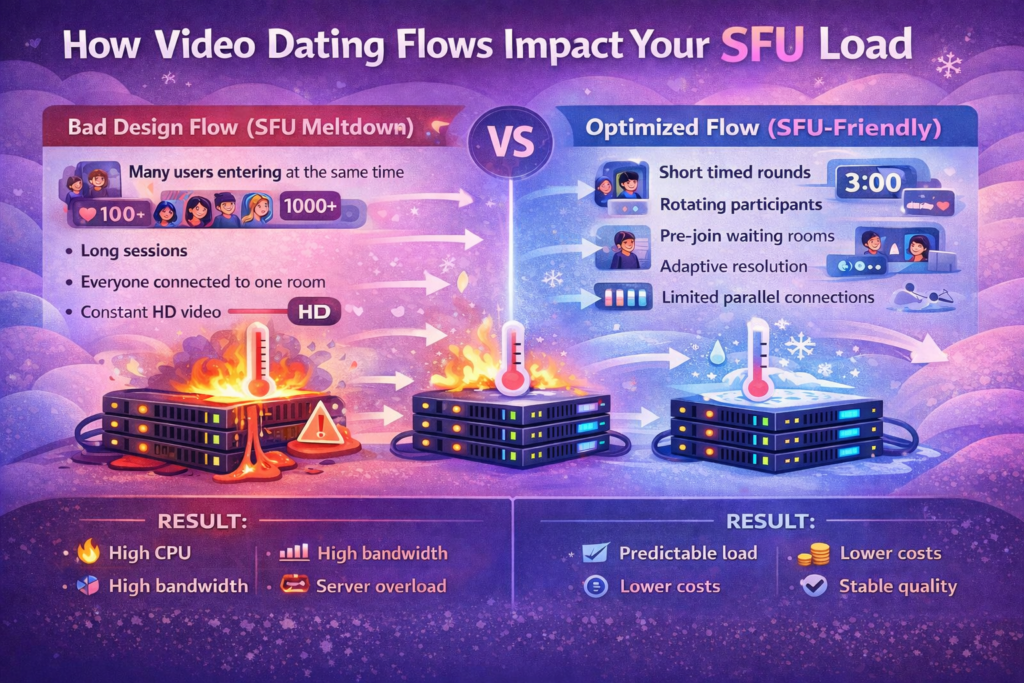
Infrastructure-Aware Matchmaking Logic
Traditional matchmaking algorithms focus purely on compatibility: shared interests, geographic proximity, demographic preferences. Infrastructure-aware matchmaking adds a crucial dimension: current system load. By incorporating infrastructure capacity into matching decisions, you can prevent overload before it happens.
Load-Based Match Timing
Instead of presenting all potential matches simultaneously, implement staggered match delivery based on current SFU capacity. When infrastructure is at 30% capacity, the algorithm might surface 10 matches instantly. At 70% capacity, it shows 5 matches with others “coming soon.” At 90% capacity, it delivers matches one at a time with deliberate pacing.
This approach feels natural to users; they’re discovering new people gradually, while giving infrastructure breathing room. The algorithm becomes a pressure release valve, automatically slowing match delivery during peak demand without explicitly telling users the system is under load.
Session Pre-Allocation and Warm Standby
When the matchmaking algorithm identifies a high-probability match (based on mutual interest signals, past behavior, or compatibility scores), it can pre-allocate SFU resources before either user initiates a video call. This “warm standby” approach reserves bandwidth and establishes partial WebRTC signaling paths, dramatically reducing connection establishment time when users do want to video chat.
The trade-off is resource reservation for sessions that may never materialize, but intelligent prediction can optimize this. Machine learning models trained on user behavior can predict video call likelihood with 70-85% accuracy, making pre-allocation worthwhile for top-tier matches while avoiding wasteful reservation for low-probability connections.
Asynchronous-First Nudging
During high-load periods, the matchmaking algorithm can subtly encourage asynchronous interaction before live video. Instead of immediately offering “Start Video Call,” the UI might suggest “Send Video Message” or “Schedule Video Date” as primary actions, with live calling as a secondary option. This shifts some demand from real-time SFU bandwidth to asynchronous video storage (which scales far more easily), smoothing out infrastructure load without degrading the core experience.
SFU Load Patterns: What to Monitor
Effective infrastructure management requires monitoring the right metrics. Here are the critical indicators for SFU health in video dating applications:
| Metric | Green Zone | Yellow Zone | Red Zone |
| Concurrent Sessions | 0-70% of capacity | 70-85% of capacity | 85-100% of capacity |
| Packet Loss Rate | < 1% | 1-3% | > 3% |
| Bandwidth Utilization | < 60% | 60-80% | > 80% |
| Connection Failures | < 2% | 2-5% | > 5% |
| ICE Negotiation Time | < 2 seconds | 2-4 seconds | > 4 seconds |
Monitoring these metrics in real-time allows your system to shift between operational zones dynamically, activating appropriate safeguards before users experience degraded service.
Advanced Techniques for Load Management
Beyond basic session gating and rate limiting, several advanced techniques can further optimize SFU utilization and prevent overload in high-scale dating applications.
Simulcast and Adaptive Bitrate Control
Simulcast allows clients to send multiple quality versions of the same video stream (typically low, medium, and high resolution), and the SFU selectively forwards the appropriate version to each recipient based on their network conditions and device capabilities. This technique dramatically reduces bandwidth waste — users on poor connections receive 360p streams while those on high-bandwidth connections get 1080p, all from the same source stream.
During high-load periods, the SFU can automatically downshift all connections to lower simulcast layers, reducing aggregate bandwidth by 60-70% without disconnecting anyone. This is far superior to hard session limits because existing users maintain their calls, just at reduced quality.
Congestion-Based Session Timeouts
Implement dynamic session timeouts that adjust based on system load. In normal conditions, a video date might have a 60-minute maximum duration. When the SFU hits 85% capacity, this timeout gradually reduces to 45 minutes, then 30 minutes at 90% capacity. Long-running sessions naturally terminate, freeing resources for new connections without abruptly ending calls.
Pair this with proactive warnings: “Your call has been running for 25 minutes. To allow others to connect during peak hours, this session will end in 5 minutes unless you extend.” Most users accept these limitations when communicated transparently, especially if premium users get exemptions.
Predictive Auto-Scaling with ML
Machine learning models can predict load spikes 15-30 minutes before they occur by analyzing historical patterns, current user activity, and external factors (day of week, local events, weather in key markets). This allows infrastructure to auto-scale proactively rather than reactively, spinning up additional SFU capacity before demand arrives rather than scrambling after saturation hits.
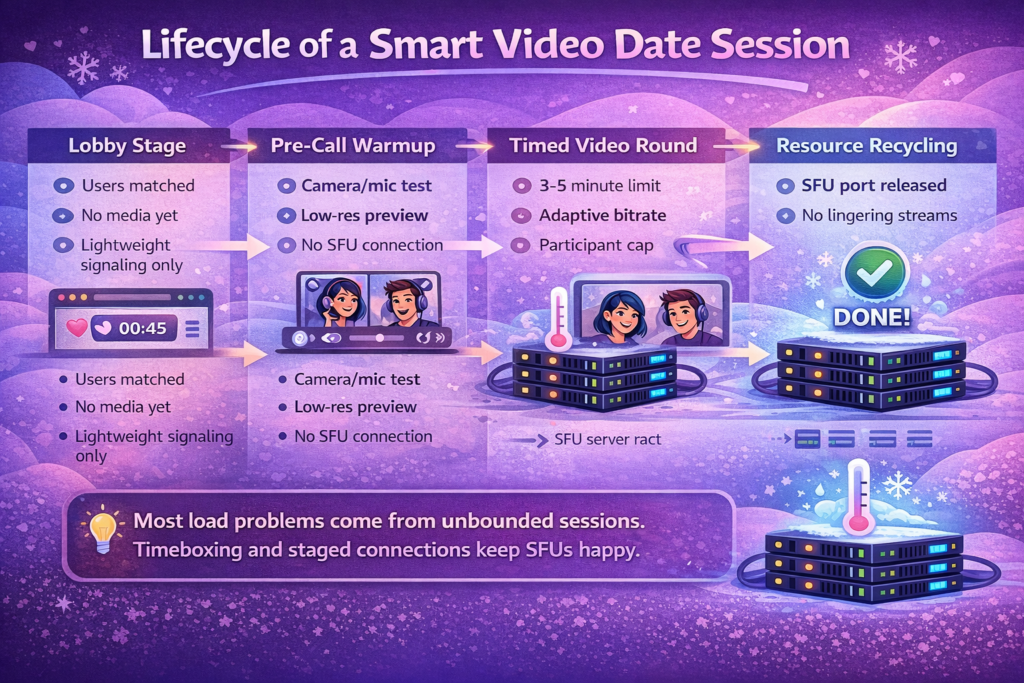
Infrastructure Cost Impact of Load Management
Effective load management doesn’t just prevent outages; it dramatically reduces infrastructure costs by allowing you to run closer to capacity without over-provisioning. Here’s a comparison of infrastructure costs for a dating app with 50,000 weekly active users:
| Approach | Monthly Cost | Characteristics |
| No Load Management | $18,000-25,000 | Massive over-provisioning for peak, frequent outages anyway |
| Basic Session Gating | $12,000-16,000 | Hard caps prevent meltdowns, 30% cost reduction |
| Intelligent Load Management | $7,000-10,000 | Full stack: gating, rate limits, infrastructure-aware matching, simulcast |
The cost savings compound at scale. A dating app serving 500,000 weekly active users might spend $200,000+ monthly on SFU infrastructure without load management versus $80,000-100,000 with intelligent controls — a $100,000+ monthly savings while actually improving reliability.
Building Resilient Video Infrastructure with Trembit
Implementing sophisticated load management for video dating applications requires deep expertise across multiple technical domains: WebRTC architecture, real-time networking, distributed systems design, and application-layer optimization. The difference between a stable, cost-efficient video platform and one that melts under peak load often comes down to architectural decisions made early in development.
Trembit specializes in building scalable real-time communication platforms for high-growth consumer applications. Our engineering teams have extensive experience implementing SFU-based video architectures, designing intelligent matchmaking systems that balance user experience with infrastructure constraints, and building monitoring and auto-scaling systems that prevent outages before they impact users.
Whether you’re launching a new video dating platform or scaling an existing one that’s hitting infrastructure limits, Trembit provides the technical partnership needed to build systems that grow with your user base. We understand that video features aren’t just about technology — they’re about creating reliable, delightful experiences that keep users engaged even during your busiest hours.
Conclusion: Designing for Peak, Not Average
The fundamental challenge in designing video dating flows is that your infrastructure must handle peak load — that Saturday night surge when everyone’s looking for connections simultaneously — not average usage. Traditional approaches over-provision capacity to astronomical levels, paying for infrastructure that sits idle 70% of the time, or under-provision and suffer regular outages during peak hours.
Intelligent load management offers a better path: session gating that degrades gracefully, rate limiting that prevents abuse without hampering legitimate use, and infrastructure-aware matchmaking that distributes load before it becomes a problem. These aren’t just defensive measures — they’re product features that improve user experience by ensuring consistent reliability.
Your SFU infrastructure doesn’t have to melt during peak hours. With thoughtful architecture, transparent communication with users about capacity constraints, and systems designed for real-world load patterns rather than idealized averages, you can build video dating experiences that scale reliably from hundreds to hundreds of thousands of concurrent users.
The most successful video dating platforms aren’t necessarily those with the most expensive infrastructure — they’re the ones that intelligently manage the infrastructure they have, creating consistent, reliable experiences that users can depend on every time they open the app.
Key Takeaways
- Video dating creates unique load patterns with 300-500% peak-to-baseline variation, requiring purpose-built infrastructure strategies
- Session gating with tiered degradation (Green/Yellow/Orange/Red zones) maintains service quality under extreme load
- Per-user rate limiting prevents abuse while bandwidth-aware throttling optimizes total system throughput
- Infrastructure-aware matchmaking proactively distributes load by timing match delivery and pre-allocating resources for high-probability connections
- Simulcast and adaptive bitrate control can reduce bandwidth consumption to 60-70% during congestion without disconnecting users
- Intelligent load management reduces infrastructure costs by 50-60% compared to naive over-provisioning while improving reliability
- Critical monitoring metrics: concurrent sessions, packet loss rate, bandwidth utilization, connection failure rate, and ICE negotiation time
The architecture decisions you make today will determine whether your video dating platform can scale smoothly to millions of users or whether you’ll spend your nights fighting infrastructure fires. By designing flows that respect your SFU’s limitations while delivering excellent user experiences, you build platforms that thrive under pressure rather than melt.