By Maryna Poplavska, Head of Project Managers, Trembit — real-time video, telemedicine and moderation delivery
An Omegle-style platform — what most people search for as an “Omegle clone” — pairs two strangers into a live one-to-one video session. The loop everybody copies (queue, pair, next) is a weekend of work. What decides whether the product survives sits elsewhere: who enters the pool, who may be paired with whom, what your servers can see, and what survives after the call. Omegle announced its own closure in November 2023 — its founder citing misuse and an unsustainable burden, financial and psychological — a week after a child-safety lawsuit settled. This covers the architecture, not the clone script.
Key takeaways
- The pairing loop is the cheap part. The policy around it — eligibility, media path, moderation timing, evidence — is the product.
- The matcher is a policy enforcement point. Random means random within an eligible set: hard filters run before the random pick.
- The media path decides what moderation is even available. Peer-to-peer and TURN relay leave your servers nothing to sample; visibility needs a server that is one end of the call, even for 1:1.
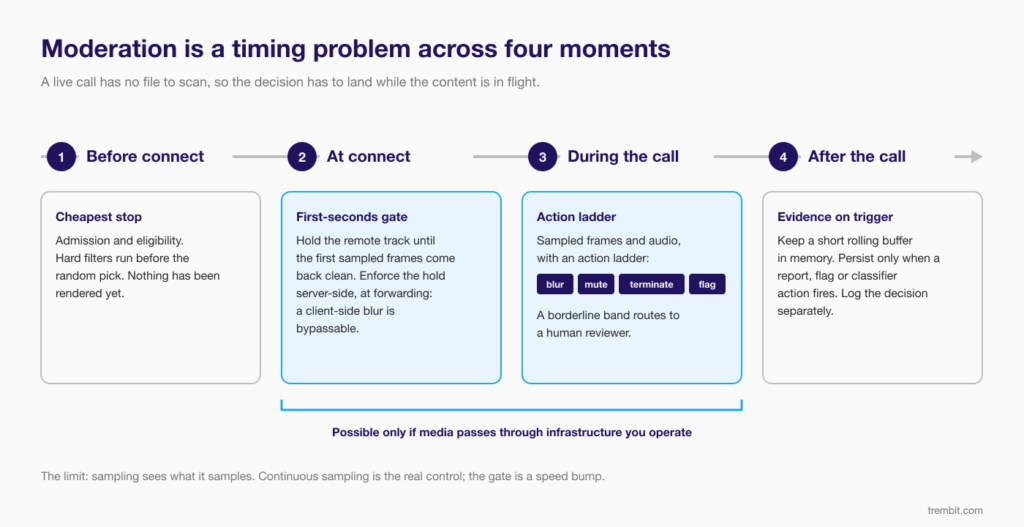
- Moderating live 1:1 video is a timing problem across four moments, not a filter on a file.
- Apple’s guidelines name “random or anonymous chat” explicitly, and for a mobile app, app review is usually the first gate.
Engineers: the matcher, the media path and moderation. Founders: the Omegle facts, the store-and-regulator table, and the cost note at the close.
Orientation, not legal advice: the regulatory table maps which doors exist, not your obligations.
What happened to Omegle, and what can anyone responsibly say about why?
Omegle’s founder, Leif K-Brooks, announced the closure on 8 November 2023 in a letter on the homepage: “Operating Omegle is no longer sustainable, financially nor psychologically,” as AP reported. The letter acknowledged that “some people misused it, including to commit unspeakably heinous crimes.”
The timing is easy to overstate. AP also wrote that the closure “arrives about a week after Omegle settled a lawsuit” in which the plaintiff accused the platform “of pairing a then 11-year-old user with a sexual predator.” Lawfare records that case — A.M. v. Omegle.com LLC — as dismissed on 2 November 2023 following the settlement. NBC News reported that Carrie Goldberg, the plaintiff’s attorney, said the shutdown was a result of the mediation between the platform and her client. No court or regulator ordered Omegle to close.
One sentence from an earlier ruling interests an architect. In July 2022 the U.S. District Court for the District of Oregon denied Omegle’s motion to dismiss as to the first four claims and granted it as to the rest. On the claims that remained it wrote that “Omegle could have satisfied its alleged obligation to Plaintiff by designing its product differently—for example, by designing a product so that it did not match minors and adults.” It reasoned that way because the plaintiff was not asking Omegle to review or remove anything users had posted — the claim was about how the product paired people.
In A.M. v. Omegle, the court was ruling on whether the case could proceed, not on what happened — on a motion to dismiss, a court takes the allegations as true for argument’s sake and decides only whether they state a claim. Nothing was tested at trial, and the case settled before any finding of fact. Lawfare notes that the opinion, “as a district court ruling, is not precedential.” A separate suit against Omegle, M.H. v. Omegle.com LLC, was dismissed and the dismissal affirmed by the Eleventh Circuit in December 2024, on claims of its own. Neither produced a ruling that Omegle was liable.
The reading below is ours: a theory about who may be matched with whom is a claim about the matching layer, and the matching layer is something you write.
What does an “Omegle clone” actually have to include?
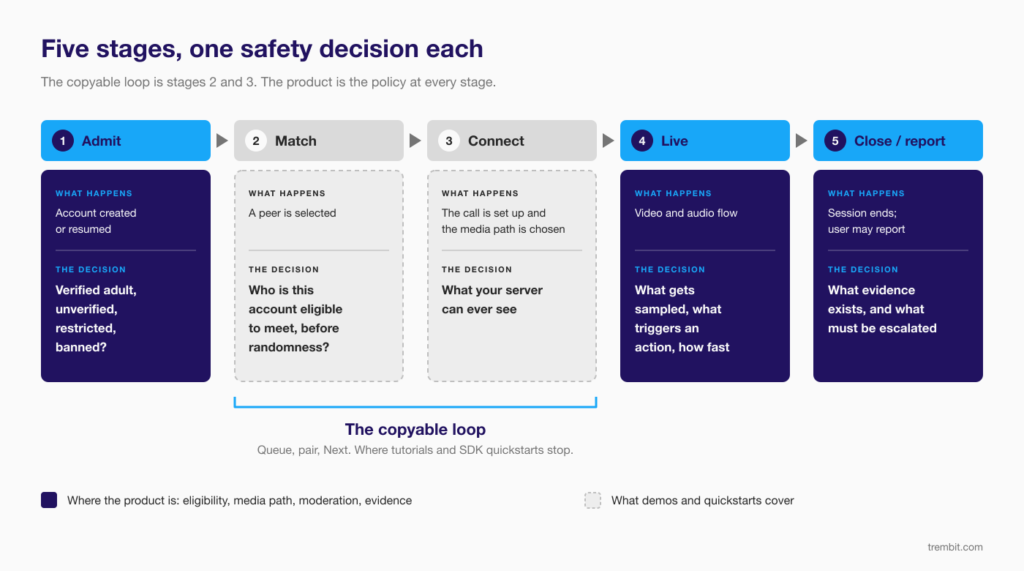
Five stages, each carrying exactly one safety decision:
| Stage | What happens | The decision made here |
|---|---|---|
| Admit | Account created or resumed | Verified adult, unverified, restricted, banned? |
| Match | A peer is selected | Who is this account eligible to meet, before randomness? |
| Connect | The call is set up and the media path is chosen | What your server can ever see |
| Live | Video and audio flow | What gets sampled, what triggers an action, how fast |
| Close / report | Session ends; user may report | What evidence exists, and what must be escalated |
The copyable part is stages 2 and 3 plus a Next button. Many build tutorials and SDK quickstarts stop there — that is the part that demos, and a reasonable place for a quickstart to stop. It is not where the product is. For a general starting point on building a video chat app at all, see that build guide; it does not cover matching, media path or moderation, which are this article’s subject.
Who gets into the pool, and who is allowed to meet whom?
Pool admission is an input to the matcher, not a job for it
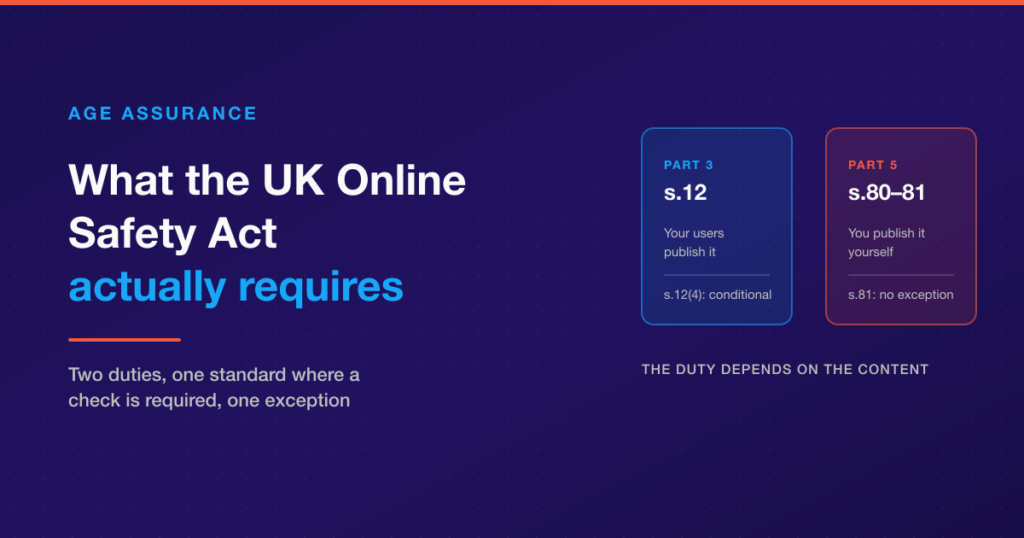
The matcher should consume account state, never compute it: it reads a flag — verified adult, unverified, restricted — and routes on it. Earning that flag is a separate subsystem with its own failure modes, legal surface and latency budget. Age checks are the clearest case, and out of scope here. For how that check works under the UK Online Safety Act, see our age assurance guide for dating and video chat apps.
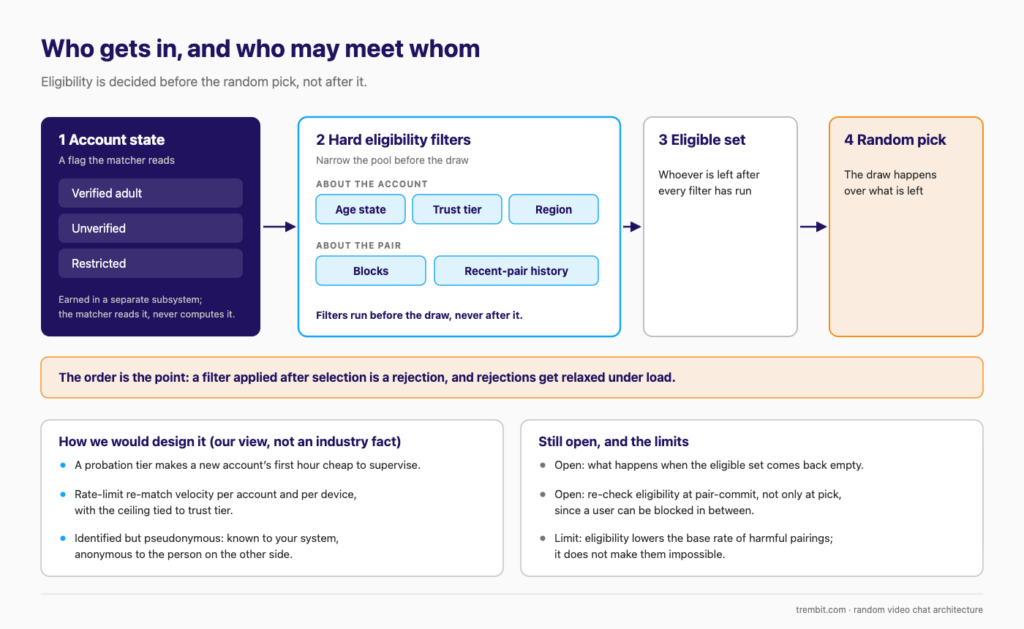
Random means random within an eligible set
Hard eligibility filters run before the random pick: the pool query is narrowed by age state, trust tier, region, blocks and recent-pair history, and the draw happens over what is left. The ordering is not cosmetic: a filter applied after selection is a rejection, and rejections get relaxed under load.
Beyond the filter ordering, what follows is how we would design it, not an industry fact: a probation tier makes a new account’s first hour cheap to supervise. Two things a real design must settle and this piece does not — what happens when the eligible set comes back empty, and re-checking eligibility at pair-commit rather than at pick, since a user can be blocked in between.
The Next button is an attack tool
If an account can burn two hundred pairings an hour, you have built a search interface over your user base and called it random. Ours, not a standard: rate-limit re-match velocity per account and per device, tie the ceiling to trust tier, and link account to device for ban evasion. We would not rely on IP alone; the web gives you no stable device identity to lean on, and fingerprinting can raise a consent question in the EU.
Anonymous to the peer, identified to you
In our view the defensible design is identified-but-pseudonymous: known to your system, anonymous to the person on the other side. A product whose value proposition is unverified anonymity with strangers is the one the store guideline points at, and we doubt downstream moderation fixes it. That is positioning, not engineering.
The limits, plainly: eligibility rules change who can be reached, not what a determined adult on a verified account does once reached, nor a conversation moving off-platform in thirty seconds. Pool design lowers the base rate of harmful pairings; it does not make them impossible.
Where we have seen this at scale: Martti, the medical interpretation platform we built, “matches patient language to available interpreters and establishes clinical-quality video connections in under 20 seconds” across 4,000+ healthcare facilities. The pool there is scarce skilled supply, not an adversarial crowd, so the policy problem is different. One constraint carries straight over, and this part is our judgement rather than anything the case study states: presence accuracy is the real speed limit on any matcher, because a pool listing users who closed the tab produces failed connects that users cannot tell apart from a broken product.
What can your server see: peer-to-peer, relay, or SFU?
The media path is chosen during connect, often by whatever the SDK defaults to, and it is expensive to revisit.
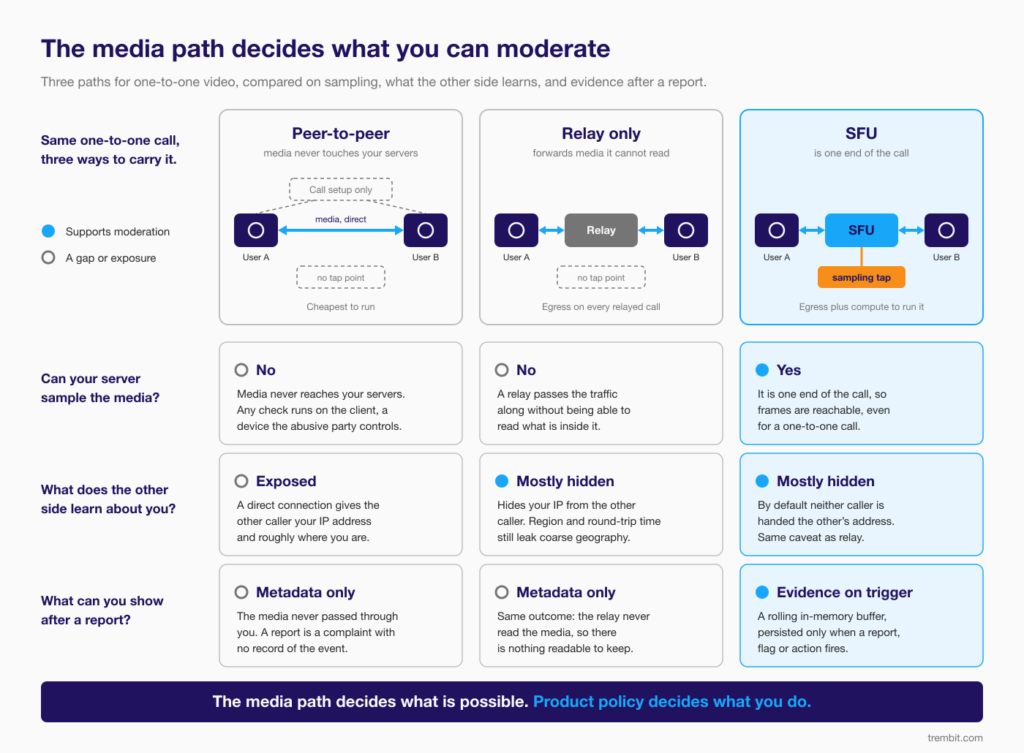
In pure peer-to-peer, media flows between the two browsers and never touches your infrastructure. Server-side sampling is therefore not possible — not hard, not costly, not possible. Any check runs on the client — in a stranger-pairing product, a device the abusive party controls.
A relay looks like it fixes that and does not. It forwards the traffic without being able to read it: the encryption is agreed between the two callers, so a relay that only passes packets along knows who is talking and how much, never what is on screen. Seeing frames needs a server that is one end of the call itself — it terminates the connection and re-encrypts it onward, which is what an SFU does, even for a one-to-one call. The consequence is ours, not a citation: whether a report leaves you with evidence or with metadata only is decided by whether the media passed through infrastructure you operate.
A second reason, unrelated to moderation: on a direct connection each side learns the other’s IP address, and an IP address gives away roughly where someone is. For a product that pairs strangers, that is a doxxing vector switched on by default. Routing every call through your own infrastructure — a relay or an SFU — closes it, because neither caller is ever handed the other’s address. Region and round-trip time still leak coarse geography, and you now hold both addresses in your own logs.
Our breakdown of how much of your traffic is relayed assumes “typically 15–40% of your user base” needs relay; relay-only sends that to 100%, so it stops being a variable: against that range it is 2.5× to 6.7× the relayed traffic, which is arithmetic rather than a guess. The absolute number depends on your resolution, session length and egress contract.
Weighing relay-only against an SFU for a one-to-one product? Bring that trade-off to the free call at the end — it is a decision we work through in video chat app development projects.
How do you moderate a call that has no file to scan?
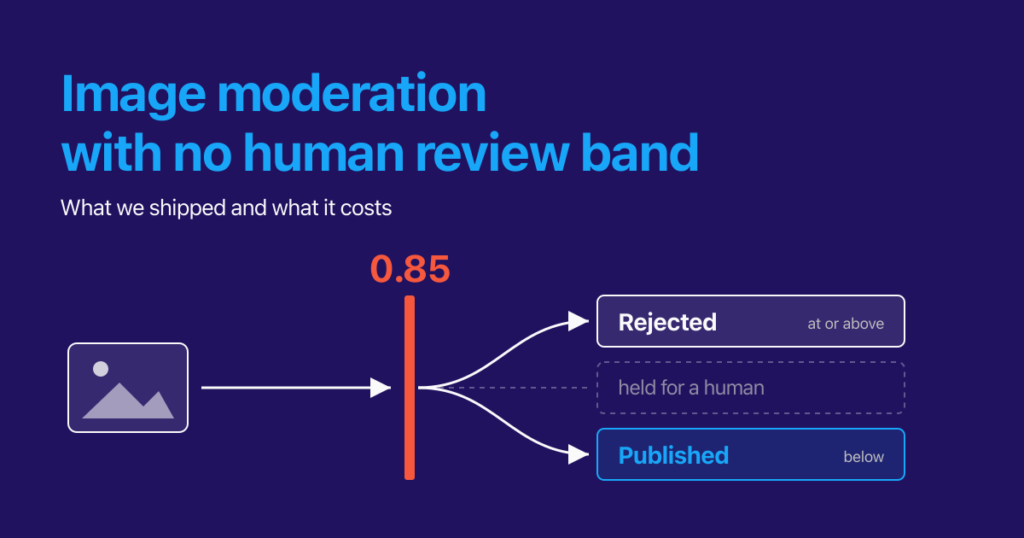
On one platform we built, the automated moderation that shipped covered the photos users uploaded. No moderation watched the live calls — what covered those was a report queue, worked after the event rather than during it.
The asymmetry is worth being precise about. An uploaded photo is a file at rest, and a check on it can take as long as it needs before anyone else sees it. That build took the slack literally: the upload waits for the verdict, and if the moderation API errors the photo stays pending rather than going live unchecked. The verdict is binary against one threshold — no borderline band, nothing held for a human. You can build it that way precisely because nothing is in flight.
A live call gives you none of that slack. Nothing is at rest, every verdict competes with connect time, and anything missed is already on the other person’s screen.
The example matters because this was not a limit of the media path. Those calls ran through an SFU, which is one end of the call, so the frames were in principle reachable. The architecture permitted moderation; it was not built.
So the honest sequence has two steps, and the first one is often never consciously taken. The media path decides what is possible. Product policy decides what you actually do. A product that settles the first question by accident — peer-to-peer, because that is the default — never reaches the second: it has not chosen light-touch moderation, it has chosen none, and finds out later.
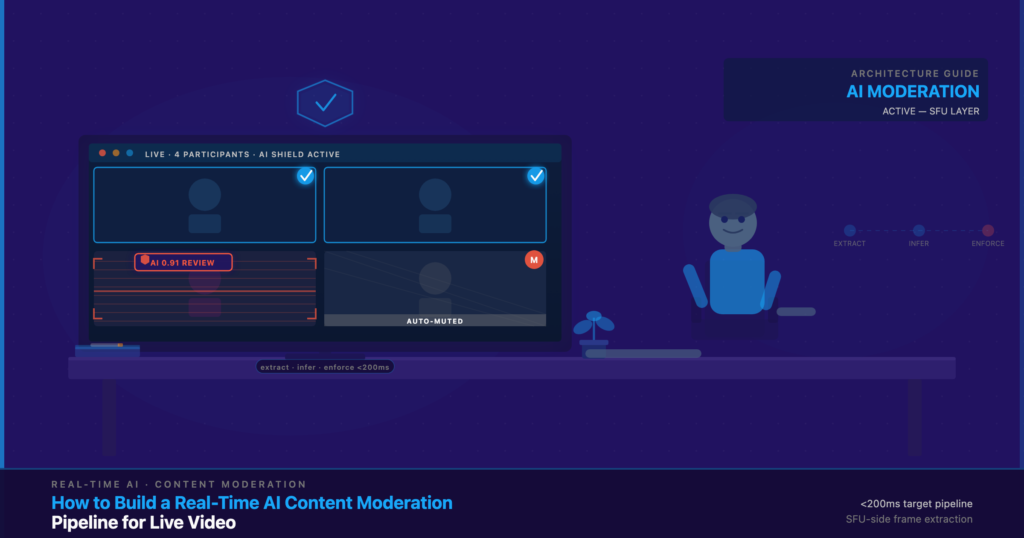
Once media reaches your infrastructure, moderation becomes a timing problem across four moments:
- Before connect — admission and eligibility: cheapest, because nothing has been rendered.
- At connect — hold the remote track until the first sampled frames come back clean. Enforce the hold server-side, at forwarding, because a client-side blur is bypassable by a modified client. That rule is ours, not a standard. Budget the wait against your own funnel, not a number from an article.
- During the call — sampled frames and audio with an action ladder: blur, mute, terminate, flag. Keep a borderline band that routes to a human — a wrongly terminated session is, to the user, indistinguishable from a broken product. The frame-sampling and coverage-window maths are worked through separately.
- After the call — reports, evidence, escalation: the next section.
Name the limit: sampling sees what it samples, a classifier tuned against wrongful terminations misses things by construction, and a clean loop from a virtual camera passes the connect gate and then switches. Continuous sampling is the real control; the gate is a speed bump.
The closest thing we have built is an AI content moderation system for a social platform with millions of users, “with a pathway that can mute, blur, or terminate a stream within seconds of detecting prohibited content.” Live streaming, not 1:1 pairing — same problem: the decision is made while the content is in flight.
What has to survive after the call ends?
By the time a report arrives, the thing being reported no longer exists: you hold a complaint about an event you have no record of.
Our answer is evidence on trigger, not by default: keep a short rolling buffer in memory and persist only when a report, flag or classifier action fires. Log the decision — content hash, scores, rule matched, action, timestamp — rather than the content. That is how the moderation system above produces audit-ready logs “without storing the actual prohibited content” — data minimisation as much as safety, since keeping everything is both more expensive and more dangerous.
Escalation is where discretion stops. For US providers, 18 U.S.C. §2258A requires a report to NCMEC’s CyberTipline “as soon as reasonably possible after obtaining actual knowledge,” while §2258A(f) says nothing in it requires a provider to “monitor any user, subscriber, or customer.” Detection is a choice; reporting is not, once you know. A filed report also triggers a one-year preservation requirement, raised from 90 days in May 2024, which your deletion jobs need to know about.
For known illegal imagery use established hash-matching tooling, not a classifier you train yourself. The enforcement ladder is short — warn, timed block, permanent block — and every step is logged. One temptation to resist: face matching to catch banned users returning under new accounts can amount to biometric processing of special-category data in the EU — a legal question before an engineering one.
An earlier, separate build, on a different stack. Its trust-and-safety layer was “reporting, blocking, and automated flagging systems” plus an “admin dashboard with real-time moderation tools and user management”, and “SMS verification and identity checks during onboarding”. From the case study: “Trust and safety architecture can’t be retrofitted — it must be foundational.”
Will the app stores and regulators let a random-chat product ship?
Which doors exist, not whether you get through them.
| Gatekeeper | Published wording |
|---|---|
| Apple App Store | Guideline 1.2: apps with user-generated content “must include” a method for filtering objectionable material, a mechanism to report offensive content “and timely responses to concerns,” the ability to block abusive users, and published contact information. Apps “that end up being used primarily for pornographic content, Chatroulette-style experiences, random or anonymous chat … do not belong on the App Store and may be removed without notice.” |
| Google Play | Its user-generated content policy requires ongoing UGC moderation, in-app reporting and blocking, and removes apps whose primary purpose is objectionable UGC — or that end up used primarily for it. Random chat is not mentioned. |
| EU | European Commission guidelines on protection of minors under the DSA (14 July 2025): the Commission “will use these guidelines to assess compliance with Article 28(1) of the DSA,” following them “is voluntary and does not automatically guarantee compliance,” and they exclude micro and small enterprises. Recommendations include minors’ accounts private by default and letting children “block and mute any user.” |
| UK / US | UK: children’s safety duties attach to user-to-user services and turn on whether children can access them, which puts age assurance upstream of the rest. US: §2258A, above, plus COPPA and state law. |
Apple’s “end up being used primarily for” is a conditional, not a flat ban: actual use governs. Private-by-default and per-user block/mute are account-model decisions landing in the same schema as your eligibility flags; our advice is to make those flags switchable per region. For a mobile product, app review is usually the first gate you meet, so this work belongs on your app-review checklist.
What have we built that’s closest, and where does the analogy stop?
Three of our published case studies bear on this product: Martti for pairing from a live pool under 20 seconds; the AI content moderation system for in-flight detection at millions-of-users scale; the geosocial video dating platform for consumer reporting, blocking and moderation tooling.
Where the analogy stops: none is an anonymous random-pairing consumer product. Martti routes against a scarce pool of skilled interpreters, the moderation system served live streams rather than 1:1 calls, and the geosocial platform had profiles and matching. This is an architecture argument assembled from adjacent builds, not a claim to have shipped the thing you searched for — a fair first question to put to us about building a video chat product.
FAQ
Why did Omegle shut down? Its founder, Leif K-Brooks, announced the closure on 8 November 2023, writing that “Operating Omegle is no longer sustainable, financially nor psychologically.” NBC News reported that the plaintiff’s attorney in a child-safety suit against the platform, Carrie Goldberg, said the shutdown was a result of the mediation. AP reported the closure came about a week after Omegle settled a lawsuit alleging the platform had paired a then 11-year-old user with a sexual predator. No court or regulator ordered Omegle to close — the claims were never tested at trial; it settled before any finding of fact.
Is it legal to build an Omegle clone? Not legal advice, and it is the wrong question. Building one is not itself prohibited; the obligations come from which markets you ship to, whether minors can reach the service, and what you do once you know about abuse. Scope those with counsel.
Can you build random video chat with peer-to-peer only? Technically yes, and it is cheapest. You give up server-side moderation entirely — media never reaches your infrastructure, so there is nothing to sample — and you expose each user’s IP address and approximate location to the stranger they were paired with. Forcing relay closes the exposure, not the moderation gap.
Will Apple or Google approve a random video chat app? Both require moderation controls, in-app reporting and user blocking; Apple adds published contact details, Google clear terms of use. Only Apple names the category, saying apps that “end up being used primarily for … Chatroulette-style experiences, random or anonymous chat” may be removed without notice. The conditional is what matters: risk attaches to actual use, which is our reason for preferring an identified-but-pseudonymous design with working controls. Apple names random and anonymous chat either way.
In random video chat the trust-and-safety architecture is the product architecture, and the decisions that matter get made in the connect path and the matcher.
One thing we would not build: unverified, anonymous pairing a minor can reach. Every control above becomes decorative once that is the product.
On budget, the shape matters more than any figure we could quote. Beyond media egress on relay-only and SFU compute if you run one, the line that gets forgotten is moderation inference per sampled frame and the human reviewers — it scales with sessions rather than servers, and we read the reporting duty above as making it staff, not software.
If you already have a build and now suspect it has no moderation surface, that is the call to book. So is the decision ahead of it: relay-only versus an SFU for one-to-one, the eligibility rules your matcher should enforce, the first-seconds gate and what it costs your funnel. A free 30-minute call with our engineers, no deck and no pitch — and we will tell you plainly if the answer is “don’t build this.” Talk to our team.