Every WebRTC conversation eventually arrives at the same question: what is this actually going to cost us?
It’s a reasonable question that gets surprisingly evasive answers. Vendor pricing pages show “contact us for enterprise pricing.” Blog posts compare sticker prices without accounting for egress fees, support tiers, or the engineering hours required to hold a self-hosted stack together. And by the time most CTOs get real numbers, they’ve already made architectural decisions that are expensive to reverse.
This article gives you what’s missing: a frank breakdown of where WebRTC costs actually come from, how they scale, what the major infrastructure options really cost at different volumes, and the decision framework Trembit uses when helping clients choose the right architecture for their growth stage.
Where WebRTC Costs Actually Come From
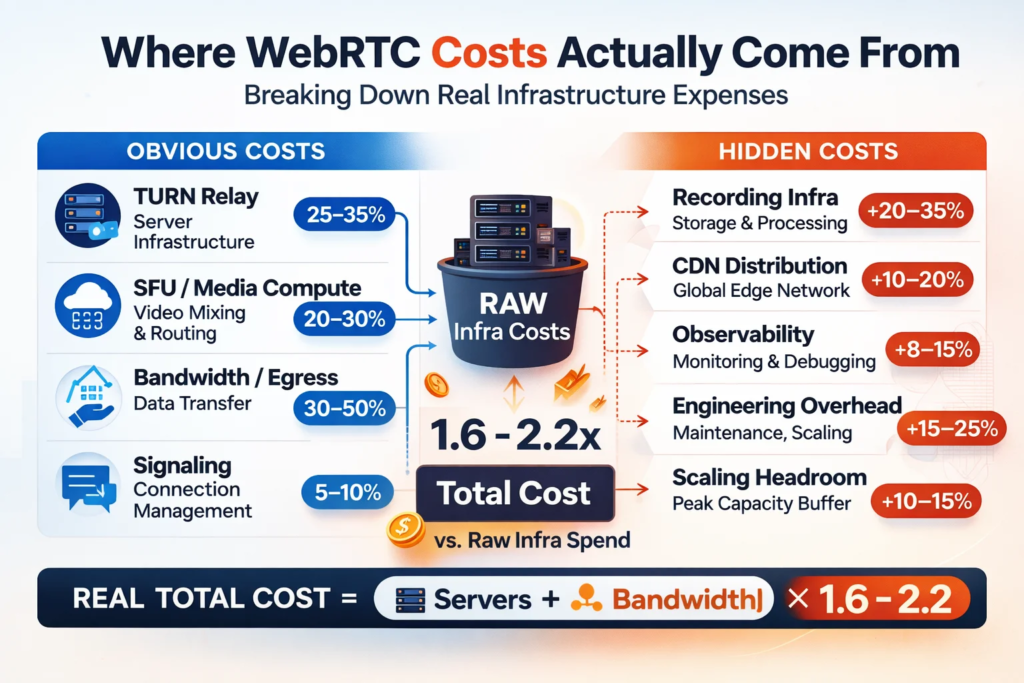
Before comparing vendors, you need to understand the cost components. Most teams budget for the obvious line items and get surprised by the rest.
The Obvious Costs
- TURN server infrastructure — relaying media for participants who can’t establish a direct P2P connection (typically 15–40% of your user base, depending on network environment).
- SFU/media server compute — CPU and memory for mixing, forwarding, and transcoding media tracks in multi-party calls.
- Bandwidth/egress — the cost of moving video and audio bits across the network, usually the largest single line item at scale.
- Signaling server — the coordination layer that establishes and manages WebRTC sessions.
The Costs Teams Miss
- Recording infrastructure — storing and processing recorded sessions adds 20–35% to compute and storage costs.
- CDN and geographic distribution — latency-sensitive media needs edge nodes; distributing multiple infrastructure costs globally significantly.
- Monitoring and observability — WebRTC quality debugging requires specialized tooling (Grafana + custom WebRTC metrics, or commercial tools like Callstats/Cyara).
- Engineering maintenance overhead — self-hosted infrastructure requires ongoing tuning, security patching, and capacity planning; this is real headcount cost.
- Scaling events — synchronous usage spikes (think: all your users starting calls at 9am Monday) require headroom that sits idle the rest of the time.
A fully-loaded WebRTC infrastructure cost is typically 1.6–2.2x the raw compute and bandwidth bill once you account for the above.
The Three Architecture Models and Their Cost Profiles
There are three fundamental ways to run WebRTC infrastructure, and each has a very different cost curve.
Model 1: Managed Cloud (Fully Hosted)
Twilio, Agora, Daily.Co, Vonage
You pay per minute, per participant, or per GB of media processed. No infrastructure to manage. Costs are predictable at low volume and become painful at scale.
Best for: Early-stage products, teams without dedicated infrastructure engineers, use cases with unpredictable or bursty traffic.
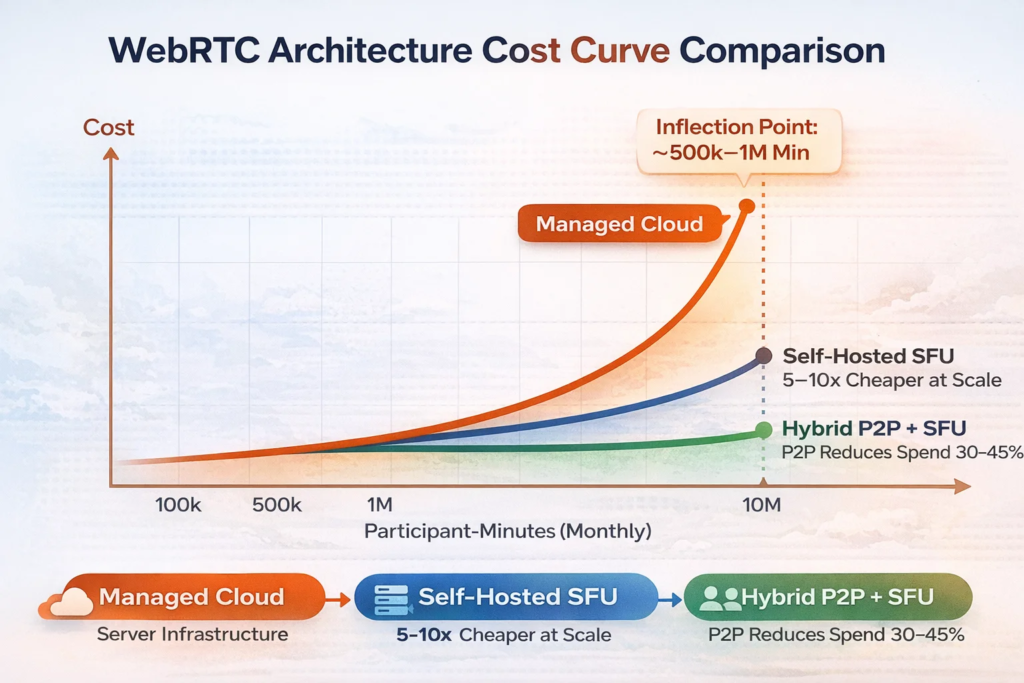
Cost behavior: Linear or super-linear. Agora charges by the minute per participant with pricing tiers; Twilio Video charges by participant-minute plus additional fees for recording and composition. At low volumes, these feel cheap. Past ~500,000 participant-minutes per month, you’re likely overpaying by 40–70% compared to a well-run self-hosted stack.
Model 2: Self-Hosted SFU
LiveKit (self-hosted), mediasoup, Janus, Pion
You run your own media servers on cloud compute (AWS, GCP, Azure), pay for the underlying infrastructure, and own the operational burden.
Best for: Products with predictable, high-volume usage and a team capable of running the infrastructure.
Cost behavior: High fixed cost, low marginal cost. The infrastructure investment is real; the per-minute cost at scale can be 5–10x cheaper than managed cloud.
Model 3: Hybrid P2P + SFU
Custom architecture with intelligent routing
For calls with 2 participants, use direct P2P WebRTC — no media server required, no egress cost. Route group calls through your SFU. This is the architecture optimization that makes the biggest difference for products where a significant percentage of calls are 1:1.
Best for: Telehealth, tutoring, customer support, sales tools — any product where 1:1 calls are the dominant use case.
Cost behavior: The P2P tier has near-zero infrastructure cost per call. Moving 50% of your call volume to P2P can reduce total infrastructure spend by 30–45%.
Real Cost Benchmarks: What You’ll Pay at Scale
The following figures are based on Trembit’s experience with production deployments and publicly available vendor pricing as of 2025. Actual costs vary based on average call duration, video resolution, geographic distribution, and recording requirements.
| Monthly Volume | Managed Cloud (Agora/Twilio) | LiveKit Cloud | Self-Hosted SFU (AWS) | Hybrid P2P + Self-Hosted |
| 50K participant-minutes | $150–$400 | $100–$250 | $300–$500 (fixed overhead) | $250–$400 |
| 500K participant-minutes | $1,500–$4,000 | $800–$2,000 | $600–$1,200 | $400–$800 |
| 2M participant-minutes | $6,000–$16,000 | $3,000–$7,000 | $1,800–$3,500 | $1,200–$2,400 |
| 10M participant-minutes | $30,000–$70,000 | $12,000–$25,000 | $6,000–$12,000 | $4,000–$8,000 |
Estimates assume: 720p video, average 20-minute call duration, 25% TURN relay usage, no recording. Add 25–40% for HD recording at scale.
The key inflection point: For most products, self-hosted becomes cost-competitive with managed cloud somewhere between 500K and 1M participant-minutes per month. Below that threshold, the engineering overhead of self-hosting rarely justifies the savings.
LiveKit vs. Agora: The Pricing Comparison Everyone Wants
This is the comparison that comes up in almost every infrastructure conversation Trembit has with CTOs, so here it is plainly.
Agora prices by the aggregate minutes of audio and video per session, with different rates for audio-only, HD video, and Full HD. Their model is transparent at the line-item level but stacks up quickly because every participant counts separately — a 4-person call for 30 minutes is 120 participant-minutes, not 30.
LiveKit offers both a cloud-managed tier and a self-hosted open-source option. LiveKit Cloud pricing is generally 30–50% lower than comparable Agora usage at moderate volumes. The self-hosted version is free for the software itself, with your cost being compute, bandwidth, and engineering time.
The real trade-off:
| Factor | Agora | LiveKit Cloud | LiveKit Self-Hosted |
| Setup complexity | Low | Low | High |
| Pricing transparency | Moderate | High | Infrastructure cost only |
| Cost at 500K min/mo | ~$2,000–$3,500 | ~$800–$1,500 | ~$600–$1,200 |
| Cost at 5M min/mo | ~$18,000–$35,000 | ~$6,000–$12,000 | ~$2,500–$5,000 |
| AI/agent integration | Moderate | Strong (native agents API) | Strong |
| Support quality | Enterprise-grade | Good | Community + vendor |
| Lock-in risk | High | Medium | Low |
Agora’s advantage is in enterprise support and global infrastructure maturity. LiveKit’s advantage is pricing, modern API design, and native support for AI agent integration — which matters increasingly as teams add Voice AI capabilities to their platforms.
For greenfield builds today, Trembit most commonly recommends starting on LiveKit Cloud, with a self-hosted migration path designed into the architecture from day one.
The Cost Optimization Levers CTOs Should Pull
If you’re already running WebRTC infrastructure and want to reduce costs without a full re-architecture, these are the highest-impact interventions:
1. Audit your TURN relay ratio. If more than 30% of your calls are going through TURN servers, something is wrong — either your TURN configuration, your client-side ICE handling, or your network topology. Reducing TURN relay from 35% to 15% of calls typically cuts bandwidth costs by 15–25%.
2. Implement adaptive bitrate aggressively. Most deployments don’t squeeze enough out of simulcast and adaptive bitrate. Properly configured, ABR can reduce bandwidth consumption by 30–40% with no perceptible quality impact for most participants.
3. Move 1:1 calls to P2P. If your product has a significant 1:1 call use case, routing those sessions directly peer-to-peer eliminates SFU processing and most egress cost for those calls. Implementation takes 2–4 weeks for most existing codebases.
4. Right-size your recording pipeline. Recording is often architected as a mirror of your live pipeline — a separate, always-on compute tier. Spot instances, async processing, and intelligent storage tiering (hot/cold) can reduce recording infrastructure cost by 40–60%.
5. Geographic traffic routing. Egress costs vary dramatically by region. Traffic routed through US-East on AWS costs significantly less than equivalent traffic through Asia-Pacific. Intelligent routing of sessions to the cheapest region that meets latency requirements is a lever most teams don’t use.
A Decision Framework: What Architecture for What Stage
- Pre-product-market-fit / under 100K participant-minutes/month: Use managed cloud. Don’t operate infrastructure you don’t need to. Daily.co or LiveKit Cloud lets your team focus on the product.
- Scaling / 100K–1M participant-minutes/month: Stay on managed cloud but begin designing your self-hosted migration path. Negotiate enterprise pricing with your vendor — discounts of 30–50% are available at this volume if you ask.
- Growth / 1M–5M participant-minutes/month: Migrate to self-hosted or hybrid. The economics are clearly favorable. This is also the stage to implement P2P routing for eligible call types.
- Scale / 5M+ participant-minutes/month: Multi-cloud or hybrid self-hosted is the only architecture that makes economic sense. At this volume, each percentage point of optimization is worth real money.
What Trembit Brings to This Problem
Cost optimization isn’t a one-time project — it’s an ongoing architectural discipline. Trembit works with telehealth, edtech, and enterprise communication platforms at each stage of this curve, from greenfield architecture decisions to cost audits on existing infrastructure that’s grown beyond its original design.
We’ve run the LiveKit-versus-managed-cloud analysis for enough clients to know that the right answer is almost never the same twice. It depends on your call mix, your recording requirements, your geographic distribution, your team’s operational capacity, and where you are in your growth curve.
What we consistently find is that teams overpay in the early stages — because they’re on managed cloud with no negotiated pricing — and then overpay again in the growth stage — because they’ve delayed the self-hosted migration past the point where it was clearly justified.
Getting the architecture right at each inflection point is where the real savings live.
If you’re unsure whether your current WebRTC infrastructure is costing you more than it should, Trembit’s engineering team offers infrastructure cost audits. [Talk to us]