Getting access to credit shapes nearly every major financial decision a person makes — buying a home, paying for education, financing a car, or funding a new business. Yet the process that decides who gets approved has long been a black box for the people on the receiving end.
Lenders need enough information to judge whether someone will repay. Applicants, meanwhile, rarely understand what tips a decision one way or the other. That information gap is exactly where AI-driven credit scoring is changing the game — by reading more signals, surfacing hidden patterns, and producing assessments that are both more precise and easier to justify.
The market reflects the shift. The global credit scoring services market is projected to reach USD 155.81 billion by 2032, growing at a compound annual growth rate of roughly 24% (Polaris Market Research). In this guide, we break down how AI credit scoring actually works, where it beats traditional models, where it still falls short, and how it’s being applied across real lending products.
Decoding Credit Scoring Concept And its Metrics
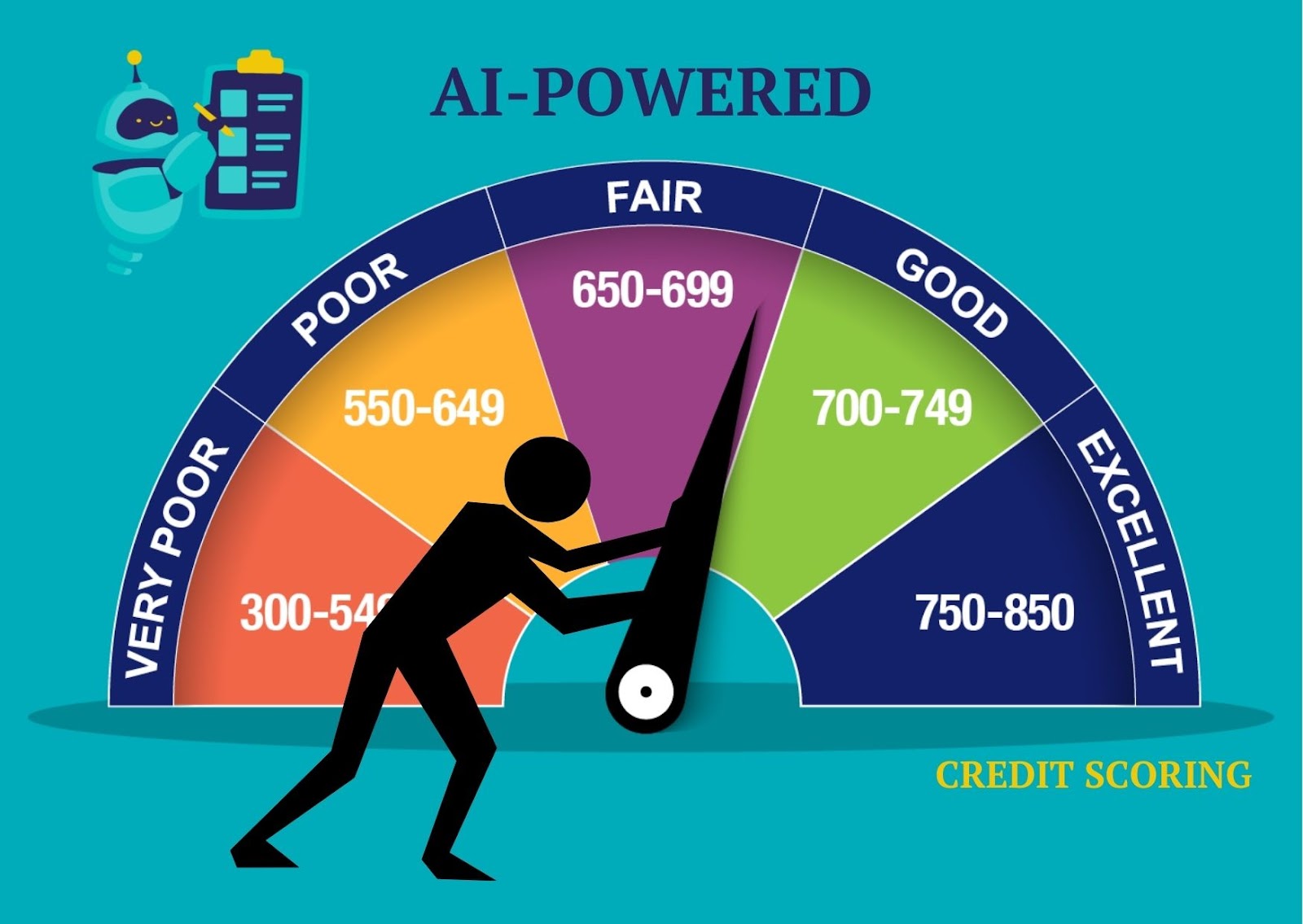
Credit scoring is the systematic evaluation of how likely a borrower is to repay a loan on time. A score gives lenders a consistent, comparable way to price risk. Most models output a number between 300 and 850 — higher scores signal lower default risk and unlock better terms (lower rates, longer repayment periods, larger limits).
Quantitative Aspects
- Income — stable, recurring revenue lowers perceived risk.
- Monthly outlays — rent or mortgage, utilities, insurance, and existing debt payments reveal how much room a borrower has to service new debt.
- Cash flow — especially critical for business borrowers, where inflow and outflow patterns indicate reliability.
Qualitative Aspects
- Relationship Status: This can play a role in financial stability, as households with two incomes may exhibit greater financial resilience than those with a single earner.
- Educational Background: While not universally used, some lenders may factor in an individual’s level of education, which can correlate with earning potential and financial acumen.
- Employment Nature: The type of job in terms of how secure and stable the job is considered. Permanent jobs are favored over temporal occupations.
- Business Structure: (for companies): In the case of business borrowers, the legal framework they operate under (e.g., sole proprietorship, limited liability company, corporation) can impact their creditworthiness. Each business structure carries its own implications for liability and financial robustness.
- Industry Sector: The sector in which a business operates can impact its credit risk, with some industries being more resilient to economic downturns than others, affecting a lender’s risk assessment.
- Accounts Upkeeping Ways: Lenders may evaluate how well a business maintains its financial records and transparency in reporting, which can build trust and confidence.
The weighting of these factors varies by lender and risk appetite. No two scoring systems treat them identically.
However, customer behaviors are not less of an important aspect that can hurt credit scoring. They include:
Payment Track Record
This is probably the most important element in terms of credit scoring. In short, your record shows how responsible you are in terms of various types of loans and credits. The clean and ownership record without public records of lawsuits, liens, or bankruptcy is good for you. If you were late for a payment, its level of lateness will determine how much of a negative impact it will have on your credit score.
Credit Utilization
This element shows what percentage of your available credits you use at the moment. It means you need to maintain your credit card balance at under 30% of the credit limit – this is considered good by most credit scoring models.
Credit History Length
This is how long you have your credit account. The longer, the better, as scoring models consider it an indicator of your ability to manage your credits.
Credit Variety
It refers to the types of credit available to you and how well you manage them. If you handle credit card bills, mortgage or rent, auto loan, and utilities bills well, you have a varied credit history and it will play in your favor.
New credit
Your new credit rating shows how often you apply for a new credit card or loan. If you applied for several new credits, credit scoring models may interpret it as preparation to use them. Applying for a credit for buying a car and a new credit card will be considered differently by scoring models because the former indicates that you were preparing to buy a car, while the latter may indicate unplanned use of your existing credits.
How AI-Credit Scores Work From the Inside?

Traditional models lean on fixed parameters and backward-looking data. AI models do something fundamentally different: they train machine learning algorithms on massive historical datasets to detect patterns a human analyst — or a linear formula — would never catch.
Here’s the process, stage by stage.
- Data Aggregation
AI-driven credit scoring systems collect data from different sources. Traditional credit data is based on payment history, the sum of outstanding debts, the duration of credit history, and other data about repayments. However, AI-powered models differ in that they incorporate alternative data as well, providing a more comprehensive view of a borrower’s financial performance. This data includes
- Transactional data – financial details about income, spending, and general financial habits.
- Online data – borrowing-related information gleaned from an applicant’s online activities, including search history, website visits, and purchases.
- Social media data – credit scoring systems look at the applicant’s posts, interactions, and friends to determine their lifestyle and social network.
- Data Processing and Feature Selection
The collected data is processed, and features in the form of variables are selected for the predictive model to use. This part of the process is extremely important as the accuracy of the predictive model depends on the selection.
2. Model Training
Machine learning algorithms use the preprocessed and engineered dataset to actually learn. As the dataset used is historical, the model detects complex patterns and dependencies within the data. Simultaneously, the model determines which features have the greatest impact on the prediction of creditworthiness and how they all interact.
3. Prediction
Once trained, the model scores new applicants in real time — estimating default risk and repayment probability based on the relationships it learned.
The payoff: a more holistic risk assessment than credit-history-only models can produce — provided fairness, transparency, and privacy are actively managed rather than assumed.
Why AI Improves Risk Assessment
Conventional scorecards share one stubborn limitation: they need a track record of past borrowing to score you at all. That locks out newcomers — young borrowers, immigrants, and small businesses — who may be perfectly creditworthy but have no history to show.
AI scoring shifts the focus from the past toward the present and future: current income, employment prospects, expected income growth. A borrower with thin history but strong forward indicators can be approved, while a long-tenured applicant juggling multiple loans simultaneously might be flagged. The result is a wider, more accurate lens on real repayment capacity.
Types of Credit Scoring Models
Credit scoring models generally fall into two camps:
- Statistical Scoring Model: Statistical scoring models adopt a data-centric approach, analyzing diverse factors obtained from credit reporting agencies. These factors encompass payment histories, credit utilization patterns, credit history lengths, types of credit accounts, and recent credit inquiries. The model then scrutinizes and correlates these factors, assigning weights based on their influence on creditworthiness. This process is entirely objective, uninfluenced by subjective judgments or experiences of credit assessors. The resultant credit score serves as a numerical representation of an individual’s credit risk, derived from statistical analysis of their financial conduct.
- Judgmental Scoring Model: In contrast, judgmental scoring models take a more subjective route, combining objective financial data with subjective evaluations. These models incorporate financial statements from individuals or organizations, payment histories, bank references, and subjective assessments made by human underwriters in decision-making. This approach allows for a more personalized assessment, considering not only financial data but also the context and circumstances surrounding an applicant’s credit history.
While statistical scoring models rely on statistical analyses of quantifiable data, judgmental scoring models integrate personal assessments and experiences into credit score determination. Both models possess their own advantages and are deployed based on the specific requirements and preferences of lending institutions or organizations.
Conventional vs. Innovative Credit Scoring Models
Traditionally, the basis of most credit scoring systems heavily relied on historical payment records and was constructed using statistical methodologies such as linear regression, decision trees, logit modeling, among others. These conventional models were limited in their use of structured data for evaluating credit risk.
- Linear regression — predicts default likelihood by modeling relationships between variables (e.g., as debt rises, default risk rises).
- Discriminant analysis — assigns each customer a composite score and sets a cutoff separating desirable from undesirable borrowers.
Two contemporary credit scoring models are:
- Deep neural networks — learn patterns across many layers without predefined equations, detecting subtle, non-linear relationships.
- Clustering — groups borrowers with similar profiles, using each cluster’s behavior as a benchmark for individuals who are hard to score directly.
While the traditional models for assessing credit mainly rely on structured data and statistical methods, AI models leverage various sources of data and more sophisticated algorithms, for offering a complete and more accurate evaluation of the credit. For instance, deep neural networks and clustering have completely transformed credit scoring systems, allowing companies to use unstructured data and detect even the smallest patterns. As a result, a higher number of people from all walks of life have access to credit.
Applications of AI-Powered Credit Scoring

Credit scoring mechanisms serve as vital instruments for lenders to evaluate the financial standing of individuals or businesses seeking credit. These models integrate diverse factors and data to prognosticate the probability of borrowers meeting their repayment obligations. The utility of AI-based credit scoring spans various sectors and plays a pivotal role in:
Precision Loan Interest Calculation
AI-infused credit scoring models refine the accuracy of computing loan interest rates through the utilization of machine learning algorithms and an extensive array of data inputs. These algorithms meticulously scrutinize a borrower’s financial background, payment trends, and other pertinent variables, culminating in a more dynamic and comprehensive evaluation compared to conventional methodologies.
In the AI-centric paradigm, sophisticated models dissect and analyze copious data sets, unearthing patterns and insights that might evade conventional observation. Consequently, the assessment of a borrower’s creditworthiness becomes more nuanced and precise.
For borrowers, this translates into personalized interest rates derived from an exhaustive AI-driven scrutiny of their credit risk. Individuals showcasing prudent financial conduct and boasting a robust credit history, as evaluated by the AI, are poised to benefit from reduced interest rates owing to a diminished perceived risk of default. Conversely, borrowers deemed to pose a higher credit risk, as gauged by the AI model, might contend with elevated interest rates to mitigate the lender’s risk, thereby incentivizing borrowers to uphold responsible financial practices.
Credit Card Approvals and Limit Determination
Credit card issuers increasingly leverage AI-based credit scoring models to assess the financial reliability of applicants. These models consider an array of factors, including credit history, income, debt, and other relevant financial behaviors, transcending conventional credit scores. The outputs of these AI-driven models substantially influence decisions pertaining to credit limits, interest rates, and credit card terms, ensuring alignment with the applicant’s risk profile.
In delineating credit limits, AI-based credit scoring harnesses machine learning algorithms to conduct an exhaustive and adaptable analysis. This entails scrutinizing an individual’s payment history, transactional patterns, and other salient financial data. For applicants boasting superior credit scores, AI’s in-depth analysis, coupled with a comprehensive dataset, may result in higher credit limits, indicative of a nuanced understanding of their lower-risk attributes. Conversely, for individuals with lower credit scores, AI’s assessment may suggest more conservative credit limits, commensurate with a perceived heightened risk of default.
This AI-augmented approach fosters a more nuanced and data-rich evaluation, facilitating credit limits that more accurately reflect an individual’s genuine creditworthiness and financial capability. Such a process aids issuers in managing risk effectively while furnishing suitable credit card options to a diverse consumer base.
Business Loan Approval
AI assumes a transformative role in augmenting traditional credit scoring paradigms when evaluating businesses seeking loans. Through machine learning algorithms, AI conducts intricate analyses of extensive datasets, extracting insights from non-traditional and dynamic variables to holistically assess a business’s creditworthiness. It facilitates real-time assessment, adaptive learning, and enhanced predictive accuracy, equipping lenders with enriched information to render loan approval decisions and delineate specific loan terms.
Insurance Premium Determination
In the insurance realm, AI-based credit scoring models transcend mere credit histories to appraise an individual’s or entity’s financial accountability. By scrutinizing extensive data, AI can furnish a more nuanced prognosis of payment reliability and overall risk, aiding insurance companies such as home insurers in setting premiums congruent with the individual’s actual risk level.
Risk Management and Portfolio Analysis
AI-driven credit scoring models usher in advanced analytics into risk management and portfolio analysis. They process voluminous data sets at high velocities, facilitating financial institutions in rendering quicker and more precise evaluations of risk exposures in their lending portfolios. AI’s predictive capabilities enable more proactive and strategic decision-making concerning diversification, risk mitigation, and capital allocation.
Financial Planning and Counseling with AI
Financial advisors leveraging AI-based credit scoring models can dispense more tailored and proactive counsel. AI can unveil deeper insights into clients’ financial proclivities and trends, facilitating more precise guidance on augmenting credit scores and overall financial well-being. Through AI, advisors can proffer strategies more aligned with an individual’s unique financial circumstances and aspirations, heightening the efficacy of financial planning and counseling.
Conventional Credit Scoring vs. AI-Powered Credit Scoring
| Aspect | Traditional Credit Scoring | AI-Based Credit Scoring |
| Data Analysis Method | Mainly relies on structured credit data and predefined regulations | Utilizes machine learning algorithms for intricate pattern recognition and predictive modeling |
| Data Considered | Limited scope, potentially overlooking numerous factors | Incorporates alternative data sources for comprehensive evaluations |
| Decision Making | Easy to explain and interpret due to clear rules and factors | Employs sophisticated algorithms that continually learn and adapt |
| Processing Speed | Longer processing times and potential delays | Provides faster and more efficient credit assessments |
| Handling of Missing Data | Struggles with missing data, possibly leading to inaccurate evaluations | Manages missing data more effectively through imputation techniques and feature engineering |
| Bias and Fairness | Subject to human judgment, which may result in discrimination and biases | Minimal biases as decisions are made solely based on relevant factors by AI algorithms |
| Model Accuracy and Predictiveness | Generally less accurate due to simplicity and limited data sources | Potential for higher accuracy due to advanced algorithms and access to diverse data types, leading to more precise credit risk assessments |
| Reviews | May necessitate manual review for borderline cases or individuals with limited credit histories | Capable of automated decisions for a wider range of individuals, potentially reducing the need for manual reviews |
It is crucial to note that traditional and AI-based credit scoring models have different advantages and disadvantages. The choice between them depends on factors, such as data availability, legislative needs, and desired predictive accuracy, matching specific requirements of a certain lending organization.
Key Advantages of AI Credit Scoring
AI-based credit scoring procedures offer a number of advantages over traditional systems, all of which improve the accuracy and overall quality of assessing a person’s or company’s creditworthiness. In this section, the benefits of AI in credit scoring are considered in-depth:
- Greater precision — more data sources mean fewer wrongly rejected or approved applicants.
- Faster decisions — applications can be scored in seconds, a competitive must for online and peer-to-peer lending.
- Finer risk segmentation — borrowers are grouped into more granular tiers, enabling fairer pricing.
- Scalability — the same model handles 10 or 100,000 applications a day without quality loss.
- Cost efficiency — automation can cut operating costs by up to 70% at some institutions.
- Fraud detection — anomaly detection flags loan stacking, identity theft, and other fraud patterns.
- Financial inclusion — alternative data opens access for thin-file borrowers, emerging markets, and small businesses.
- Fewer human errors — consistent, automated processing reduces operational mistakes.
Case in Point: How Trembit Applies AI to Credit Analysis
To make this concrete, here’s how we approach it in practice. At Trembit, we built an AI-powered Intelligent Document Processing (IDP) solution purpose-built for the credit industry — with a particular focus on vehicle and machinery lease financing.
The system extracts, analyzes, and interprets data from large volumes of credit documents, then enriches it with information from open databases to build a comprehensive view of credit risk. That gives credit analysts the context to make faster, better-informed decisions.
Under the hood:
- Abacus Smaug 34B LLM — powers deep analysis of complex financial documents.
- LangChain — orchestrates the AI components into coherent processing workflows.
- Python + OCR libraries — handle initial text extraction.
- Node.js — provides a scalable application architecture.
The solution scales from small credit firms to large enterprises handling high document volumes and complex workflows — streamlining document handling while sharpening decision accuracy.
Closing Thoughts
AI has moved credit scoring from a rigid, backward-looking exercise to a dynamic, far more inclusive one. By processing vast and varied datasets, machine learning models surface insights traditional methods simply can’t — expanding access to credit while improving accuracy.
But the technology is only as trustworthy as its governance. The future of credit scoring belongs to organizations that pair AI’s analytical power with rigorous fairness, transparency, and privacy practices.
At Trembit, we build AI and machine learning solutions that bring exactly that balance of precision and accountability to financial risk analysis. If you’re exploring how to apply AI to credit assessment or document processing, let’s talk.