Imagine you’re developing an innovative fitness startup where real-time video streaming is a key feature. How do you choose the best video streaming service? What are the available options, and how can you effectively manage video delay and costs? Selecting the right video streaming technology is vital for delivering smooth, high-quality content that keeps users engaged and motivated. In this article, we delve into the top three video streaming technologies that are perfect for fitness startups. These solutions offer robust features, scalability, and user-friendly interfaces to help your business stand out in the competitive fitness industry.
Choosing the Right Technology for Fast Startup Launches
First, the rule of thumb is: “If you build the startup, you need to select the technology that will allow you to launch the application as soon as possible.” Ⓒ Stanislav Zayarsky: Forget costs, scalability, and other factors. You must release fast, get user feedback, make changes, and iterate repeatedly! Such a rule of thumb will limit your selection to just a few options: Vonage, Twilio, and Agora. Those 3 options are so-called CPaas providers, which are more or less equal in functionality and pricing. But since Vonage and Twilio are more mature than Agora, I will remove Agora. Any decent software engineer could quickly integrate those cloud video streaming systems into your application. It will work nicely and you could overgrow. The downside is that Vonage and Twilio charge you per minute per stream, which will eventually come with a $$$ check. But while you are growing and have few customers, forget about those costs. Later, you will have a chance to switch to another video streaming provider. And now I hear the question: “Why should we switch later? I want to have the best video streaming technology from the beginning!” Well, the term “Best” changes according to your needs. For the startup, “best” equals “Fastest to launch.” For a more prominent company, “Best” means cost-wise. Let’s check several use cases:
Use case #1: Personal one-to-one training.
If most planned interactions happen 1-to-1 between coach and trainee, then the Twilio peer 2 peer mechanism works best: https://www.twilio.com/video/pricing. Let’s calculate some numbers to give you an understanding of what to expect. For example, you will have 100 fitness sessions daily, each lasting 1 hour. Twilio pricing is $0.0015 per stream per minute. That would be 100 sessions x 60 minutes x 2 participants x $0.0015 = $18 per day. Or $18 / 100 participants = $0.18 per participant per 1 hour session. You might ask what will happen when you reach 10.000 fitness sessions per day. Well, congratulations, this is great platform growth, in this case, we can optimize and switch from Twilio to our Trembit.com custom platform, and instead of $1800 per day pay at least x3 less. More details here: sz@trembit.com
Use case #2: Fitness class for small groups of up to 50 people in a room.
In this case, you can’t use peer-to-peer connections, meaning you will get regular pricing from Twilio or Vonage. The price is the same for both providers $0.004 per stream per minute. Let’s imagine you have 100 one-hour fitness sessions per day, with 10 participants on average in the room: 100 sessions x 60 minutes x 10 participants x $0.004 = $240 per day. Or $240 / 100 sessions / 10 participants = $0.24 per participant per 1-hour session. If you have more sessions and users per day. We have a custom platform here in Trembit.com. Contact me for more details to save costs: sz@trembit.com
Use case #3: Large fitness event for 50+ participants.
In those events, you usually have a coach on a big screen, and participants don’t stream video. Or you might have Coach + several participants highlighted so everyone can see them. 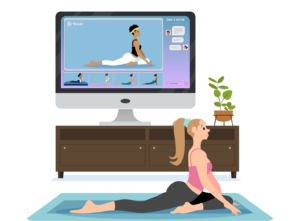 For such a case, technically, we grab the main screen with Coach+highlighted users as one video and restream it to everyone. You can check how it works inside if you are a technical person. Ok, we will use Twilio or Vonage to organize video conferencing in the main room and then restream that room to other participants. The video delay inside the room would be kind of real-time, and the audience will get a video with a slight delay (7-10 seconds). We delay that video to lower the costs, and usually, the audience won’t notice it. Let’s assume you have 100 fitness sessions per day, with 50 users on average in each session. A studio room with 5 participants costs 100 sessions x 60 minutes x 5 participants x $0.004 = $120 per day. Restream to other 50 users costs: In one session, 50 users, 60 minutes duration, (720p) 1 Mbit video bitrate equals 22 Gigabytes per session. 22 Gigabytes x 100 sessions = 2197 Gigabytes per day. The average restream cost in the market (Wowza.com) is around $0.09 per GB, so we get 2197 GB x $0.09 = $197 per day. Total for Large fitness events with 50+5 participants would be $120 + $197 = $317 per day or $0.06 per participant per 1-hour session. Eventually, you will get to a greater number of users. And we have a custom video streaming solution for this case in Trembit.com. Contact me for more details: sz@trembit.com
Choosing the Right Streaming Service: Vonage, Twilio, or Agora?
Selecting the ideal video streaming service is crucial for the success of your fitness startup, as it impacts both user experience and operational efficiency. Vonage, Twilio, and Agora are leading contenders in this space, each offering unique advantages. Vonage is renowned for its reliability and extensive integrations, making it an excellent choice for startups that need a robust, scalable solution.
Twilio stands out for its flexibility and peer-to-peer capabilities, particularly beneficial for one-on-one training sessions. Meanwhile, Agora offers competitive pricing and real-time engagement features, appealing to startups looking for cost-effective solutions with interactive functionalities. However, it’s important to note that Vonage and Twilio, being more mature services, provide a more comprehensive support system and a larger community of developers, which can be invaluable during the initial launch phase.
Summary
After evaluating the primary use cases, you might use different video streaming providers for each scenario. This strategy is effective but may involve additional development and maintenance costs. For startups, launching quickly is key. Start by building your initial version with reliable platforms like Vonage or Twilio. Deploy your application to users swiftly, gather valuable feedback, and continuously improve your offering. As you reach a stable growth phase, explore cost-saving strategies to optimize your video streaming services.
If you need further assistance or encounter technical issues while building your fitness application, please don’t hesitate to contact us. We would be glad to help.