Ever wonder what feature users want most after basic video chat? Recording. The ability to save and replay video conferences has become essential across industries. Businesses that automate video conference recording gain a powerful tool that extends the value of every virtual meeting beyond its scheduled time slot.
Recording serves practical purposes in numerous fields. Doctors record consultations for patients to review treatment instructions later. Students access recorded lectures to study at their own pace. Marketing teams capture product demonstrations for repeated use. Event organizers preserve live sessions for those who couldn’t attend. In each case, recording transforms a one-time conversation into a permanent, accessible resource.
Success with video recording hinges on selecting appropriate tools and configurations. High-quality audio capture demands proper microphones with noise cancellation capabilities. Clear video requires adequate cameras and lighting setups. The right software makes a difference too – look for solutions that are easy to use but still offer essential features like cloud storage and compatible formats. Every choice you make affects how good your recordings turn out.
In this article, we’ll show you the best ways to set up video conference recording for your needs.
What Are the Ways to Implement Video Conference Recording?
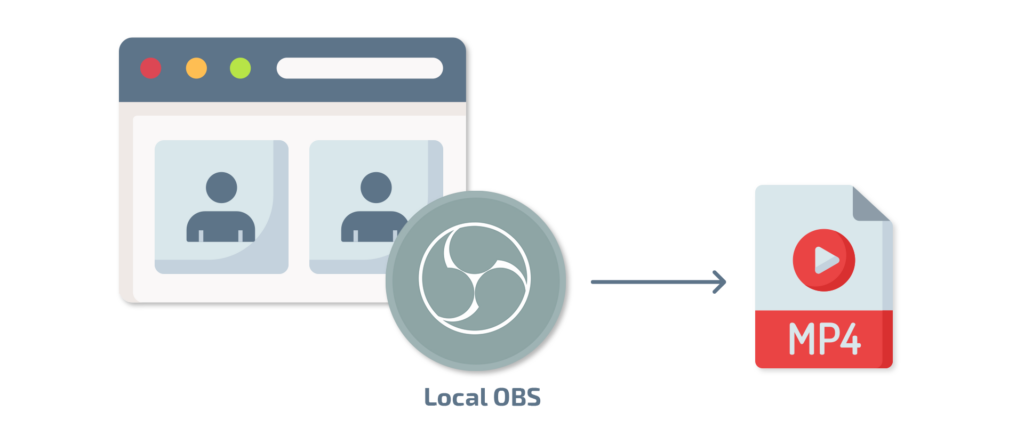
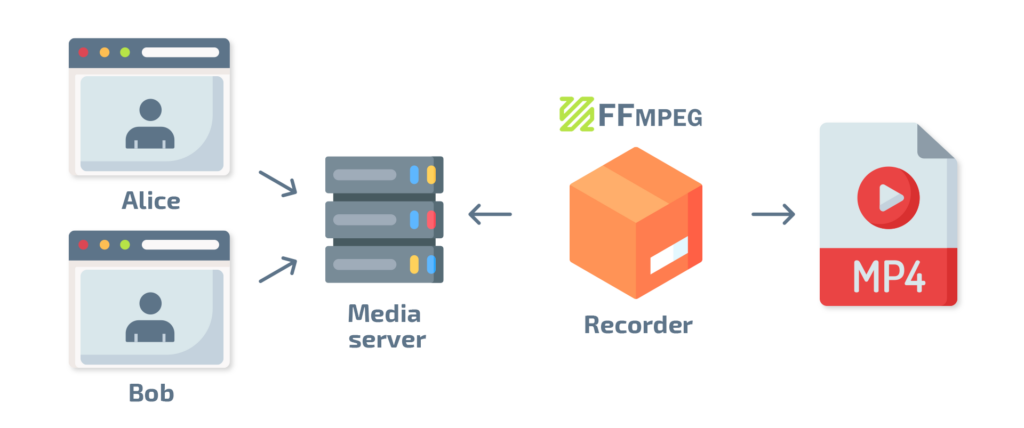
There are three main ways to implement video conference recording: local recording software on the user’s device, browser-based server-side recording using a virtual participant, and direct server-side media processing with tools like FFmpeg. Each carries its own trade-offs depending on your technical requirements and how your users work.
Local Recording Software: Simple But Limited
The most straightforward approach is using screen recording software on a participant’s device. While widely accessible, this method comes with notable limitations:
- Performance issues – Recording requires substantial CPU and memory, which can slow down the user’s device during important meetings
- Reliability risks – If the user’s computer crashes or freezes, the entire recording is lost
- Human error factor – Users might forget to start recording or accidentally stop it
- Technical barriers – Many users struggle with installing and configuring third-party recording applications
These limitations make local recording impractical for business-critical meetings where consistent, reliable recording is essential.
Ever wonder what feature users want most after basic video chat? Recording. The ability to save and replay video conferences has become essential across industries. Businesses that automate video conference recording gain a powerful tool that extends the value of every virtual meeting beyond its scheduled time slot.
Recording serves practical purposes in numerous fields. Doctors record consultations for patients to review treatment instructions later. Students access recorded lectures to study at their own pace. Marketing teams capture product demonstrations for repeated use. Event organizers preserve live sessions for those who couldn’t attend. In each case, recording transforms a one-time conversation into a permanent, accessible resource.
Success with video recording hinges on selecting appropriate tools and configurations. High-quality audio capture demands proper microphones with noise cancellation capabilities. Clear video requires adequate cameras and lighting setups. The right software makes a difference too – look for solutions that are easy to use but still offer essential features like cloud storage and compatible formats. Every choice you make affects how good your recordings turn out.
In this article, we’ll show you the best ways to set up video conference recording for your needs.
What Are the Ways to Implement Video Conference Recording?
There are three main ways to implement video conference recording: local recording software on the user’s device, browser-based server-side recording using a virtual participant, and direct server-side media processing with tools like FFmpeg. Each carries its own trade-offs depending on your technical requirements and how your users work.
Local Recording Software: Simple But Limited
The most straightforward approach is using screen recording software on a participant’s device. While widely accessible, this method comes with notable limitations:
- Performance issues – Recording requires substantial CPU and memory, which can slow down the user’s device during important meetings
- Reliability risks – If the user’s computer crashes or freezes, the entire recording is lost
- Human error factor – Users might forget to start recording or accidentally stop it
- Technical barriers – Many users struggle with installing and configuring third-party recording applications
These limitations make local recording impractical for business-critical meetings where consistent, reliable recording is essential.
Ever wonder what feature users want most after basic video chat? Recording. The ability to save and replay video conferences has become essential across industries. Businesses that automate video conference recording gain a powerful tool that extends the value of every virtual meeting beyond its scheduled time slot.
Recording serves practical purposes in numerous fields. Doctors record consultations for patients to review treatment instructions later. Students access recorded lectures to study at their own pace. Marketing teams capture product demonstrations for repeated use. Event organizers preserve live sessions for those who couldn’t attend. In each case, recording transforms a one-time conversation into a permanent, accessible resource.
Success with video recording hinges on selecting appropriate tools and configurations. High-quality audio capture demands proper microphones with noise cancellation capabilities. Clear video requires adequate cameras and lighting setups. The right software makes a difference too – look for solutions that are easy to use but still offer essential features like cloud storage and compatible formats. Every choice you make affects how good your recordings turn out.
In this article, we’ll show you the best ways to set up video conference recording for your needs.
What Are the Ways to Implement Video Conference Recording?
There are three main ways to implement video conference recording: local recording software on the user’s device, browser-based server-side recording using a virtual participant, and direct server-side media processing with tools like FFmpeg. Each carries its own trade-offs depending on your technical requirements and how your users work.
Local Recording Software: Simple But Limited
The most straightforward approach is using screen recording software on a participant’s device. While widely accessible, this method comes with notable limitations:
- Performance issues – Recording requires substantial CPU and memory, which can slow down the user’s device during important meetings
- Reliability risks – If the user’s computer crashes or freezes, the entire recording is lost
- Human error factor – Users might forget to start recording or accidentally stop it
- Technical barriers – Many users struggle with installing and configuring third-party recording applications
These limitations make local recording impractical for business-critical meetings where consistent, reliable recording is essential.
Ever wonder what feature users want most after basic video chat? Recording. The ability to save and replay video conferences has become essential across industries. Businesses that automate video conference recording gain a powerful tool that extends the value of every virtual meeting beyond its scheduled time slot.
Recording serves practical purposes in numerous fields. Doctors record consultations for patients to review treatment instructions later. Students access recorded lectures to study at their own pace. Marketing teams capture product demonstrations for repeated use. Event organizers preserve live sessions for those who couldn’t attend. In each case, recording transforms a one-time conversation into a permanent, accessible resource.
Success with video recording hinges on selecting appropriate tools and configurations. High-quality audio capture demands proper microphones with noise cancellation capabilities. Clear video requires adequate cameras and lighting setups. The right software makes a difference too – look for solutions that are easy to use but still offer essential features like cloud storage and compatible formats. Every choice you make affects how good your recordings turn out.
In this article, we’ll show you the best ways to set up video conference recording for your needs.
What Are the Ways to Implement Video Conference Recording?
There are three main ways to implement video conference recording: local recording software on the user’s device, browser-based server-side recording using a virtual participant, and direct server-side media processing with tools like FFmpeg. Each carries its own trade-offs depending on your technical requirements and how your users work.
Local Recording Software: Simple But Limited
The most straightforward approach is using screen recording software on a participant’s device. While widely accessible, this method comes with notable limitations:
- Performance issues – Recording requires substantial CPU and memory, which can slow down the user’s device during important meetings
- Reliability risks – If the user’s computer crashes or freezes, the entire recording is lost
- Human error factor – Users might forget to start recording or accidentally stop it
- Technical barriers – Many users struggle with installing and configuring third-party recording applications
These limitations make local recording impractical for business-critical meetings where consistent, reliable recording is essential.
Ever wonder what feature users want most after basic video chat? Recording. The ability to save and replay video conferences has become essential across industries. Businesses that automate video conference recording gain a powerful tool that extends the value of every virtual meeting beyond its scheduled time slot.
Recording serves practical purposes in numerous fields. Doctors record consultations for patients to review treatment instructions later. Students access recorded lectures to study at their own pace. Marketing teams capture product demonstrations for repeated use. Event organizers preserve live sessions for those who couldn’t attend. In each case, recording transforms a one-time conversation into a permanent, accessible resource.
Success with video recording hinges on selecting appropriate tools and configurations. High-quality audio capture demands proper microphones with noise cancellation capabilities. Clear video requires adequate cameras and lighting setups. The right software makes a difference too – look for solutions that are easy to use but still offer essential features like cloud storage and compatible formats. Every choice you make affects how good your recordings turn out.
In this article, we’ll show you the best ways to set up video conference recording for your needs.
What Are the Ways to Implement Video Conference Recording?
There are three main ways to implement video conference recording: local recording software on the user’s device, browser-based server-side recording using a virtual participant, and direct server-side media processing with tools like FFmpeg. Each carries its own trade-offs depending on your technical requirements and how your users work.
Local Recording Software: Simple But Limited
The most straightforward approach is using screen recording software on a participant’s device. While widely accessible, this method comes with notable limitations:
- Performance issues – Recording requires substantial CPU and memory, which can slow down the user’s device during important meetings
- Reliability risks – If the user’s computer crashes or freezes, the entire recording is lost
- Human error factor – Users might forget to start recording or accidentally stop it
- Technical barriers – Many users struggle with installing and configuring third-party recording applications
These limitations make local recording impractical for business-critical meetings where consistent, reliable recording is essential.
Ever wonder what feature users want most after basic video chat? Recording. The ability to save and replay video conferences has become essential across industries. Businesses that automate video conference recording gain a powerful tool that extends the value of every virtual meeting beyond its scheduled time slot.
Recording serves practical purposes in numerous fields. Doctors record consultations for patients to review treatment instructions later. Students access recorded lectures to study at their own pace. Marketing teams capture product demonstrations for repeated use. Event organizers preserve live sessions for those who couldn’t attend. In each case, recording transforms a one-time conversation into a permanent, accessible resource.
Success with video recording hinges on selecting appropriate tools and configurations. High-quality audio capture demands proper microphones with noise cancellation capabilities. Clear video requires adequate cameras and lighting setups. The right software makes a difference too – look for solutions that are easy to use but still offer essential features like cloud storage and compatible formats. Every choice you make affects how good your recordings turn out.
In this article, we’ll show you the best ways to set up video conference recording for your needs.
What Are the Ways to Implement Video Conference Recording?
There are three main ways to implement video conference recording: local recording software on the user’s device, browser-based server-side recording using a virtual participant, and direct server-side media processing with tools like FFmpeg. Each carries its own trade-offs depending on your technical requirements and how your users work.
Local Recording Software: Simple But Limited
The most straightforward approach is using screen recording software on a participant’s device. While widely accessible, this method comes with notable limitations:
- Performance issues – Recording requires substantial CPU and memory, which can slow down the user’s device during important meetings
- Reliability risks – If the user’s computer crashes or freezes, the entire recording is lost
- Human error factor – Users might forget to start recording or accidentally stop it
- Technical barriers – Many users struggle with installing and configuring third-party recording applications
These limitations make local recording impractical for business-critical meetings where consistent, reliable recording is essential.
Ever wonder what feature users want most after basic video chat? Recording. The ability to save and replay video conferences has become essential across industries. Businesses that automate video conference recording gain a powerful tool that extends the value of every virtual meeting beyond its scheduled time slot.
Recording serves practical purposes in numerous fields. Doctors record consultations for patients to review treatment instructions later. Students access recorded lectures to study at their own pace. Marketing teams capture product demonstrations for repeated use. Event organizers preserve live sessions for those who couldn’t attend. In each case, recording transforms a one-time conversation into a permanent, accessible resource.
Success with video recording hinges on selecting appropriate tools and configurations. High-quality audio capture demands proper microphones with noise cancellation capabilities. Clear video requires adequate cameras and lighting setups. The right software makes a difference too – look for solutions that are easy to use but still offer essential features like cloud storage and compatible formats. Every choice you make affects how good your recordings turn out.
In this article, we’ll show you the best ways to set up video conference recording for your needs.
What Are the Ways to Implement Video Conference Recording?
There are three main ways to implement video conference recording: local recording software on the user’s device, browser-based server-side recording using a virtual participant, and direct server-side media processing with tools like FFmpeg. Each carries its own trade-offs depending on your technical requirements and how your users work.
Local Recording Software: Simple But Limited
The most straightforward approach is using screen recording software on a participant’s device. While widely accessible, this method comes with notable limitations:
- Performance issues – Recording requires substantial CPU and memory, which can slow down the user’s device during important meetings
- Reliability risks – If the user’s computer crashes or freezes, the entire recording is lost
- Human error factor – Users might forget to start recording or accidentally stop it
- Technical barriers – Many users struggle with installing and configuring third-party recording applications
These limitations make local recording impractical for business-critical meetings where consistent, reliable recording is essential.
Ever wonder what feature users want most after basic video chat? Recording. The ability to save and replay video conferences has become essential across industries. Businesses that automate video conference recording gain a powerful tool that extends the value of every virtual meeting beyond its scheduled time slot.
Recording serves practical purposes in numerous fields. Doctors record consultations for patients to review treatment instructions later. Students access recorded lectures to study at their own pace. Marketing teams capture product demonstrations for repeated use. Event organizers preserve live sessions for those who couldn’t attend. In each case, recording transforms a one-time conversation into a permanent, accessible resource.
Success with video recording hinges on selecting appropriate tools and configurations. High-quality audio capture demands proper microphones with noise cancellation capabilities. Clear video requires adequate cameras and lighting setups. The right software makes a difference too – look for solutions that are easy to use but still offer essential features like cloud storage and compatible formats. Every choice you make affects how good your recordings turn out.
In this article, we’ll show you the best ways to set up video conference recording for your needs.
What Are the Ways to Implement Video Conference Recording?
There are three main ways to implement video conference recording: local recording software on the user’s device, browser-based server-side recording using a virtual participant, and direct server-side media processing with tools like FFmpeg. Each carries its own trade-offs depending on your technical requirements and how your users work.
Local Recording Software: Simple But Limited
The most straightforward approach is using screen recording software on a participant’s device. While widely accessible, this method comes with notable limitations:
- Performance issues – Recording requires substantial CPU and memory, which can slow down the user’s device during important meetings
- Reliability risks – If the user’s computer crashes or freezes, the entire recording is lost
- Human error factor – Users might forget to start recording or accidentally stop it
- Technical barriers – Many users struggle with installing and configuring third-party recording applications
These limitations make local recording impractical for business-critical meetings where consistent, reliable recording is essential.
Ever wonder what feature users want most after basic video chat? Recording. The ability to save and replay video conferences has become essential across industries. Businesses that automate video conference recording gain a powerful tool that extends the value of every virtual meeting beyond its scheduled time slot.
Recording serves practical purposes in numerous fields. Doctors record consultations for patients to review treatment instructions later. Students access recorded lectures to study at their own pace. Marketing teams capture product demonstrations for repeated use. Event organizers preserve live sessions for those who couldn’t attend. In each case, recording transforms a one-time conversation into a permanent, accessible resource.
Success with video recording hinges on selecting appropriate tools and configurations. High-quality audio capture demands proper microphones with noise cancellation capabilities. Clear video requires adequate cameras and lighting setups. The right software makes a difference too – look for solutions that are easy to use but still offer essential features like cloud storage and compatible formats. Every choice you make affects how good your recordings turn out.
In this article, we’ll show you the best ways to set up video conference recording for your needs.
What Are the Ways to Implement Video Conference Recording?
There are three main ways to implement video conference recording: local recording software on the user’s device, browser-based server-side recording using a virtual participant, and direct server-side media processing with tools like FFmpeg. Each carries its own trade-offs depending on your technical requirements and how your users work.
Local Recording Software: Simple But Limited
The most straightforward approach is using screen recording software on a participant’s device. While widely accessible, this method comes with notable limitations:
- Performance issues – Recording requires substantial CPU and memory, which can slow down the user’s device during important meetings
- Reliability risks – If the user’s computer crashes or freezes, the entire recording is lost
- Human error factor – Users might forget to start recording or accidentally stop it
- Technical barriers – Many users struggle with installing and configuring third-party recording applications
These limitations make local recording impractical for business-critical meetings where consistent, reliable recording is essential.
Ever wonder what feature users want most after basic video chat? Recording. The ability to save and replay video conferences has become essential across industries. Businesses that automate video conference recording gain a powerful tool that extends the value of every virtual meeting beyond its scheduled time slot.
Recording serves practical purposes in numerous fields. Doctors record consultations for patients to review treatment instructions later. Students access recorded lectures to study at their own pace. Marketing teams capture product demonstrations for repeated use. Event organizers preserve live sessions for those who couldn’t attend. In each case, recording transforms a one-time conversation into a permanent, accessible resource.
Success with video recording hinges on selecting appropriate tools and configurations. High-quality audio capture demands proper microphones with noise cancellation capabilities. Clear video requires adequate cameras and lighting setups. The right software makes a difference too – look for solutions that are easy to use but still offer essential features like cloud storage and compatible formats. Every choice you make affects how good your recordings turn out.
In this article, we’ll show you the best ways to set up video conference recording for your needs.
What Are the Ways to Implement Video Conference Recording?
There are three main ways to implement video conference recording: local recording software on the user’s device, browser-based server-side recording using a virtual participant, and direct server-side media processing with tools like FFmpeg. Each carries its own trade-offs depending on your technical requirements and how your users work.
Local Recording Software: Simple But Limited
The most straightforward approach is using screen recording software on a participant’s device. While widely accessible, this method comes with notable limitations:
- Performance issues – Recording requires substantial CPU and memory, which can slow down the user’s device during important meetings
- Reliability risks – If the user’s computer crashes or freezes, the entire recording is lost
- Human error factor – Users might forget to start recording or accidentally stop it
- Technical barriers – Many users struggle with installing and configuring third-party recording applications
These limitations make local recording impractical for business-critical meetings where consistent, reliable recording is essential.

Ever wonder what feature users want most after basic video chat? Recording. The ability to save and replay video conferences has become essential across industries. Businesses that automate video conference recording gain a powerful tool that extends the value of every virtual meeting beyond its scheduled time slot.
Recording serves practical purposes in numerous fields. Doctors record consultations for patients to review treatment instructions later. Students access recorded lectures to study at their own pace. Marketing teams capture product demonstrations for repeated use. Event organizers preserve live sessions for those who couldn’t attend. In each case, recording transforms a one-time conversation into a permanent, accessible resource.
Success with video recording hinges on selecting appropriate tools and configurations. High-quality audio capture demands proper microphones with noise cancellation capabilities. Clear video requires adequate cameras and lighting setups. The right software makes a difference too – look for solutions that are easy to use but still offer essential features like cloud storage and compatible formats. Every choice you make affects how good your recordings turn out.
In this article, we’ll show you the best ways to set up video conference recording for your needs.
What Are the Ways to Implement Video Conference Recording?
There are three main ways to implement video conference recording: local recording software on the user’s device, browser-based server-side recording using a virtual participant, and direct server-side media processing with tools like FFmpeg. Each carries its own trade-offs depending on your technical requirements and how your users work.
Local Recording Software: Simple But Limited
The most straightforward approach is using screen recording software on a participant’s device. While widely accessible, this method comes with notable limitations:
- Performance issues – Recording requires substantial CPU and memory, which can slow down the user’s device during important meetings
- Reliability risks – If the user’s computer crashes or freezes, the entire recording is lost
- Human error factor – Users might forget to start recording or accidentally stop it
- Technical barriers – Many users struggle with installing and configuring third-party recording applications
These limitations make local recording impractical for business-critical meetings where consistent, reliable recording is essential.
Ever wonder what feature users want most after basic video chat? Recording. The ability to save and replay video conferences has become essential across industries. Businesses that automate video conference recording gain a powerful tool that extends the value of every virtual meeting beyond its scheduled time slot.
Recording serves practical purposes in numerous fields. Doctors record consultations for patients to review treatment instructions later. Students access recorded lectures to study at their own pace. Marketing teams capture product demonstrations for repeated use. Event organizers preserve live sessions for those who couldn’t attend. In each case, recording transforms a one-time conversation into a permanent, accessible resource.
Success with video recording hinges on selecting appropriate tools and configurations. High-quality audio capture demands proper microphones with noise cancellation capabilities. Clear video requires adequate cameras and lighting setups. The right software makes a difference too – look for solutions that are easy to use but still offer essential features like cloud storage and compatible formats. Every choice you make affects how good your recordings turn out.
In this article, we’ll show you the best ways to set up video conference recording for your needs.
What Are the Ways to Implement Video Conference Recording?
There are three main ways to implement video conference recording: local recording software on the user’s device, browser-based server-side recording using a virtual participant, and direct server-side media processing with tools like FFmpeg. Each carries its own trade-offs depending on your technical requirements and how your users work.
Local Recording Software: Simple But Limited
The most straightforward approach is using screen recording software on a participant’s device. While widely accessible, this method comes with notable limitations:
- Performance issues – Recording requires substantial CPU and memory, which can slow down the user’s device during important meetings
- Reliability risks – If the user’s computer crashes or freezes, the entire recording is lost
- Human error factor – Users might forget to start recording or accidentally stop it
- Technical barriers – Many users struggle with installing and configuring third-party recording applications
These limitations make local recording impractical for business-critical meetings where consistent, reliable recording is essential.
Ever wonder what feature users want most after basic video chat? Recording. The ability to save and replay video conferences has become essential across industries. Businesses that automate video conference recording gain a powerful tool that extends the value of every virtual meeting beyond its scheduled time slot.
Recording serves practical purposes in numerous fields. Doctors record consultations for patients to review treatment instructions later. Students access recorded lectures to study at their own pace. Marketing teams capture product demonstrations for repeated use. Event organizers preserve live sessions for those who couldn’t attend. In each case, recording transforms a one-time conversation into a permanent, accessible resource.
Success with video recording hinges on selecting appropriate tools and configurations. High-quality audio capture demands proper microphones with noise cancellation capabilities. Clear video requires adequate cameras and lighting setups. The right software makes a difference too – look for solutions that are easy to use but still offer essential features like cloud storage and compatible formats. Every choice you make affects how good your recordings turn out.
In this article, we’ll show you the best ways to set up video conference recording for your needs.
What Are the Ways to Implement Video Conference Recording?
There are three main ways to implement video conference recording: local recording software on the user’s device, browser-based server-side recording using a virtual participant, and direct server-side media processing with tools like FFmpeg. Each carries its own trade-offs depending on your technical requirements and how your users work.
Local Recording Software: Simple But Limited
The most straightforward approach is using screen recording software on a participant’s device. While widely accessible, this method comes with notable limitations:
- Performance issues – Recording requires substantial CPU and memory, which can slow down the user’s device during important meetings
- Reliability risks – If the user’s computer crashes or freezes, the entire recording is lost
- Human error factor – Users might forget to start recording or accidentally stop it
- Technical barriers – Many users struggle with installing and configuring third-party recording applications
These limitations make local recording impractical for business-critical meetings where consistent, reliable recording is essential.
Ever wonder what feature users want most after basic video chat? Recording. The ability to save and replay video conferences has become essential across industries. Businesses that automate video conference recording gain a powerful tool that extends the value of every virtual meeting beyond its scheduled time slot.
Recording serves practical purposes in numerous fields. Doctors record consultations for patients to review treatment instructions later. Students access recorded lectures to study at their own pace. Marketing teams capture product demonstrations for repeated use. Event organizers preserve live sessions for those who couldn’t attend. In each case, recording transforms a one-time conversation into a permanent, accessible resource.
Success with video recording hinges on selecting appropriate tools and configurations. High-quality audio capture demands proper microphones with noise cancellation capabilities. Clear video requires adequate cameras and lighting setups. The right software makes a difference too – look for solutions that are easy to use but still offer essential features like cloud storage and compatible formats. Every choice you make affects how good your recordings turn out.
In this article, we’ll show you the best ways to set up video conference recording for your needs.
What Are the Ways to Implement Video Conference Recording?
There are three main ways to implement video conference recording: local recording software on the user’s device, browser-based server-side recording using a virtual participant, and direct server-side media processing with tools like FFmpeg. Each carries its own trade-offs depending on your technical requirements and how your users work.
Local Recording Software: Simple But Limited
The most straightforward approach is using screen recording software on a participant’s device. While widely accessible, this method comes with notable limitations:
- Performance issues – Recording requires substantial CPU and memory, which can slow down the user’s device during important meetings
- Reliability risks – If the user’s computer crashes or freezes, the entire recording is lost
- Human error factor – Users might forget to start recording or accidentally stop it
- Technical barriers – Many users struggle with installing and configuring third-party recording applications
These limitations make local recording impractical for business-critical meetings where consistent, reliable recording is essential.
Ever wonder what feature users want most after basic video chat? Recording. The ability to save and replay video conferences has become essential across industries. Businesses that automate video conference recording gain a powerful tool that extends the value of every virtual meeting beyond its scheduled time slot.
Recording serves practical purposes in numerous fields. Doctors record consultations for patients to review treatment instructions later. Students access recorded lectures to study at their own pace. Marketing teams capture product demonstrations for repeated use. Event organizers preserve live sessions for those who couldn’t attend. In each case, recording transforms a one-time conversation into a permanent, accessible resource.
Success with video recording hinges on selecting appropriate tools and configurations. High-quality audio capture demands proper microphones with noise cancellation capabilities. Clear video requires adequate cameras and lighting setups. The right software makes a difference too – look for solutions that are easy to use but still offer essential features like cloud storage and compatible formats. Every choice you make affects how good your recordings turn out.
In this article, we’ll show you the best ways to set up video conference recording for your needs.
What Are the Ways to Implement Video Conference Recording?
There are three main ways to implement video conference recording: local recording software on the user’s device, browser-based server-side recording using a virtual participant, and direct server-side media processing with tools like FFmpeg. Each carries its own trade-offs depending on your technical requirements and how your users work.
Local Recording Software: Simple But Limited
The most straightforward approach is using screen recording software on a participant’s device. While widely accessible, this method comes with notable limitations:
- Performance issues – Recording requires substantial CPU and memory, which can slow down the user’s device during important meetings
- Reliability risks – If the user’s computer crashes or freezes, the entire recording is lost
- Human error factor – Users might forget to start recording or accidentally stop it
- Technical barriers – Many users struggle with installing and configuring third-party recording applications
These limitations make local recording impractical for business-critical meetings where consistent, reliable recording is essential.

Ever wonder what feature users want most after basic video chat? Recording. The ability to save and replay video conferences has become essential across industries. Businesses that automate video conference recording gain a powerful tool that extends the value of every virtual meeting beyond its scheduled time slot.
Recording serves practical purposes in numerous fields. Doctors record consultations for patients to review treatment instructions later. Students access recorded lectures to study at their own pace. Marketing teams capture product demonstrations for repeated use. Event organizers preserve live sessions for those who couldn’t attend. In each case, recording transforms a one-time conversation into a permanent, accessible resource.
Success with video recording hinges on selecting appropriate tools and configurations. High-quality audio capture demands proper microphones with noise cancellation capabilities. Clear video requires adequate cameras and lighting setups. The right software makes a difference too – look for solutions that are easy to use but still offer essential features like cloud storage and compatible formats. Every choice you make affects how good your recordings turn out.
In this article, we’ll show you the best ways to set up video conference recording for your needs.
What Are the Ways to Implement Video Conference Recording?
There are three main ways to implement video conference recording: local recording software on the user’s device, browser-based server-side recording using a virtual participant, and direct server-side media processing with tools like FFmpeg. Each carries its own trade-offs depending on your technical requirements and how your users work.
Local Recording Software: Simple But Limited
The most straightforward approach is using screen recording software on a participant’s device. While widely accessible, this method comes with notable limitations:
- Performance issues – Recording requires substantial CPU and memory, which can slow down the user’s device during important meetings
- Reliability risks – If the user’s computer crashes or freezes, the entire recording is lost
- Human error factor – Users might forget to start recording or accidentally stop it
- Technical barriers – Many users struggle with installing and configuring third-party recording applications
These limitations make local recording impractical for business-critical meetings where consistent, reliable recording is essential.
Ever wonder what feature users want most after basic video chat? Recording. The ability to save and replay video conferences has become essential across industries. Businesses that automate video conference recording gain a powerful tool that extends the value of every virtual meeting beyond its scheduled time slot.
Recording serves practical purposes in numerous fields. Doctors record consultations for patients to review treatment instructions later. Students access recorded lectures to study at their own pace. Marketing teams capture product demonstrations for repeated use. Event organizers preserve live sessions for those who couldn’t attend. In each case, recording transforms a one-time conversation into a permanent, accessible resource.
Success with video recording hinges on selecting appropriate tools and configurations. High-quality audio capture demands proper microphones with noise cancellation capabilities. Clear video requires adequate cameras and lighting setups. The right software makes a difference too – look for solutions that are easy to use but still offer essential features like cloud storage and compatible formats. Every choice you make affects how good your recordings turn out.
In this article, we’ll show you the best ways to set up video conference recording for your needs.
What Are the Ways to Implement Video Conference Recording?
There are three main ways to implement video conference recording: local recording software on the user’s device, browser-based server-side recording using a virtual participant, and direct server-side media processing with tools like FFmpeg. Each carries its own trade-offs depending on your technical requirements and how your users work.
Local Recording Software: Simple But Limited
The most straightforward approach is using screen recording software on a participant’s device. While widely accessible, this method comes with notable limitations:
- Performance issues – Recording requires substantial CPU and memory, which can slow down the user’s device during important meetings
- Reliability risks – If the user’s computer crashes or freezes, the entire recording is lost
- Human error factor – Users might forget to start recording or accidentally stop it
- Technical barriers – Many users struggle with installing and configuring third-party recording applications
These limitations make local recording impractical for business-critical meetings where consistent, reliable recording is essential.
Ever wonder what feature users want most after basic video chat? Recording. The ability to save and replay video conferences has become essential across industries. Businesses that automate video conference recording gain a powerful tool that extends the value of every virtual meeting beyond its scheduled time slot.
Recording serves practical purposes in numerous fields. Doctors record consultations for patients to review treatment instructions later. Students access recorded lectures to study at their own pace. Marketing teams capture product demonstrations for repeated use. Event organizers preserve live sessions for those who couldn’t attend. In each case, recording transforms a one-time conversation into a permanent, accessible resource.
Success with video recording hinges on selecting appropriate tools and configurations. High-quality audio capture demands proper microphones with noise cancellation capabilities. Clear video requires adequate cameras and lighting setups. The right software makes a difference too – look for solutions that are easy to use but still offer essential features like cloud storage and compatible formats. Every choice you make affects how good your recordings turn out.
In this article, we’ll show you the best ways to set up video conference recording for your needs.
What Are the Ways to Implement Video Conference Recording?
There are three main ways to implement video conference recording: local recording software on the user’s device, browser-based server-side recording using a virtual participant, and direct server-side media processing with tools like FFmpeg. Each carries its own trade-offs depending on your technical requirements and how your users work.
Local Recording Software: Simple But Limited
The most straightforward approach is using screen recording software on a participant’s device. While widely accessible, this method comes with notable limitations:
- Performance issues – Recording requires substantial CPU and memory, which can slow down the user’s device during important meetings
- Reliability risks – If the user’s computer crashes or freezes, the entire recording is lost
- Human error factor – Users might forget to start recording or accidentally stop it
- Technical barriers – Many users struggle with installing and configuring third-party recording applications
These limitations make local recording impractical for business-critical meetings where consistent, reliable recording is essential.
Ever wonder what feature users want most after basic video chat? Recording. The ability to save and replay video conferences has become essential across industries. Businesses that automate video conference recording gain a powerful tool that extends the value of every virtual meeting beyond its scheduled time slot.
Recording serves practical purposes in numerous fields. Doctors record consultations for patients to review treatment instructions later. Students access recorded lectures to study at their own pace. Marketing teams capture product demonstrations for repeated use. Event organizers preserve live sessions for those who couldn’t attend. In each case, recording transforms a one-time conversation into a permanent, accessible resource.
Success with video recording hinges on selecting appropriate tools and configurations. High-quality audio capture demands proper microphones with noise cancellation capabilities. Clear video requires adequate cameras and lighting setups. The right software makes a difference too – look for solutions that are easy to use but still offer essential features like cloud storage and compatible formats. Every choice you make affects how good your recordings turn out.
In this article, we’ll show you the best ways to set up video conference recording for your needs.
What Are the Ways to Implement Video Conference Recording?
There are three main ways to implement video conference recording: local recording software on the user’s device, browser-based server-side recording using a virtual participant, and direct server-side media processing with tools like FFmpeg. Each carries its own trade-offs depending on your technical requirements and how your users work.
Local Recording Software: Simple But Limited
The most straightforward approach is using screen recording software on a participant’s device. While widely accessible, this method comes with notable limitations:
- Performance issues – Recording requires substantial CPU and memory, which can slow down the user’s device during important meetings
- Reliability risks – If the user’s computer crashes or freezes, the entire recording is lost
- Human error factor – Users might forget to start recording or accidentally stop it
- Technical barriers – Many users struggle with installing and configuring third-party recording applications
These limitations make local recording impractical for business-critical meetings where consistent, reliable recording is essential.
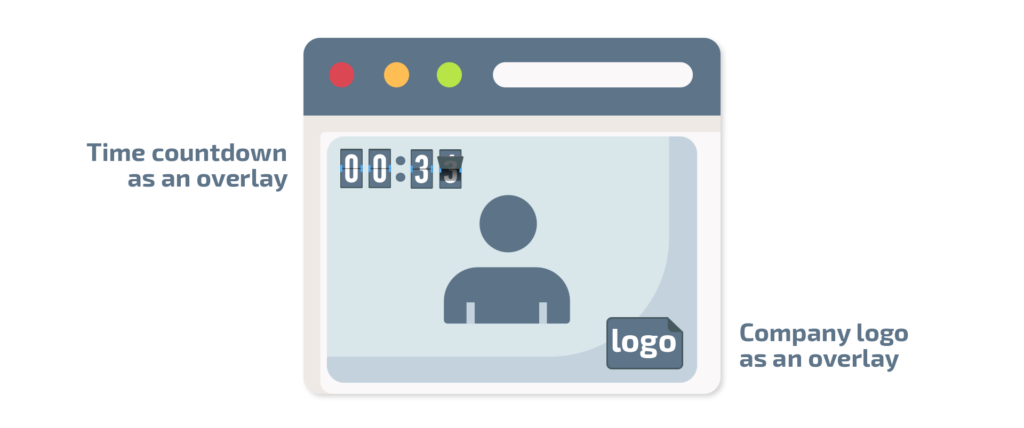
- Add your company logo for brand recognition
- Display speaker names and titles
- Include session information or timers
- Show social media handles or website URLs
- Feature calls-to-action for viewers
Ever wonder what feature users want most after basic video chat? Recording. The ability to save and replay video conferences has become essential across industries. Businesses that automate video conference recording gain a powerful tool that extends the value of every virtual meeting beyond its scheduled time slot.
Recording serves practical purposes in numerous fields. Doctors record consultations for patients to review treatment instructions later. Students access recorded lectures to study at their own pace. Marketing teams capture product demonstrations for repeated use. Event organizers preserve live sessions for those who couldn’t attend. In each case, recording transforms a one-time conversation into a permanent, accessible resource.
Success with video recording hinges on selecting appropriate tools and configurations. High-quality audio capture demands proper microphones with noise cancellation capabilities. Clear video requires adequate cameras and lighting setups. The right software makes a difference too – look for solutions that are easy to use but still offer essential features like cloud storage and compatible formats. Every choice you make affects how good your recordings turn out.
In this article, we’ll show you the best ways to set up video conference recording for your needs.
What Are the Ways to Implement Video Conference Recording?
There are three main ways to implement video conference recording: local recording software on the user’s device, browser-based server-side recording using a virtual participant, and direct server-side media processing with tools like FFmpeg. Each carries its own trade-offs depending on your technical requirements and how your users work.
Local Recording Software: Simple But Limited
The most straightforward approach is using screen recording software on a participant’s device. While widely accessible, this method comes with notable limitations:
- Performance issues – Recording requires substantial CPU and memory, which can slow down the user’s device during important meetings
- Reliability risks – If the user’s computer crashes or freezes, the entire recording is lost
- Human error factor – Users might forget to start recording or accidentally stop it
- Technical barriers – Many users struggle with installing and configuring third-party recording applications
These limitations make local recording impractical for business-critical meetings where consistent, reliable recording is essential.
Ever wonder what feature users want most after basic video chat? Recording. The ability to save and replay video conferences has become essential across industries. Businesses that automate video conference recording gain a powerful tool that extends the value of every virtual meeting beyond its scheduled time slot.
Recording serves practical purposes in numerous fields. Doctors record consultations for patients to review treatment instructions later. Students access recorded lectures to study at their own pace. Marketing teams capture product demonstrations for repeated use. Event organizers preserve live sessions for those who couldn’t attend. In each case, recording transforms a one-time conversation into a permanent, accessible resource.
Success with video recording hinges on selecting appropriate tools and configurations. High-quality audio capture demands proper microphones with noise cancellation capabilities. Clear video requires adequate cameras and lighting setups. The right software makes a difference too – look for solutions that are easy to use but still offer essential features like cloud storage and compatible formats. Every choice you make affects how good your recordings turn out.
In this article, we’ll show you the best ways to set up video conference recording for your needs.
What Are the Ways to Implement Video Conference Recording?
There are three main ways to implement video conference recording: local recording software on the user’s device, browser-based server-side recording using a virtual participant, and direct server-side media processing with tools like FFmpeg. Each carries its own trade-offs depending on your technical requirements and how your users work.
Local Recording Software: Simple But Limited
The most straightforward approach is using screen recording software on a participant’s device. While widely accessible, this method comes with notable limitations:
- Performance issues – Recording requires substantial CPU and memory, which can slow down the user’s device during important meetings
- Reliability risks – If the user’s computer crashes or freezes, the entire recording is lost
- Human error factor – Users might forget to start recording or accidentally stop it
- Technical barriers – Many users struggle with installing and configuring third-party recording applications
These limitations make local recording impractical for business-critical meetings where consistent, reliable recording is essential.
Ever wonder what feature users want most after basic video chat? Recording. The ability to save and replay video conferences has become essential across industries. Businesses that automate video conference recording gain a powerful tool that extends the value of every virtual meeting beyond its scheduled time slot.
Recording serves practical purposes in numerous fields. Doctors record consultations for patients to review treatment instructions later. Students access recorded lectures to study at their own pace. Marketing teams capture product demonstrations for repeated use. Event organizers preserve live sessions for those who couldn’t attend. In each case, recording transforms a one-time conversation into a permanent, accessible resource.
Success with video recording hinges on selecting appropriate tools and configurations. High-quality audio capture demands proper microphones with noise cancellation capabilities. Clear video requires adequate cameras and lighting setups. The right software makes a difference too – look for solutions that are easy to use but still offer essential features like cloud storage and compatible formats. Every choice you make affects how good your recordings turn out.
In this article, we’ll show you the best ways to set up video conference recording for your needs.
What Are the Ways to Implement Video Conference Recording?
There are three main ways to implement video conference recording: local recording software on the user’s device, browser-based server-side recording using a virtual participant, and direct server-side media processing with tools like FFmpeg. Each carries its own trade-offs depending on your technical requirements and how your users work.
Local Recording Software: Simple But Limited
The most straightforward approach is using screen recording software on a participant’s device. While widely accessible, this method comes with notable limitations:
- Performance issues – Recording requires substantial CPU and memory, which can slow down the user’s device during important meetings
- Reliability risks – If the user’s computer crashes or freezes, the entire recording is lost
- Human error factor – Users might forget to start recording or accidentally stop it
- Technical barriers – Many users struggle with installing and configuring third-party recording applications
These limitations make local recording impractical for business-critical meetings where consistent, reliable recording is essential.
Ever wonder what feature users want most after basic video chat? Recording. The ability to save and replay video conferences has become essential across industries. Businesses that automate video conference recording gain a powerful tool that extends the value of every virtual meeting beyond its scheduled time slot.
Recording serves practical purposes in numerous fields. Doctors record consultations for patients to review treatment instructions later. Students access recorded lectures to study at their own pace. Marketing teams capture product demonstrations for repeated use. Event organizers preserve live sessions for those who couldn’t attend. In each case, recording transforms a one-time conversation into a permanent, accessible resource.
Success with video recording hinges on selecting appropriate tools and configurations. High-quality audio capture demands proper microphones with noise cancellation capabilities. Clear video requires adequate cameras and lighting setups. The right software makes a difference too – look for solutions that are easy to use but still offer essential features like cloud storage and compatible formats. Every choice you make affects how good your recordings turn out.
In this article, we’ll show you the best ways to set up video conference recording for your needs.
What Are the Ways to Implement Video Conference Recording?
There are three main ways to implement video conference recording: local recording software on the user’s device, browser-based server-side recording using a virtual participant, and direct server-side media processing with tools like FFmpeg. Each carries its own trade-offs depending on your technical requirements and how your users work.
Local Recording Software: Simple But Limited
The most straightforward approach is using screen recording software on a participant’s device. While widely accessible, this method comes with notable limitations:
- Performance issues – Recording requires substantial CPU and memory, which can slow down the user’s device during important meetings
- Reliability risks – If the user’s computer crashes or freezes, the entire recording is lost
- Human error factor – Users might forget to start recording or accidentally stop it
- Technical barriers – Many users struggle with installing and configuring third-party recording applications
These limitations make local recording impractical for business-critical meetings where consistent, reliable recording is essential.
- Automatic transcription – Convert speech to searchable text in real-time
- Speaker identification – Automatically label who is speaking
- Meeting summarization – Create concise AI-generated summaries of key points
- Action item extraction – Identify and compile tasks mentioned during meetings
- Content indexing – Make specific moments findable through keyword search
Ever wonder what feature users want most after basic video chat? Recording. The ability to save and replay video conferences has become essential across industries. Businesses that automate video conference recording gain a powerful tool that extends the value of every virtual meeting beyond its scheduled time slot.
Recording serves practical purposes in numerous fields. Doctors record consultations for patients to review treatment instructions later. Students access recorded lectures to study at their own pace. Marketing teams capture product demonstrations for repeated use. Event organizers preserve live sessions for those who couldn’t attend. In each case, recording transforms a one-time conversation into a permanent, accessible resource.
Success with video recording hinges on selecting appropriate tools and configurations. High-quality audio capture demands proper microphones with noise cancellation capabilities. Clear video requires adequate cameras and lighting setups. The right software makes a difference too – look for solutions that are easy to use but still offer essential features like cloud storage and compatible formats. Every choice you make affects how good your recordings turn out.
In this article, we’ll show you the best ways to set up video conference recording for your needs.
What Are the Ways to Implement Video Conference Recording?
There are three main ways to implement video conference recording: local recording software on the user’s device, browser-based server-side recording using a virtual participant, and direct server-side media processing with tools like FFmpeg. Each carries its own trade-offs depending on your technical requirements and how your users work.
Local Recording Software: Simple But Limited
The most straightforward approach is using screen recording software on a participant’s device. While widely accessible, this method comes with notable limitations:
- Performance issues – Recording requires substantial CPU and memory, which can slow down the user’s device during important meetings
- Reliability risks – If the user’s computer crashes or freezes, the entire recording is lost
- Human error factor – Users might forget to start recording or accidentally stop it
- Technical barriers – Many users struggle with installing and configuring third-party recording applications
These limitations make local recording impractical for business-critical meetings where consistent, reliable recording is essential.
Ever wonder what feature users want most after basic video chat? Recording. The ability to save and replay video conferences has become essential across industries. Businesses that automate video conference recording gain a powerful tool that extends the value of every virtual meeting beyond its scheduled time slot.
Recording serves practical purposes in numerous fields. Doctors record consultations for patients to review treatment instructions later. Students access recorded lectures to study at their own pace. Marketing teams capture product demonstrations for repeated use. Event organizers preserve live sessions for those who couldn’t attend. In each case, recording transforms a one-time conversation into a permanent, accessible resource.
Success with video recording hinges on selecting appropriate tools and configurations. High-quality audio capture demands proper microphones with noise cancellation capabilities. Clear video requires adequate cameras and lighting setups. The right software makes a difference too – look for solutions that are easy to use but still offer essential features like cloud storage and compatible formats. Every choice you make affects how good your recordings turn out.
In this article, we’ll show you the best ways to set up video conference recording for your needs.
What Are the Ways to Implement Video Conference Recording?
There are three main ways to implement video conference recording: local recording software on the user’s device, browser-based server-side recording using a virtual participant, and direct server-side media processing with tools like FFmpeg. Each carries its own trade-offs depending on your technical requirements and how your users work.
Local Recording Software: Simple But Limited
The most straightforward approach is using screen recording software on a participant’s device. While widely accessible, this method comes with notable limitations:
- Performance issues – Recording requires substantial CPU and memory, which can slow down the user’s device during important meetings
- Reliability risks – If the user’s computer crashes or freezes, the entire recording is lost
- Human error factor – Users might forget to start recording or accidentally stop it
- Technical barriers – Many users struggle with installing and configuring third-party recording applications
These limitations make local recording impractical for business-critical meetings where consistent, reliable recording is essential.
- Serverless processing – Scale recording resources automatically based on demand
- Microservices architecture – Process different aspects of recording independently
- Container orchestration – Deploy recording services efficiently across infrastructure
- Multi-region redundancy – Ensure recording availability regardless of regional outages
Ever wonder what feature users want most after basic video chat? Recording. The ability to save and replay video conferences has become essential across industries. Businesses that automate video conference recording gain a powerful tool that extends the value of every virtual meeting beyond its scheduled time slot.
Recording serves practical purposes in numerous fields. Doctors record consultations for patients to review treatment instructions later. Students access recorded lectures to study at their own pace. Marketing teams capture product demonstrations for repeated use. Event organizers preserve live sessions for those who couldn’t attend. In each case, recording transforms a one-time conversation into a permanent, accessible resource.
Success with video recording hinges on selecting appropriate tools and configurations. High-quality audio capture demands proper microphones with noise cancellation capabilities. Clear video requires adequate cameras and lighting setups. The right software makes a difference too – look for solutions that are easy to use but still offer essential features like cloud storage and compatible formats. Every choice you make affects how good your recordings turn out.
In this article, we’ll show you the best ways to set up video conference recording for your needs.
What Are the Ways to Implement Video Conference Recording?
There are three main ways to implement video conference recording: local recording software on the user’s device, browser-based server-side recording using a virtual participant, and direct server-side media processing with tools like FFmpeg. Each carries its own trade-offs depending on your technical requirements and how your users work.
Local Recording Software: Simple But Limited
The most straightforward approach is using screen recording software on a participant’s device. While widely accessible, this method comes with notable limitations:
- Performance issues – Recording requires substantial CPU and memory, which can slow down the user’s device during important meetings
- Reliability risks – If the user’s computer crashes or freezes, the entire recording is lost
- Human error factor – Users might forget to start recording or accidentally stop it
- Technical barriers – Many users struggle with installing and configuring third-party recording applications
These limitations make local recording impractical for business-critical meetings where consistent, reliable recording is essential.
Ever wonder what feature users want most after basic video chat? Recording. The ability to save and replay video conferences has become essential across industries. Businesses that automate video conference recording gain a powerful tool that extends the value of every virtual meeting beyond its scheduled time slot.
Recording serves practical purposes in numerous fields. Doctors record consultations for patients to review treatment instructions later. Students access recorded lectures to study at their own pace. Marketing teams capture product demonstrations for repeated use. Event organizers preserve live sessions for those who couldn’t attend. In each case, recording transforms a one-time conversation into a permanent, accessible resource.
Success with video recording hinges on selecting appropriate tools and configurations. High-quality audio capture demands proper microphones with noise cancellation capabilities. Clear video requires adequate cameras and lighting setups. The right software makes a difference too – look for solutions that are easy to use but still offer essential features like cloud storage and compatible formats. Every choice you make affects how good your recordings turn out.
In this article, we’ll show you the best ways to set up video conference recording for your needs.
What Are the Ways to Implement Video Conference Recording?
There are three main ways to implement video conference recording: local recording software on the user’s device, browser-based server-side recording using a virtual participant, and direct server-side media processing with tools like FFmpeg. Each carries its own trade-offs depending on your technical requirements and how your users work.
Local Recording Software: Simple But Limited
The most straightforward approach is using screen recording software on a participant’s device. While widely accessible, this method comes with notable limitations:
- Performance issues – Recording requires substantial CPU and memory, which can slow down the user’s device during important meetings
- Reliability risks – If the user’s computer crashes or freezes, the entire recording is lost
- Human error factor – Users might forget to start recording or accidentally stop it
- Technical barriers – Many users struggle with installing and configuring third-party recording applications
These limitations make local recording impractical for business-critical meetings where consistent, reliable recording is essential.
- Peer-to-peer recording captures media streams directly between participants.
- SFU-based recording pulls directly from Selective Forwarding Units, skipping extra processing.
- WebCodecs integration uses the WebCodecs API for more efficient client-side work.
Ever wonder what feature users want most after basic video chat? Recording. The ability to save and replay video conferences has become essential across industries. Businesses that automate video conference recording gain a powerful tool that extends the value of every virtual meeting beyond its scheduled time slot.
Recording serves practical purposes in numerous fields. Doctors record consultations for patients to review treatment instructions later. Students access recorded lectures to study at their own pace. Marketing teams capture product demonstrations for repeated use. Event organizers preserve live sessions for those who couldn’t attend. In each case, recording transforms a one-time conversation into a permanent, accessible resource.
Success with video recording hinges on selecting appropriate tools and configurations. High-quality audio capture demands proper microphones with noise cancellation capabilities. Clear video requires adequate cameras and lighting setups. The right software makes a difference too – look for solutions that are easy to use but still offer essential features like cloud storage and compatible formats. Every choice you make affects how good your recordings turn out.
In this article, we’ll show you the best ways to set up video conference recording for your needs.
What Are the Ways to Implement Video Conference Recording?
There are three main ways to implement video conference recording: local recording software on the user’s device, browser-based server-side recording using a virtual participant, and direct server-side media processing with tools like FFmpeg. Each carries its own trade-offs depending on your technical requirements and how your users work.
Local Recording Software: Simple But Limited
The most straightforward approach is using screen recording software on a participant’s device. While widely accessible, this method comes with notable limitations:
- Performance issues – Recording requires substantial CPU and memory, which can slow down the user’s device during important meetings
- Reliability risks – If the user’s computer crashes or freezes, the entire recording is lost
- Human error factor – Users might forget to start recording or accidentally stop it
- Technical barriers – Many users struggle with installing and configuring third-party recording applications
These limitations make local recording impractical for business-critical meetings where consistent, reliable recording is essential.
Ever wonder what feature users want most after basic video chat? Recording. The ability to save and replay video conferences has become essential across industries. Businesses that automate video conference recording gain a powerful tool that extends the value of every virtual meeting beyond its scheduled time slot.
Recording serves practical purposes in numerous fields. Doctors record consultations for patients to review treatment instructions later. Students access recorded lectures to study at their own pace. Marketing teams capture product demonstrations for repeated use. Event organizers preserve live sessions for those who couldn’t attend. In each case, recording transforms a one-time conversation into a permanent, accessible resource.
Success with video recording hinges on selecting appropriate tools and configurations. High-quality audio capture demands proper microphones with noise cancellation capabilities. Clear video requires adequate cameras and lighting setups. The right software makes a difference too – look for solutions that are easy to use but still offer essential features like cloud storage and compatible formats. Every choice you make affects how good your recordings turn out.
In this article, we’ll show you the best ways to set up video conference recording for your needs.
What Are the Ways to Implement Video Conference Recording?
There are three main ways to implement video conference recording: local recording software on the user’s device, browser-based server-side recording using a virtual participant, and direct server-side media processing with tools like FFmpeg. Each carries its own trade-offs depending on your technical requirements and how your users work.
Local Recording Software: Simple But Limited
The most straightforward approach is using screen recording software on a participant’s device. While widely accessible, this method comes with notable limitations:
- Performance issues – Recording requires substantial CPU and memory, which can slow down the user’s device during important meetings
- Reliability risks – If the user’s computer crashes or freezes, the entire recording is lost
- Human error factor – Users might forget to start recording or accidentally stop it
- Technical barriers – Many users struggle with installing and configuring third-party recording applications
These limitations make local recording impractical for business-critical meetings where consistent, reliable recording is essential.
- Chaptered recordings – Automatically divide long meetings into searchable segments
- Multi-view playback – Allow viewers to choose which video feeds to focus on
- Interactive polls and Q&A – Preserve interactive elements within recordings
- Collaborative annotation – Enable viewers to add notes to specific moments in recordings
- Integrated editing tools – Trim and enhance recordings without external software
Ever wonder what feature users want most after basic video chat? Recording. The ability to save and replay video conferences has become essential across industries. Businesses that automate video conference recording gain a powerful tool that extends the value of every virtual meeting beyond its scheduled time slot.
Recording serves practical purposes in numerous fields. Doctors record consultations for patients to review treatment instructions later. Students access recorded lectures to study at their own pace. Marketing teams capture product demonstrations for repeated use. Event organizers preserve live sessions for those who couldn’t attend. In each case, recording transforms a one-time conversation into a permanent, accessible resource.
Success with video recording hinges on selecting appropriate tools and configurations. High-quality audio capture demands proper microphones with noise cancellation capabilities. Clear video requires adequate cameras and lighting setups. The right software makes a difference too – look for solutions that are easy to use but still offer essential features like cloud storage and compatible formats. Every choice you make affects how good your recordings turn out.
In this article, we’ll show you the best ways to set up video conference recording for your needs.
What Are the Ways to Implement Video Conference Recording?
There are three main ways to implement video conference recording: local recording software on the user’s device, browser-based server-side recording using a virtual participant, and direct server-side media processing with tools like FFmpeg. Each carries its own trade-offs depending on your technical requirements and how your users work.
Local Recording Software: Simple But Limited
The most straightforward approach is using screen recording software on a participant’s device. While widely accessible, this method comes with notable limitations:
- Performance issues – Recording requires substantial CPU and memory, which can slow down the user’s device during important meetings
- Reliability risks – If the user’s computer crashes or freezes, the entire recording is lost
- Human error factor – Users might forget to start recording or accidentally stop it
- Technical barriers – Many users struggle with installing and configuring third-party recording applications
These limitations make local recording impractical for business-critical meetings where consistent, reliable recording is essential.
Ever wonder what feature users want most after basic video chat? Recording. The ability to save and replay video conferences has become essential across industries. Businesses that automate video conference recording gain a powerful tool that extends the value of every virtual meeting beyond its scheduled time slot.
Recording serves practical purposes in numerous fields. Doctors record consultations for patients to review treatment instructions later. Students access recorded lectures to study at their own pace. Marketing teams capture product demonstrations for repeated use. Event organizers preserve live sessions for those who couldn’t attend. In each case, recording transforms a one-time conversation into a permanent, accessible resource.
Success with video recording hinges on selecting appropriate tools and configurations. High-quality audio capture demands proper microphones with noise cancellation capabilities. Clear video requires adequate cameras and lighting setups. The right software makes a difference too – look for solutions that are easy to use but still offer essential features like cloud storage and compatible formats. Every choice you make affects how good your recordings turn out.
In this article, we’ll show you the best ways to set up video conference recording for your needs.
What Are the Ways to Implement Video Conference Recording?
There are three main ways to implement video conference recording: local recording software on the user’s device, browser-based server-side recording using a virtual participant, and direct server-side media processing with tools like FFmpeg. Each carries its own trade-offs depending on your technical requirements and how your users work.
Local Recording Software: Simple But Limited
The most straightforward approach is using screen recording software on a participant’s device. While widely accessible, this method comes with notable limitations:
- Performance issues – Recording requires substantial CPU and memory, which can slow down the user’s device during important meetings
- Reliability risks – If the user’s computer crashes or freezes, the entire recording is lost
- Human error factor – Users might forget to start recording or accidentally stop it
- Technical barriers – Many users struggle with installing and configuring third-party recording applications
These limitations make local recording impractical for business-critical meetings where consistent, reliable recording is essential.
Ever wonder what feature users want most after basic video chat? Recording. The ability to save and replay video conferences has become essential across industries. Businesses that automate video conference recording gain a powerful tool that extends the value of every virtual meeting beyond its scheduled time slot.
Recording serves practical purposes in numerous fields. Doctors record consultations for patients to review treatment instructions later. Students access recorded lectures to study at their own pace. Marketing teams capture product demonstrations for repeated use. Event organizers preserve live sessions for those who couldn’t attend. In each case, recording transforms a one-time conversation into a permanent, accessible resource.
Success with video recording hinges on selecting appropriate tools and configurations. High-quality audio capture demands proper microphones with noise cancellation capabilities. Clear video requires adequate cameras and lighting setups. The right software makes a difference too – look for solutions that are easy to use but still offer essential features like cloud storage and compatible formats. Every choice you make affects how good your recordings turn out.
In this article, we’ll show you the best ways to set up video conference recording for your needs.
What Are the Ways to Implement Video Conference Recording?
There are three main ways to implement video conference recording: local recording software on the user’s device, browser-based server-side recording using a virtual participant, and direct server-side media processing with tools like FFmpeg. Each carries its own trade-offs depending on your technical requirements and how your users work.
Local Recording Software: Simple But Limited
The most straightforward approach is using screen recording software on a participant’s device. While widely accessible, this method comes with notable limitations:
- Performance issues – Recording requires substantial CPU and memory, which can slow down the user’s device during important meetings
- Reliability risks – If the user’s computer crashes or freezes, the entire recording is lost
- Human error factor – Users might forget to start recording or accidentally stop it
- Technical barriers – Many users struggle with installing and configuring third-party recording applications
These limitations make local recording impractical for business-critical meetings where consistent, reliable recording is essential.
Ever wonder what feature users want most after basic video chat? Recording. The ability to save and replay video conferences has become essential across industries. Businesses that automate video conference recording gain a powerful tool that extends the value of every virtual meeting beyond its scheduled time slot.
Recording serves practical purposes in numerous fields. Doctors record consultations for patients to review treatment instructions later. Students access recorded lectures to study at their own pace. Marketing teams capture product demonstrations for repeated use. Event organizers preserve live sessions for those who couldn’t attend. In each case, recording transforms a one-time conversation into a permanent, accessible resource.
Success with video recording hinges on selecting appropriate tools and configurations. High-quality audio capture demands proper microphones with noise cancellation capabilities. Clear video requires adequate cameras and lighting setups. The right software makes a difference too – look for solutions that are easy to use but still offer essential features like cloud storage and compatible formats. Every choice you make affects how good your recordings turn out.
In this article, we’ll show you the best ways to set up video conference recording for your needs.
What Are the Ways to Implement Video Conference Recording?
There are three main ways to implement video conference recording: local recording software on the user’s device, browser-based server-side recording using a virtual participant, and direct server-side media processing with tools like FFmpeg. Each carries its own trade-offs depending on your technical requirements and how your users work.
Local Recording Software: Simple But Limited
The most straightforward approach is using screen recording software on a participant’s device. While widely accessible, this method comes with notable limitations:
- Performance issues – Recording requires substantial CPU and memory, which can slow down the user’s device during important meetings
- Reliability risks – If the user’s computer crashes or freezes, the entire recording is lost
- Human error factor – Users might forget to start recording or accidentally stop it
- Technical barriers – Many users struggle with installing and configuring third-party recording applications
These limitations make local recording impractical for business-critical meetings where consistent, reliable recording is essential.
Ever wonder what feature users want most after basic video chat? Recording. The ability to save and replay video conferences has become essential across industries. Businesses that automate video conference recording gain a powerful tool that extends the value of every virtual meeting beyond its scheduled time slot.
Recording serves practical purposes in numerous fields. Doctors record consultations for patients to review treatment instructions later. Students access recorded lectures to study at their own pace. Marketing teams capture product demonstrations for repeated use. Event organizers preserve live sessions for those who couldn’t attend. In each case, recording transforms a one-time conversation into a permanent, accessible resource.
Success with video recording hinges on selecting appropriate tools and configurations. High-quality audio capture demands proper microphones with noise cancellation capabilities. Clear video requires adequate cameras and lighting setups. The right software makes a difference too – look for solutions that are easy to use but still offer essential features like cloud storage and compatible formats. Every choice you make affects how good your recordings turn out.
In this article, we’ll show you the best ways to set up video conference recording for your needs.
What Are the Ways to Implement Video Conference Recording?
There are three main ways to implement video conference recording: local recording software on the user’s device, browser-based server-side recording using a virtual participant, and direct server-side media processing with tools like FFmpeg. Each carries its own trade-offs depending on your technical requirements and how your users work.
Local Recording Software: Simple But Limited
The most straightforward approach is using screen recording software on a participant’s device. While widely accessible, this method comes with notable limitations:
- Performance issues – Recording requires substantial CPU and memory, which can slow down the user’s device during important meetings
- Reliability risks – If the user’s computer crashes or freezes, the entire recording is lost
- Human error factor – Users might forget to start recording or accidentally stop it
- Technical barriers – Many users struggle with installing and configuring third-party recording applications
These limitations make local recording impractical for business-critical meetings where consistent, reliable recording is essential.
- How long recordings will be stored
- Automatic deletion schedules
- Storage optimization techniques (compression, archiving)
- Cloud vs. local storage options
Ever wonder what feature users want most after basic video chat? Recording. The ability to save and replay video conferences has become essential across industries. Businesses that automate video conference recording gain a powerful tool that extends the value of every virtual meeting beyond its scheduled time slot.
Recording serves practical purposes in numerous fields. Doctors record consultations for patients to review treatment instructions later. Students access recorded lectures to study at their own pace. Marketing teams capture product demonstrations for repeated use. Event organizers preserve live sessions for those who couldn’t attend. In each case, recording transforms a one-time conversation into a permanent, accessible resource.
Success with video recording hinges on selecting appropriate tools and configurations. High-quality audio capture demands proper microphones with noise cancellation capabilities. Clear video requires adequate cameras and lighting setups. The right software makes a difference too – look for solutions that are easy to use but still offer essential features like cloud storage and compatible formats. Every choice you make affects how good your recordings turn out.
In this article, we’ll show you the best ways to set up video conference recording for your needs.
What Are the Ways to Implement Video Conference Recording?
There are three main ways to implement video conference recording: local recording software on the user’s device, browser-based server-side recording using a virtual participant, and direct server-side media processing with tools like FFmpeg. Each carries its own trade-offs depending on your technical requirements and how your users work.
Local Recording Software: Simple But Limited
The most straightforward approach is using screen recording software on a participant’s device. While widely accessible, this method comes with notable limitations:
- Performance issues – Recording requires substantial CPU and memory, which can slow down the user’s device during important meetings
- Reliability risks – If the user’s computer crashes or freezes, the entire recording is lost
- Human error factor – Users might forget to start recording or accidentally stop it
- Technical barriers – Many users struggle with installing and configuring third-party recording applications
These limitations make local recording impractical for business-critical meetings where consistent, reliable recording is essential.
- Access controls and permissions
- Encryption at rest and in transit
- Secure sharing mechanisms
- Compliance with relevant regulations (GDPR, HIPAA, etc.)
Ever wonder what feature users want most after basic video chat? Recording. The ability to save and replay video conferences has become essential across industries. Businesses that automate video conference recording gain a powerful tool that extends the value of every virtual meeting beyond its scheduled time slot.
Recording serves practical purposes in numerous fields. Doctors record consultations for patients to review treatment instructions later. Students access recorded lectures to study at their own pace. Marketing teams capture product demonstrations for repeated use. Event organizers preserve live sessions for those who couldn’t attend. In each case, recording transforms a one-time conversation into a permanent, accessible resource.
Success with video recording hinges on selecting appropriate tools and configurations. High-quality audio capture demands proper microphones with noise cancellation capabilities. Clear video requires adequate cameras and lighting setups. The right software makes a difference too – look for solutions that are easy to use but still offer essential features like cloud storage and compatible formats. Every choice you make affects how good your recordings turn out.
In this article, we’ll show you the best ways to set up video conference recording for your needs.
What Are the Ways to Implement Video Conference Recording?
There are three main ways to implement video conference recording: local recording software on the user’s device, browser-based server-side recording using a virtual participant, and direct server-side media processing with tools like FFmpeg. Each carries its own trade-offs depending on your technical requirements and how your users work.
Local Recording Software: Simple But Limited
The most straightforward approach is using screen recording software on a participant’s device. While widely accessible, this method comes with notable limitations:
- Performance issues – Recording requires substantial CPU and memory, which can slow down the user’s device during important meetings
- Reliability risks – If the user’s computer crashes or freezes, the entire recording is lost
- Human error factor – Users might forget to start recording or accidentally stop it
- Technical barriers – Many users struggle with installing and configuring third-party recording applications
These limitations make local recording impractical for business-critical meetings where consistent, reliable recording is essential.
Ever wonder what feature users want most after basic video chat? Recording. The ability to save and replay video conferences has become essential across industries. Businesses that automate video conference recording gain a powerful tool that extends the value of every virtual meeting beyond its scheduled time slot.
Recording serves practical purposes in numerous fields. Doctors record consultations for patients to review treatment instructions later. Students access recorded lectures to study at their own pace. Marketing teams capture product demonstrations for repeated use. Event organizers preserve live sessions for those who couldn’t attend. In each case, recording transforms a one-time conversation into a permanent, accessible resource.
Success with video recording hinges on selecting appropriate tools and configurations. High-quality audio capture demands proper microphones with noise cancellation capabilities. Clear video requires adequate cameras and lighting setups. The right software makes a difference too – look for solutions that are easy to use but still offer essential features like cloud storage and compatible formats. Every choice you make affects how good your recordings turn out.
In this article, we’ll show you the best ways to set up video conference recording for your needs.
What Are the Ways to Implement Video Conference Recording?
There are three main ways to implement video conference recording: local recording software on the user’s device, browser-based server-side recording using a virtual participant, and direct server-side media processing with tools like FFmpeg. Each carries its own trade-offs depending on your technical requirements and how your users work.
Local Recording Software: Simple But Limited
The most straightforward approach is using screen recording software on a participant’s device. While widely accessible, this method comes with notable limitations:
- Performance issues – Recording requires substantial CPU and memory, which can slow down the user’s device during important meetings
- Reliability risks – If the user’s computer crashes or freezes, the entire recording is lost
- Human error factor – Users might forget to start recording or accidentally stop it
- Technical barriers – Many users struggle with installing and configuring third-party recording applications
These limitations make local recording impractical for business-critical meetings where consistent, reliable recording is essential.
Ever wonder what feature users want most after basic video chat? Recording. The ability to save and replay video conferences has become essential across industries. Businesses that automate video conference recording gain a powerful tool that extends the value of every virtual meeting beyond its scheduled time slot.
Recording serves practical purposes in numerous fields. Doctors record consultations for patients to review treatment instructions later. Students access recorded lectures to study at their own pace. Marketing teams capture product demonstrations for repeated use. Event organizers preserve live sessions for those who couldn’t attend. In each case, recording transforms a one-time conversation into a permanent, accessible resource.
Success with video recording hinges on selecting appropriate tools and configurations. High-quality audio capture demands proper microphones with noise cancellation capabilities. Clear video requires adequate cameras and lighting setups. The right software makes a difference too – look for solutions that are easy to use but still offer essential features like cloud storage and compatible formats. Every choice you make affects how good your recordings turn out.
In this article, we’ll show you the best ways to set up video conference recording for your needs.
What Are the Ways to Implement Video Conference Recording?
There are three main ways to implement video conference recording: local recording software on the user’s device, browser-based server-side recording using a virtual participant, and direct server-side media processing with tools like FFmpeg. Each carries its own trade-offs depending on your technical requirements and how your users work.
Local Recording Software: Simple But Limited
The most straightforward approach is using screen recording software on a participant’s device. While widely accessible, this method comes with notable limitations:
- Performance issues – Recording requires substantial CPU and memory, which can slow down the user’s device during important meetings
- Reliability risks – If the user’s computer crashes or freezes, the entire recording is lost
- Human error factor – Users might forget to start recording or accidentally stop it
- Technical barriers – Many users struggle with installing and configuring third-party recording applications
These limitations make local recording impractical for business-critical meetings where consistent, reliable recording is essential.
Ever wonder what feature users want most after basic video chat? Recording. The ability to save and replay video conferences has become essential across industries. Businesses that automate video conference recording gain a powerful tool that extends the value of every virtual meeting beyond its scheduled time slot.
Recording serves practical purposes in numerous fields. Doctors record consultations for patients to review treatment instructions later. Students access recorded lectures to study at their own pace. Marketing teams capture product demonstrations for repeated use. Event organizers preserve live sessions for those who couldn’t attend. In each case, recording transforms a one-time conversation into a permanent, accessible resource.
Success with video recording hinges on selecting appropriate tools and configurations. High-quality audio capture demands proper microphones with noise cancellation capabilities. Clear video requires adequate cameras and lighting setups. The right software makes a difference too – look for solutions that are easy to use but still offer essential features like cloud storage and compatible formats. Every choice you make affects how good your recordings turn out.
In this article, we’ll show you the best ways to set up video conference recording for your needs.
What Are the Ways to Implement Video Conference Recording?
There are three main ways to implement video conference recording: local recording software on the user’s device, browser-based server-side recording using a virtual participant, and direct server-side media processing with tools like FFmpeg. Each carries its own trade-offs depending on your technical requirements and how your users work.
Local Recording Software: Simple But Limited
The most straightforward approach is using screen recording software on a participant’s device. While widely accessible, this method comes with notable limitations:
- Performance issues – Recording requires substantial CPU and memory, which can slow down the user’s device during important meetings
- Reliability risks – If the user’s computer crashes or freezes, the entire recording is lost
- Human error factor – Users might forget to start recording or accidentally stop it
- Technical barriers – Many users struggle with installing and configuring third-party recording applications
These limitations make local recording impractical for business-critical meetings where consistent, reliable recording is essential.
Ever wonder what feature users want most after basic video chat? Recording. The ability to save and replay video conferences has become essential across industries. Businesses that automate video conference recording gain a powerful tool that extends the value of every virtual meeting beyond its scheduled time slot.
Recording serves practical purposes in numerous fields. Doctors record consultations for patients to review treatment instructions later. Students access recorded lectures to study at their own pace. Marketing teams capture product demonstrations for repeated use. Event organizers preserve live sessions for those who couldn’t attend. In each case, recording transforms a one-time conversation into a permanent, accessible resource.
Success with video recording hinges on selecting appropriate tools and configurations. High-quality audio capture demands proper microphones with noise cancellation capabilities. Clear video requires adequate cameras and lighting setups. The right software makes a difference too – look for solutions that are easy to use but still offer essential features like cloud storage and compatible formats. Every choice you make affects how good your recordings turn out.
In this article, we’ll show you the best ways to set up video conference recording for your needs.
What Are the Ways to Implement Video Conference Recording?
There are three main ways to implement video conference recording: local recording software on the user’s device, browser-based server-side recording using a virtual participant, and direct server-side media processing with tools like FFmpeg. Each carries its own trade-offs depending on your technical requirements and how your users work.
Local Recording Software: Simple But Limited
The most straightforward approach is using screen recording software on a participant’s device. While widely accessible, this method comes with notable limitations:
- Performance issues – Recording requires substantial CPU and memory, which can slow down the user’s device during important meetings
- Reliability risks – If the user’s computer crashes or freezes, the entire recording is lost
- Human error factor – Users might forget to start recording or accidentally stop it
- Technical barriers – Many users struggle with installing and configuring third-party recording applications
These limitations make local recording impractical for business-critical meetings where consistent, reliable recording is essential.
Ever wonder what feature users want most after basic video chat? Recording. The ability to save and replay video conferences has become essential across industries. Businesses that automate video conference recording gain a powerful tool that extends the value of every virtual meeting beyond its scheduled time slot.
Recording serves practical purposes in numerous fields. Doctors record consultations for patients to review treatment instructions later. Students access recorded lectures to study at their own pace. Marketing teams capture product demonstrations for repeated use. Event organizers preserve live sessions for those who couldn’t attend. In each case, recording transforms a one-time conversation into a permanent, accessible resource.
Success with video recording hinges on selecting appropriate tools and configurations. High-quality audio capture demands proper microphones with noise cancellation capabilities. Clear video requires adequate cameras and lighting setups. The right software makes a difference too – look for solutions that are easy to use but still offer essential features like cloud storage and compatible formats. Every choice you make affects how good your recordings turn out.
In this article, we’ll show you the best ways to set up video conference recording for your needs.
What Are the Ways to Implement Video Conference Recording?
There are three main ways to implement video conference recording: local recording software on the user’s device, browser-based server-side recording using a virtual participant, and direct server-side media processing with tools like FFmpeg. Each carries its own trade-offs depending on your technical requirements and how your users work.
Local Recording Software: Simple But Limited
The most straightforward approach is using screen recording software on a participant’s device. While widely accessible, this method comes with notable limitations:
- Performance issues – Recording requires substantial CPU and memory, which can slow down the user’s device during important meetings
- Reliability risks – If the user’s computer crashes or freezes, the entire recording is lost
- Human error factor – Users might forget to start recording or accidentally stop it
- Technical barriers – Many users struggle with installing and configuring third-party recording applications
These limitations make local recording impractical for business-critical meetings where consistent, reliable recording is essential.
Ever wonder what feature users want most after basic video chat? Recording. The ability to save and replay video conferences has become essential across industries. Businesses that automate video conference recording gain a powerful tool that extends the value of every virtual meeting beyond its scheduled time slot.
Recording serves practical purposes in numerous fields. Doctors record consultations for patients to review treatment instructions later. Students access recorded lectures to study at their own pace. Marketing teams capture product demonstrations for repeated use. Event organizers preserve live sessions for those who couldn’t attend. In each case, recording transforms a one-time conversation into a permanent, accessible resource.
Success with video recording hinges on selecting appropriate tools and configurations. High-quality audio capture demands proper microphones with noise cancellation capabilities. Clear video requires adequate cameras and lighting setups. The right software makes a difference too – look for solutions that are easy to use but still offer essential features like cloud storage and compatible formats. Every choice you make affects how good your recordings turn out.
In this article, we’ll show you the best ways to set up video conference recording for your needs.
What Are the Ways to Implement Video Conference Recording?
There are three main ways to implement video conference recording: local recording software on the user’s device, browser-based server-side recording using a virtual participant, and direct server-side media processing with tools like FFmpeg. Each carries its own trade-offs depending on your technical requirements and how your users work.
Local Recording Software: Simple But Limited
The most straightforward approach is using screen recording software on a participant’s device. While widely accessible, this method comes with notable limitations:
- Performance issues – Recording requires substantial CPU and memory, which can slow down the user’s device during important meetings
- Reliability risks – If the user’s computer crashes or freezes, the entire recording is lost
- Human error factor – Users might forget to start recording or accidentally stop it
- Technical barriers – Many users struggle with installing and configuring third-party recording applications
These limitations make local recording impractical for business-critical meetings where consistent, reliable recording is essential.
Ever wonder what feature users want most after basic video chat? Recording. The ability to save and replay video conferences has become essential across industries. Businesses that automate video conference recording gain a powerful tool that extends the value of every virtual meeting beyond its scheduled time slot.
Recording serves practical purposes in numerous fields. Doctors record consultations for patients to review treatment instructions later. Students access recorded lectures to study at their own pace. Marketing teams capture product demonstrations for repeated use. Event organizers preserve live sessions for those who couldn’t attend. In each case, recording transforms a one-time conversation into a permanent, accessible resource.
Success with video recording hinges on selecting appropriate tools and configurations. High-quality audio capture demands proper microphones with noise cancellation capabilities. Clear video requires adequate cameras and lighting setups. The right software makes a difference too – look for solutions that are easy to use but still offer essential features like cloud storage and compatible formats. Every choice you make affects how good your recordings turn out.
In this article, we’ll show you the best ways to set up video conference recording for your needs.
What Are the Ways to Implement Video Conference Recording?
There are three main ways to implement video conference recording: local recording software on the user’s device, browser-based server-side recording using a virtual participant, and direct server-side media processing with tools like FFmpeg. Each carries its own trade-offs depending on your technical requirements and how your users work.
Local Recording Software: Simple But Limited
The most straightforward approach is using screen recording software on a participant’s device. While widely accessible, this method comes with notable limitations:
- Performance issues – Recording requires substantial CPU and memory, which can slow down the user’s device during important meetings
- Reliability risks – If the user’s computer crashes or freezes, the entire recording is lost
- Human error factor – Users might forget to start recording or accidentally stop it
- Technical barriers – Many users struggle with installing and configuring third-party recording applications
These limitations make local recording impractical for business-critical meetings where consistent, reliable recording is essential.
Ever wonder what feature users want most after basic video chat? Recording. The ability to save and replay video conferences has become essential across industries. Businesses that automate video conference recording gain a powerful tool that extends the value of every virtual meeting beyond its scheduled time slot.
Recording serves practical purposes in numerous fields. Doctors record consultations for patients to review treatment instructions later. Students access recorded lectures to study at their own pace. Marketing teams capture product demonstrations for repeated use. Event organizers preserve live sessions for those who couldn’t attend. In each case, recording transforms a one-time conversation into a permanent, accessible resource.
Success with video recording hinges on selecting appropriate tools and configurations. High-quality audio capture demands proper microphones with noise cancellation capabilities. Clear video requires adequate cameras and lighting setups. The right software makes a difference too – look for solutions that are easy to use but still offer essential features like cloud storage and compatible formats. Every choice you make affects how good your recordings turn out.
In this article, we’ll show you the best ways to set up video conference recording for your needs.
What Are the Ways to Implement Video Conference Recording?
There are three main ways to implement video conference recording: local recording software on the user’s device, browser-based server-side recording using a virtual participant, and direct server-side media processing with tools like FFmpeg. Each carries its own trade-offs depending on your technical requirements and how your users work.
Local Recording Software: Simple But Limited
The most straightforward approach is using screen recording software on a participant’s device. While widely accessible, this method comes with notable limitations:
- Performance issues – Recording requires substantial CPU and memory, which can slow down the user’s device during important meetings
- Reliability risks – If the user’s computer crashes or freezes, the entire recording is lost
- Human error factor – Users might forget to start recording or accidentally stop it
- Technical barriers – Many users struggle with installing and configuring third-party recording applications
These limitations make local recording impractical for business-critical meetings where consistent, reliable recording is essential.
Ever wonder what feature users want most after basic video chat? Recording. The ability to save and replay video conferences has become essential across industries. Businesses that automate video conference recording gain a powerful tool that extends the value of every virtual meeting beyond its scheduled time slot.
Recording serves practical purposes in numerous fields. Doctors record consultations for patients to review treatment instructions later. Students access recorded lectures to study at their own pace. Marketing teams capture product demonstrations for repeated use. Event organizers preserve live sessions for those who couldn’t attend. In each case, recording transforms a one-time conversation into a permanent, accessible resource.
Success with video recording hinges on selecting appropriate tools and configurations. High-quality audio capture demands proper microphones with noise cancellation capabilities. Clear video requires adequate cameras and lighting setups. The right software makes a difference too – look for solutions that are easy to use but still offer essential features like cloud storage and compatible formats. Every choice you make affects how good your recordings turn out.
In this article, we’ll show you the best ways to set up video conference recording for your needs.
What Are the Ways to Implement Video Conference Recording?
There are three main ways to implement video conference recording: local recording software on the user’s device, browser-based server-side recording using a virtual participant, and direct server-side media processing with tools like FFmpeg. Each carries its own trade-offs depending on your technical requirements and how your users work.
Local Recording Software: Simple But Limited
The most straightforward approach is using screen recording software on a participant’s device. While widely accessible, this method comes with notable limitations:
- Performance issues – Recording requires substantial CPU and memory, which can slow down the user’s device during important meetings
- Reliability risks – If the user’s computer crashes or freezes, the entire recording is lost
- Human error factor – Users might forget to start recording or accidentally stop it
- Technical barriers – Many users struggle with installing and configuring third-party recording applications
These limitations make local recording impractical for business-critical meetings where consistent, reliable recording is essential.
- Recording Quality Scores: Measure video/audio quality against benchmarks
- System Reliability: Track successful recordings vs. failures
- User Satisfaction: Gather feedback on the recording experience
- Storage Efficiency: Monitor space usage and compression ratios
- Access Patterns: Understand how and when recordings are being viewed
Ever wonder what feature users want most after basic video chat? Recording. The ability to save and replay video conferences has become essential across industries. Businesses that automate video conference recording gain a powerful tool that extends the value of every virtual meeting beyond its scheduled time slot.
Recording serves practical purposes in numerous fields. Doctors record consultations for patients to review treatment instructions later. Students access recorded lectures to study at their own pace. Marketing teams capture product demonstrations for repeated use. Event organizers preserve live sessions for those who couldn’t attend. In each case, recording transforms a one-time conversation into a permanent, accessible resource.
Success with video recording hinges on selecting appropriate tools and configurations. High-quality audio capture demands proper microphones with noise cancellation capabilities. Clear video requires adequate cameras and lighting setups. The right software makes a difference too – look for solutions that are easy to use but still offer essential features like cloud storage and compatible formats. Every choice you make affects how good your recordings turn out.
In this article, we’ll show you the best ways to set up video conference recording for your needs.
What Are the Ways to Implement Video Conference Recording?
There are three main ways to implement video conference recording: local recording software on the user’s device, browser-based server-side recording using a virtual participant, and direct server-side media processing with tools like FFmpeg. Each carries its own trade-offs depending on your technical requirements and how your users work.
Local Recording Software: Simple But Limited
The most straightforward approach is using screen recording software on a participant’s device. While widely accessible, this method comes with notable limitations:
- Performance issues – Recording requires substantial CPU and memory, which can slow down the user’s device during important meetings
- Reliability risks – If the user’s computer crashes or freezes, the entire recording is lost
- Human error factor – Users might forget to start recording or accidentally stop it
- Technical barriers – Many users struggle with installing and configuring third-party recording applications
These limitations make local recording impractical for business-critical meetings where consistent, reliable recording is essential.
Ever wonder what feature users want most after basic video chat? Recording. The ability to save and replay video conferences has become essential across industries. Businesses that automate video conference recording gain a powerful tool that extends the value of every virtual meeting beyond its scheduled time slot.
Recording serves practical purposes in numerous fields. Doctors record consultations for patients to review treatment instructions later. Students access recorded lectures to study at their own pace. Marketing teams capture product demonstrations for repeated use. Event organizers preserve live sessions for those who couldn’t attend. In each case, recording transforms a one-time conversation into a permanent, accessible resource.
Success with video recording hinges on selecting appropriate tools and configurations. High-quality audio capture demands proper microphones with noise cancellation capabilities. Clear video requires adequate cameras and lighting setups. The right software makes a difference too – look for solutions that are easy to use but still offer essential features like cloud storage and compatible formats. Every choice you make affects how good your recordings turn out.
In this article, we’ll show you the best ways to set up video conference recording for your needs.
What Are the Ways to Implement Video Conference Recording?
There are three main ways to implement video conference recording: local recording software on the user’s device, browser-based server-side recording using a virtual participant, and direct server-side media processing with tools like FFmpeg. Each carries its own trade-offs depending on your technical requirements and how your users work.
Local Recording Software: Simple But Limited
The most straightforward approach is using screen recording software on a participant’s device. While widely accessible, this method comes with notable limitations:
- Performance issues – Recording requires substantial CPU and memory, which can slow down the user’s device during important meetings
- Reliability risks – If the user’s computer crashes or freezes, the entire recording is lost
- Human error factor – Users might forget to start recording or accidentally stop it
- Technical barriers – Many users struggle with installing and configuring third-party recording applications
These limitations make local recording impractical for business-critical meetings where consistent, reliable recording is essential.
Ever wonder what feature users want most after basic video chat? Recording. The ability to save and replay video conferences has become essential across industries. Businesses that automate video conference recording gain a powerful tool that extends the value of every virtual meeting beyond its scheduled time slot.
Recording serves practical purposes in numerous fields. Doctors record consultations for patients to review treatment instructions later. Students access recorded lectures to study at their own pace. Marketing teams capture product demonstrations for repeated use. Event organizers preserve live sessions for those who couldn’t attend. In each case, recording transforms a one-time conversation into a permanent, accessible resource.
Success with video recording hinges on selecting appropriate tools and configurations. High-quality audio capture demands proper microphones with noise cancellation capabilities. Clear video requires adequate cameras and lighting setups. The right software makes a difference too – look for solutions that are easy to use but still offer essential features like cloud storage and compatible formats. Every choice you make affects how good your recordings turn out.
In this article, we’ll show you the best ways to set up video conference recording for your needs.
What Are the Ways to Implement Video Conference Recording?
There are three main ways to implement video conference recording: local recording software on the user’s device, browser-based server-side recording using a virtual participant, and direct server-side media processing with tools like FFmpeg. Each carries its own trade-offs depending on your technical requirements and how your users work.
Local Recording Software: Simple But Limited
The most straightforward approach is using screen recording software on a participant’s device. While widely accessible, this method comes with notable limitations:
- Performance issues – Recording requires substantial CPU and memory, which can slow down the user’s device during important meetings
- Reliability risks – If the user’s computer crashes or freezes, the entire recording is lost
- Human error factor – Users might forget to start recording or accidentally stop it
- Technical barriers – Many users struggle with installing and configuring third-party recording applications
These limitations make local recording impractical for business-critical meetings where consistent, reliable recording is essential.
Ever wonder what feature users want most after basic video chat? Recording. The ability to save and replay video conferences has become essential across industries. Businesses that automate video conference recording gain a powerful tool that extends the value of every virtual meeting beyond its scheduled time slot.
Recording serves practical purposes in numerous fields. Doctors record consultations for patients to review treatment instructions later. Students access recorded lectures to study at their own pace. Marketing teams capture product demonstrations for repeated use. Event organizers preserve live sessions for those who couldn’t attend. In each case, recording transforms a one-time conversation into a permanent, accessible resource.
Success with video recording hinges on selecting appropriate tools and configurations. High-quality audio capture demands proper microphones with noise cancellation capabilities. Clear video requires adequate cameras and lighting setups. The right software makes a difference too – look for solutions that are easy to use but still offer essential features like cloud storage and compatible formats. Every choice you make affects how good your recordings turn out.
In this article, we’ll show you the best ways to set up video conference recording for your needs.
What Are the Ways to Implement Video Conference Recording?
There are three main ways to implement video conference recording: local recording software on the user’s device, browser-based server-side recording using a virtual participant, and direct server-side media processing with tools like FFmpeg. Each carries its own trade-offs depending on your technical requirements and how your users work.
Local Recording Software: Simple But Limited
The most straightforward approach is using screen recording software on a participant’s device. While widely accessible, this method comes with notable limitations:
- Performance issues – Recording requires substantial CPU and memory, which can slow down the user’s device during important meetings
- Reliability risks – If the user’s computer crashes or freezes, the entire recording is lost
- Human error factor – Users might forget to start recording or accidentally stop it
- Technical barriers – Many users struggle with installing and configuring third-party recording applications
These limitations make local recording impractical for business-critical meetings where consistent, reliable recording is essential.
- Server-side recording works better than local recording – it’s more reliable and easier for users
- Add features like restreaming and overlays to make your platform more powerful
- New AI tools can turn basic recordings into searchable, interactive resources
- Cloud systems help your recording solution grow as your business expands
Ever wonder what feature users want most after basic video chat? Recording. The ability to save and replay video conferences has become essential across industries. Businesses that automate video conference recording gain a powerful tool that extends the value of every virtual meeting beyond its scheduled time slot.
Recording serves practical purposes in numerous fields. Doctors record consultations for patients to review treatment instructions later. Students access recorded lectures to study at their own pace. Marketing teams capture product demonstrations for repeated use. Event organizers preserve live sessions for those who couldn’t attend. In each case, recording transforms a one-time conversation into a permanent, accessible resource.
Success with video recording hinges on selecting appropriate tools and configurations. High-quality audio capture demands proper microphones with noise cancellation capabilities. Clear video requires adequate cameras and lighting setups. The right software makes a difference too – look for solutions that are easy to use but still offer essential features like cloud storage and compatible formats. Every choice you make affects how good your recordings turn out.
In this article, we’ll show you the best ways to set up video conference recording for your needs.
What Are the Ways to Implement Video Conference Recording?
There are three main ways to implement video conference recording: local recording software on the user’s device, browser-based server-side recording using a virtual participant, and direct server-side media processing with tools like FFmpeg. Each carries its own trade-offs depending on your technical requirements and how your users work.
Local Recording Software: Simple But Limited
The most straightforward approach is using screen recording software on a participant’s device. While widely accessible, this method comes with notable limitations:
- Performance issues – Recording requires substantial CPU and memory, which can slow down the user’s device during important meetings
- Reliability risks – If the user’s computer crashes or freezes, the entire recording is lost
- Human error factor – Users might forget to start recording or accidentally stop it
- Technical barriers – Many users struggle with installing and configuring third-party recording applications
These limitations make local recording impractical for business-critical meetings where consistent, reliable recording is essential.
Ever wonder what feature users want most after basic video chat? Recording. The ability to save and replay video conferences has become essential across industries. Businesses that automate video conference recording gain a powerful tool that extends the value of every virtual meeting beyond its scheduled time slot.
Recording serves practical purposes in numerous fields. Doctors record consultations for patients to review treatment instructions later. Students access recorded lectures to study at their own pace. Marketing teams capture product demonstrations for repeated use. Event organizers preserve live sessions for those who couldn’t attend. In each case, recording transforms a one-time conversation into a permanent, accessible resource.
Success with video recording hinges on selecting appropriate tools and configurations. High-quality audio capture demands proper microphones with noise cancellation capabilities. Clear video requires adequate cameras and lighting setups. The right software makes a difference too – look for solutions that are easy to use but still offer essential features like cloud storage and compatible formats. Every choice you make affects how good your recordings turn out.
In this article, we’ll show you the best ways to set up video conference recording for your needs.
What Are the Ways to Implement Video Conference Recording?
There are three main ways to implement video conference recording: local recording software on the user’s device, browser-based server-side recording using a virtual participant, and direct server-side media processing with tools like FFmpeg. Each carries its own trade-offs depending on your technical requirements and how your users work.
Local Recording Software: Simple But Limited
The most straightforward approach is using screen recording software on a participant’s device. While widely accessible, this method comes with notable limitations:
- Performance issues – Recording requires substantial CPU and memory, which can slow down the user’s device during important meetings
- Reliability risks – If the user’s computer crashes or freezes, the entire recording is lost
- Human error factor – Users might forget to start recording or accidentally stop it
- Technical barriers – Many users struggle with installing and configuring third-party recording applications
These limitations make local recording impractical for business-critical meetings where consistent, reliable recording is essential.
Ever wonder what feature users want most after basic video chat? Recording. The ability to save and replay video conferences has become essential across industries. Businesses that automate video conference recording gain a powerful tool that extends the value of every virtual meeting beyond its scheduled time slot.
Recording serves practical purposes in numerous fields. Doctors record consultations for patients to review treatment instructions later. Students access recorded lectures to study at their own pace. Marketing teams capture product demonstrations for repeated use. Event organizers preserve live sessions for those who couldn’t attend. In each case, recording transforms a one-time conversation into a permanent, accessible resource.
Success with video recording hinges on selecting appropriate tools and configurations. High-quality audio capture demands proper microphones with noise cancellation capabilities. Clear video requires adequate cameras and lighting setups. The right software makes a difference too – look for solutions that are easy to use but still offer essential features like cloud storage and compatible formats. Every choice you make affects how good your recordings turn out.
In this article, we’ll show you the best ways to set up video conference recording for your needs.
What Are the Ways to Implement Video Conference Recording?
There are three main ways to implement video conference recording: local recording software on the user’s device, browser-based server-side recording using a virtual participant, and direct server-side media processing with tools like FFmpeg. Each carries its own trade-offs depending on your technical requirements and how your users work.
Local Recording Software: Simple But Limited
The most straightforward approach is using screen recording software on a participant’s device. While widely accessible, this method comes with notable limitations:
- Performance issues – Recording requires substantial CPU and memory, which can slow down the user’s device during important meetings
- Reliability risks – If the user’s computer crashes or freezes, the entire recording is lost
- Human error factor – Users might forget to start recording or accidentally stop it
- Technical barriers – Many users struggle with installing and configuring third-party recording applications
These limitations make local recording impractical for business-critical meetings where consistent, reliable recording is essential.
Ever wonder what feature users want most after basic video chat? Recording. The ability to save and replay video conferences has become essential across industries. Businesses that automate video conference recording gain a powerful tool that extends the value of every virtual meeting beyond its scheduled time slot.
Recording serves practical purposes in numerous fields. Doctors record consultations for patients to review treatment instructions later. Students access recorded lectures to study at their own pace. Marketing teams capture product demonstrations for repeated use. Event organizers preserve live sessions for those who couldn’t attend. In each case, recording transforms a one-time conversation into a permanent, accessible resource.
Success with video recording hinges on selecting appropriate tools and configurations. High-quality audio capture demands proper microphones with noise cancellation capabilities. Clear video requires adequate cameras and lighting setups. The right software makes a difference too – look for solutions that are easy to use but still offer essential features like cloud storage and compatible formats. Every choice you make affects how good your recordings turn out.
In this article, we’ll show you the best ways to set up video conference recording for your needs.
What Are the Ways to Implement Video Conference Recording?
There are three main ways to implement video conference recording: local recording software on the user’s device, browser-based server-side recording using a virtual participant, and direct server-side media processing with tools like FFmpeg. Each carries its own trade-offs depending on your technical requirements and how your users work.
Local Recording Software: Simple But Limited
The most straightforward approach is using screen recording software on a participant’s device. While widely accessible, this method comes with notable limitations:
- Performance issues – Recording requires substantial CPU and memory, which can slow down the user’s device during important meetings
- Reliability risks – If the user’s computer crashes or freezes, the entire recording is lost
- Human error factor – Users might forget to start recording or accidentally stop it
- Technical barriers – Many users struggle with installing and configuring third-party recording applications
These limitations make local recording impractical for business-critical meetings where consistent, reliable recording is essential.
Ever wonder what feature users want most after basic video chat? Recording. The ability to save and replay video conferences has become essential across industries. Businesses that automate video conference recording gain a powerful tool that extends the value of every virtual meeting beyond its scheduled time slot.
Recording serves practical purposes in numerous fields. Doctors record consultations for patients to review treatment instructions later. Students access recorded lectures to study at their own pace. Marketing teams capture product demonstrations for repeated use. Event organizers preserve live sessions for those who couldn’t attend. In each case, recording transforms a one-time conversation into a permanent, accessible resource.
Success with video recording hinges on selecting appropriate tools and configurations. High-quality audio capture demands proper microphones with noise cancellation capabilities. Clear video requires adequate cameras and lighting setups. The right software makes a difference too – look for solutions that are easy to use but still offer essential features like cloud storage and compatible formats. Every choice you make affects how good your recordings turn out.
In this article, we’ll show you the best ways to set up video conference recording for your needs.
What Are the Ways to Implement Video Conference Recording?
There are three main ways to implement video conference recording: local recording software on the user’s device, browser-based server-side recording using a virtual participant, and direct server-side media processing with tools like FFmpeg. Each carries its own trade-offs depending on your technical requirements and how your users work.
Local Recording Software: Simple But Limited
The most straightforward approach is using screen recording software on a participant’s device. While widely accessible, this method comes with notable limitations:
- Performance issues – Recording requires substantial CPU and memory, which can slow down the user’s device during important meetings
- Reliability risks – If the user’s computer crashes or freezes, the entire recording is lost
- Human error factor – Users might forget to start recording or accidentally stop it
- Technical barriers – Many users struggle with installing and configuring third-party recording applications
These limitations make local recording impractical for business-critical meetings where consistent, reliable recording is essential.