By the Trembit Engineering Team · Last updated: 2026-07-08
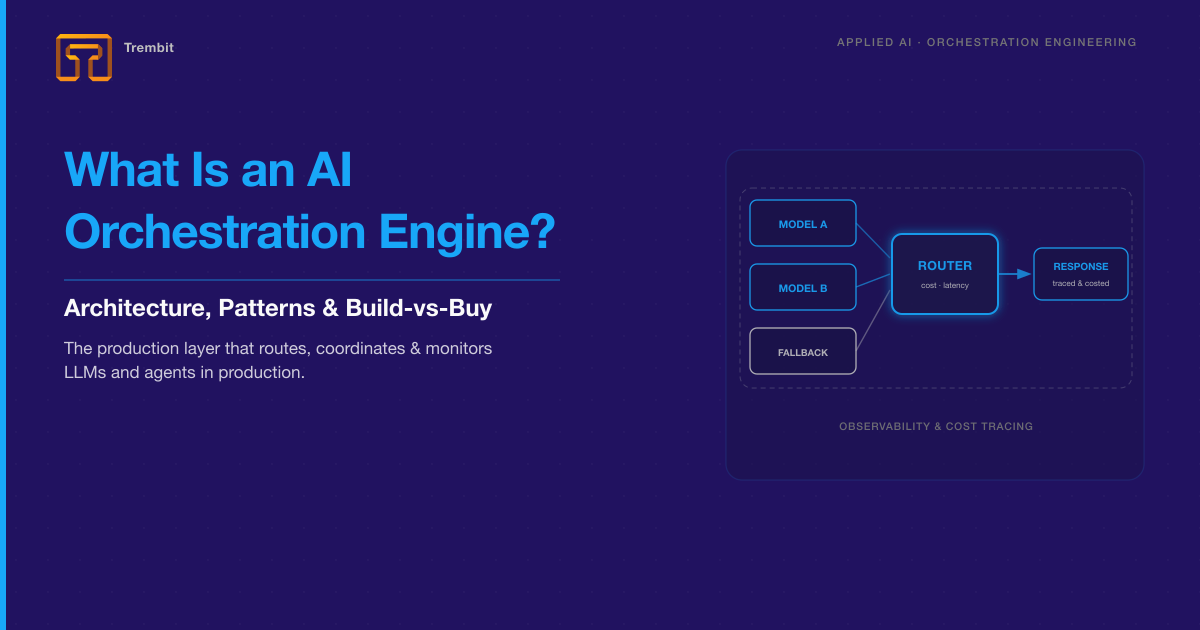
An AI orchestration engine is the production layer that sits between your application and its models. It routes each request to the right model, handles fallback and retries when one fails, manages the RAG and context pipeline, coordinates multi-step and multi-agent workflows, enforces guardrails, and gives your team observability and cost control across the whole system. Most engineers can call an LLM API in an afternoon. The orchestration engine is what makes that call reliable, traceable, affordable, and auditable at scale — the difference between an AI demo and an AI product.
Key takeaways
- An AI orchestration engine is the layer between an app and its models. It is not a single tool — it’s an architectural role that can be filled by a framework, a managed platform, or custom code.
- Its five core jobs: model routing, fallback/reliability, context and RAG management, multi-step or multi-agent coordination, and observability/cost control.
- “Orchestration platform” (a product you buy) and “orchestration engine” (the architectural layer, however built) are related but not identical — you can build the engine on top of a framework without buying a full platform.
- Build-vs-buy is a spectrum, not a binary: raw SDK calls → orchestration framework (LangGraph, LlamaIndex) → managed platform (Vertex AI Agent Builder, Microsoft Foundry Agent Service, Bedrock Agents) → fully custom engine.
- The orchestration layer is what turns an AI prototype into a system you can put in front of paying customers. In our experience, most production AI failures trace back to a missing piece of this layer, not the model itself.
What Is an AI Orchestration Engine, and Why Do Production AI Systems Need One?
An AI orchestration engine — sometimes called LLM orchestration — is the coordinating layer that turns individual model calls into a dependable system. In a prototype, an application calls one model with one prompt and returns whatever comes back. That works in a demo. It breaks in production, because production introduces conditions the demo never had: rate limits and provider outages, hallucinations on inputs nobody scripted, token bills that scale with usage instead of value, and multi-step chains that fail silently and keep running on bad state.
The orchestration engine is the layer that absorbs those conditions. It does five jobs. Model routing sends each request to the right model for the task, cost, and latency budget. Fallback and reliability detect failures and rate limits, retry, and switch to a secondary provider so one outage doesn’t take the feature down. Context and RAG management grounds answers in your own data instead of the model’s training cutoff. Multi-step and multi-agent coordination manages tool calls, hand-offs, and state across a chain so a broken step doesn’t poison the rest. And observability and cost control trace every request end to end — which model ran, what context it retrieved, what tool it called, how long it took, and what it cost.
None of this is exotic. It’s the same distributed-systems discipline you’d demand of any critical dependency, applied to a class of dependency — probabilistic models — that fails in less predictable ways than a database or an HTTP service. That’s the whole reason the category exists: in the systems we’ve shipped, the model is rarely the hard part. Making the model behave like production infrastructure is. It’s the same routing, fallback, and latency-budget discipline Trembit has applied to real-time video and voice systems that can’t fail since 2009 — and when that orchestration has to run inside a live call, a rarer problem we also solve, the budgets get tighter still.
What Is the Difference Between “AI Orchestration” and Just Calling an LLM API?
Calling an LLM API is one request to one model with no safety net: if the provider is down, the response is wrong, or the bill spikes, your application inherits the problem directly. AI orchestration is that same call wrapped in a system — routing logic that picks the model, a fallback path when the primary fails, context injected before the prompt, guardrails on the input and output, and a trace of everything that happened. Put simply: a raw API call gives you an answer; orchestration gives you an answer you can rely on, explain, and afford when a real user sends a real input at 2 a.m.
What Are the Core Components of an AI Orchestration Architecture?
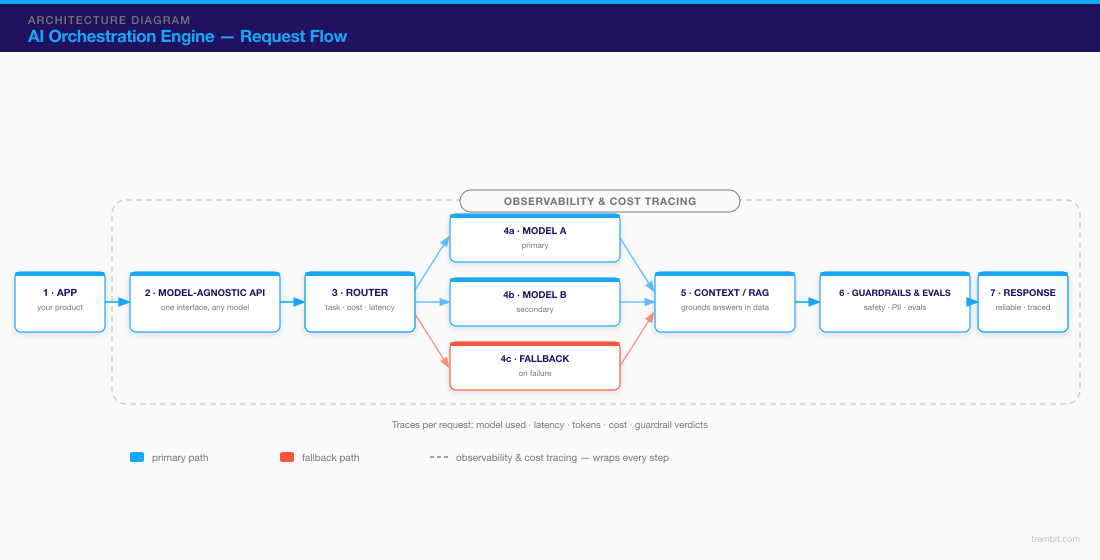
An orchestration architecture is usually described as a request flowing through five components: a router, a reliability/fallback layer, a context/RAG layer, a coordination layer for tools and agents, and a guardrails-and-observability layer wrapping the whole flow. Here is what each one does and why it matters.
Model Routing — How Does an Orchestration Engine Choose Which Model Handles a Request?
Routing decides which model answers a given request, based on task type, cost target, and latency budget. A classification task might go to a small, cheap, fast model; a complex reasoning task to a premium one; a request that needs a specific capability (vision, long context, function calling) to whichever model provides it best. Most routing setups define a primary model per task, plus a secondary and a fallback in a provider chain, so a request has somewhere to go when the first choice is unavailable. Routing is also a major lever for token savings — reserving expensive models for the work that actually needs them, though context-size management and caching are at least as large a cost lever in most systems. Routing policy and cost engineering are deep topics in their own right; we cover the mechanics of routing rules, provider fallback chains, and cost control in a dedicated article on AI platform architecture.
Fallback and Reliability — What Happens When a Model Is Down or Rate-Limited?
Fallback is what keeps a feature alive when a model returns a 429, times out, or the provider has an outage. The engine detects the failure, retries with backoff, and — if retries don’t clear it — routes to a secondary model or provider so the user still gets a result. Where a full answer isn’t possible, the system degrades gracefully: a simpler or slightly slower response instead of an error page. Retries carry one trap worth calling out: if a step already fired a side effect before it failed — charged a card, sent a notification, wrote to a downstream system — a naive retry double-fires it, so any retryable side effect needs an idempotency key or dedup check to stay safe to repeat. This is not an AI-specific invention. It’s the same reliability discipline you’d apply to any critical dependency — health checks, retries, circuit breaking, graceful degradation — applied to model providers, which happen to fail more often and less predictably than most services in your stack.
RAG and Context Management — How Does an Orchestration Engine Ground Answers in Real Data?
Retrieval-augmented generation (RAG) is how an orchestration engine makes a model answer from your data instead of guessing from its training set. The pipeline ingests source documents, chunks them, generates embeddings, stores them in a vector index, and — at query time — retrieves the relevant chunks, re-ranks them, and injects them into the prompt as context. Done well, it reduces hallucination and lets the model cite where an answer came from. RAG is also where orchestration stops being a pure AI problem and becomes an integration problem: the data usually lives in an ERP, a CRM, a data warehouse, or a document store, and connecting to those systems cleanly is often the larger share of the work. LlamaIndex is one widely used framework for this ingestion-and-retrieval layer (LlamaIndex docs).
Multi-Agent and Multi-Step Coordination — How Are Tool Calls and Hand-offs Managed?
Coordination is what keeps a chain of steps — or a set of cooperating agents — from falling apart. It covers planning and delegation between agents, tool and function calling, and state management across the chain, plus step-level error handling and timeouts so one failed call doesn’t corrupt everything downstream. Frameworks like LangGraph model this as a graph of steps with explicit, inspectable state (LangGraph docs), which is what makes a multi-step workflow debuggable instead of a black box. Note the boundary here: the agents themselves — their roles, prompts, and behavior — are a distinct topic from the layer that coordinates them. For the agents, see AI Agents; the production coordination and failure-mode patterns for multi-agent systems are the subject of a separate, deeper guide.
Guardrails, Evals, and Observability — How Do You Trust and Measure an AI System Over Time?
This is the layer that lets you run AI like a production system rather than a science experiment. Guardrails check inputs and outputs for safety, format, and PII before anything reaches a user — the OWASP Top 10 for LLM Applications catalogs the risks this layer is meant to contain, including prompt injection and sensitive-information disclosure. An eval harness scores prompt and model changes before release, so you catch a regression in staging instead of in production. Observability traces every request end to end — model, context, tools, latency, and cost — so a wrong answer becomes something you can replay, not guess at. And cost tracking with per-request attribution and budget ceilings keeps the token bill explainable. For the broader discipline of governing and measuring AI risk over a system’s life, the NIST AI Risk Management Framework is the authoritative reference.
What Are the Common AI Orchestration Patterns?
Most orchestration designs are a combination of a few recognizable patterns. Naming them makes an architecture easier to reason about and easier to hand off.
- Sequential / chain pattern. A fixed pipeline of steps runs in order — parse, then retrieve, then generate, then validate. Best when the workflow is deterministic and every request follows the same path.
- Router pattern. A first step classifies the request, then dispatches it to a specialist path or model. This is the pattern behind cost control (cheap model for easy queries, premium model for hard ones) and behind capability matching.
- Orchestrator-worker / multi-agent pattern. A coordinating agent breaks a task into sub-tasks and delegates them to specialist agents or tools, then assembles the results. Best for open-ended tasks where the steps aren’t known in advance — and the pattern most in need of the coordination and error-handling discipline described above.
- Human-in-the-loop pattern. A step pauses for human review or approval before the workflow proceeds — common wherever an AI action has real consequences (a financial decision, a clinical note, an outbound message). This is central to AI systems designed as an assistant that proposes and a human that approves, rather than full automation.
These patterns compose. A real system might route a request, run a sequential RAG pipeline for the common case, escalate the hard case to a multi-agent worker, and pause for human approval before acting. The orchestration engine is what holds that composition together.
Should You Build or Buy an AI Orchestration Platform?
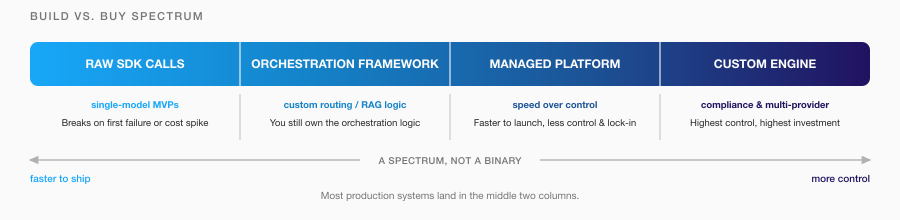
The honest answer is: it depends on how specific your requirements are, and most teams land in the middle of a spectrum rather than at either end. Build-vs-buy for orchestration is not a binary choice between “use a product” and “write everything from scratch.” It’s four points on a line, and the right one depends on how much control your routing, compliance, and cost requirements actually demand.
| Approach | Best for | Trade-off |
|---|---|---|
| Raw provider SDK calls | Very early prototypes, single-model MVPs | No routing, no fallback, no observability — breaks the first time a model fails or costs spike |
| Orchestration framework (LangChain, LlamaIndex, LangGraph, Semantic Kernel) | Teams that want control over routing/fallback/RAG logic without building primitives from scratch | You still write and own the orchestration logic; frameworks give scaffolding, not a finished platform |
| Managed orchestration platform (Vertex AI Agent Builder, Microsoft Foundry Agent Service, AWS Bedrock Agents) | Teams that want to move fast and can accept some platform lock-in | Faster to a working system; less control over routing internals, tracing detail, and cross-provider model-agnosticism |
| Fully custom orchestration engine | Teams with specific compliance, multi-provider, or cost-control requirements a framework or platform doesn’t fit | Highest control and lowest lock-in; highest engineering investment |
Most production systems settle into the two middle rows. A common shape is a framework for the orchestration logic with a managed service underneath for one piece — for example, using AWS Bedrock Agents (Bedrock Agents docs) or Vertex AI Agent Builder (Vertex AI Agent Builder) as the agent runtime, while writing custom routing and cost logic on top. “Always build custom” is rarely the right answer, and any vendor who leads with it is selling, not advising. Custom pays off specifically where a framework or platform can’t meet a hard requirement — strict data residency, a model mix no single platform supports, or cost-control logic the platform hides. If you’re weighing this decision and want a specific recommendation for your stack rather than a general spectrum, that’s exactly what a Trembit AI Architecture Review produces: a documented build-vs-buy recommendation for your specific architecture — which of the four approaches fits, where a framework or managed platform meets your routing, compliance, and cost requirements and where it won’t, with the trade-offs written down so your team can act on it.
Which AI Orchestration Frameworks and Platforms Should You Consider?
There is no single “best” orchestration tool — the useful question is which tool fits which job. Here is a neutral rundown of the frameworks and platforms most teams evaluate, cited to each project’s own documentation.
- LangChain — a general-purpose framework for composing LLM calls, tools, and memory into chains and applications (LangChain docs).
- LangGraph — a lower-level, graph-based framework from the LangChain team for stateful, multi-step, and multi-agent workflows with explicit control over state and branching (LangGraph docs).
- LlamaIndex — focused on the data/RAG side: ingestion, indexing, retrieval, and re-ranking to ground models in your own documents (LlamaIndex docs).
- Semantic Kernel — Microsoft’s SDK for orchestrating AI in application code, popular in.NET-centric stacks (Semantic Kernel docs); a known alternative Trembit does not standardize on, listed here for completeness.
- Vertex AI Agent Builder (Google Cloud) — a managed platform for building and running agents and orchestration on GCP (Vertex AI Agent Builder).
- Microsoft Foundry Agent Service (Microsoft; formerly Azure AI Foundry Agent Service) — Azure’s managed agent runtime with integrated identity, guardrails, and observability (Foundry Agent Service docs).
- AWS Bedrock Agents — a managed agent runtime on AWS with tool use and knowledge-base integration (Bedrock Agents docs).
Trembit works primarily with LangChain, LlamaIndex, and LangGraph, plus custom engines where frameworks don’t fit, and deploys against all three major clouds. The frameworks give scaffolding; the managed platforms trade some control for speed; the right combination depends on your existing stack and constraints, not on which tool is fashionable this quarter. If you need the full AI build around this layer — data, models, applications, and interfaces, not just orchestration — that’s our AI Development practice.
What Drives the Cost of Building an AI Orchestration Engine?
Cost is driven by scope, not by a fixed price, and it scales with a handful of specific decisions. The main drivers:
- Number of models and providers to support. A single-model system is far simpler than a model-agnostic layer that routes across OpenAI, Anthropic, Gemini, and self-hosted open-weight models with fallback between them.
- Whether you need RAG and context pipelines. Ingestion, embeddings, a vector store, retrieval, and re-ranking add a whole subsystem — and connecting it to your existing data sources is often the larger part of the effort.
- Multi-agent coordination complexity. A fixed sequential chain is cheaper to build and operate than a multi-agent system with delegation, tool use, and cross-step state management.
- Compliance requirements. Audit trails, data residency, PII handling, and guardrail depth all add engineering, and they cost far more when retrofitted under audit pressure than when architected in from the start.
- Observability tooling. Tracing, evals, cost dashboards, and budget alerting are the difference between a system you can operate and one you can only hope works.
We keep this driver-based on purpose — a realistic estimate comes from a scoping conversation about your actual requirements, not from a price on a web page. (The cost of building an AI agent specifically is a separate topic we treat on its own.)
Where Does AI Orchestration Run in a Live Video or Voice Product?
Everything above describes orchestration for typical request/response and agentic workflows, where “reliable” means correct routing, fallback, and traceability on API calls. When AI runs inside a live call — a voice agent with barge-in, real-time captioning, in-call moderation — the constraints change. Now you’re working against hard real-time latency budgets and integrating with the media path itself, not just the reliability of an API request. That’s a different engineering problem with a different playbook. If your product puts AI inside a live audio or video session, see Trembit’s work on AI orchestration for real-time voice and video.
How Does Trembit Approach AI Orchestration?
Trembit builds the orchestration layer as a distributed-systems problem first and an AI problem second — routing, fallback, timeouts, state, and latency budgets are disciplines the team has applied to real-time systems since 2009. We’re model-agnostic by design: the whole point of the orchestration layer is that you can switch models when pricing, quality, or availability changes without rewriting your application. This is infrastructure teams commit to for years, which is how Trembit tends to work — many client engagements run one to three years or longer, past the launch and into the operating life of the system. Tracing, evals, guardrails, and cost control go in as the system is built, not bolted on after launch. Where a project is regulated, that same discipline extends to compliance: Trembit has built HIPAA- and GDPR-compliant systems and holds KBV certification for psychotherapy telemedicine, so guardrails, audit trails, and data residency can be architected in from the start rather than retrofitted under audit pressure. (The fintech engagement below is an orchestration-and-monitoring example, not a compliance one.)
Proof point — Eska (FinTech leasing). For Eska’s leasing-risk platform, Trembit built a Node.js orchestration and API layer coordinating a multi-service AI pipeline: Python NLP/ML services that parse unstructured leasing contracts, a predictive risk-scoring engine, and automated decision routing — all integrated with the client’s Odoo ERP. The system includes model-performance monitoring, automated retraining triggers when accuracy drifts, and shadow / A-B deployment so a new model is validated against live traffic before it takes over. It’s a concrete example of orchestrating an ML pipeline with monitoring and safe model rollout, not a slide. (Read the Eska case study.) In a separate aviation-sector multimodal AI engagement, the team orchestrated a real-time multimodal model with dynamic context injection and a vector-based validation guardrail — evidence that the same discipline extends to multimodal, lower-latency orchestration.
If you’re moving an AI prototype into production, Trembit’s AI orchestration team can review your architecture and give you a documented build-vs-buy recommendation — see AI orchestration services.
FAQ
What is an AI orchestration engine?
An AI orchestration engine is the production layer between an application and the AI models it uses. It routes each request to the appropriate model, retries and falls back to a secondary provider when one fails or is rate-limited, manages the retrieval and context (RAG) pipeline that grounds answers in your data, coordinates multi-step and multi-agent workflows, enforces guardrails on inputs and outputs, and traces every request for observability and cost control. It is best understood as an architectural role rather than a single product — the layer that makes model calls reliable, explainable, and affordable at production scale.
What is the difference between an AI orchestration engine and an AI orchestration platform?
The terms are related but not identical. An orchestration engine is the architectural layer or role — the coordinating logic between your app and its models — however it happens to be built. An orchestration platform is a specific product that can fill that role: an open-source framework like LangGraph or LlamaIndex, or a managed service like Vertex AI Agent Builder or AWS Bedrock Agents. You can have an orchestration engine without buying a dedicated platform — for example, by writing custom routing and fallback logic on top of a lightweight framework. The engine is the “what”; the platform is one possible “how.”
Do I need an AI orchestration engine if I’m only using one model?
Often, yes — the need scales with production criticality, not with how many models you use. A single-model MVP still in testing may not need one. But a single-model system serving real customers usually benefits from fallback (a secondary provider or a degraded mode when the primary is down), guardrails on inputs and outputs, and per-request cost tracking. A one-model production feature with no fallback goes fully offline the first time that provider has an outage, and no observability means every wrong answer is a guess. Model count is the wrong metric; how much it costs you when the AI misbehaves is the right one.
What’s the difference between AI orchestration and workflow automation (RPA)?
Workflow automation and RPA execute deterministic, rule-based steps — the same input always produces the same output, and the failure modes are predictable. AI orchestration coordinates probabilistic model calls and agent decisions, which means it must handle non-deterministic failure modes that RPA never faces: hallucination, ambiguous or malformed tool calls, and outputs that are plausible but wrong. Orchestration therefore leans heavily on guardrails, evals, and fallback in ways deterministic automation doesn’t. The two also compose — an orchestration engine can call an RPA workflow as one deterministic step. (We treat the full AI-workflow-automation-versus-RPA comparison as a separate topic in its own right.)
Should I use a framework like LangChain or LangGraph, or build a custom orchestration engine?
It depends on how specific your requirements are, and it’s a spectrum rather than a binary. A framework gives you scaffolding and keeps you in control of routing, fallback, and RAG logic without building the primitives yourself. A managed platform trades some of that control for speed to a working system. A fully custom engine makes sense when you have hard requirements a framework or platform can’t meet — strict data residency, a specific multi-provider model mix, or cost-control logic the platform hides. Most teams end up in the middle: a framework, sometimes with a managed service underneath for one component. The fastest way to a specific answer is an AI architecture review of your actual stack.
What Should You Do Next?
The orchestration layer is what turns a working AI prototype into a production system — the difference between a model call that works in a demo and one that stays reliable, traceable, and affordable when real users hit it. Whether you build on a framework, adopt a managed platform, or engineer a custom layer, the five jobs stay the same: routing, fallback, context, coordination, and observability. If you’re making that build-vs-buy call now, talk to an AI engineer about your orchestration architecture through Trembit’s AI orchestration team.