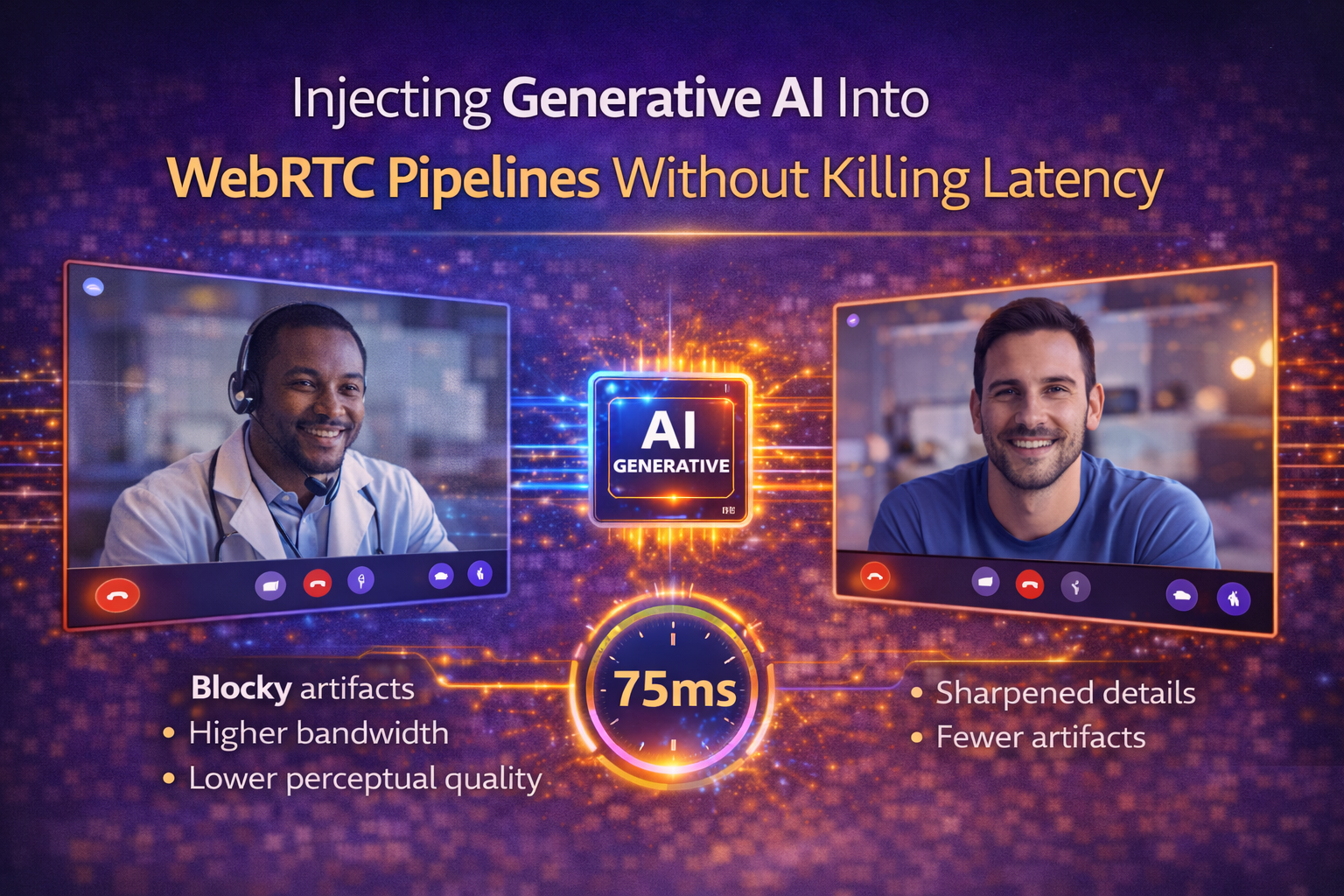
Real-time communication demands split-second responsiveness. A video call feels natural when latency stays below 300 milliseconds. Exceed 500 milliseconds, and conversations become awkward — speakers talk over each other, pauses feel unnatural, and engagement drops. These tight latency constraints created a problem when generative AI entered the picture.
The OpenAI Realtime API’s WebRTC integration enables developers to build AI voice agents with sub-300ms latency for natural conversations. This represents a fundamental shift in how real-time communication platforms can leverage AI capabilities. In 2026, the question is no longer whether to integrate AI into WebRTC applications, but how to do it without destroying the low-latency experience users expect.
The challenge is architectural. Adding generative AI to a media pipeline means injecting Speech-to-Text transcription, Large Language Model inference, and Text-to-Speech synthesis into a system that was optimized for direct peer-to-peer communication. Each component adds latency. The cumulative effect can easily push total delay beyond acceptable thresholds, turning a smooth conversation into a frustrating exercise in waiting.
The AI Latency Stack
Understanding where latency accumulates is the first step toward managing it. A traditional WebRTC call is straightforward: capture audio, encode it, transmit over the network, decode it, and play it back. Total latency for a well-optimized setup runs 60-150 milliseconds, depending on network conditions.
Adding AI transforms this simple pipeline into something far more complex. The original audio stream must be transcribed into text by an Automatic Speech Recognition system. The transcript feeds into one or more AI models that generate an appropriate response. The response goes into a Text-to-Speech system that vocalizes it back to the user. A study on Timing in Conversation shows that speakers typically start responding within 200 milliseconds after another speaker finishes.
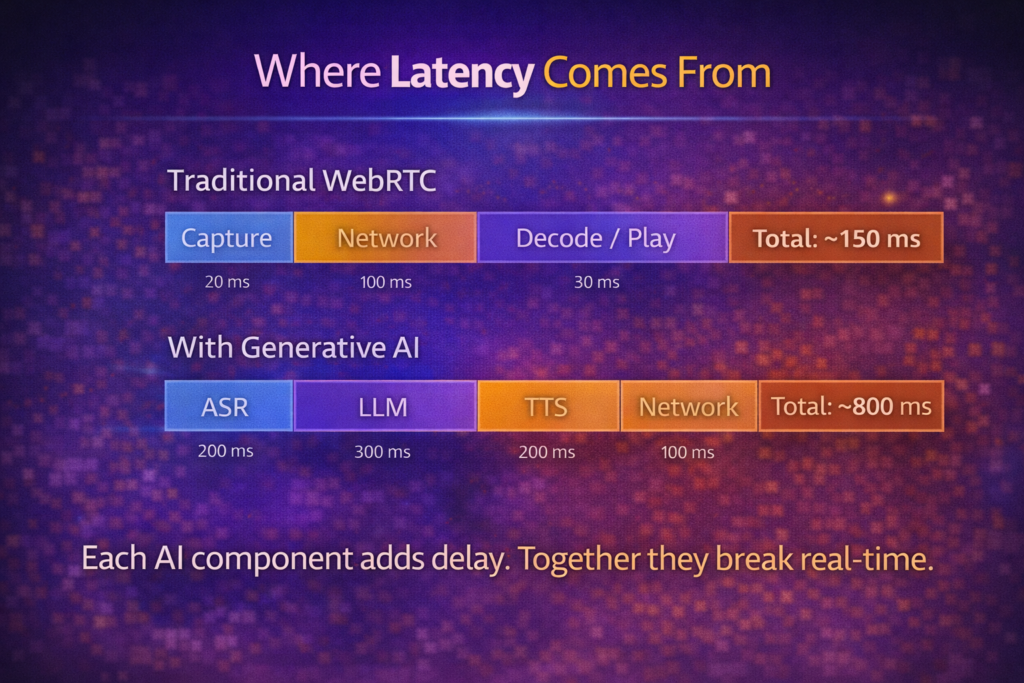
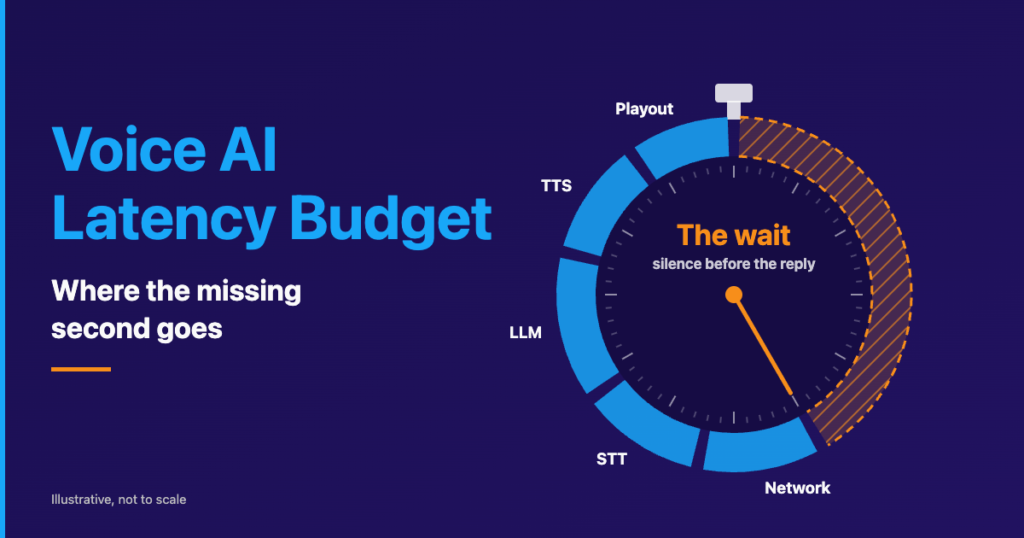
Each stage contributes latency. ASR systems need sufficient audio context to transcribe accurately, typically 100-500 milliseconds of speech. LLM inference time varies dramatically based on model size and prompt complexity, ranging from 50 milliseconds for small models with short prompts to several seconds for large models generating lengthy responses. TTS synthesis adds another 100-300 milliseconds to convert generated text into natural-sounding speech. Network transmission contributes its own overhead, particularly when AI processing happens on remote servers rather than locally.
The math is brutal. Even optimistically estimating 200ms for ASR, 300ms for LLM inference, 200ms for TTS, and 100ms for network round-trips yields 800 milliseconds total — well beyond the threshold for natural conversation. Production systems routinely measure total latencies of 1-3 seconds when using sequential AI pipelines, making real-time interaction impossible.
Inline Versus Sidecar Architecture
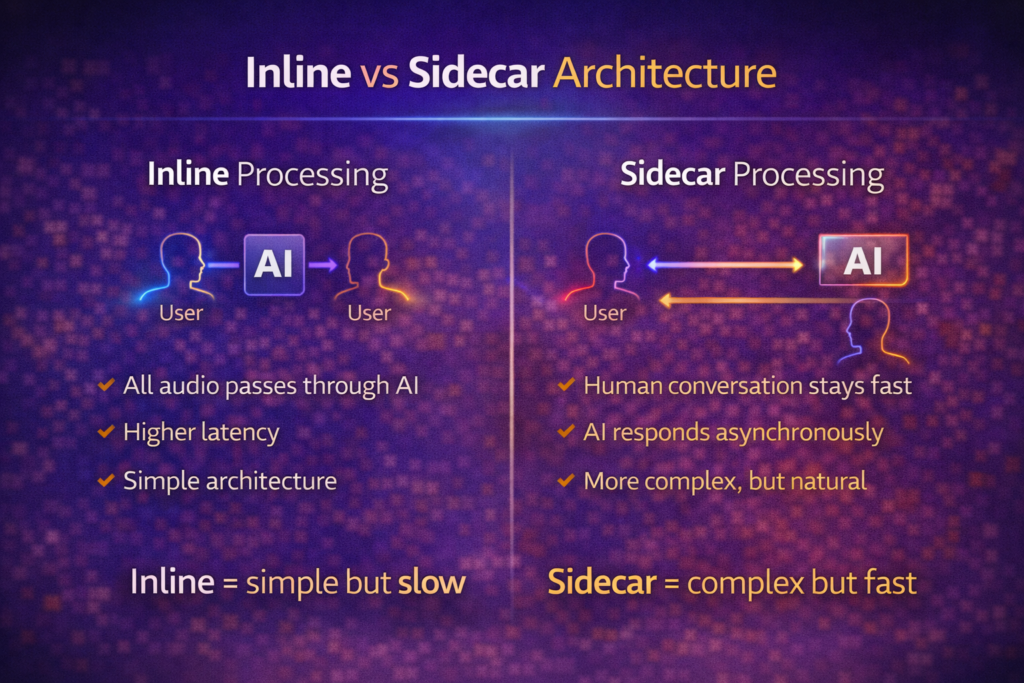
The first major architectural decision is where AI processing sits relative to the main media flow. Two patterns have emerged: inline processing and sidecar processing.
Inline architecture places AI directly in the media pipeline. Audio flows from the sender, through the AI processing stack (ASR → LLM → TTS), and out to receivers. This approach is conceptually simple and ensures all participants receive AI-processed audio. It’s appropriate for applications where AI should respond to every utterance — for example, real-time translation services where all speech must be translated before forwarding.
However, inline processing creates a critical path dependency. Every millisecond of AI processing directly adds to perceived latency. If the LLM takes 500ms to generate a response, participants wait 500ms before hearing anything. This approach only works when AI processing can be guaranteed to complete within acceptable latency bounds.
Sidecar architecture runs AI processing parallel to the main media flow. The original WebRTC session continues with its normal low latency while AI components subscribe to audio streams, process them asynchronously, and inject results as separate media tracks or data channel messages. Participants hear each other with normal WebRTC latency while AI-generated responses arrive separately.
This architecture decouples AI processing time from user-to-user communication latency. Two humans can have a natural conversation while an AI assistant listens and contributes when it has something to say, similar to how a human participant would behave in a group call. The tradeoff is increased architectural complexity—the system must manage multiple concurrent streams and handle synchronization between human speech and AI responses.
Hybrid Approaches
Production systems often use hybrid architectures that combine elements of both patterns. For instance:
Fast Path / Slow Path Splitting: Route simple queries through a fast inline pipeline using small, optimized models. Send complex queries to a sidecar pipeline with more capable but slower models. This ensures common cases maintain low latency while still handling edge cases that require more sophisticated reasoning.
Streaming with Progressive Response: Use sidecar architecture but begin playing back AI responses before they’re fully generated. As the LLM produces tokens, it immediately synthesizes and plays back the corresponding audio. This reduces perceived latency even when total inference time is long.
Selective Inline Processing: Only inject AI inline when explicitly requested by users (a “push to translate” button, for example). Normal conversation flows through unmodified WebRTC while AI processing activates on demand.
The choice between inline, sidecar, and hybrid approaches depends on application requirements, acceptable latency thresholds, and whether AI must process every utterance or can contribute selectively.
| Architecture Pattern | User-User Latency | AI Response Latency | Complexity | Best Use Case |
| Inline Sequential | High (+800-3000ms) | Matches user-user | Low | Full AI mediation required |
| Inline Streaming | Medium (+200-500ms) | Starts early | Medium | Real-time translation |
| Sidecar Async | Low (baseline) | Independent | High | AI assistant/copilot |
| Hybrid Fast/Slow | Low-Medium | Adaptive | Very High | Variable query complexity |
GPU Scheduling: The Hidden Bottleneck
Modern AI processing relies heavily on GPU acceleration. ASR models, LLMs, and TTS engines all run faster on GPUs than CPUs, often by orders of magnitude. However, GPUs were designed for graphics rendering, not real-time AI inference. NVIGI pipelines run asynchronously to frame generation, with latency requirements dictated not by human visual perception (measured in milliseconds), but by how fast humans listen, think, and speak (measured in hundreds of milliseconds).
The challenge is GPU scheduling. When multiple workloads compete for GPU resources — video encoding/decoding for WebRTC, AI model inference, and potentially other application tasks — the GPU scheduler must decide which work to prioritize. Poor scheduling decisions can cause AI inference to wait for video processing to complete, adding hundreds of milliseconds of latency.
Commodity GPUs lack efficient preemptive scheduling support. Once a GPU kernel starts executing, it typically runs to completion before the GPU can switch to other work. For long-running inference tasks, this creates head-of-line blocking where real-time workloads must wait for batch processing to finish.
GPU Scheduling Strategies
Several approaches can optimize GPU scheduling for mixed WebRTC and AI workloads:
Stream-Based Prioritization: Modern GPU APIs support multiple execution streams with different priorities. Assign real-time AI inference to high-priority streams and less time-sensitive work to low-priority streams. The GPU scheduler will preempt low-priority work when high-priority work arrives, reducing latency for critical inference tasks.
Kernel Batching: Instead of launching individual inference requests as separate GPU operations, batch multiple requests together. This amortizes kernel launch overhead and improves GPU utilization. However, batching introduces latency — requests must wait for a batch to fill before processing begins. Dynamic batching algorithms balance latency against throughput by adjusting batch size based on current load.
Async Compute: Leverage asynchronous compute capabilities to overlap AI inference with video processing. NVIGI’s GPU scheduling uses D3D async compute for D3D plugins and CUDA in Graphics for CUDA plugins, taking advantage of a driver interface for setting relative priorities of CUDA vs D3D graphics workloads. This allows AI and media processing to run truly concurrently rather than serially.
Model Partitioning: Split large AI models across CPU and GPU. Run lightweight components (tokenization, simple transformations) on CPU while reserving GPU for computationally intensive operations (attention mechanisms, large matrix multiplications). This reduces GPU contention and allows CPU and GPU to work in parallel.
Inference Caching: Cache inference results for common inputs. When a user asks a frequently asked question, return the cached response immediately rather than running inference again. This effectively reduces the number of GPU inference operations, leaving more capacity for unique queries.
Production implementations often combine multiple strategies. A real-time translation service might use high-priority streams for active speakers, batch inference requests from listeners who aren’t currently speaking, and cache translations for common phrases.
Async Inference: Breaking the Sequential Chain
The most impactful optimization for reducing AI latency in WebRTC applications is breaking the sequential ASR → LLM → TTS pipeline into parallel, overlapping operations.
Traditional pipelines wait for each stage to complete before starting the next. The ASR system must finish transcribing an entire utterance before the LLM can begin processing it. The LLM must generate a complete response before TTS can start synthesizing speech. This sequential processing guarantees maximum latency — the sum of all component latencies.
Async inference eliminates these dependencies through streaming and parallelization. Modern ASR systems can produce incremental transcripts as speech arrives rather than waiting for silence to indicate utterance completion. Modern real-time AI systems coordinate through WebRTC transport which provides low-latency bidirectional streaming, allowing listening, thinking, and speaking to happen in parallel, not in sequence.
Streaming ASR
Instead of waiting for a complete utterance, streaming ASR emits partial transcripts as confidence increases. After 100ms of speech, it might output “I think…” After 200ms: “I think that we…” After 300ms: “I think that we should…” The LLM can begin processing these partial transcripts immediately rather than waiting for the complete sentence.
This introduces new challenges. Partial transcripts are often wrong — “recognize speech” might initially transcribe as “wreck a nice beach” before correcting itself. The LLM must handle corrections gracefully, potentially revising its reasoning as the transcript stabilizes. However, the latency reduction is substantial — the LLM can begin inference 200-400ms sooner than with batch-mode ASR.
Progressive LLM Inference
Large language models generate responses token by token. A response like “I recommend reviewing the financial reports” is produced sequentially: “I” → “recommend” → “reviewing” → “the” → “financial” → “reports”. Traditional systems wait for the entire response before proceeding to TTS.
Streaming LLM APIs expose this token-by-token generation, allowing downstream systems to begin processing before the response completes. The biggest unlock was letting the model start talking as soon as it “knows enough,” not waiting for full reasoning; streaming partials cut perceived latency more than any codec tweak.
Chunked TTS
Modern TTS systems can synthesize audio from partial text inputs. Instead of waiting for the complete LLM response, TTS begins as soon as the first few words are available. By the time the LLM generates the second half of its response, TTS is already playing back the first half.
This chunking must be done carefully. Cutting text at arbitrary points can produce unnatural prosody. Production implementations identify safe chunking boundaries — typically at punctuation marks or natural phrase boundaries — to maintain speech quality while minimizing latency.
The Async Inference Pipeline
Combining streaming ASR, progressive LLM inference, and chunked TTS creates an async inference pipeline where all components run in parallel:
- 100ms: First audio chunk arrives, streaming ASR begins processing
- 150ms: Partial transcript “I need to…” available, LLM begins inference
- 200ms: LLM generates first token “You”, TTS begins synthesis
- 250ms: More transcript arrives “I need to schedule…”, LLM updates reasoning
- 300ms: First synthesized audio chunk plays back to the user
- 500ms: Complete utterance transcribed, LLM finalizing response
- 600ms: Full response synthesized and playing
The user hears the AI begin responding after 300ms rather than waiting 600ms+ for the sequential pipeline to complete. This halving of perceived latency makes the difference between conversational and unusable.
Practical Implementation Patterns
Successfully deploying AI-enhanced WebRTC requires careful attention to implementation details. These patterns have proven effective in production deployments:
Voice Activity Detection (VAD) Gating
Not all audio requires AI processing. Silence, background noise, and non-speech sounds consume processing resources without producing useful results. Voice Activity Detection distinguishes speech from non-speech audio, allowing systems to activate AI processing only when someone is actually speaking.
Modern VAD algorithms achieve very low latency — typically 10-30ms to detect speech onset. By gating AI processing behind VAD, systems avoid wasting GPU cycles on silence and reduce average latency by skipping processing entirely when users aren’t speaking.
Barge-In Handling
Natural conversation involves interruptions. One participant starts speaking before another finishes. Sequential AI pipelines struggle with this pattern — if the AI is generating a response when the user interrupts, should it continue or stop?
Barge-in matters; let users interrupt and send the new audio right away: it makes the assistant feel alive. Production implementations monitor for speech onset while the AI is responding. When detected, they immediately:
- Cancel in-progress LLM generation
- Stop TTS playback
- Reset the inference pipeline
- Begin processing the new user input
This requires coordination across all pipeline components and adds significant implementation complexity, but it’s essential for natural interaction.
Multi-Model Strategies
Different queries require different model capabilities. Simple questions (“What time is it?”) can be answered by small, fast models. Complex questions (“Analyze this medical image and provide a differential diagnosis”) require larger, more capable models.
Multi-model strategies route queries to appropriate models based on detected complexity:
- Intent classification models (very fast, <10ms) categorize incoming queries
- Simple intents route to small local models (50-100ms inference)
- Complex intents route to large cloud models (300-1000ms inference)
- Hybrid intents start with fast models and escalate to larger models if needed
This approach optimizes for the common case — if 80% of queries can be handled by fast models, average latency drops dramatically even though complex queries take longer.
Adaptive Quality Management
Network conditions and device capabilities vary across participants. A powerful desktop with fast internet can handle more sophisticated AI processing than a mobile device on a marginal connection.
Adaptive quality management detects client capabilities and adjusts AI processing accordingly:
- High-capability clients receive full AI processing with large models
- Medium-capability clients use smaller models or reduced processing
- Low-capability clients fall back to server-side processing or minimal AI
This ensures everyone gets the best experience their environment supports, rather than forcing everyone to the lowest common denominator.
Monitoring and Optimization
Real-time AI systems require continuous monitoring to maintain latency targets. Key metrics include:
Component-Level Latency: Measure ASR latency, LLM inference time, and TTS synthesis time separately. This identifies bottlenecks and informs optimization priorities.
End-to-End Latency: Track total time from speech onset to AI response playback. This is what users actually experience.
GPU Utilization: Monitor GPU usage patterns to identify scheduling inefficiencies or resource contention.
Quality Metrics: Track transcription accuracy, LLM response relevance, and TTS naturalness. Optimizing for latency without maintaining quality degrades user experience.
Percentile Analysis: Mean latency hides problems. Track 50th, 90th, 95th, and 99th percentile latencies to understand tail behavior.
Production systems often implement per-client latency budgets. If a client consistently exceeds latency targets, the system automatically degrades to simpler models or reduces processing until performance recovers. This prevents isolated performance issues from degrading the entire application.
Building AI-Enhanced Communication Platforms
Integrating generative AI into WebRTC applications requires expertise across multiple domains: real-time media processing and WebRTC internals, AI model optimization and deployment, GPU programming and scheduling, distributed systems architecture, and continuous performance optimization.
Trembit brings comprehensive expertise in building advanced real-time communication platforms that leverage AI capabilities without sacrificing performance. The team has deep experience in WebRTC implementations, AI model integration, and the architectural patterns needed to maintain sub-300ms latency while enabling sophisticated AI features.
Trembit works with organizations to design and implement AI-enhanced communication solutions that balance innovation with usability. From architecture design and model selection through deployment and ongoing optimization, Trembit provides the technical depth needed to successfully integrate AI into real-time applications. The approach emphasizes practical results — delivering measurable improvements in functionality while maintaining the low-latency experience users expect.
Whether building a new AI-powered communication platform or adding AI capabilities to an existing WebRTC application, Trembit can help navigate the complex tradeoffs between latency, functionality, and resource usage. The team provides guidance on architecture patterns, model selection, GPU optimization, and implementation strategies that work in production environments with real users.
The Path Forward
The integration of generative AI into real-time communication platforms represents a fundamental shift in how these systems operate. The technical challenges are significant, but the patterns and tools needed for success exist today. The infrastructure for real-time AI agents exists now: streaming architectures, WebRTC transport, and Realtime LLMs that skip transcription entirely.
Success requires treating latency as a first-class requirement rather than an afterthought. Systems must be designed from the ground up for async processing, progressive response, and parallel execution. The sequential pipelines that work for offline AI processing simply cannot meet the latency requirements of real-time communication.
The organizations that successfully integrate AI into WebRTC applications will enjoy significant competitive advantages. AI-enhanced features like real-time translation, intelligent transcription, and conversational agents can differentiate products in crowded markets. However, these features only provide value if they work within the latency constraints users expect.
The future of real-time communication is AI-enhanced, but only for platforms that solve the latency challenge. The technical patterns exist. The infrastructure is available. What remains is execution — building systems that deliver AI capabilities while maintaining the sub-300ms responsiveness that makes real-time communication feel natural.
Building an AI-enhanced communication platform? Trembit’s team has extensive experience integrating generative AI into WebRTC applications while maintaining low latency. Reach out to discuss your AI integration challenges and learn how to deliver sophisticated AI features without sacrificing the real-time experience users demand.