By Trembit Engineering Team · Last updated: 2026-07-08
An AI agent is a system built around a large language model that can take actions — call tools, read and write to your real systems, and decide the next step — instead of only generating text in reply to a prompt. The defining feature isn’t intelligence; it’s agency: the ability to act, not just answer. This piece looks at AI agents for business — specifically the business and back-office kind that read a document, update a record, or route a request. Real-time voice agents that talk to customers on a live call are a separate discipline, and not our subject here.
Key takeaways
- An AI agent acts — it reads, decides, calls tools, and updates systems. A chatbot only answers. That single distinction — agency — is the whole category.
- Agents are a strong fit for high-volume, pattern-following work that mixes reading, light judgment, and decision-making: triage, document processing, drafting, and routing.
- Agents are a poor fit for open-ended, high-stakes, or rarely-repeated decisions where a wrong autonomous action is expensive and hard to reverse.
- The gap between an impressive demo and a production agent is almost entirely engineering discipline — grounding in real data (RAG), integration into real systems, human-in-the-loop checkpoints, and an audit trail — not a smarter model.
- “Autonomous” is a spectrum, not a switch. Production agents earn autonomy incrementally, starting with propose-and-approve and widening scope only as they prove reliable.
What is an AI agent, and how is it different from a chatbot or RPA?
Three tools get lumped together in AI pitches, and they are not the same thing.
A chatbot answers. You send a message, it generates a reply. It can be very good at that — but it does not reach into your CRM, move a file, or change a record. When the conversation ends, nothing in your business has changed.
RPA (robotic process automation) acts, but only on rigid rules and clean, structured input. It clicks the button, copies the field, pastes it in the next screen — reliably and fast, as long as the input arrives in exactly the shape it expects. Change the form layout or hand it a free-text email, and it stalls.
An AI agent acts on messy, unstructured input using judgment. It reads the scanned contract, decides which cases it can handle and which it can’t, calls the right system to update a record, and escalates the ambiguous ones to a person. The reasoning happens in language, not in hard-coded field positions, which is why it survives inputs that break a rules engine — and why it needs guardrails a rules engine doesn’t.
Put simply: a chatbot talks, RPA follows a script, and an agent does the work that used to require a person to read something and make a call.
What does “agentic” actually mean?
Concretely, agency means three things: tool use (the agent can call functions and APIs to read and write in real systems), context across steps (it carries state through a multi-step task instead of treating each message as isolated), and autonomous next-step decisions within defined bounds (it chooses what to do next rather than waiting for you to spell out each move).
Here’s the honest caveat the vendor blogs skip: much of what’s marketed as “agentic AI” today is a single tool-call loop — a chatbot with one plugin — not a system that plans and acts across many steps. Gartner has a name for the broader version of this problem, “agent washing”: rebranding assistants, RPA, and chatbots as agents without real agentic capability, and it estimates only about 130 of the thousands of self-described agentic vendors are the real thing. When you evaluate a tool, ask what it actually does between your prompt and the result. If the answer is “generates text,” it’s a chatbot, whatever the label says.
What can AI agents for business actually automate today?
The reliable wins share a shape: high volume, a repeating pattern, reading and light judgment, and a human able to catch a bad output before it does damage. Notably, when MIT’s NANDA initiative surveyed enterprise AI deployments, it found the biggest measurable ROI wasn’t in flashy sales and marketing tools — it was in back-office automation, the unglamorous operational work. (That study measures broader generative-AI adoption, not agents specifically, but the direction holds.) That matches what we see in production. The categories below are where agents earn their keep today.
Document intake and classification. An agent reads incoming emails, PDFs, forms, and scanned files, works out what each one is, and sorts it — an invoice here, a support request there, a contract to the review queue. This is the single most common production pattern we build.
Request triage and routing. The agent reads an inbound request, decides which team or workflow it belongs to, and sends it there with a reason attached — instead of a person manually sorting a shared inbox all morning.
Drafting for human approval. The agent writes the first draft — a support reply, a summary, a record update — and a person approves, edits, or rejects it before anything is sent. The human stays in control of the outcome; the agent removes the blank-page work.
Data extraction and validation from unstructured sources. Pulling payment terms out of a contract, line items off a scanned receipt, or key fields out of a free-text note — then checking those values against expected ranges and flagging anything that looks off. This is the part traditional automation simply can’t do.
Record updates in existing systems, with an audit trail. Writing the extracted or approved result back into your CRM, ERP, or ticketing tool through its API — every action logged, so you can see later exactly what the agent changed and why.
Internal knowledge retrieval (grounded Q&A). An agent that answers staff questions from your own documents, policies, and handbooks — retrieving the relevant passage at query time and citing it, instead of guessing from a model’s general memory. The grounding is what makes the answer trustworthy.
None of these replace a role. Each one removes the repetitive slice of a role, so skilled people spend their time on the cases that actually need them.
What do AI agents still NOT reliably do — and where does the hype outrun the reality?
This is the part vendor content leaves out. If you’re deciding whether to invest, these limits matter more than the capability list.
Fully autonomous action on consequential, irreversible decisions. Financial approvals, medical judgments, legal commitments — an agent should not commit these on its own in current production practice. Not because the model can’t produce an answer, but because a confidently wrong action that sends money, denies care, or signs something is expensive and hard to unwind. These need a human checkpoint, by design.
Novel, rarely-repeated situations. Agents pattern-match against what they’ve seen in training and in the context you give them. Hand one a genuinely new case — a situation outside that pattern — and it won’t reason its way to the right answer the way a skilled human draws on judgment and experience. Agents are strongest exactly where the work repeats; they’re weakest where every case is different.
Anything requiring accountability nobody can audit. In a regulated workflow, “the agent decided” is not a defensible answer. If there’s no logged trail of what the agent saw, what it decided, and who approved it, the automation is a liability regardless of how well it performs. The audit trail isn’t paperwork bolted on afterward — it’s a precondition for letting the agent act at all.
Long-horizon, multi-day autonomous planning with no checkpoints. Reliability degrades over long chains of actions. Each step carries a small chance of a wrong turn, and those compound. Agents that run reliably in production tend to work in bounded loops with checkpoints, not open-ended multi-day missions with no one watching.
Acting safely on untrusted input without a threat model. An agent that reads incoming emails, PDFs, and scanned documents and can then write to your CRM or ERP is exposed to prompt injection — hidden instructions planted in a document that hijack the agent into taking an action it shouldn’t. This is the #1 risk in the OWASP Top 10 for LLM Applications, and it’s specific to exactly the architecture this piece describes: untrusted text feeding a system with write access to real tools. It doesn’t make agents unusable — it makes an untrusted-input threat model (input validation, least-privilege tool scopes, human approval on write actions) a precondition, not an afterthought. An agent that reads the outside world and writes to your systems with no defense against adversarial input is a security incident waiting to happen.
Replacing a role wholesale. The failure mode we see most often is scope. A team sets out to build a “do everything” agent for an entire job function, and it fails in production the same way the failed chatbot pilot did — impressive in the demo, unreliable on real inputs, trusted by no one. The agents that survive do one narrow, well-bounded job. Ambition about scope is the most common way these projects die.
Gartner projects that over 40% of agentic AI projects will be canceled by the end of 2027, citing escalating costs, unclear business value, and inadequate risk controls. That’s not an argument against agents. It’s an argument against building the wrong one.
Why do so many AI agent pilots fail to reach production?
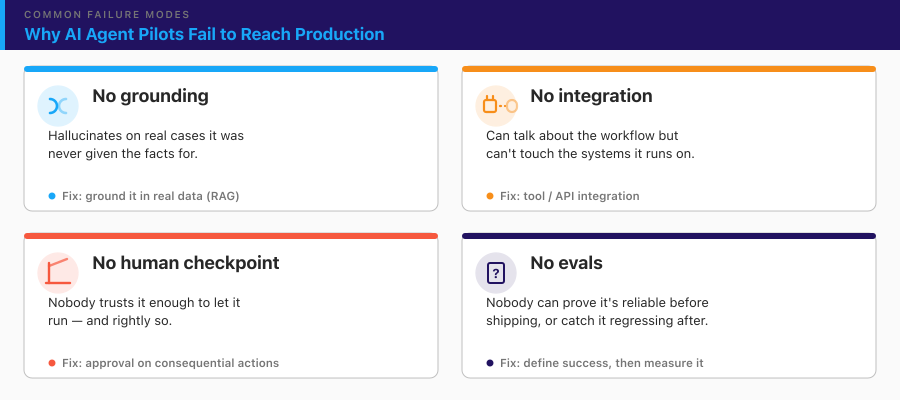
Mostly a handful of recurring reasons, and the first four come up in almost every stalled pilot.
No grounding. The agent runs on the model’s general knowledge instead of your actual data, so it hallucinates the moment it hits a real case it was never given the facts for. Retrieval over your own documents (RAG) is the biggest lever against this — and it’s the step teams skip.
No integration. The agent can talk about the workflow but can’t touch the systems it runs on. A model that can describe how to update the CRM but can’t actually update it is a demo, not a deployment. The hard part was never the model — it’s the connectivity.
No human checkpoint. Without approval steps on the actions that matter, nobody trusts the agent enough to let it run — and rightly so. An agent with no checkpoints and no guardrails is either unused or dangerous.
No evals. Nobody defined what “done right” looks like, so nobody can prove the agent is reliable before it ships or catch it regressing after. If you can’t measure it, you can’t trust it, and you certainly can’t defend it.
Cost and latency at production volume. A pilot that looks cheap on a hundred test documents can become uneconomic at a hundred thousand. Every document may take several LLM calls where a deterministic script would take none, and each call adds cost and seconds of latency that compound at scale. Teams that never model per-unit run cost against the volume they actually process — or against the RPA license they already pay for — discover in production that the economics don’t work, even though the agent does.
Notice that none of these is “the model wasn’t smart enough.” A better model doesn’t fix an ungrounded, unintegrated, unmeasured, or uneconomic pilot. Engineering discipline does.
AI agents vs. RPA vs. chatbots — what’s the difference in practice?
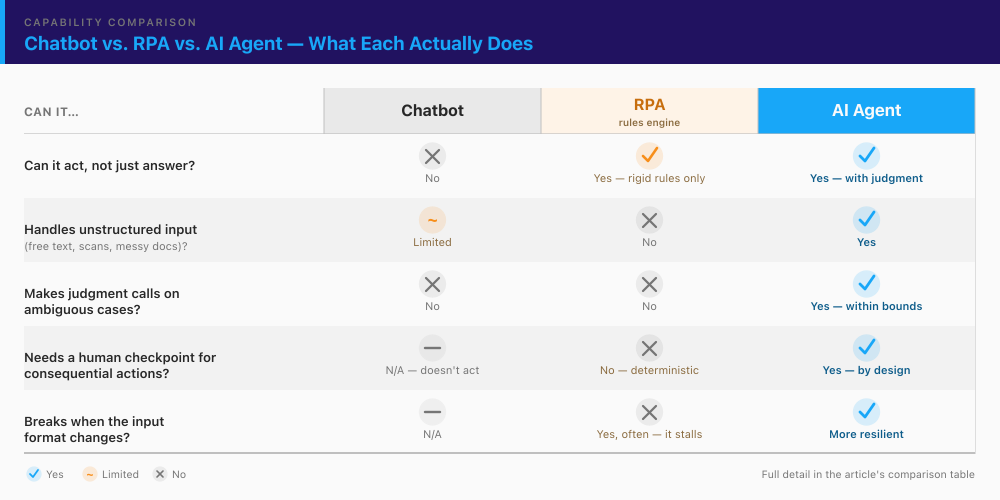
Here’s the comparison in one view. This is the fastest way to place a given tool.
| Chatbot | RPA / rules engine | AI agent | |
|---|---|---|---|
| Can it act, not just answer? | No | Yes, on rigid rules | Yes, with judgment |
| Handles unstructured input (free text, scans, messy docs)? | Limited | No | Yes |
| Makes judgment calls on ambiguous cases? | No | No | Yes, within defined bounds |
| Needs a human checkpoint for consequential actions? | N/A — it doesn’t act | No — deterministic by design | Yes — by design |
| Breaks when the input format changes? | N/A | Yes, often | More resilient — grounded in language, not exact fields |
The practical point isn’t to pick one. It’s that they combine. RPA is excellent at the deterministic steps — and useless the moment a case needs interpretation. An agent is the judgment layer that handles the messy, ambiguous inputs and then hands the clean, rule-based steps to RPA or a script. In a well-designed workflow, the agent decides which cases it can handle, does those, routes the rest to a person, and passes the deterministic mechanics to the tools you already run. Map which steps are rules and which need judgment, and you’ll know exactly where each tool belongs.
What are realistic AI agent use cases by function?
Organized by business function rather than industry, since the pattern repeats across verticals.
Back-office and admin. The “AI co-worker” pattern: an agent reads incoming documents and requests, classifies and triages them, drafts the response or record update, routes anything ambiguous to the right person, and completes only the routine, low-risk cases itself. This is the highest-ROI category for most companies drowning in operational admin — reading, sorting, copying, routing — that follows a pattern but is too messy for a script.
Customer and support operations. Ticket triage and routing, plus response drafting. The agent reads an inbound ticket, classifies it, routes it to the right queue, and drafts a reply for an agent to approve and send. It takes the repetitive volume off the support team and gets the genuinely hard cases to a human faster — it doesn’t pretend to close every ticket on its own.
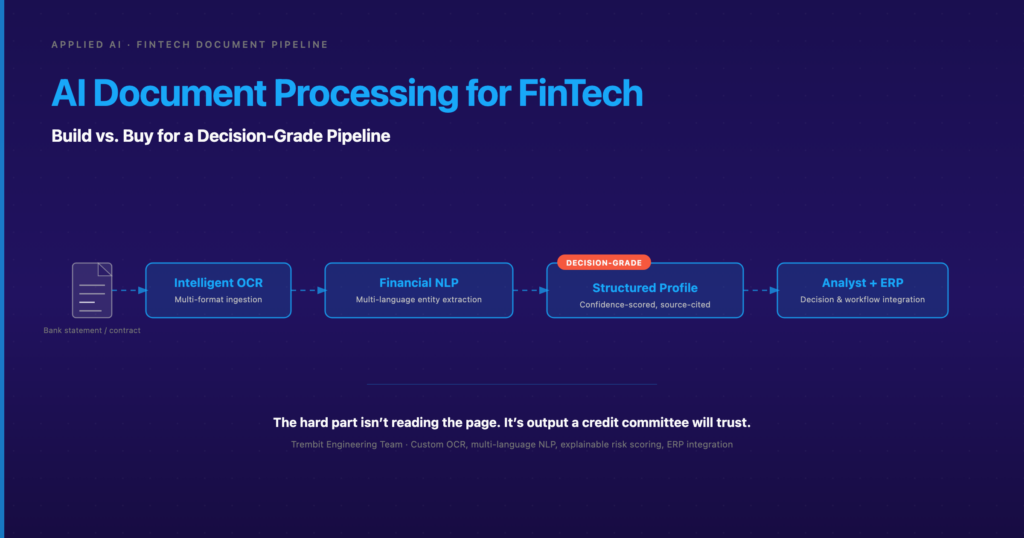
Finance and operations. Contract and document review, risk scoring, and exception handling. An agent reads unstructured financial documents, applies explainable scoring, auto-completes the clean cases, and routes the rest to an analyst with its reasoning attached. This is exactly the pattern in the Eska pipeline described below — and a case where the “human handles the judgment calls” rule isn’t optional.
Internal knowledge. Grounded Q&A over your own docs, policies, and handbooks, so staff get accurate, cited answers instead of digging through shared drives — and internal admin workflows like enrolment or support requests get triaged automatically. The whole value here is grounding: an internal assistant that guesses is worse than none.
How do you evaluate whether a workflow is a good fit for an AI agent?
Before you scope a pilot, run the candidate workflow through five questions. If it fails most of them, an agent is probably the wrong tool — and a good partner will tell you so.
-
Is it high-volume and repetitive, but not fully rule-based? If plain rules already handle it, use RPA — it’s cheaper and more predictable. If it repeats often but keeps needing interpretation a script can’t give, that’s the agent’s sweet spot. This is the “RPA can’t do this” test.
-
Can a wrong or uncertain output be caught before it causes harm? If a human (or a downstream check) can review the agent’s output before it commits, the risk is manageable. If a wrong action is instant, expensive, and irreversible, either add a checkpoint or don’t automate it. This is the reversibility test.
-
Is the data available to ground the agent? RAG needs a corpus — real documents, records, and policies the agent can retrieve from. A blank model with no grounding will hallucinate on your specifics. No corpus, no reliable agent.
-
Can the agent actually reach the systems it needs to act in? If it can’t securely connect to your CRM, ERP, ticketing, or data through their APIs, it can only talk about the work, not do it. This is the integration test — and it’s usually the hardest part.
-
Can you measure success? If you can’t define what “done right” looks like — a metric like volume handled, hours saved, or turnaround time — you can’t build evals, and you can’t tell whether the agent is working. If you can’t define done, you can’t ship it.
A workflow that passes all five is a strong candidate. One that fails the reversibility or the measurement test is where most doomed pilots start.
Not sure how your workflow scores on these? That’s exactly what a scoping call is for — we’ll tell you which tool fits before anyone writes code.
How Trembit builds AI agents that survive contact with production
The word “agent” is easy to demo and hard to ship. The difference is entirely in the engineering around the model, and it’s the same discipline we describe on our AI agents and automation service: scope one real workflow with a clear metric, ground it in your data with RAG, integrate it into your systems through tool and function calling, put a human in the loop on anything consequential, back it with evals, and log a full audit trail. Model-agnostic — we pick OpenAI, Anthropic, Gemini, or an open model based on the task, cost, and data-residency need, not a vendor allegiance.
Anthropic’s own engineering guidance points the same way: start with a single-purpose agent that does one thing well, keep meaningful human oversight, and expand deliberately — “do the simplest thing that works.” That’s not caution for its own sake; it’s how an agent earns trust. It’s also the same production-reliability discipline we’ve spent 15+ years applying to real-time video and voice systems that aren’t allowed to fail — 50+ shipped across healthcare, education, and enterprise — now pointed at agent workflows.
The clearest proof is Eska’s automated leasing decision pipeline. The pipeline reads unstructured leasing contracts with Python-based NLP and OCR, scores credit risk with an explainable machine-learning model, then auto-approves low-risk applications, routes high-risk ones to a human analyst with the AI’s risk breakdown attached, and flags borderline cases for review. It’s wired into the client’s Odoo ERP through a Node.js integration layer, with monitoring and retraining built in.
To be precise about the category: Eska’s auto-approve/route/flag step is score-threshold branching on an ML model, not a multi-step LLM agent reasoning its way through each case — closer to “ML + RPA” than to the language-model agents defined at the top of this piece. We include it because it’s the same read → score → route → human pattern running in production, and the discipline that matters most — a human in the loop on every consequential call, every decision traceable — is identical whether the judgment layer is a scored model or an LLM. That’s the part most pilots get wrong, and it’s the part Eska got right.
And the outcome is the point. In the client’s words: “Before ESKA, our analysts spent hours reading contracts and making risk calls on instinct. Now the system reads the contract, scores the risk, and explains why — and our default rate has dropped because we catch problems before they become losses.” The system didn’t replace the analysts — it caught the problems earlier, so fewer of them turned into losses.
If you’ve identified a workflow, that’s the shape of what a pilot looks like.
Frequently asked questions
What is an AI agent, in plain terms?
An AI agent is software built around a language model that does things instead of only saying things. Where a chatbot generates a reply and stops, an agent reads a document, calls a tool or API, updates a record, and decides what to do next — often with a person approving anything consequential before it commits. The defining trait is agency: the ability to take actions in your real systems, within defined bounds, not just produce text. In business use, that usually means reading messy inputs, making a light judgment call, and either completing a routine case or escalating a hard one.
What’s the difference between an AI agent and a chatbot?
A chatbot responds to messages — you ask, it answers, nothing in your systems changes. An AI agent takes actions: it reads documents, calls tools and APIs, updates records, and decides what to do next, usually with a human approving the consequential steps. The simplest test is to ask what happens after the response. If the tool can move a file, update your CRM, or route a request, it’s acting like an agent. If it only produces text on screen, it’s a chatbot — regardless of what the marketing calls it.
Can AI agents work without any human oversight?
Not for anything consequential — not reliably, not in current production practice. Agents that run in the real world use human-in-the-loop checkpoints on any action with real impact, and only widen their autonomy as they earn trust on narrow, well-measured workflows. “Fully autonomous” claims are mostly marketing running ahead of production reality for business use cases. The mature approach isn’t approving every trivial step — that just adds friction — it’s calibrating oversight to consequence: routine, low-risk cases run on their own, and anything expensive or hard to reverse waits for a person.
What business tasks are AI agents good at right now?
The reliable categories today are document intake and classification, request triage and routing, drafting responses or records for a human to approve, extracting and validating data from unstructured sources like PDFs and free-text notes, updating records in existing systems with a full audit trail, and internal knowledge retrieval grounded in your own documents. The common thread is high-volume, pattern-following work that mixes reading and light judgment, where a person can catch a bad output before it causes harm. Agents take the repetitive slice off skilled staff — they don’t replace the role.
Why do AI agent pilots often fail to reach production?
Almost always for four reasons, and none of them is model quality. No grounding: the agent runs on general knowledge instead of your data, so it hallucinates on real cases (RAG fixes this). No integration: it can talk about the workflow but can’t touch the systems it runs on. No human checkpoint: with no approvals on consequential actions, nobody trusts it enough to let it run. No evals: nobody defined what “done right” looks like, so reliability can’t be proven before shipping or measured after. A pilot that skips these looks great in a demo and collapses on real inputs.
How is an AI agent different from RPA (robotic process automation)?
RPA follows fixed rules on clean, structured input — click here, copy that field, paste it there. It’s fast and dependable for deterministic steps, and useless the moment a case needs interpretation or the input arrives as unstructured text. An AI agent handles exactly that: it reads messy inputs, makes a judgment call, and decides what to do — including when to escalate to a person. In practice the two complement each other. The agent takes the ambiguous cases; RPA handles the deterministic ones. Mapping which steps are rules and which need judgment is part of scoping the work.
Where this leaves you
AI agents are real — and narrow. They’re a high-ROI tool for high-volume, pattern-following work that needs a bit of judgment: reading, triaging, drafting, routing, updating records. They are not a replacement for your team, and they are not safe to run unsupervised on consequential decisions. The projects that succeed pick one bounded workflow, ground it, integrate it, keep a human in the loop, and measure it.
If you’ve spotted a workflow like that, the next step is scoping an AI agent with Trembit — we’ll tell you honestly whether an agent is the right tool, and where a simpler one would do.
Related reading: our implementation playbook for building an AI admin co-worker , the wider AI development picture, and the agent’s orchestration layer.