By Eugenia Nemkova, Marketing Director at Trembit · Last updated: 30 September 2026 · Vendor facts checked on each company’s own site on 24 September 2026
A teletherapy app development company builds the software therapists and clients use for live sessions at a distance: the private video layer for 1:1 and group therapy, plus the waiting rooms, consent-based recording, session notes, and compliance controls around it. This guide compares six vendors that have published proof of building exactly that, judged on how their video works, what compliance they can evidence, and what therapy work they’ve actually shipped. It deliberately leaves out meditation, CBT self-help, and mood-tracking app builders, which is a different engineering problem. If you need a broader telehealth platform (EHR integration, scheduling, and remote monitoring for any specialty), see our guide to telemedicine app development companies.
Key takeaways
- We screened 24 vendors, most of them named by AI search engines and “top mental health developer” lists for this query. Only six had a published therapy case, on their own site, that identifies how the video works. Most “mental health app development” pages describe self-help apps, not live sessions.
- Three of the six published therapy cases run on a third-party video service (Zoom, Twilio, OpenTok). Two run on self-hosted media paths (peer-to-peer or open-source media servers). One names WebRTC without describing the server side. That split decides who controls where session media is decrypted.
- Group therapy is where proof thins out: only two vendors publish a group-session size from a delivered therapy build.
- HIPAA work appears on five of the six vendors’ own pages. One of the six states German KBV certification for psychotherapy video. KBV is the strictest rung, because it governs the media path itself.
- Trembit publishes this guide and is one of the six. It gets the same format and the same evidence standard as everyone else, and no ranking: entries are listed alphabetically.
Short on time? The comparison table has the shortlist (start with its “Video architecture evidence” column), and the vendor questions are the part to take into a sales call. The sections before the table explain how the list was built.
What Does a Teletherapy App Development Company Actually Build?
The session video is the part everyone sees, and it’s the part that fails in ways specific to therapy. A teletherapy build typically covers:
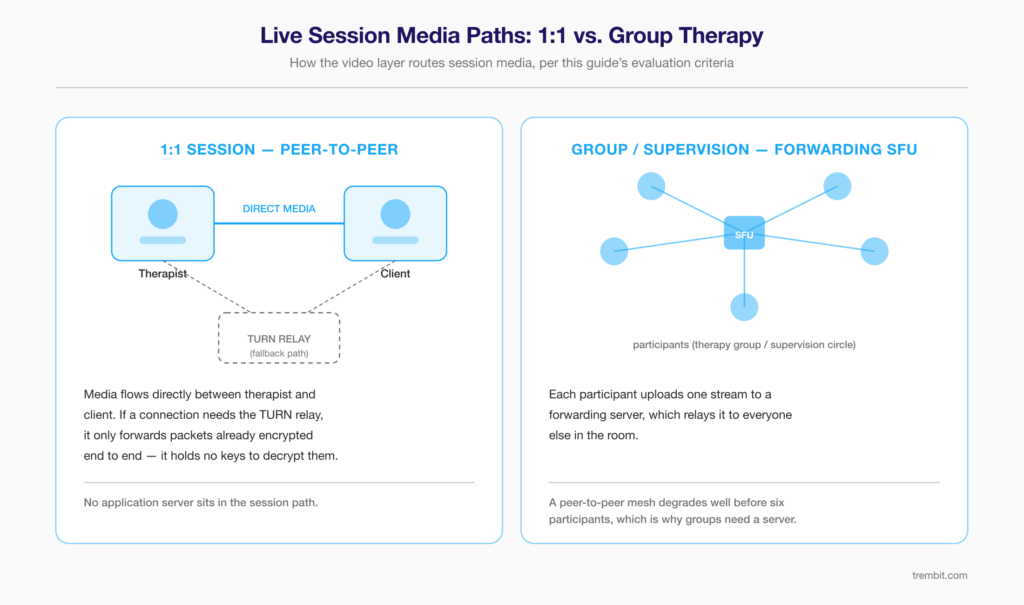
- The live session media path. Peer-to-peer WebRTC for 1:1 sessions, where media flows directly between therapist and client, or a media server (an SFU that forwards streams) for groups. A third option is renting that layer from a video API or SDK vendor (Zoom, Twilio, Vonage). Each choice decides who can technically access session content.
- Group sessions and supervision. Several participants on mixed devices, where one client on a budget phone shouldn’t degrade the room for everyone. Audio matters more than video: a meeting tool may drop “quiet” speakers, which is unacceptable when a quiet participant is the one who needs attention.
- The clinical wrapper. A virtual waiting room, scheduling, consent-based recording (both parties agree, visible indicator, deletion rights), encrypted therapist notes, in-session chat, and sometimes therapy-specific tools such as EMDR bilateral stimulation or shared worksheets.
- Compliance controls for each market. Business Associate Agreements (BAAs) and audit trails for HIPAA in the US, data processing agreements and enforceable data residency for GDPR in the EU/UK, and, for psychotherapy billed to German statutory insurance, a video service certified under KBV Anlage 31b.
How Did We Evaluate These Companies?
The long list (24 vendors). Every vendor cited when we asked ChatGPT, Claude, Perplexity, and Google AI Mode for the “best development company for a mental health teletherapy video app” in September 2026, or listed in the third-party “top mental health developers” articles they cited. We added vendors from our own competitor research, vendors already screened for our telemedicine guide, vendors that turned up in a search for published teletherapy case studies, and Trembit.
Five criteria, each checked on the vendor’s own website on 24 September 2026:
- A published mental-health or therapy case where live sessions are part of the build, not a general healthcare case and not a self-help app.
- Video architecture evidence. The case or service page identifies how the video works: a named video API or SDK, WebRTC with or without a named media server, or a peer-to-peer design. Group sessions addressed specifically.
- Compliance evidence per regime: HIPAA, GDPR, and KBV, each recorded as stated on the site or “not stated on site.” We don’t infer a certification from a badge or a third-party list.
- Therapy workflow depth: waiting room, session notes, consent, groups or supervision.
- Verifiable reputation: the vendor’s Clutch rating and review count, read on Clutch itself.
Vendors that failed criterion 1 or 2 were dropped, however well known. That removed 18 of the 24. Most had a mental-health services page listing “HIPAA-compliant video sessions” as a feature, but no published therapy case describing the video, or a case that was a meditation, journaling, intake, or practice-management product without live sessions. One vendor’s relevant case page returned a 404 on the day we checked, another’s site was unreachable, and one listicle name couldn’t be matched to a company site at all. We’ll re-check them in the next update.
Disclosure. Trembit, which publishes this guide, is included because it meets the criteria above, not because this is our list. Every entry uses the same fields and the same evidence standard. No vendor paid for placement or was contacted before publication, and where a fact isn’t on a vendor’s own site we say “not stated on site” rather than guess.
Which Teletherapy App Development Companies Made the List?
Six vendors passed the screen. They’re listed alphabetically; this is a comparison, not a ranking. Clutch figures were read on each vendor’s Clutch profile on 24 September 2026.
| Company | HQ / delivery | Best for | Video architecture evidence | Group sessions | HIPAA / GDPR / KBV (as stated on site) | Therapy proof | Clutch | Watch-outs |
|---|---|---|---|---|---|---|---|---|
| Cleveroad | Offices in Estonia, US, Norway; Ukrainian-origin team | Teletherapy inside a broader mental-health product with US EHR sync | Therapy case uses Zoom for sessions, PubNub for chat | Not stated on site | HIPAA (case) / GDPR in regulations list / KBV not stated | Online Therapy Services Ecosystem (US) | 4.9 (81 reviews) | Session video is a third-party service in the published case |
| CodeIT | Tallinn, Estonia; offices in Ukraine | Therapy platforms with in-session tools around a video API | OpenTok API for live sessions | Not stated (1:1 with waiting room) | Not stated on the case page | TeleTherapy platform for children with autism (US) | 4.9 (28 reviews) | Published case dates from 2016–2018 |
| Itexus | US-registered; development office in Warsaw | Consumer therapy marketplaces with therapist matching | Twilio for live video sessions | Group chat prototyped; group video not stated | HIPAA (case) / GDPR in site-wide claims / KBV not stated | LifeHelp, women’s mental-health platform | 4.9 (41 reviews) | Primary focus is fintech; healthcare is a secondary practice |
| ScienceSoft | McKinney, Texas; offices in US, EU, Latin America | US behavioral-health providers wanting a large, certified vendor | Mental-health iOS case lists WebRTC; server side not described | Group, couple, and family sessions listed as features; no group case | HIPAA (case) / GDPR listed / KBV not stated; ISO 13485, 27001, 9001 | iOS teletherapy MVP for a mental-health startup (4 months) | 4.8 (42 reviews) | US-centric compliance content |
| Trembit | Kyiv, Ukraine; Valencia and London; UK-registered | Private-by-architecture therapy video, groups, German statutory psychotherapy, rescuing stalled builds | Peer-to-peer for 1:1 with self-hosted STUN/TURN; groups P2P or forwarding SFU | Up to 20 (groups and supervision circles) | HIPAA delivery, signs BAAs / GDPR (DSGVO), German hosting / KBV-certified platform | webPRAX Face2Face, used daily by thousands of therapists | 4.9 (16 reviews) | ~30-person specialist team; partners on EHR/billing breadth |
| WebRTC.ventures | Charlottesville, Virginia; mostly nearshore Latin American team | Scaling or replacing therapy video on open-source media servers | Jitsi Videobridge + coTURN (scaling case); Kurento + Coturn (teletherapy case) | “+15 users” conferencing in a teletherapy case | HIPAA (case) / GDPR not stated / KBV not stated | Sessions Health: 500 to 5,000 concurrent 1:1 calls | No reviews on Clutch | No dedicated mental-health page; no Clutch reviews yet |
Each company gets a self-contained profile below, in the same order and format.
Cleveroad
A broad custom-software and mobile studio with a dedicated mental-health page covering six product types, of which teletherapy is one (the others are meditation, CBT, mood tracking, addiction recovery, and sleep).
- Best for: a mental-health product where live sessions sit alongside booking, payments, and US EHR integration.
- Proof point: the Online Therapy Services Ecosystem case: mobile and web apps plus an admin panel for a US mental-healthcare provider, with two-way sync to the Kareo EHR. The case names Zoom for virtual consultations and PubNub for HIPAA-compliant chat. Its mental-health page lists Twilio, Vonage, WebRTC, and Zoom SDK as video integrations.
- Compliance: the case describes HIPAA work (AWS hosting, AES-256 encryption of PHI). GDPR appears in its regulations list. KBV not stated on site. The company states ISO 9001 and ISO 27001 certification.
- Reputation: Clutch 4.9 across 81 reviews.
- Watch-outs: the published therapy case rents its session video from Zoom, and no group-session case is published.
- Not a fit if: you need to control the media path yourself, for example to guarantee no server can decrypt sessions.
CodeIT
A software development company headquartered in Tallinn, with delivery offices in Ukraine, whose healthcare portfolio includes a live online-therapy platform.
- Best for: therapy platforms where clinicians need in-session tools (materials, whiteboard, recording) built around a video API.
- Proof point: TeleTherapy, a platform for online therapy sessions for children with autism, built for a US healthcare provider in 2016–2018 by a seven-person team. It extended existing mobile apps into a web platform, used the OpenTok API for live video, and added a waiting room, a patient materials library, a whiteboard, media sharing, and session recording.
- Compliance: HIPAA, GDPR, and KBV not stated on the case page.
- Reputation: Clutch 4.9 across 28 reviews.
- Watch-outs: the therapy case is several years old; ask for recent real-time video work and for current compliance scope.
- Not a fit if: you need documented HIPAA or GDPR evidence from a comparable therapy build up front.
Itexus
A software company whose homepage leads with fintech, with a secondary healthcare practice that includes mental-health telemedicine cases.
- Best for: consumer-facing therapy marketplaces: questionnaire-based therapist matching, chat, and scheduled video sessions.
- Proof point: LifeHelp, a platform where women access therapy and peer mentors. A chatbot questionnaire returns a shortlist of three therapists; clients get text chat five days a week plus scheduled video sessions on Twilio. A second case covers design of a mental-health telemedicine MVP with automatic specialist matching.
- Compliance: the LifeHelp case states the platform meets HIPAA requirements for access, audit, integrity, transmission, and device security. The site lists GDPR and HIPAA among its compliance areas. KBV not stated on site.
- Reputation: Clutch 4.9 across 41 reviews.
- Watch-outs: group features in the published case are community chats, not group video.
- Not a fit if: group therapy video is central to your product.
ScienceSoft
A large IT consulting and software company (founded 1989) with a deep healthcare practice and a long guide on telehealth software for mental health.
- Best for: US behavioral-health organizations that want a large, ISO-certified vendor covering integrations, compliance, and support in one contract.
- Proof point: an iOS telemedicine app for a mental-health startup, delivered as an MVP in four months: in-app video therapy sessions, messaging, and self-management tools, with WebRTC and WebSocket in the stack. Its mental-health page also shows a sample architecture that includes “a video streaming and messaging server.”
- Compliance: the case describes HIPAA controls (end-to-end PHI encryption, multi-factor authentication). GDPR appears in its compliance list. KBV not stated on site. The company states ISO 13485, ISO 27001, and ISO 9001 certification.
- Reputation: Clutch 4.8 across 42 reviews.
- Watch-outs: group, couple, and family sessions appear as features on its mental-health page, but no group-session case is published. Compliance content is US-first (HIPAA, 42 CFR Part 2, HITRUST).
- Not a fit if: your first market is Germany or you need EU-specific certification experience.
Trembit
A WebRTC and real-time video specialist whose therapy work centers on a certified psychotherapy platform in Germany.
- Best for: therapy video where privacy is enforced by architecture, group sessions, psychotherapy billed to German statutory insurance, and rescuing therapy-video builds that have stalled with another team.
- Proof point: webPRAX Face2Face, a KBV-certified psychotherapy video platform in Germany, used daily by thousands of therapists. 1:1 sessions run peer-to-peer on 100% German-hosted infrastructure with self-hosted STUN/TURN. When a connection has to fall back to the TURN relay, the relay forwards packets that are already encrypted end to end with DTLS-SRTP and holds no keys to decrypt them, so no server can access or store session content. Group sessions and supervision circles of up to 20 run peer-to-peer or through a forwarding SFU, depending on session size. It also has dual-consent recording, encrypted therapist notes, and EMDR tools. Trembit also built a multi-participant clinical video platform for EU care teams, load-tested under concurrent group sessions.
- Compliance: KBV-certified platform (webPRAX Face2Face); GDPR/DSGVO with Germany-only hosting; HIPAA delivery experience. Its teletherapy platform page states it signs a BAA before engineers access PHI, and a GDPR Article 28 DPA where it touches personal data.
- Reputation: Clutch 4.9 across 16 reviews, fewer than the larger studios here. Review count mostly tracks company size, so for therapy video, one delivered platform you can check on a public certification list is stronger evidence than a long run of general reviews.
- Watch-outs: a ~30-person team (20+ engineers) focused on the video layer; it expects to partner on EHR, billing, and marketing-site work rather than own every workstream.
- Not a fit if: you’re building a content-led self-help, meditation, or CBT app with no live sessions.
WebRTC.ventures
WebRTC.ventures is a WebRTC-focused agency (an AgilityFeat company) with a mostly nearshore team in Latin America and two mental-health video cases.
- Best for: scaling, stabilizing, or replacing a therapy video stack built on open-source media servers.
- Proof point: Sessions Health, a practice-management EHR for mental-health professionals. It re-architected the video layer on multi-region Jitsi Videobridge with coTURN TURN servers and Peermetrics monitoring, moving capacity from about 500 to 5,000 concurrent 1:1 HIPAA-compliant sessions. A second teletherapy case replaced a mental-health group’s platform “after facing multiple communication issues with their first development team,” using Kurento Media Server, Coturn, and FreeSWITCH for phone access, with “+15 users” video conferencing.
- Compliance: HIPAA stated in the Sessions Health case. GDPR and KBV not stated on site.
- Reputation: its Clutch profile had no reviews on the date checked.
- Watch-outs: no dedicated mental-health or telehealth service page, and no Clutch reviews to check against.
- Not a fit if: you want one vendor to own the full clinical product (EHR, billing, patient apps) as well as the video.
Comparing two or three of these on the media-path question? Trembit’s teletherapy engineering team offers a free 30-minute architecture call for exactly that (details at the end of this guide). Bring the shortlist and the session types you need.
How Do HIPAA, GDPR, and KBV Differ for Therapy Video?
The three regimes don’t differ mainly in paperwork. They differ in what they allow on the media path.
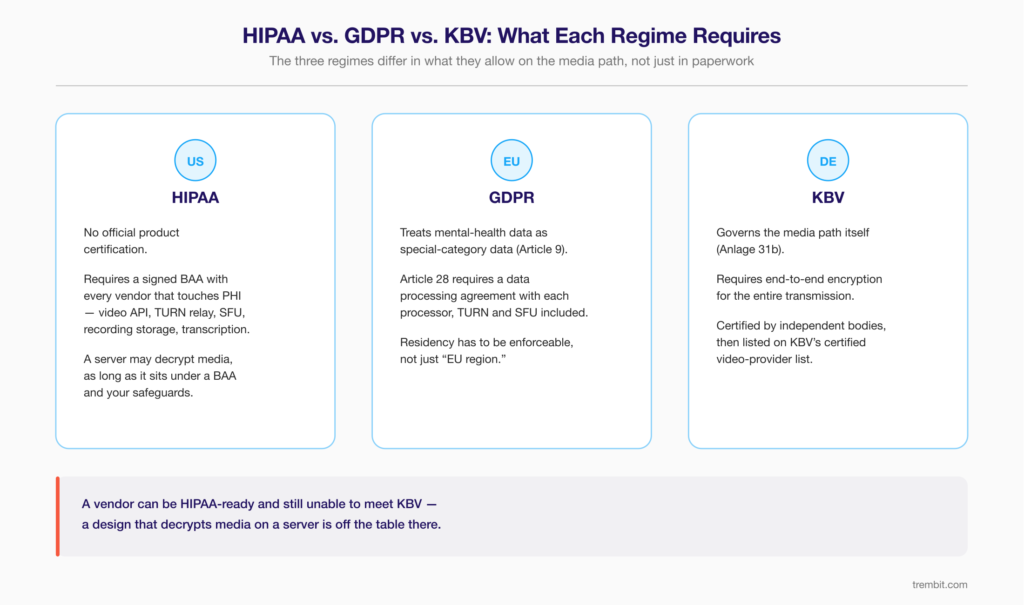
- HIPAA (US) has no official product certification. The HHS guidance on business associates requires a BAA with every vendor that creates, receives, or transmits PHI for you. For therapy video that includes the video API, TURN relay, SFU, recording storage, and transcription provider. A server may decrypt media, as long as it sits under a BAA and your safeguards.
- GDPR (EU/UK) treats mental-health data as special-category data under Article 9, and Article 28 requires a data processing agreement with each processor, again including SFU and TURN providers. Residency has to be enforceable, not just “EU region.”
- KBV (Germany, psychotherapy billed to statutory insurance) governs the media itself. Under KBV Anlage 31b, the KBV’s own guidance requires the video service to be end-to-end encrypted for the entire transmission. Services are certified by independent certifying bodies under KBV and GKV rules, then appear on the KBV’s list of certified video providers (the version current at publication is dated 24 August 2026).
So a vendor can be HIPAA-ready and still unable to meet KBV, because a design that decrypts media on a server is off the table there. We map all three regimes rung by rung, with the video-layer requirement for each, on our teletherapy platform development page.
What Should You Ask a Teletherapy Vendor Before You Sign?
These questions separate vendors that have engineered therapy video from vendors that have configured it. Ask for answers tied to a real build.
- Where does session media get decrypted, and is there a server in the path at all? A precise answer names the topology per session type (peer-to-peer, forwarding SFU, SDK vendor cloud). “It’s encrypted” isn’t an answer. Why it matters to you: every server that can decrypt media is one more system your privacy policy, contracts, and breach exposure have to cover.
- Where do your TURN servers run, and who operates them? TURN relays media for clients behind strict firewalls. If it sits in another jurisdiction or with an uncontracted provider, your residency promise has a hole in it. Why it matters to you: the clients who hit TURN are often the ones on hospital, school, or corporate networks, so a gap here shows up in exactly the sessions you can least afford to lose.
- Can you show a delivered group therapy session at six or more participants, on budget phones? Peer-to-peer mesh degrades well before that, because every participant has to upload a separate stream to every other one. Even with a forwarding server, six participants is where budget phones reach the edge of their decoding headroom. Our analysis of that six-participant cliff explains why. A vendor who hasn’t tested there hasn’t met the problem. Why it matters to you: group sessions fail on real devices and networks, not in the demo, so an untested vendor leaves you to find the limit after launch.
- Who signs the BAA or DPA, and does it cover every subprocessor? List them together: hosting, video API, TURN, SFU, recording storage, transcription or AI note-taking. Why it matters to you: one uncovered subprocessor makes the whole data flow non-compliant, and the liability sits with you as the provider.
- How does recording consent work mid-session? Both parties should opt in, see a visible indicator, and be able to withdraw. Deletion should reach backups. Why it matters to you: a consent failure in a therapy session damages client trust in a way a bug fix can’t repair.
- Have you taken a platform through KBV certification yourself, or is it a claim? Ask which platform, and check it against the KBV’s published list of certified video providers. Why it matters to you: without a listed service, sessions can’t be billed to German statutory insurance, which closes that market.
- What happens to audio when the network degrades? In therapy, audio has to survive when video can’t. Ask how bandwidth is reserved for it. Why it matters to you: a therapy session can continue through frozen video, but once audio drops, the session is over.
FAQ
How can I verify a teletherapy vendor’s compliance claims? Ask what process produced each claim. For HIPAA, there’s no official product certification, so ask which subprocessors carry a signed BAA and how PHI is logged and stored. For GDPR, ask for the DPA and a data-flow map showing where every component runs, TURN and SFU included. For KBV, ask which platform the vendor took through certification, then check it against the KBV’s published list of certified video providers. A vendor who answers with named components, documents, and a real platform is a different risk from one who answers with a badge.
Do teletherapy platforms need a different video architecture than general telehealth? Often, yes. A 1:1 therapy session can run peer-to-peer, with media flowing directly between therapist and client, and any TURN relay only forwarding packets it can’t decrypt. That’s the most private option and the cheapest to run. Group therapy can’t stay peer-to-peer for long: each participant uploads a separate stream to every other one, so the mesh degrades well before six participants, and larger groups need a forwarding SFU with simulcast and a reserved audio budget. A platform built on one topology for every session type can work well for consultations and still break first in group therapy.
Is KBV certification required outside Germany? No. KBV certification applies to video services used for psychotherapy and other consultations billed to German statutory health insurance. Outside Germany, HIPAA (US) or GDPR (EU/UK) set the rules. It’s still a useful yardstick for any buyer. KBV Anlage 31b requires end-to-end encryption for the entire transmission and certification by independent bodies before a service is listed, which rules out designs where a server decrypts session media. A vendor that has built to that bar has shown it can make privacy an architectural property rather than a policy.
How much does teletherapy platform development cost? Published ranges vary widely with scope. ScienceSoft’s mental-health telehealth guide puts a custom telepsychiatry solution with virtual consultations only at $150,000–$250,000. RaftLabs publishes $45,000–$80,000 for a focused first-version teletherapy platform and $90,000–$160,000 for a full platform with EHR, outcome measurement, group sessions, and billing (both as published on their sites, September 2026). What moves the number: which regimes you need (KBV, GDPR, HIPAA), group sessions versus 1:1 only, recording or AI features that need server-side media, residency constraints, clinical tools, and how many platforms you ship. Treat any quote given before a scoping conversation as a starting point.
Can an existing teletherapy platform be brought into KBV compliance, or does it need a rebuild? It depends on the media path. Start with a gap analysis against Anlage 31b. If sessions already run end-to-end encrypted with no server able to access content, and every component (TURN included) can be hosted in Germany or the EEA, the work is mostly hardening, documentation, audit trails, and the certification review. If the platform relies on a video SDK whose cloud decrypts or routes media outside the region, that layer usually has to be replaced, while scheduling, notes, and the rest of the product can often stay.
The right vendor depends on three things: whether your sessions are 1:1, groups, or both; which regimes apply in your markets; and whether the video is infrastructure you need to control or a feature you can rent. Settle those and the shortlist narrows quickly.
If the video path is the hard part, talk to a team that has taken psychotherapy video through KBV certification. It’s a free 30-minute call with an engineer, not a sales pitch. Bring your session types, target markets, and current stack or vendor proposals. We’ll map where media gets decrypted, where your TURN servers need to live, and where the certification risk sits.