By Eugenia Nemkova, Marketing Director, Trembit · Last updated: 30 September 2026
A voice AI agent development company designs, builds, and hands over a custom voice agent that holds spoken conversations in real time: on a phone line, inside a web or mobile app, or as a participant in a video call. It owns the whole path, from speech recognition, the language model, and speech synthesis to barge-in, turn-taking, and the SIP or WebRTC transport underneath. That is a different purchase from a voice AI platform such as Vapi or Retell, where you configure a hosted agent yourself and pay per minute. This guide covers both and scores them separately, because they answer different questions. For a broader comparison that includes live video AI, moderation, and translation, see our guide to the best real-time AI development companies; this piece is voice only, and adds a platform tier and a telephony column that guide doesn’t have.
Key takeaways
- Platforms and integrators are different purchases. A platform (Vapi, Retell, LiveKit Cloud, Telnyx) is usually the right first move at modest call volume with a standard call flow. An integrator earns its fee when audio must stay in the EU or on your servers, the agent has to live inside an existing PBX or contact centre, per-minute pricing dominates at volume, or you need latency control the platform doesn’t expose.
- Telephony depth is the criterion most “best voice AI” lists skip. Bridging narrowband phone audio from SIP trunks and a PBX into an AI pipeline is its own engineering project. A team that has only demoed in a browser tab hasn’t done it yet.
- Compliance for audio is its own problem. A vendor’s BAA can cover text and not audio. Before patient audio goes through a realtime speech model, confirm that the audio modality itself is on the provider’s current HIPAA-eligible list.
- Almost nobody publishes a measured end-to-end voice-agent latency, Trembit included. Most figures on vendor sites are targets or unexplained tables. Ask how a number was measured, on which deployment, before you weigh it.
- This list groups nine integrators by lane, not by rank. Trembit is included on the same terms and in the same format as everyone else.
Already know you need a custom build? Skip to the integrator comparison table and profiles. Not sure yet whether a platform would do? Start with integrator or platform.
What Is a Voice AI Agent Development Company, and How Is It Different from a Voice AI Platform?
A voice AI platform sells you a hosted agent runtime: you write the prompt, pick the models, attach a phone number, and pay per minute. A voice AI agent development company (an integrator) builds an agent you own, on infrastructure you choose, and takes responsibility for the parts a platform abstracts away. Those parts are where most production problems live: how fast the agent notices the caller has stopped speaking, how cleanly it stops when interrupted, how phone audio gets from a SIP trunk into the speech model, and where recordings and transcripts are allowed to go.
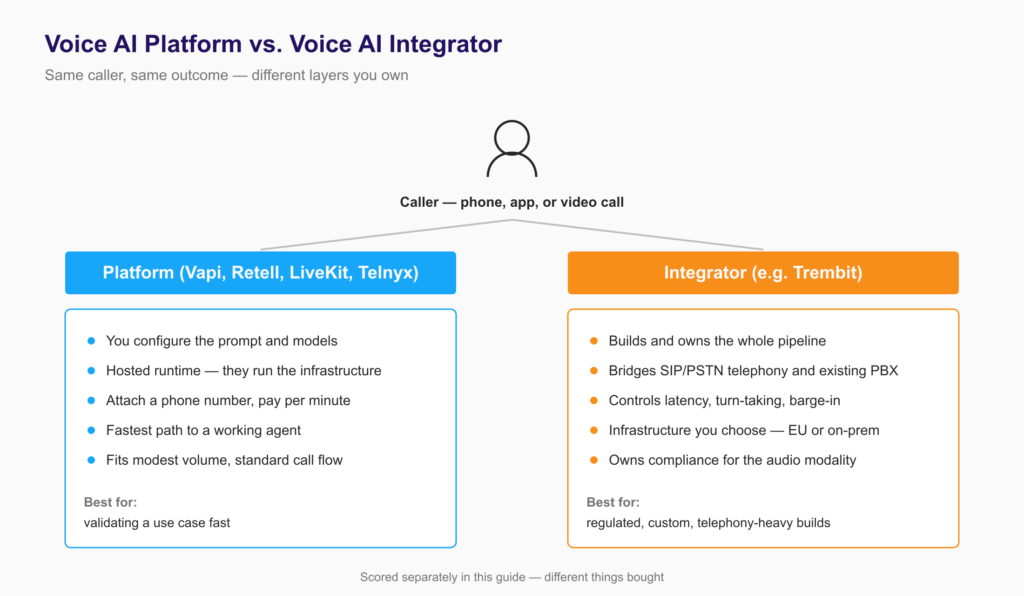
The two tiers overlap more than vendors admit. Good integrators build on platform and framework components (LiveKit Agents, Pipecat, the OpenAI Realtime API, Twilio or Telnyx trunks) where they fit, and replace them where they don’t. So the real question isn’t “platform or agency”. It’s which layer you need someone else to own.
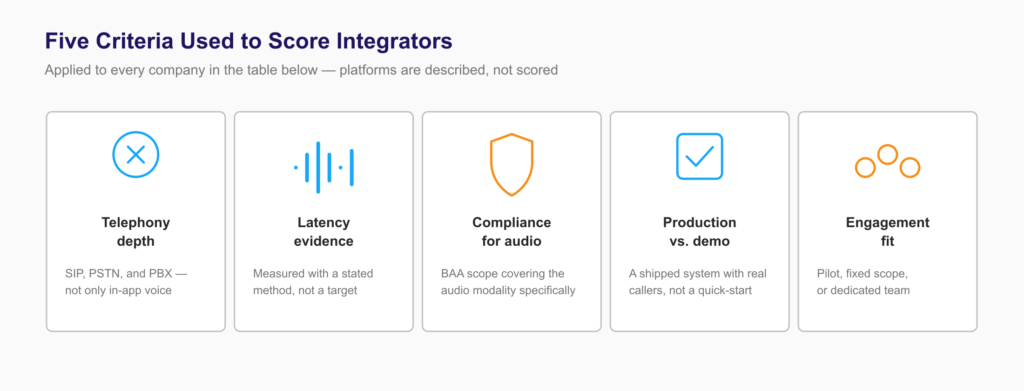
That’s why this guide describes platforms and scores integrators, and never mixes them in one ranking. Integrators are compared on five voice-specific criteria:
- Telephony depth: SIP trunks, PSTN, and existing PBX or contact-centre integration, not only in-app voice.
- Latency evidence: measured numbers with a stated method, versus targets and marketing figures.
- Compliance for audio: BAA scope that covers the audio modality, EU or on-premises hosting, zero audio persistence where required.
- Production versus demo: a shipped system with real callers, not a framework quick-start.
- Engagement fit: packaged pilot, fixed scope, dedicated team, or consulting.
The business risk behind all five is the same: a voice agent that passes the demo and then fails real callers loses customers on the phone line, where they hang up instead of complaining, and a compliance gap found after launch can take the agent offline entirely.
How Do You Evaluate a Voice AI Agent Development Company?
Each criterion above comes with one question that separates teams that have shipped from teams that have wired an LLM to a microphone.
Telephony: “Have you bridged real phone audio into an AI pipeline, and what broke?” Phone trunks typically carry narrowband 8 kHz audio (often G.711), which speech models tuned on wideband browser audio can handle less accurately. Next to a FreeSWITCH or Asterisk PBX, the decision that matters most is keeping AI inference off the switch’s media threads, so one slow model call doesn’t stall audio for every other caller; we wrote that failure mode up in our guide to building a voice AI agent on FreeSWITCH. “We use the platform’s phone numbers” is fine for a pilot and untested for a contact centre.
Latency: “What did a system that real callers used measure, per stage, and how?” The targets we design to, published on our voice AI service page, are a first response roughly 500–1,200 ms after the caller stops speaking and later turns nearer 300–600 ms; at around two seconds callers tend to assume the line dropped. Those are design targets, not measured results. Ask for speech-to-text, LLM, text-to-speech, and transport separately, and treat any table without a named deployment or method as a claim to test on a call. Where the milliseconds go (endpointing, jitter buffers, barge-in) is covered in our breakdown of voice AI agents on WebRTC.
Compliance: “Draw the BAA or DPA chain for my call path, component by component.” Under HIPAA, any vendor that handles protected health information on your behalf is a business associate and needs a Business Associate Agreement (HHS guidance on business associates). Coverage is per service and per modality, so the carrier, speech-to-text, LLM, text-to-speech, recording storage, and logs all have to be covered or kept in-house. For EU buyers, the parallel question is whether every component, including phone numbers and logs, runs in-region.
Production: “What happened the first time the system met real callers?” In one production agent we built, a phone-screening agent for a staffing company, early versions transcribed accurately and still lost candidates, because the bot spoke before people finished a thought or left awkward silences. The fix was a multi-signal turn-taking model (audio energy, speech cadence, syntactic completeness, falling intonation) instead of a framework’s default endpointing. That telephony-and-turn-taking layer is what our voice AI agent development practice works on.
Engagement fit: “What’s the smallest engagement that solves my problem?” A packaged pilot suits one call flow in one language; a dedicated team suits a product where the agent is the core feature. If you already have an agent that’s too slow or blocked by legal, a latency audit or compliance review is cheaper than a rebuild.
Which Voice AI Agent Platforms Can You Configure Instead of Building? (Context, Not Ranked)
These are the tools most buyers should try first, and most integrators build on. They are not ranked against the integrators below. Prices and plan terms were checked on each vendor’s own site on 23–24 September 2026 and change often.
Vapi charges $0.05 per minute for hosting, with speech-to-text, model, voice, and telephony billed separately at provider rates (pricing). HIPAA is a paid add-on listed at $2,000 per month, with a BAA signed through the dashboard and recordings kept in private storage (HIPAA docs). It runs a separate EU region and supports bring-your-own SIP trunks. Right for developers who want code-level control without running infrastructure.
Retell AI starts at $0.055 per minute for its voice infrastructure (“Retell Voice Infra”), with all-in rates of roughly $0.07–$0.31 per minute depending on the LLM, and 20 concurrent calls on pay-as-you-go (pricing). A custom BAA is an Enterprise feature. It connects to your own carrier via elastic SIP trunking or a SIP URI, with guides for Twilio, Telnyx, Vonage, Avaya, Genesys Cloud, Five9, and Amazon Connect (custom telephony docs). Right for phone-first use cases that must plug into an existing contact-centre stack.
LiveKit Agents is an open-source framework (Apache 2.0) that handles the STT-LLM-TTS pipeline, turn detection, interruptions, and phone callers (Agents docs). Self-host it or run it on LiveKit Cloud, whose plans run from a free Build tier through Ship ($50/month) and Scale ($500/month) to Enterprise; a signed BAA is offered only on Scale and Enterprise (pricing). Right for teams that want to own the agent code, and the framework several integrators below build on.
Telnyx is a licensed carrier (it states 45+ countries) running voice AI agents on its own network, with GPUs co-located at its points of presence. It lists voice AI at $0.05 per minute for STT, TTS, and orchestration, and states SOC 2 Type II (Voice AI Agents). It says in-region infrastructure supports GDPR, PCI, and HIPAA; confirm BAA terms before routing patient audio. Right when the phone network is a big part of your latency and cost problem.
The OpenAI Realtime API is a speech-to-speech model API rather than a platform: it connects over WebRTC or WebSocket and can receive phone calls over SIP (Telephony and SIP guide). For healthcare, coverage for text-based Azure OpenAI doesn’t automatically extend to realtime audio, so check the current Microsoft HIPAA-eligible services list (Azure HIPAA offering) for the audio modality specifically before routing PHI. We covered the workarounds in OpenAI Realtime API, WebRTC, and the HIPAA audio gap.
Top Voice AI Agent Integrators in 2026
The nine companies below build custom voice agents for clients. They’re grouped by lane (real-time/WebRTC specialists, a telecom-native shop, AI-first voice teams, and a commerce lane), not ranked. Trembit comes first because we wrote the list, not because we scored ourselves first; the profile format is the same for everyone.
How we sourced it: every non-Trembit fact below was read on the company’s own website on 23–24 September 2026, and is reported as the company states it. Clutch figures come from our 11 September 2026 competitor review. Where a company’s own pages contradict each other, we say so rather than pick the flattering number. None of the companies was contacted, and none paid for placement.
| Company | HQ | Voice focus | Telephony stated | Compliance stated | Named proof on site | Best for |
|---|---|---|---|---|---|---|
| Trembit | Kyiv, UA (+ Valencia, London) | Phone agents, in-app and in-call voice, in-call translation | SIP/PSTN bridge (FreeSWITCH) in production | HIPAA, GDPR, KBV; on-prem option | 10× screening throughput (phone agent); sub-second in-call translation | Regulated voice, phone + WebRTC in one agent, EU residency, stalled-build rescue |
| WebRTC.ventures | Charlottesville, VA, US | Voice AI in WebRTC apps, IVR modernisation | SIP stated | Designs for HIPAA and financial regulation | Scale claim (100M+ MAU products); no voice metric | WebRTC products adding voice, US team |
| Fora Soft | Offices in UAE, Hong Kong, Kazakhstan | AI call agents, LiveKit agents | Twilio, Telnyx, FreeSWITCH, LiveKit SIP | “SOC 2 / HIPAA patterns” in your cloud | Per-stage latency budget; Nucleus case | Packaged pilot with a published latency budget |
| RTC League | New York / Lahore (conflicting) | Contact-centre voice agents, LiveKit | SIP gateways, PBX, sells SIP trunks | SOC 2 Type II and BAA claimed | No voice case readable without JS | LiveKit-centric builds (verify claims) |
| Sheerbit | Ahmedabad, IN (+ Bothell, WA) | Telecom and carrier voice agents | FreeSWITCH, FusionPBX, Asterisk, Kamailio, SIP | “HIPAA-eligible deployments”, BAA support | Latency/WER table with no deployment named | PBX- and carrier-heavy agents |
| Softcery | Tallinn, EE | Voice agents inside B2B SaaS products | “WebRTC + telephony” | Not stated on pages checked | Callable live demos | Self-hosted agent stack for SaaS platforms |
| Relinns Technologies | Mohali, IN | CRM-connected phone agents | Twilio, Telnyx, SignalWire, SIP, WebRTC | HIPAA, GDPR, SOC 2 and others listed | Alta International (property) | Fast prototype on a platform base |
| RaftLabs | Dublin, IE / Ahmedabad, IN | Phone agents for SMB and mid-market | Twilio (case) | Not named on voice page | Perceptional: 12 weeks to launch | Fixed-scope, non-regulated phone agents |
| Clover Dynamics | Lviv, UA | Voice commerce, call-centre agent assist | Twilio Flex (case) | General HIPAA/GDPR adherence | Live voice-commerce demo | Voice commerce, see-it-first buyers |
Trembit: real-time and compliance-heavy voice agents (Kyiv, Ukraine)
Lane: real-time/WebRTC specialist. HQ: Kyiv, with presence in Valencia and London. Voice focus: phone agents, voice agents inside apps and video calls, real-time speech translation.
Trembit has worked in real-time video and voice since 2009, across 50+ projects, and treats a voice agent as a real-time system first: when an agent feels slow, we measure the jitter buffer, codec, endpointing, and network hop before swapping models. Telephony: we run FreeSWITCH in production as a SIP proxy and PSTN bridge on a HIPAA/GDPR-compliant healthcare communications platform, connecting WebRTC and mobile clients with phone callers and hospitals’ own SIP conferencing (details). Our stack includes LiveKit Agents, Pipecat, the OpenAI Realtime and Gemini Live APIs, FreeSWITCH, and Asterisk. Compliance: HIPAA, GDPR, and KBV, the latter through a KBV-certified psychotherapy video platform in Germany (webPRAX Face2Face). Timeline: our voice AI agent development page describes the standard path as discovery and a latency budget in weeks 1–2, a proof of concept on real calls within 4–8 weeks in total, then a production build of typically 3–5 months.
Proof (each a single production engagement, not a standing metric):
- AI phone-screening agent, staffing company. 10× screening throughput, same-day turnaround, and 80%+ fewer recruiter screening hours, with AI self-identification, consent capture, and ATS integration (case study).
- In-call medical translation, healthcare platform. Speech recognised, translated, and delivered as dubbed audio inside the same encrypted call, with audio intercepted at RTP level in a custom mediasoup SFU: sub-second latency, zero audio persistence, HIPAA and GDPR (case study).
- Real-time speech-to-text, media company. Partial results in 1–2 seconds, on the client’s own GPU servers, with no audio sent to external services.
Gaps, stated plainly: we have not published a measured end-to-end response latency (caller stops speaking → first agent audio) for a delivered voice agent; our measured numbers are for translation and speech-to-text. The engineering targets on our service page are the industry-reported ranges above (first response in roughly 500–1,200 ms, barge-in stopping the agent within tens of milliseconds), labelled there as targets, not results. A voice agent running on FreeSWITCH is demo-level for us, not production.
Best for: regulated voice in health and finance, one agent that answers both phone and app callers, and EU or on-prem data residency. Also for rescuing a stalled build: an in-house or platform-based agent that never got past the demo, or went live too slow. Rescues tend to turn into long engagements; Learnster, a learning platform that had stalled under a previous team, has been with us for 7+ years. Not best for: a quick no-code agent at low volume; use one of the platforms above.
WebRTC.ventures: voice AI for WebRTC applications (Charlottesville, VA, USA)
Lane: real-time/WebRTC specialist. HQ: Charlottesville, Virginia, with operations in Panama City.
WebRTC.ventures is a WebRTC-focused agency with a dedicated “WebRTC Voice AI Integration Services” offering. It states expertise “across WebRTC, SIP, real-time media pipelines, ASR, LLM orchestration, TTS and observability”, lists conversational IVR modernisation for telecom and CPaaS clients, and says it designs voice AI “to meet regulatory requirements such as HIPAA and financial compliance”. A distinctive strength is testing: its QA service lists latency baselines, barge-in validation, and load tests on STT, TTS, and LLM backends. Its headline proof is a scale claim (“products used by more than 100 million monthly active users”) rather than a voice-agent metric. Best for: a US-based team adding voice AI to an existing WebRTC product, with testing as a first-class workstream.
Fora Soft: packaged AI call agents with a published latency budget
Lane: real-time/WebRTC specialist. HQ: its About page lists offices in Ajman (UAE), Hong Kong, and Astana (Kazakhstan); its AI call agent page gives a New York contact. Founded 2005.
Fora Soft has built video and real-time software since 2005 and now sells AI call agents as a packaged service. It is one of the few integrators that publishes a per-stage budget: turn-taking ~50–150 ms, streaming STT under 300 ms, first TTS audio ~75–150 ms, targeting a “full spoken reply in under 800 ms”. Telephony is stated plainly: “Twilio Voice, Telnyx, FreeSWITCH, or LiveKit SIP brings the call in over PSTN or SIP”. Compliance is framed as deployment in your cloud with “SOC 2 / HIPAA patterns” and consented call recording. It publishes entry prices: pilot from $8K (2–3 weeks), production from $16K, scale programme from $32K. Its named voice proof is work for Nucleus, a platform it describes as carrying 600M+ call minutes a month. Best for: buyers who want a fixed, priced entry point and a stated latency budget to hold the vendor to.
RTC League: LiveKit-centric voice agents (claims need checking)
Lane: real-time/WebRTC specialist. HQ: conflicting on its own site: the voice page lists New York and Lahore offices, while its machine-readable agents.md says “Headquarters: Lahore, Pakistan · Primary Market: United States”. Clutch lists it as founded 2021, with one review.
RTC League sells LiveKit-based voice agents and LiveKit support, plus its own voice agent product, TelEcho. Telephony is a real focus: it offers “SIP gateways and telephony connectivity so AI agents work with your existing PBX, cloud telephony provider, or the global phone network”, and sells SIP trunking itself. Compliance: its security page states SOC 2 Type II and that it “will enter into a Business Associate Agreement”, with audit reports under NDA. Several claims are harder to weigh. Latency figures differ across its own pages (“under a second” on the voice page, “500ms” and “Sub-100ms” in agents.md, “<999ms” on the homepage). The homepage says “#1 On The LiveKit Global Community”, which we couldn’t match to an independent LiveKit listing. The logo strip includes NHS, OpenAI, and Spotify, with no case study we could find behind them, and its case studies render only in the browser, so non-JavaScript crawlers can’t read the proof. Best for: LiveKit-based contact-centre agents, if you ask for the SOC 2 report and a reference call before shortlisting.
Sheerbit: telecom-native voice agents (Ahmedabad, India)
Lane: telecom-native. HQ: Ahmedabad, India, with a US address in Bothell, Washington.
Sheerbit comes at voice AI from the telephony side: a VoIP shop built on FreeSWITCH, FusionPBX, Asterisk, Kamailio, and SIP trunking that has added a voice-agent practice, a real strength inside a carrier or PBX environment. Its voice page carries a “Numbers from Production Deployments” table: 240–290 ms end-to-end latency, 4.2% average word error rate, 96.8% intent accuracy, and 5,000 concurrent sessions per 32-core/128 GB node. No deployment, client, or measurement method is attached, so treat these as claims to reproduce on a pilot. The site’s own counts also disagree: the voice page says “200+ Voice AI Projects Delivered”, while its homepage showed 74+ projects in total when we reviewed it on 11 September 2026. Compliance: it states “HIPAA-eligible deployments” with SRTP, encryption at rest, and “BAA support”. It publishes price bands: $15K–$35K for a single-use-case agent (4–6 weeks), $50K–$80K for multi-intent enterprise (8–12 weeks), and $80K–$120K+ for carrier-grade (12–14 weeks). Best for: telephony-heavy agents on an existing PBX or carrier network; ask for the method behind the benchmark table.
Softcery: self-hosted conversational AI for SaaS platforms (Tallinn, Estonia)
Lane: AI-first voice team. HQ: Tallinn, Estonia (Softcery OÜ).
Softcery now positions itself as a “conversational AI stack for B2B software platforms”: agents that speak, type, and operate a product, with self-hosted, swappable components (STT, LLM, TTS, VAD, RTC) deployable on managed cloud, private cloud, or on-premises. It lists “WebRTC + telephony” in its stack without naming SIP providers, and runs an AI voice receptionist for law firms, Casegen. Its proof is unusually tangible: live, callable demo agents (legal receptionist, hotel receptionist) that pick up without a sign-up. We found no compliance statement on the pages we checked, so ask directly for a regulated build. Best for: a SaaS company that wants a voice agent inside its own product and wants to own and self-host the stack.
Relinns Technologies: CRM-connected phone agents (Mohali, India)
Lane: AI-first voice team. HQ: Mohali, Punjab, India.
Relinns Technologies is a broader AI development company (it also runs the BotPenguin chatbot platform) with a dedicated voice agent service promising a prototype in 48 hours. Telephony: it names Twilio, Telnyx, SignalWire, SIP, and WebRTC, deployed “on your telephony infrastructure”, and publishes useful transport content on WebRTC versus SIP for voice agents. Compliance: it lists HIPAA, GDPR, PCI DSS, SOC 2, and FHIR support and “BAA-ready architecture”; its latency figure is a “Sub-300ms Latency Target”, stated as a target. Its named case, for UK property agency Alta International, combined Retell AI, Twilio, ElevenLabs, and Microsoft Dynamics, with every portal enquiry called back immediately and every call logged: an integrator building on a managed platform rather than replacing it. Best for: a phone agent wired into your CRM quickly, on a platform base.
RaftLabs: fixed-scope phone agents for SMB and mid-market (Dublin, Ireland)
Lane: AI-first voice team. HQ: Dublin, Ireland, and Ahmedabad, India.
RaftLabs is a broad custom-software and AI shop with a voice agent service, its own hospitality voice product (Call Eva), and an ungated voice-AI cost and latency calculator. It sells fixed-scope phases, with the first voice phase listed from $9,500. Its clearest voice proof is Perceptional, an AI phone-interview platform built on Twilio and ElevenLabs that went from concept to launch in 12 weeks and handles hundreds of simultaneous calls. For Call Eva it cites user-reported support-call cost reductions of 60–95%. We found no HIPAA or GDPR statement on its voice page. Best for: non-regulated, fixed-budget phone agents where speed to a first version matters most.
Clover Dynamics: voice commerce and call-centre agent assist (Lviv, Ukraine)
Lane: commerce-focused. HQ: Lviv, Ukraine.
Clover Dynamics frames voice around commerce rather than telephony or compliance, and its site hosts a live voice-commerce agent you can talk to in the browser while it fills a cart. Its call-centre work is agent assist rather than an autonomous agent: a Belgian call-centre system on Twilio Flex, Azure OpenAI Whisper, and LangChain that transcribes calls in real time, classifies call reasons, and guides operators, with qualitative results. Its LiveKit integration page states general adherence to HIPAA and GDPR. Best for: voice commerce and agent-assist projects where you want to hear the agent before you sign.
Should You Hire an Integrator or Use a Platform?
Start on a platform when you’re validating the use case, call volume is modest, and the call flow is standard. You’ll reach real callers fastest, and the per-minute bill is the price of not running infrastructure. Hire an integrator when one of four things is true:
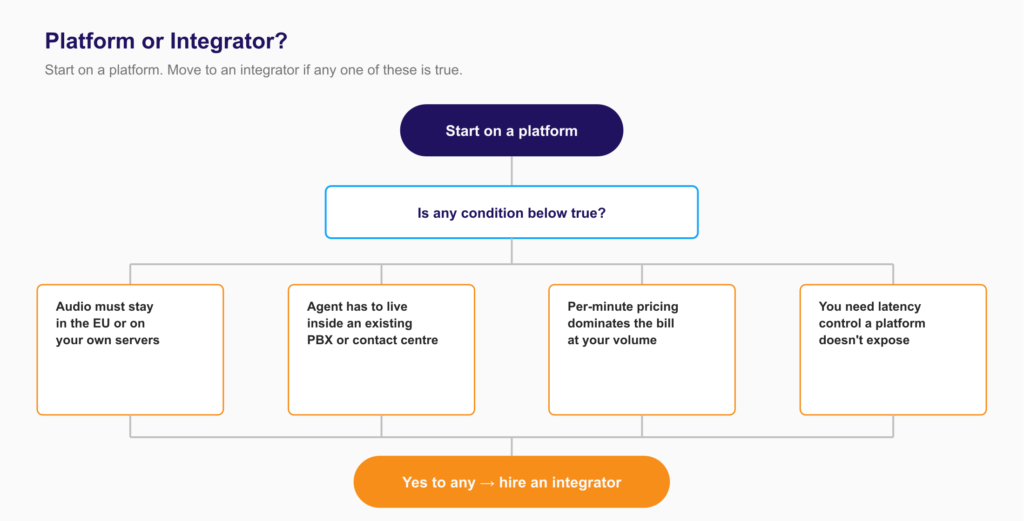
- Audio must stay in the EU or on your servers, and every component (carrier, speech models, logs) has to be in-region or self-hosted.
- The agent has to live inside an existing PBX or contact centre, with dialplans, queues, and human handoff that carry the conversation context.
- Per-minute pricing has become the biggest line on the bill at production volume.
- The behaviour that makes or breaks the product sits in a layer the platform owns: turn-taking, barge-in timing, jitter-buffer depth, media topology.
Most teams do both in sequence: prototype on a platform, then move the layers that matter in-house once a threshold is crossed. For the full criterion-by-criterion decision table (managed platform, open framework, model API, custom pipeline), see the comparison on our voice AI agent development page.
Weighing this for a specific product? That’s what our free 30-minute scoping call is for.
What Does It Cost to Build or Run a Voice AI Agent?
Two costs matter, and buyers often only model one: the cost to build, and the cost per minute to run.
Running cost. Platform rates published in September 2026 give the range: Vapi’s $0.05/minute hosting plus provider costs, Retell’s all-in $0.07–$0.31/minute depending on the model, and Telnyx’s $0.05/minute for STT, TTS, and orchestration. Compliance adds fixed cost too: Vapi lists HIPAA at $2,000/month, and LiveKit Cloud offers a BAA only from its $500/month Scale plan. In our own cost breakdown of a voice AI platform, a worked example of 10,000 calls a month on a cascaded pipeline came to about $0.06–$0.16 per minute in component costs before engineering and operations. Text-to-speech and the choice of a speech-to-speech model move it most.
Build cost. Some integrators publish packaged prices: Fora Soft’s pilots start from $8K, RaftLabs’ first voice phase from $9,500, and Sheerbit’s bands run from $15K–$35K for a single use case to $80K–$120K+ for carrier-grade. Those are entry points for defined scope. Trembit doesn’t publish a rate card; we quote after a scoping call, because the drivers below change the answer by multiples:
- Call volume and peak concurrency, which decide both infrastructure sizing and when a platform stops being cheaper.
- Cascaded or speech-to-speech architecture, and self-hosted or API-based models.
- Telephony depth: a phone number on a platform versus integration with an existing PBX, dialplans, and human handoff.
- Languages and domain vocabulary, each of which needs testing on real phone audio.
- Systems the agent must act in (CRM, EHR, ATS, booking, ticketing).
- Compliance and data residency: the BAA or DPA chain, EU or on-premises hosting, zero-persistence audio.
Frequently Asked Questions
What’s the difference between a voice AI agent platform like Vapi or Retell and a voice AI agent development company? A platform sells a hosted agent runtime: you configure prompts, models, and phone numbers, and pay per minute. A development company, or integrator, builds an agent you own on infrastructure you choose, and takes responsibility for telephony integration, latency tuning, and compliance. Many integrators build on platform components where they fit, so the choice is about which layers you need someone else to own.
Do I need an integrator, or is a managed platform enough for my call volume? At modest volume with a standard call flow, a managed platform is usually enough and the fastest route to real callers. You need an integrator when audio must stay in the EU or on your own servers, when the agent has to work inside an existing PBX or contact centre, when per-minute fees dominate your costs at volume, or when you need control over turn-taking and latency that the platform doesn’t expose. If a platform pilot or an in-house build has stalled, an integrator can also take it over rather than start again.
Which voice AI agent companies handle SIP and PSTN telephony, not just in-app voice? On this list, Trembit, Fora Soft, RTC League, Sheerbit, and Relinns state SIP or PSTN integration explicitly, and WebRTC.ventures lists SIP expertise. Sheerbit is the most telecom-native, with a FreeSWITCH, Asterisk, and Kamailio core. On the platform side, Vapi and Retell both accept your own SIP trunk, LiveKit supports SIP trunks from Twilio, Telnyx, Plivo, and Sinch, and Telnyx is itself a carrier.
Can a voice AI agent be HIPAA-compliant, and does that depend on who builds it? Yes, and it depends on the whole call path rather than any one vendor’s badge. Every service that touches patient audio needs a BAA that covers that service and that modality, from the carrier to speech-to-text, the model, text-to-speech, and recording storage. Coverage for text doesn’t automatically extend to audio, so check each provider’s current HIPAA-eligible list for the audio modality. The builder decides which components are used and where audio goes, so ask them to show the BAA chain for your design.
How much does it cost to build a custom voice AI agent versus using a platform? Platforms published running costs between about $0.05 and $0.31 per minute in September 2026, plus fixed fees for compliance tiers. Integrators that publish packaged prices start at roughly $8K–$15K for a single-use-case pilot and go past $120K for carrier-grade builds. What moves the number is call volume, architecture, telephony depth, languages, system integrations, and compliance scope. Our voice AI cost breakdown models the running side per component.
How fast should a voice AI agent respond? The targets we design to are a first response within roughly 500–1,200 ms of the caller finishing and later turns nearer 300–600 ms; at around two seconds callers tend to assume the line dropped. Those are design targets, not measured results. What a given agent achieves depends on model choice, transport, geography, and endpointing, so ask any vendor for a measured, per-stage figure from a system that real callers used.
Planning a Voice AI Agent?
If you’re choosing between a platform and a custom build, stuck on latency, or blocked by a compliance review of your audio path, book a free 30-minute call with a Trembit real-time engineer. Bring the specific decision: the call volume you’re modelling, the PBX the agent has to live in, the BAA gap legal flagged, or the turn-taking problem callers keep hanging up on. We’ll map the latency budget and the compliance path with you, and tell you honestly if a platform would serve you better. No deck, no pitch. Start on our voice AI agent development page.