By Eugenia Nemkova, Marketing Director, Trembit · Last updated 21 October 2026
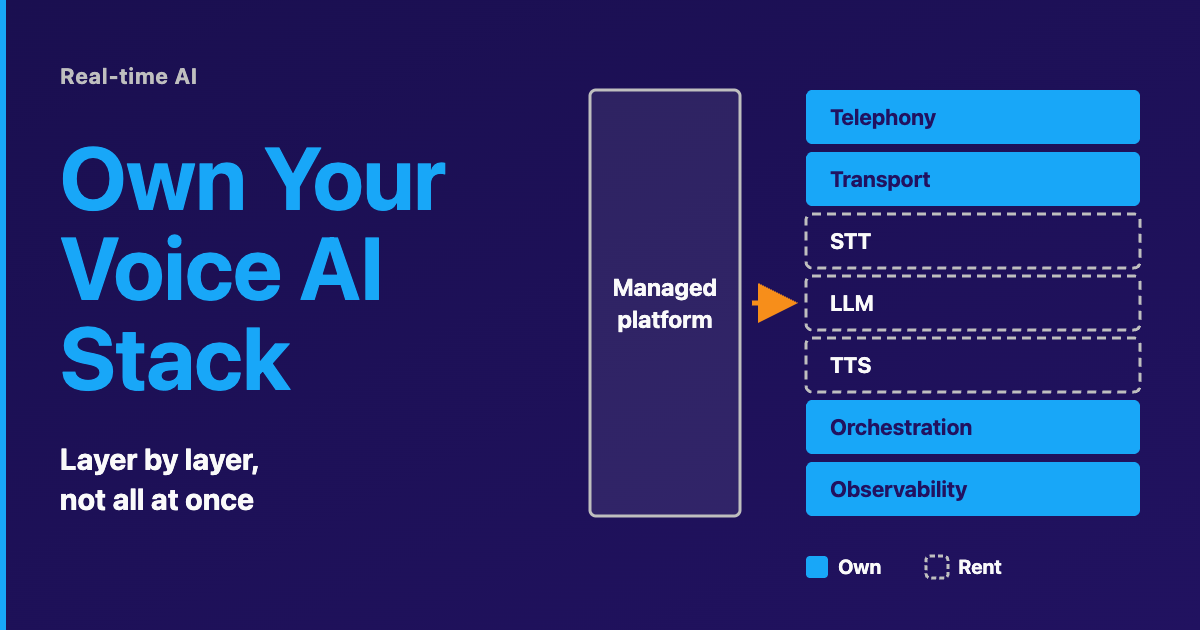
A Vapi alternative or Retell alternative can be another managed platform, an open framework on managed hosting, or a stack you run yourself. This guide covers the last case: replacing the hosted runtime (telephony, orchestration, turn-taking, call logging) with components you operate, while you keep renting the speech-to-text, LLM and text-to-speech APIs. It is a decision you make layer by layer, not all at once. Our view is that teams on Vapi or Retell should stay until a specific signal fires: cost at volume, a compliance gap, a latency control they can’t reach, a phone system the platform can’t join, or exit risk. Below are the signals, the layers you’d take over, and a migration without a big-bang cutover.
Key takeaways
- Leave on evidence, not frustration. Five signals justify a look: cost at volume, BAA or residency gaps, latency control, PBX/SIP integration and lock-in. One signal justifies measuring; two or three justify a plan.
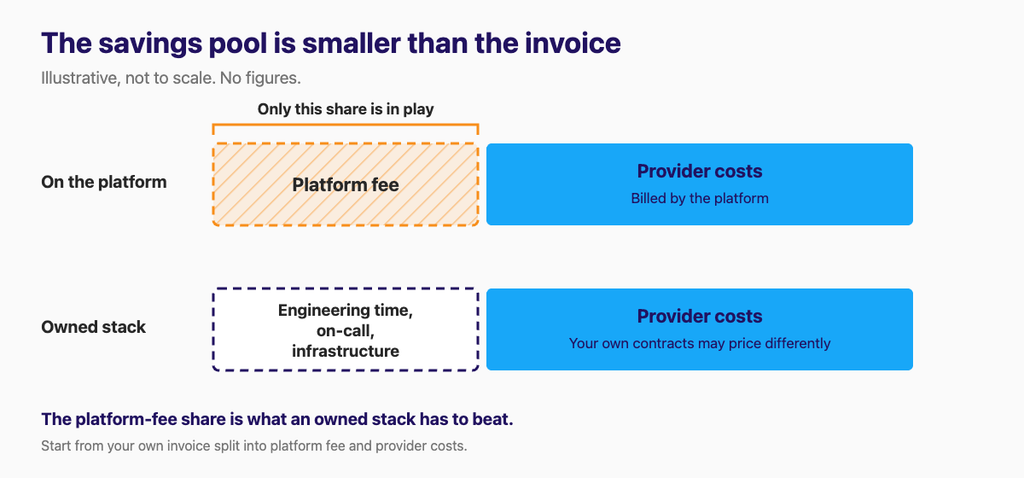
- The savings pool is smaller than the invoice. Vapi bills provider costs with no markup, so leaving removes the platform fees, not the model bill.
- In our judgment, teams usually take over telephony and orchestration and keep renting the model APIs.
- Owning the stack moves compliance work; it doesn’t delete it. Every component that stores or processes audio needs its own BAA or DPA, signed by you.
- Migrate one assistant at a time, split traffic at the phone number, and keep the platform as your rollback.
Not the engineer? Read when to leave for the decision test, then jump to how to migrate and what we’ve built. Engineers: start at the layer map.
When does it actually make sense to leave Vapi or Retell?
When a signal has fired and you can show it with your own data. Each signal below has a test you can run this week.
| Signal | Test it this week | What the result means |
|---|---|---|
| Per-minute cost | Split last month’s invoice into platform fee and pass-through provider costs | Only the platform-fee share is in play |
| BAA or data residency | Draw the BAA chain for one call | A party that can’t sign is a blocker |
| Latency and turn-taking | List the controls you need and check which are exposed | A control you can’t reach is a ceiling |
| PBX/SIP | Map where the call must live: PBX, contact centre, transfers, recording | Test that path first |
| Lock-in | Inventory what’s portable (prompts, tool schemas) and what isn’t (platform objects) | Exit cost grows with each platform-only object |
Measure latency before you blame the platform. Our guide to the latency budget and turn-taking shows where the milliseconds go.
The savings pool. Vapi’s pricing page lists hosting at $0.05 per minute on usage-only pricing, says provider costs carry “no markup”, and lists models as “pass-through at cost”. Retell’s pricing page lists voice infrastructure at $0.055 per minute, with LLM, TTS and telephony as separate lines. It doesn’t say whether those lines are at provider cost, so compare them with direct provider rates. (Both checked 21 October 2026.)
Vapi also lists fixed lines: HIPAA at $2,000 a month, and Success Packages (Core is $29 a month; Pro is 10% of hosting with a $999 monthly minimum). On usage-only pricing with HIPAA, 100,000 minutes a month is $5,000 of hosting plus $2,000, so about $7,000 of platform fees. A Success Package adds to that floor. On Retell, the infrastructure line alone is $5,500 at that volume. Your model spend stays when you leave, though your own provider contracts may price it higher or lower than the platform does. The platform-fee share is what an owned stack has to beat once you add engineering time, on-call and infrastructure. Our model of owned-side component costs covers that side; start from your own invoice split.
Haven’t built yet? Choosing between an integrator and a platform is the buy-side version of this decision.
When should you stay on the platform?
Trembit sells custom builds, so we aren’t neutral here. Stay anyway if most of these hold:
- Voice is a feature of your product, not the product.
- Volume is modest: the platform fee costs less than replacing it.
- The flow is standard: answer, a few tool calls, a transfer.
- The platform’s current tiers meet your residency and BAA needs.
- Nobody on the team can carry on-call for a real-time system.
Count what you would rebuild: call logs, transcripts, dashboards, test runs and concurrency management. Concurrency is a line item. Vapi includes 4, 10 or 30 concurrent calls depending on the package and sells extra lines at $10 per line per month. Retell includes 20 and charges $8 per extra concurrent call per month (both checked 21 October 2026). On an owned stack, concurrency is capacity you plan and monitor yourself.
What are the real alternatives to Vapi and Retell?
They fall into four classes, and the class decides what you own. Disclosure: class 4 is what we sell.
| Class | You own | You still rent | Fits |
|---|---|---|---|
| 1. Another managed platform | Prompts, tool contracts | Runtime, telephony, logging | Leaving over one vendor issue |
| 2. Open framework, managed hosting | Agent code, turn-taking | Media servers, scaling | Code-level control, no ops team |
| 3. Open framework, self-hosted | Code, servers, SIP, logs | Model APIs | Residency or on-prem mandates; voice is the product |
| 4. Custom pipeline or integrator | Your choice | Your choice | Non-standard media paths, regulated audio, PBX-heavy estates |
Vendor facts for the two open frameworks (checked 12 October 2026):
- LiveKit Agents runs an STT-LLM-TTS pipeline with its own turn-detection model and telephony support. It is open source “under the Apache 2.0 license”, and agent servers register with a LiveKit server “either self hosted or LiveKit Cloud” (LiveKit Agents docs).
- Pipecat is BSD-2 licensed (GitHub). Pipecat Cloud runs agents “fully managed in Daily-hosted regions” or “in your own VPC” (Pipecat docs).
What does owning the voice stack mean, layer by layer?
A common split, in our judgment, is to own four of these seven layers and keep renting three.
| Layer | Platform today | Owning it means | Common split |
|---|---|---|---|
| Telephony / SIP | Terminates trunk or numbers, handles transfers | You run the SIP endpoint, transfers and recording | Own (carrier stays rented) |
| Transport (WebRTC/WebSocket) | Moves audio between caller, models and app | You operate the media path | Own |
| STT | Calls a provider | You hold the contract | Rent |
| LLM | Calls a provider | You hold the contract | Rent |
| TTS | Calls a provider | You hold the contract | Rent |
| Orchestration | Turn-taking, barge-in, tool calls | Your code, framework or custom | Own |
| Observability and testing | Logs, transcripts, dashboards, tests | You build or buy each piece | Own or buy |
Read the last column as a pattern, not a rule; an on-prem mandate may pull STT in-house too.
Transport is a real choice. WebSocket carries audio over TCP: one lost packet stalls everything behind it, and there is no built-in jitter buffer or echo cancellation, which suits a stable server-to-server leg. WebRTC carries media over UDP with jitter buffering, echo cancellation and congestion control built in, and you operate media servers and TURN. That is the same problem as any real-time AI over WebRTC build.
Telephony and SIP: the layer teams underestimate
Your carrier relationship usually survives the move. What changes is the signalling endpoint, the media path, transfers and recording. From the vendor docs (checked 21 October 2026):
- Vapi BYO SIP links your DID to a
byo-sip-trunkcredential. Its docs warn that missing signalling IPs can cause 401 errors on inbound calls (Vapi SIP trunk docs). - Retell recommends elastic SIP trunking. On its “Dial to SIP URI” path, “you will not be able to use Retell’s transfer call feature” (Retell custom telephony docs).
- LiveKit SIP, if you self-host, “needs to be deployed separately”, and it doesn’t support SIP REGISTER or SIPREC (LiveKit SIP docs).
Plan for three things:
- Audio quality. PSTN audio is usually G.711 at 8 kHz, which caps STT accuracy and TTS quality whatever the model.
- DTMF. IVR menus and PIN entry arrive as DTMF, typically as RTP events (RFC 4733).
- Transfers. A blind transfer is usually a SIP REFER to the carrier or PBX. A warm transfer bridges a second leg and keeps you in the media path, where recording and consent rules apply.
If your setup registers to a PBX or depends on SIPREC, confirm the target runtime supports it first. Our PBX-side architecture with FreeSWITCH covers bridging an existing phone estate to an AI runtime.
Orchestration: where owning pays and where it hurts
In our view, orchestration is the layer that most often drives a move, and the hardest to get right. Three mechanics decide whether a call feels natural:
- Endpointing. Silence-based voice-activity detection cuts off callers who pause mid-thought. Semantic endpointing waits for a complete utterance but adds delay.
- Barge-in. On an interruption, stop TTS, cancel the pending generation and truncate the history to what the caller actually heard. Otherwise the LLM reasons from sentences the caller never heard.
- Echo. Barge-in also depends on echo cancellation, or the agent hears itself.
Choose the framework deliberately. Our comparison of which orchestration framework fits makes the point that switching later is an unplanned project of its own.
Observability and testing: what the platform gave you without asking
Logs, transcripts, per-call cost, dashboards and test runs come with the platform. After the move, each one is a work item: per-turn logs, recording storage with retention, call replay against a new prompt, and alerts when completion rates drift.
Do the BAA, GDPR and data-residency gaps close if you self-host?
Partly. Self-hosting gives you control over where audio goes. It changes who signs the agreements, not how many you need.
Where the platforms stand:
- Vapi offers HIPAA as “a paid compliance add-on with Usage only or any Success Package”, enabled in the dashboard, not the API. PHI may pass only through the
/callendpoint. HIPAA mode and Zero Data Retention “are mutually exclusive”, and recordings, transcripts and logs “are still stored, in Vapi’s private HIPAA-compliant storage” unless you configure your own (Vapi HIPAA docs, checked 21 October 2026). - Vapi’s EU region is “available only with the Premier Success Package” (Vapi EU region docs, checked 21 October 2026).
- Retell’s pricing page lists “HIPAA / BAA” and, under Enterprise, “Custom BAA”, without saying which plan includes a BAA (checked 21 October 2026). Confirm the tier with Retell.
Under HIPAA, a party that “creates, receives, maintains, or transmits protected health information” on a covered entity’s behalf is a business associate. The definition reaches data-transmission providers that require “access on a routine basis” to that information (45 CFR 160.103). The assurances “must be documented through a written contract or other written agreement or arrangement” (45 CFR 164.502(e)).
STT, LLM, TTS, recording storage and logs all process or keep call content, so each needs a BAA in the US or a data processing agreement under GDPR. A carrier that only transmits the call may fall outside the definition under what is often called the conduit exception; confirm with counsel whether yours does. Speech-to-speech models need one more check: the audio-modality HIPAA gap.
Self-hosting doesn’t fix access control, retention, deletion or incident response; those become yours. This is a design consideration, not legal advice.
How do you migrate without a big-bang cutover?
Martin Fowler’s strangler fig pattern fits: “we move bits of behavior from the legacy system into the new code base” (Fowler). Here the platform is the legacy system and the phone number is the seam.
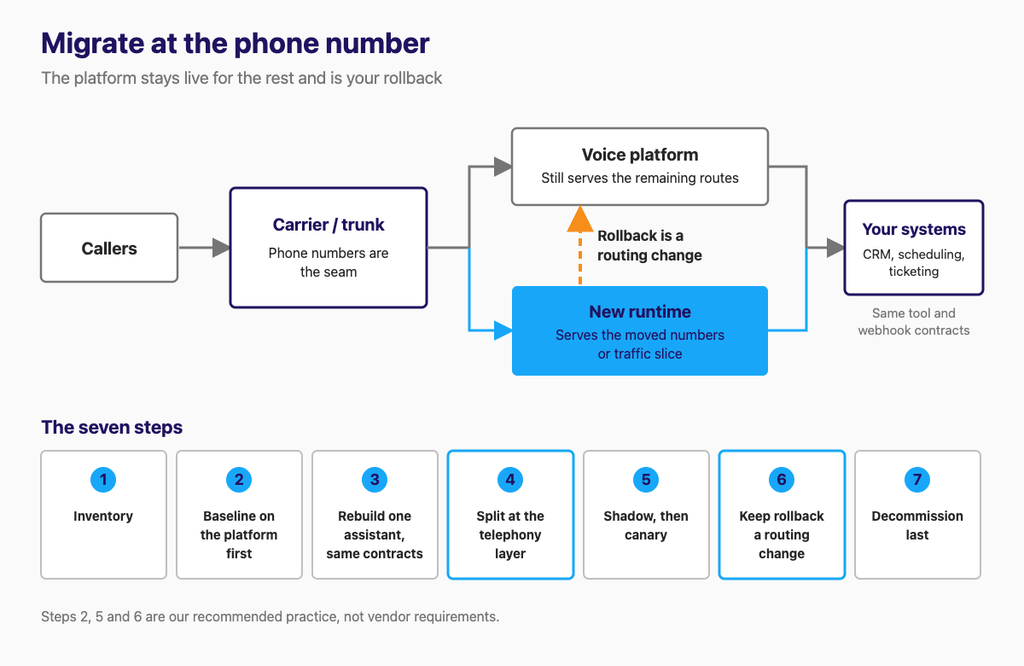
The stakes are customer-facing: a failed cutover shows up as missed calls, dropped transfers and recordings that never landed. The sequence below limits that exposure to the traffic you chose to move.
- Inventory assistants, prompts, tool and webhook contracts, phone numbers (and who owns each), transfer rules, and the recordings and transcripts you can export.
- Baseline on the platform first: end-to-end response time, interruption handling, task completion and cost per completed call. Without a baseline, “parity” is an opinion.
- Rebuild one assistant behind the same contracts, so your CRM, scheduling and ticketing systems don’t notice.
- Split at the telephony layer. Route some numbers, or a slice of traffic, to the new runtime at the carrier or trunk. The platform serves the rest.
- Shadow, then canary. Test the new stack on scripted or recorded calls (where consent allows) first. Replay tests recognition and answers, not timing. A caller’s pauses and interruptions were reactions to the old agent, so barge-in and endpointing problems only show up in live traffic. Then send a small share of live calls, and widen it only when the baseline metrics hold.
- Keep rollback a routing change. Leave the platform assistant configured and billable for an agreed window.
- Decommission last, after exporting call history and a defined stable period.
For sizing, our voice AI service page gives 4–8 weeks in total for a proof of concept on real calls, and typically 3–5 months for a production build. Those are custom-build timelines; how long a migration takes depends on what step 1 turns up.
Steps 2, 5 and 6 are our recommended practice, not vendor requirements. Two common mistakes:
- Measuring after the move. Without a platform baseline, you can’t show the new stack is better.
- Cutting every number over before the new stack is proven. Move number ownership early if needed (see the FAQ); move traffic late.
It is the same discipline we wrote up for teams moving off CPaaS video.
Planning a move off Vapi or Retell? A free 30-minute call with a Trembit real-time engineer is the place to pressure-test your cutover sequence.
What does owning the stack add to your workload?
The bill that isn’t on the invoice:
- on-call for a system where failure means dropped calls
- concurrency capacity
- carrier relationships and SIP debugging
- evals whenever a prompt or model changes
- framework upgrades: pin versions and read changelogs, because both open frameworks release often
It’s worth it when voice is the product, when residency or PBX constraints rule out every platform tier, or when the platform-fee share clearly exceeds the cost of the team you’d add. If a first in-house real-time build has already stalled, we also take over stalled WebRTC builds.
What does owning a voice stack look like in production?
Trembit has built the owned layers these migrations move to. Three engagements show what that looks like:
- An AI phone-screening agent for a staffing company. We built the conversation and turn-taking layer. It includes real-time STT tuned for phone audio, natural TTS, silence detection and interruption handling, and call-quality monitoring with alerts when metrics drift. Early versions had “accurate transcription but awkward timing”. The fix was a multi-signal turn-taking model that combines audio energy, speech cadence, syntactic completeness and prosody. The case study records 10x screening throughput and an 80%+ reduction in initial screening hours.
- In-call medical translation for Cloudbreak (a video-conferencing build, not a phone agent). C/C++ modules on a custom mediasoup SFU intercept audio at the RTP level, and the pipeline keeps zero data persistence (case study). That is audio-path control under HIPAA and GDPR.
- On-premises speech-to-text for a media company. GPU inference runs on the client’s own infrastructure with “no audio sent to external services” and returns partial results within 1–2 seconds (case study). That is the self-hosted STT option from the layer map.
On telephony, we run FreeSWITCH in production as a SIP/PSTN bridge on a HIPAA/GDPR healthcare communications platform (FreeSWITCH and HIPAA). That is the bridge role, not a voice-AI runtime. Owning a stack is also a long commitment. On Learnster’s corporate-learning platform, we took over a stalled project and still run the engineering programme, an ongoing partnership of 7+ years.
We haven’t documented a Vapi or Retell migration or a Pipecat or LiveKit Agents delivery. We also haven’t published a measured end-to-end response time for a delivered agent, so we don’t claim one.
Frequently asked questions
Is Vapi open source, and can you self-host it? We found no open-source release of the Vapi platform. Its pricing page describes “a fully managed platform”, and its documentation FAQ says “No, Vapi does not support on-premise deployments” (checked 21 October 2026). If you need to self-host, look at classes 3 and 4 above.
What is the difference between Vapi and Retell? Mainly pricing structure, SIP behaviour and compliance tiering. Vapi lists $0.05 per minute of hosting with provider costs passed through. Retell lists $0.055 per minute of infrastructure with LLM, TTS and telephony itemised. Retell’s SIP-URI path loses its transfer feature. Vapi’s EU region needs the Premier package, and Retell’s BAA tier needs confirming. We don’t rank them.
Can I keep my phone numbers when I leave? Numbers on a carrier account you hold stay with you. A free Vapi number sits on Vapi’s own carrier accounts with no port-out PIN. Vapi’s docs say to “buy or port it into that provider directly, then import it into Vapi” (Vapi docs). Retell-purchased numbers are US and Canada only, and its docs describe importing numbers but not porting them out (Retell docs), so confirm with Retell.
Should the replacement be Pipecat or LiveKit Agents? It depends more on transport and hosting than on features. Our Pipecat vs LiveKit Agents comparison covers the choice.
Planning a move off Vapi or Retell?
Book a free 30-minute call with a Trembit real-time engineer. The minimum to bring is your last invoice and your monthly minutes. If you have the BAA or DPA status of each sub-processor and your number and assistant counts, bring them too. We’ll tell you whether a signal has actually fired, which layers to take over first and how we’d sequence the cutover, or that staying is the better call. No deck, no pitch. Book the call through our voice AI agent development page.