AI document processing for FinTech is the use of custom OCR, natural language processing, and machine learning to turn unstructured financial documents — bank statements, leasing contracts, loan applications, KYC files — into structured, decision-grade data that underwriting, risk, and compliance teams can act on with confidence. It goes further than generic OCR, which reads characters: a decision-grade pipeline has to understand what it reads, reconcile numbers across pages and periods, and produce output a credit committee and a regulator will actually trust. The hard part isn’t lifting text off a page — off-the-shelf tools already do that. It’s the format diversity, multi-language terminology, and numerical precision of real financial documents, plus the explainability that decides whether an AI-generated risk score gets used at all or quietly routed around.
Key takeaways
- Generic OCR and template-based extractors fail on real-world financial documents because formats, languages, and layouts vary too much from one issuing bank to the next. The fix isn’t more templates — it’s teaching a model to read a document semantically, the way an analyst does, so it generalizes to formats it has never seen.
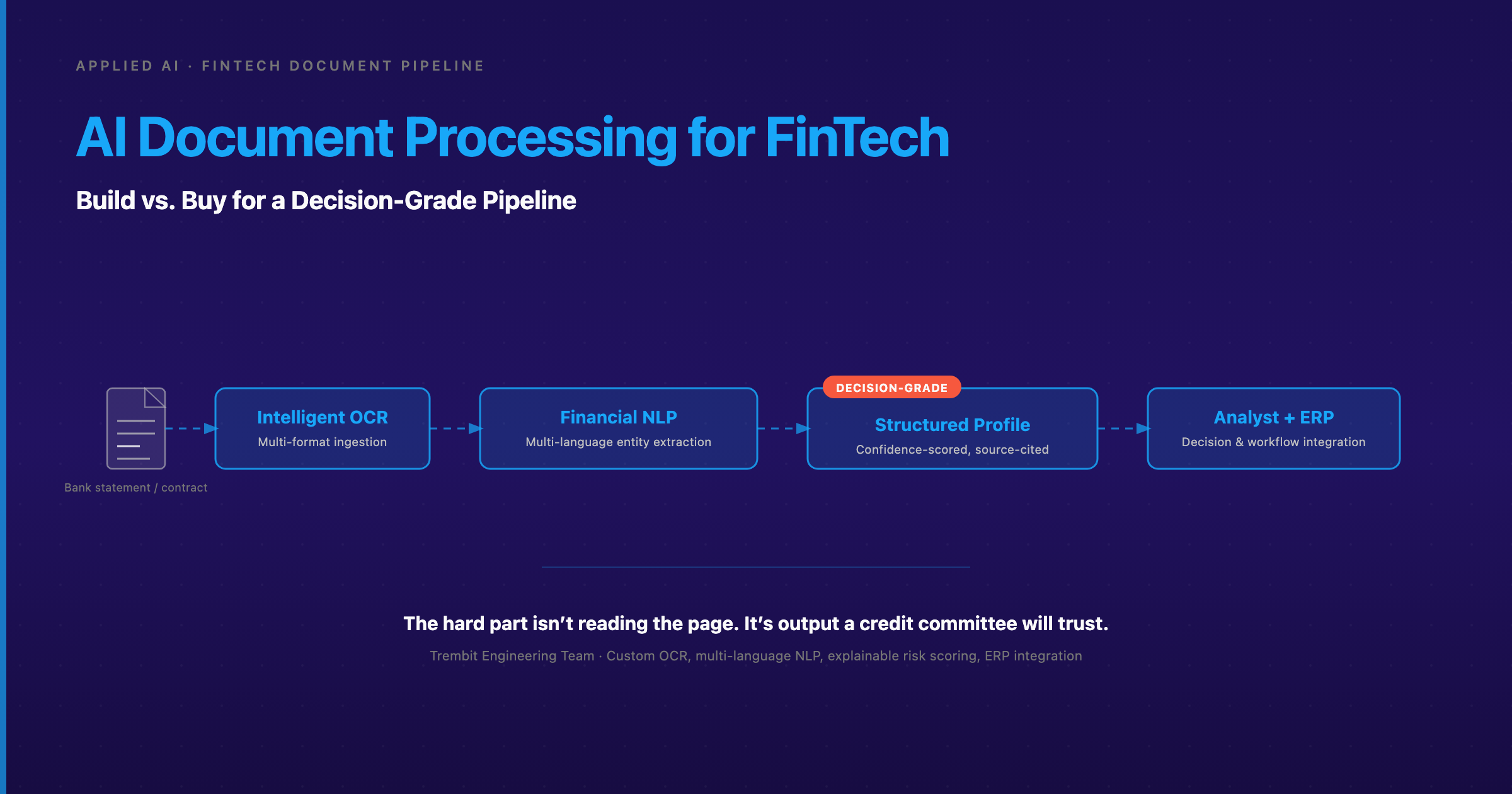
- A decision-grade pipeline has four layers: intelligent OCR and ingestion → multi-language financial NLP and entity extraction → a structured financial profile with confidence scoring and source citations → integration into the underwriting or ERP workflow.
- Numerical accuracy needs redundant, cross-checked verification, not just a better OCR engine. A multi-pass system that checks extracted numbers against mathematical and temporal consistency catches over 95% of OCR numerical errors before they reach a report.
- Explainability isn’t a nice-to-have for financial-services AI — it’s the reason a risk-scoring system gets used at all. Credit analysts and regulators need a weighted, auditable breakdown of why a document or contract scored the way it did, not a single opaque number.
- Parsing accuracy is the foundation everything downstream depends on: the difference between 98% and 90% contract-parsing accuracy is the difference between a system analysts trust and one they work around.
- Build vs. buy is a real trade-off, not a default answer. Off-the-shelf IDP platforms move faster for standardized document types; custom builds earn their cost when document diversity, explainability, and ERP-native integration are core to the product and compliance posture. Most published “IDP buyer’s guide” content skips this trade-off because platform vendors wrote it.
This is a dual-audience piece. If you’re scoping the technical architecture, start with “What does a decision-grade pipeline actually look like.” If you’re weighing whether an AI-generated profile or score will hold up with your risk committee and regulators, jump straight to “How do you build explainability” and “What results can you expect.”
What is AI document processing in FinTech, and how is it different from generic OCR?
AI document processing in FinTech combines OCR, NLP, and machine learning to convert unstructured financial documents into structured, actionable data — but the “AI” part is doing something generic OCR never attempts. OCR reads characters: it turns an image of a page into a string of text. Decision-grade financial document AI has to understand what those characters mean in context — recognize the difference between a running balance and a single transaction, infer that a recurring monthly credit is a salary even when the label differs from one bank to the next, and reconcile figures that appear across multiple pages and statement periods.
In a FinTech setting the document types are specific and unforgiving: multi-month bank statements, leasing and loan contracts, financial statements, and KYC documents. Each carries numbers that directly change an approval decision, and each arrives in a format the system doesn’t control. That combination — high-stakes numbers plus uncontrolled format — is what separates financial document AI from the general “scan a form” problem that template tools were built for. The rest of this guide is about what that difference actually costs to build.
Why do generic OCR and template-based tools fail on real financial documents?
They fail because real financial documents are not standardized, and template-based extraction assumes they are. A template says “the balance is in cell B12, transactions start at row 15” — which works for the top twenty formats you’ve seen and breaks the moment a bank updates its layout or a new institution appears. Trembit hit exactly this wall building an AI financial document analyzer for a European leasing company, where every application meant reviewing three to twelve months of statements drawn from dozens of European banks. Here is what breaks generic tooling on documents like these:
- Extreme format diversity across issuing institutions. A Commerzbank statement looks nothing like a BNP Paribas statement, which looks nothing like an ING statement — different column structures, different ways of distinguishing debits from credits, different balance presentation. And that’s before the hundreds of smaller regional banks, each with its own conventions.
- Multi-language financial terminology a general translator misses. “Habenzinsen” (German for credit interest), “virement” (French for transfer), and “storno” (a reversal) are financial-semantics terms, not vocabulary a keyword dictionary or a generic translation layer handles correctly across languages and banking conventions.
- Scanned and degraded image quality. Applicants submit phone photos of bank letters, faded print, skewed scans, and stamps overlapping text — conditions where a standard OCR engine produces garbled output that then needs manual correction.
- Transaction categorization without standardized labels. The same salary payment might appear as “GEHALT,” “SALAIRE,” “Loonbetaling,” or just a company name with no description. The system has to infer the category from context, amount, and timing — not read it off a fixed field.
The through-line: template extraction is brittle by design. It covers the formats you anticipated and fails silently on everything else — which, in a portfolio spanning dozens of banks and seven languages, is a constant stream of new cases. That’s the setup for the architecture the next section describes: read the document semantically instead of matching it to a template.
What does a decision-grade AI document processing pipeline actually look like?
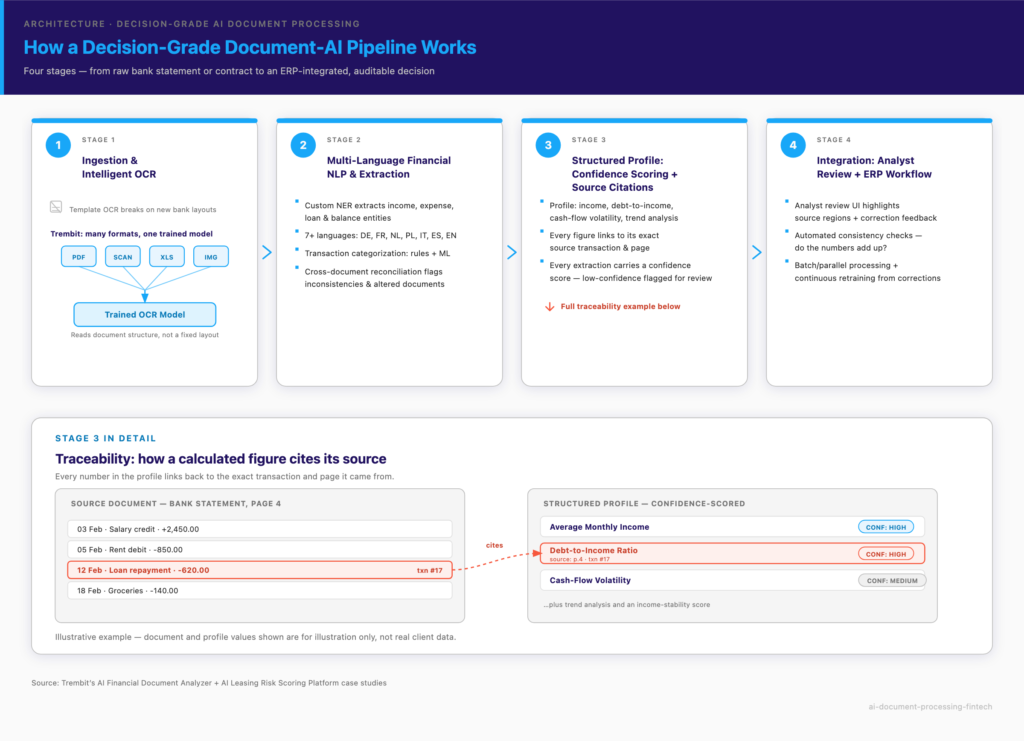
A decision-grade pipeline is built in four layers, each solving a distinct failure mode. This is the architecture Trembit shipped in the AI Financial Document Analyzer for Leasing Decisions — you can read the full build there and verify every claim below against the primary source.
1. Ingestion and intelligent OCR. A multi-format pipeline accepts native and scanned PDFs, spreadsheets, images, and mixed uploads, and routes each to the right processing path without the user having to declare what they sent. The OCR here is not a generic engine — it’s custom models trained in PyTorch on the typographic and numerical conventions of European financial documents specifically: comma-as-decimal separators, DD.MM.YYYY versus DD/MM/YYYY dates, and the currency symbols in play. Scanned and phone-captured submissions are deskewed and quality-enhanced before OCR runs, and a page-classification step identifies what each page actually is — a statement page, a cover letter, a loan schedule — instead of treating a multi-document upload as one blob.
2. Multi-language financial entity extraction and NLP. Custom TensorFlow named-entity-recognition models pull income, expense, loan, and balance entities regardless of the bank’s formatting or language, backed by domain-specific language models covering the languages the business actually operates in — for this build, German, French, Dutch, Polish, Italian, Spanish, and English. Transaction categorization combines rules and ML, and a cross-statement reconciliation step links transactions across months to track recurring income, catch missed payments, and flag inconsistencies that can indicate an altered document.
3. A structured financial profile with confidence scoring and source citations. The output is not raw extracted data — it’s a calculated profile: average monthly income, recurring obligations, debt-to-income ratio, cash-flow volatility, income-stability score, and trend analysis over the statement period. Two properties make it decision-grade. First, every number links back to the exact transaction and page it was derived from, so an underwriter can verify any figure in seconds instead of hunting through the original documents. Second, every extraction and calculation carries a confidence score, and anything below threshold is flagged for human review rather than presented as fact. This traceability is the single detail that turns the system from a black box analysts distrust into a tool they actively prefer — it is the case study’s own strongest lesson, and it’s why confidence-thresholded routing to a human is a design principle, not an afterthought (a pattern we go deeper on in Building an AI “Admin Co-Worker” with human-in-the-loop).
4. Integration and operational validation. An analyst review interface shows the AI-generated profile beside the original documents with highlighted source regions, and captures corrections as a feedback loop. Automated consistency rules cross-check the numbers — do individual transactions sum to the difference between opening and closing balance? — catching extraction errors before they reach underwriting. Batch, parallel processing handles peak-volume periods, and analyst corrections feed continuous retraining so accuracy improves each cycle.
The lesson underneath the whole architecture, stated plainly: the solution to document-format diversity is not more templates — it’s teaching the model to read the semantic structure of a financial document the way a human analyst does. A number in bold at the foot of a column is probably a balance; a two-column layout with dates on the left and amounts on the right is probably a transaction list; the largest regular monthly credit is probably salary. That semantic reading generalizes to banks the system has never seen, which is exactly what a template-based tool cannot do. Getting there is a genuine AI development effort — custom-trained OCR and NER, not a configuration exercise on someone else’s extractor.
How do you build explainability that risk committees and regulators will actually accept?
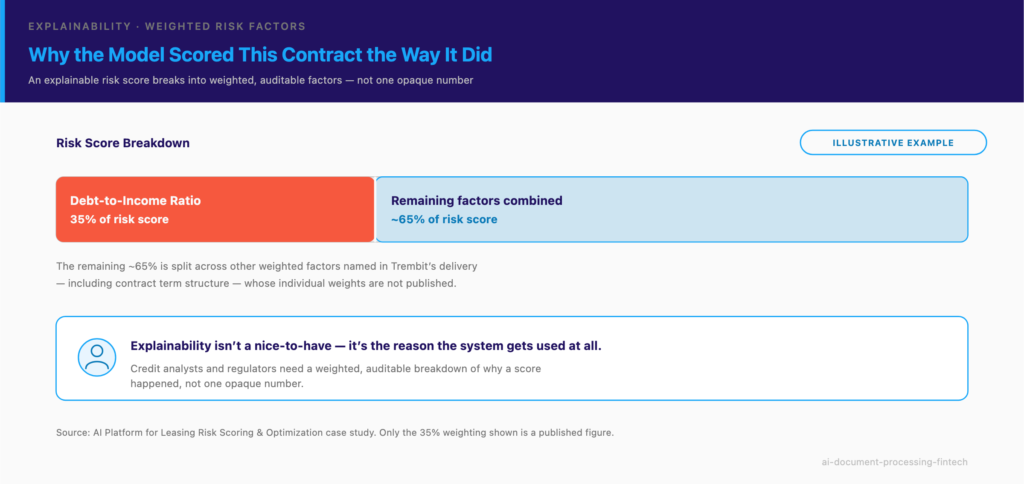
You build it by making every score decomposable into weighted, auditable factors a credit analyst can inspect and challenge — because a risk conclusion no one can question is a risk conclusion no one will use. This is the layer that speaks to the Head of Risk half of the audience, and it’s the core of the AI Platform for Leasing Risk Scoring & Optimization Trembit built for ESKA.
Black-box scores don’t get adopted. Financial regulators and internal risk committees don’t accept a prediction without a reason, and neither do the analysts who have to sign off on it. On this build, the team could have shipped a higher-raw-accuracy model using a more complex ensemble — but credit analysts wouldn’t use a system that says “this contract is high risk” without saying why. That’s not a preference; it tracks the direction of regulation. Under the EU AI Act (Annex III), AI used to evaluate creditworthiness is classified as high-risk and carries transparency and human-oversight obligations. And under the GDPR, individuals have the right to meaningful information about the logic of solely automated decisions (Articles 13–15) and the right to obtain human intervention and contest them (Article 22). A score you can’t explain is a score you can’t defend to either body.
What the explainability layer looks like in practice. Not a single opaque number — a breakdown of contributing factors per score, each weighted. The case study’s own example: a risk score where a high debt-to-income ratio contributed 35%, the contract term structure another quantified share, and so on. When an analyst can see that the debt ratio drove 35% of the score and exactly how the rest was apportioned, they can either agree or point to precisely where the model is likely wrong — and that feedback loop is what makes the system improve over time.
Calibrate for consequence asymmetry, not raw accuracy. In lending and leasing, a false negative — approving something that later defaults — costs orders of magnitude more than a false positive — flagging a good contract for a review it didn’t need. A model tuned purely for overall accuracy ignores that asymmetry. The decision threshold has to be calibrated to minimize default exposure, which is a different optimization target than “how often is the model right.”
Design for small data, not big data. Consumer credit scoring has millions of labeled examples; a leasing portfolio may have only thousands of contracts with a relatively low default rate. Training a model that generalizes from that few positive examples without overfitting is a fundamentally harder problem than large-dataset classification — and it’s why disciplined feature engineering, calibration, and explainability carry more weight here than raw model complexity, which would just memorize the handful of defaults you have.
The finding that matters most for this audience, in the case study’s own framing: explainability isn’t a feature — it’s the reason the system gets used at all. It’s what turned an AI recommendation analysts ignored into a tool they relied on.
If your risk committee or compliance team would ask “why did the model decide this” before trusting a single score, that requirement should shape the architecture from day one — not get bolted on after a pilot proves the accuracy. That’s exactly the kind of decision an architecture session exists to pressure-test, and it’s central to how we scope intelligent document processing builds.
Should you build custom AI document processing or buy an off-the-shelf IDP platform?
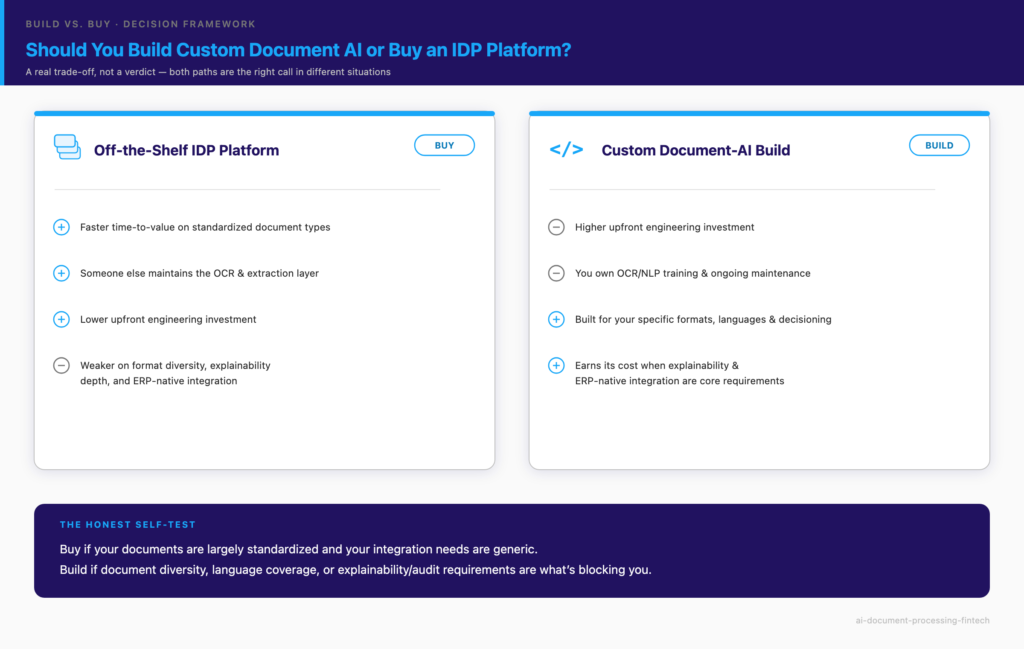
Buy when your documents are largely standardized and your integration needs are generic; build when document diversity, explainability, or ERP-native depth are the things actually blocking you. That’s the honest version of the answer, and it’s worth stating plainly because most published guidance on this question was written by platform vendors with a single preferred conclusion.
What buying a platform gets you. Faster time-to-value on common document types, someone else maintaining the OCR and extraction layer, and lower upfront engineering investment. For a team processing a handful of standardized form types with generic downstream needs, an off-the-shelf IDP platform is very often the faster, better call — and pretending otherwise would be vendor spin.
Where buying breaks down for financial-services use cases. Platforms are built for the common case, not your specific mix of document formats, languages, and decisioning logic. Explainability and confidence-scoring depth vary widely between products and may not satisfy your regulators or your risk committee. And “integration” on many platforms means another dashboard to log into and copy-paste from — not scoring that happens natively inside the ERP where your analysts already work. Those three gaps — format coverage, explainability depth, and integration depth — are precisely the ones that matter most in regulated lending.
Where custom-build earns its cost. When document diversity, explainability requirements, or integration depth are core to the product and compliance posture rather than conveniences. That’s the combination Trembit has built for European leasing: dozens of European bank formats and seven-plus languages in the document analyzer, and Odoo-native decisioning with regulator-auditable scoring in the risk platform. No general-purpose product was going to cover that combination well enough to be trusted with the decision.
An honest self-test instead of a verdict: if your documents are largely standardized and your integration is generic, a platform is probably the right answer, and you should start there. If your document diversity, language coverage, or explainability and audit requirements are what’s actually stalling you, that’s a build conversation — because those are the requirements platforms are structurally weakest on.
How does AI document processing integrate into existing underwriting and ERP workflows?
It integrates by disappearing into the workflow analysts already use — scoring documents automatically as they’re submitted and surfacing results where the work already happens, rather than adding a separate tool to log into. On the ESKA leasing platform, that meant native integration with the client’s Odoo ERP through a Node.js API layer connecting the Python ML services to the Odoo frontend — and it’s the difference between a system that gets adopted and one that gets abandoned within weeks. This is genuine ERP integration work, not a bolt-on dashboard.
A tiered decision pipeline, not a binary verdict. Contracts below a configurable risk threshold are auto-approved; higher-risk contracts are routed to an analyst with the AI’s reasoning attached; borderline and high-ambiguity cases are escalated with the specific concerns highlighted. That structure keeps humans on the decisions that need judgment and takes them off the ones that don’t — without ever handing a consequential call to a model unsupervised.
Invisible infrastructure, not another tool to learn. The case study’s own lesson is blunt: a standalone tool analysts have to log into separately, paste contract data into, and then manually transfer results back out of gets abandoned fast. The entire value comes from the AI sitting inside the existing workflow — contracts scored automatically on submission, results appearing where analysts already work, approvals flowing through the process they already know.
Operation is ongoing, not a one-time deployment. Financial risk models drift as economic conditions and portfolios change, so performance monitoring, drift detection, and retraining triggers are part of the system, not a launch-day afterthought — the production-coordination layer we cover in What Is an AI Orchestration Engine?. A model deployed once and forgotten quietly degrades until it’s making decisions on patterns that no longer hold.
What results can you expect from AI document processing in leasing and lending?
The results below come from Trembit’s financial document-AI work for European leasing — across two builds documented in full at the end of this piece: the document analyzer that turns bank statements into structured profiles, and the risk-scoring platform that decides what to do with them. Each figure is tied to the build that produced it. They’re what well-scoped builds achieved on those portfolios, not universal benchmarks; a different document mix, language set, or risk model will produce different numbers.
| Outcome | Result | Build |
|---|---|---|
| Processing time | Minutes per application — down from hours of manual analyst review | Document analyzer |
| Format and language coverage | Multi-format ingestion across dozens of European banks; 7+ European languages | Document analyzer |
| Numerical accuracy safeguard | Multi-pass verification catches over 95% of OCR numerical errors before they reach a report | Document analyzer |
| Contract-parsing accuracy | 98% — the level at which analysts trusted the output; at 90% they didn’t | Risk-scoring platform |
In the client’s own words:
“Trembit built us an AI system that reads bank statements the way our best analysts do — except it handles every European bank format, works in seven languages, and finishes in minutes instead of hours…”
— Leasing company operations director
“Before ESKA, our analysts spent hours reading contracts and making risk calls on instinct. Now the system reads the contract, scores the risk, and explains why — and our default rate has dropped…”
— ESKA platform client
The point isn’t the headline number — it’s what the number depended on. Minutes-per-application only mattered because the output was trustworthy, and the output was only trustworthy because of the traceability, the confidence scoring, and the explainability underneath it. Speed without decision-grade accuracy just moves the bottleneck to re-checking.