In the rapidly evolving world of telehealth, delivering seamless, secure, and scalable video consultations is a top priority for healthcare providers. CTOs tasked with selecting the right video infrastructure often face a confusing array of options. Among these, WebRTC, LiveKit, and Janus stand out as prominent choices—but which one fits best?
At Trembit, with extensive experience crafting real-time communication systems and telehealth solutions, we understand the need for clear, unbiased technical comparisons. This article breaks down these three technologies based on key requirements for telehealth: performance, scalability, security, customization flexibility, and ease of integration.
Why CTOs Need Beyond-the-Surface Comparisons
Most online discussions paint an overly simplistic picture of video technologies. Marketing hype often overshadows critical details such as latency impacts, server load patterns, or deep customization complexity — all crucial for telehealth settings, where video interruptions or data breaches can affect patient care quality and confidentiality.
Trembit’s engineering teams have evaluated these platforms in real telehealth MVPs, drawing on direct development insights rather than vendor claims. This article aims to provide CTOs with actionable data and practical pros and cons to inform their technology choices.
Overview of Technologies
| Technology | Description | Core Strengths | Typical Use Cases |
| WebRTC | Open-source protocol enabling peer-to-peer real-time media communication directly in web browsers without plugins. | Ultra-low latency, broad browser support, no server needed for simple calls. | 1:1 video calls, simple conferencing, P2P group chats |
| LiveKit | Open-source SDK and server combining WebRTC with SFU (Selective Forwarding Unit) architecture to manage multi-party video at scale. | Scalable group video, advanced features (custom layouts, recording), cloud-friendly. | Group telehealth, multi-party consultations, webinars |
| Janus | Modular WebRTC server framework with plugin-based architecture providing flexibility in routing, recording, and advanced signaling. | Ultra-low latency, broad browser support, and no server needed for simple calls. | Complex telehealth workflows, custom media handling, security-sensitive deployments |
Performance and Latency
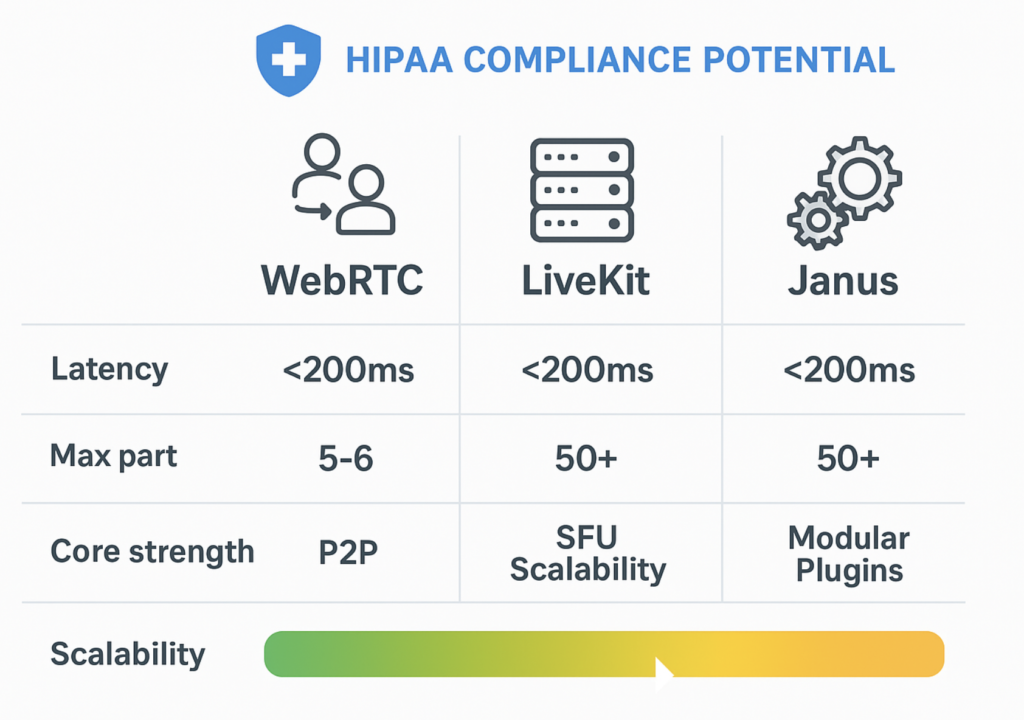
- WebRTC delivers the lowest latency between two peers due to its peer-to-peer nature, but suffers as group sizes grow because each client manages multiple connections independently.
- LiveKit uses SFU architecture to forward streams efficiently, maintaining latency typically under 200ms for groups of up to dozens of participants.
- Janus provides flexible routing with low latency and supports advanced media handling; latency depends on the specific plugin and architecture, but can be tuned extensively.
In telehealth, where conversations must feel natural and uninterrupted, maintaining latency below 250ms is essential. All three can achieve this, but LiveKit and Janus scale better beyond simple calls.
Scalability and Load Management
| Metric | WebRTC | LiveKit | Janus |
| Max participants (typical) | 5-6 per call (P2P overhead) | 50+ (SFU optimized) | 50+ with advanced tuning |
| Server load | Minimal for 1:1; high for multi-party | Medium, optimized routing | Variable, depends on plugin usage |
| Cloud readiness | No native server component | Requires careful architectural design | Requires careful architecture design |
LiveKit’s built-in SFU server shines in multi-party telehealth scenarios by reducing the client resource burden and network complexity. Janus, being modular, can handle complex scenarios but needs skilled customization.
Security and Compliance
Telehealth requires strict compliance with HIPAA, GDPR, and other healthcare regulations. Security considerations include encrypted media, secure signaling, data retention policies, and audit logs.
- WebRTC offers end-to-end encryption by default, but it depends on the implementation for signaling security.
- LiveKit provides encryption in transit and at rest, with the ability to integrate authentication and access control mechanisms.
- Janus supports encrypted transport and customizable security layers, allowing implementation of sophisticated privacy controls needed for sensitive telehealth data.
At Trembit, we’ve implemented custom security modules in LiveKit and Janus-based telehealth solutions, ensuring compliance and patient data protection.
Customization and Integration
| Aspect | WebRTC | LiveKit | Janus |
| API complexity | Moderate; browser APIs | Simple SDKs, REST APIs | Complex plugin-based SDK and APIs |
| Media control | Limited to peer streams | Advanced layout, simulcast, recording | Extensive plugin options for media manipulation |
| Extensibility | Low (client-based) | Moderate (server SDK) | Very high (plugin architecture) |
For telehealth products requiring advanced features like multi-role participants (doctor, patient, assistant), recording with metadata, live annotation, or integration with EHR systems, Janus provides unmatched flexibility. LiveKit strikes a balance by supporting advanced multi-party features with an easier learning curve.
Trembit’s Experience in Telehealth Video Solutions
Trembit has successfully delivered telehealth platforms integrating scalable LiveKit clusters, custom Janus servers for secure and compliant workflows, and optimized WebRTC for lightweight consultations. Our approach combines performance tuning, seamless user experience, and robust security to meet strict healthcare standards.
Choosing the Right Technology Matrix
| Use Case | Best Fit | Why? |
| Simple 1:1 video consultations | WebRTC | Minimal latency, no server required. |
| Multi-party group consultations/scaling | LiveKit | SFU architecture, scalable, manageable server component. |
| Highly customized workflows, security-focused | Janus | Plugin flexibility, custom routing, advanced media capabilities. |
Performance and Latency
- WebRTC delivers the lowest latency between two peers due to its peer-to-peer nature, but suffers as group sizes grow because each client manages multiple connections independently.
- LiveKit uses SFU architecture to forward streams efficiently, maintaining latency typically under 200ms for groups of up to dozens of participants.
- Janus provides flexible routing with low latency and supports advanced media handling; latency depends on the specific plugin and architecture, but can be tuned extensively.
In telehealth, where conversations must feel natural and uninterrupted, maintaining latency below 250ms is essential. All three can achieve this, but LiveKit and Janus scale better beyond simple calls.
Scalability and Load Management
| Metric | WebRTC | LiveKit | Janus |
| Max participants (typical) | 5-6 per call (P2P overhead) | 50+ (SFU optimized) | 50+ with advanced tuning |
| Server load | Minimal for 1:1; high for multi-party | Medium, optimized routing | Variable, depends on plugin usage |
| Cloud readiness | No native server component | Built-in server, easily deployable on the cloud | Requires careful architectural design |
LiveKit’s built-in SFU server shines in multi-party telehealth scenarios by reducing the client resource burden and network complexity. Janus, being modular, can handle complex scenarios but needs skilled customization.
Security and Compliance
Telehealth requires strict compliance with HIPAA, GDPR, and other healthcare regulations. Security considerations include encrypted media, secure signaling, data retention policies, and audit logs.
- WebRTC offers end-to-end encryption by default, but it depends on the implementation for signaling security.
- LiveKit provides encryption in transit and at rest, with the ability to integrate authentication and access control mechanisms.
- Janus supports encrypted transport and customizable security layers, allowing implementation of sophisticated privacy controls needed for sensitive telehealth data.
At Trembit, we’ve implemented custom security modules in LiveKit and Janus-based telehealth solutions, ensuring compliance and patient data protection.
Customization and Integration
| Aspect | WebRTC | LiveKit | Janus |
| API complexity | Moderate; browser APIs | Simple SDKs, REST APIs | Complex plugin-based SDK and APIs |
| Media control | Limited to peer streams | Advanced layout, simulcast, recording | Extensive plugin options for media manipulation |
| Extensibility | Low (client-based) | Moderate (server SDK) | Very high (plugin architecture) |
For telehealth products requiring advanced features like multi-role participants (doctor, patient, assistant), recording with metadata, live annotation, or integration with EHR systems, Janus provides unmatched flexibility. LiveKit strikes a balance by supporting advanced multi-party features with an easier learning curve.
Trembit’s Experience in Telehealth Video Solutions
Trembit has successfully delivered telehealth platforms integrating scalable LiveKit clusters, custom Janus servers for secure and compliant workflows, and optimized WebRTC for lightweight consultations. Our approach combines performance tuning, a seamless user experience, and robust security to meet the strictest healthcare standards.
Choosing the Right Technology Matrix
| Use Case | Best Fit | Why? |
| Simple 1:1 video consultations | WebRTC | Minimal latency, no server required. |
| Multi-party group consultations/scaling | LiveKit | SFU architecture is a scalable, manageable server component. |
| Highly customized workflows, security-focused | Janus | Plugin flexibility, custom routing, and advanced media capabilities. |
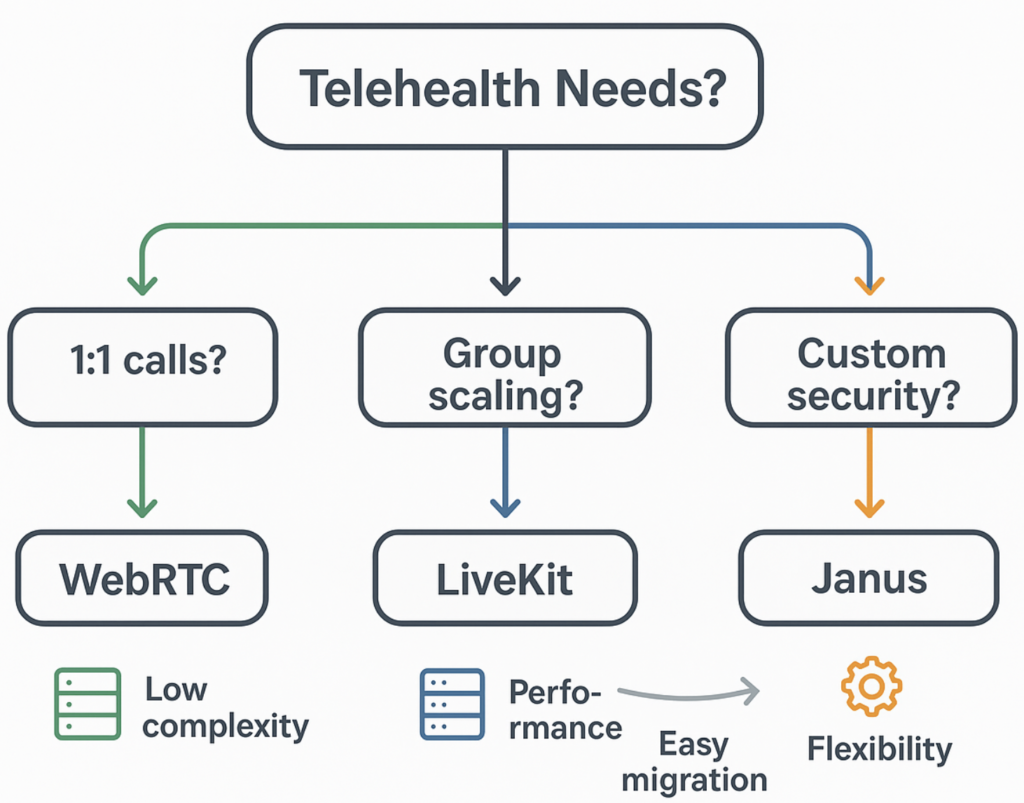
Choosing the ideal video streaming foundation hinges on your telehealth product’s objectives, your team’s technical skills, and regulatory demands.
Trembit recommends that CTOs carefully weigh simplicity, scalability, and security to build a solution that not only meets current needs but also supports long-term growth.