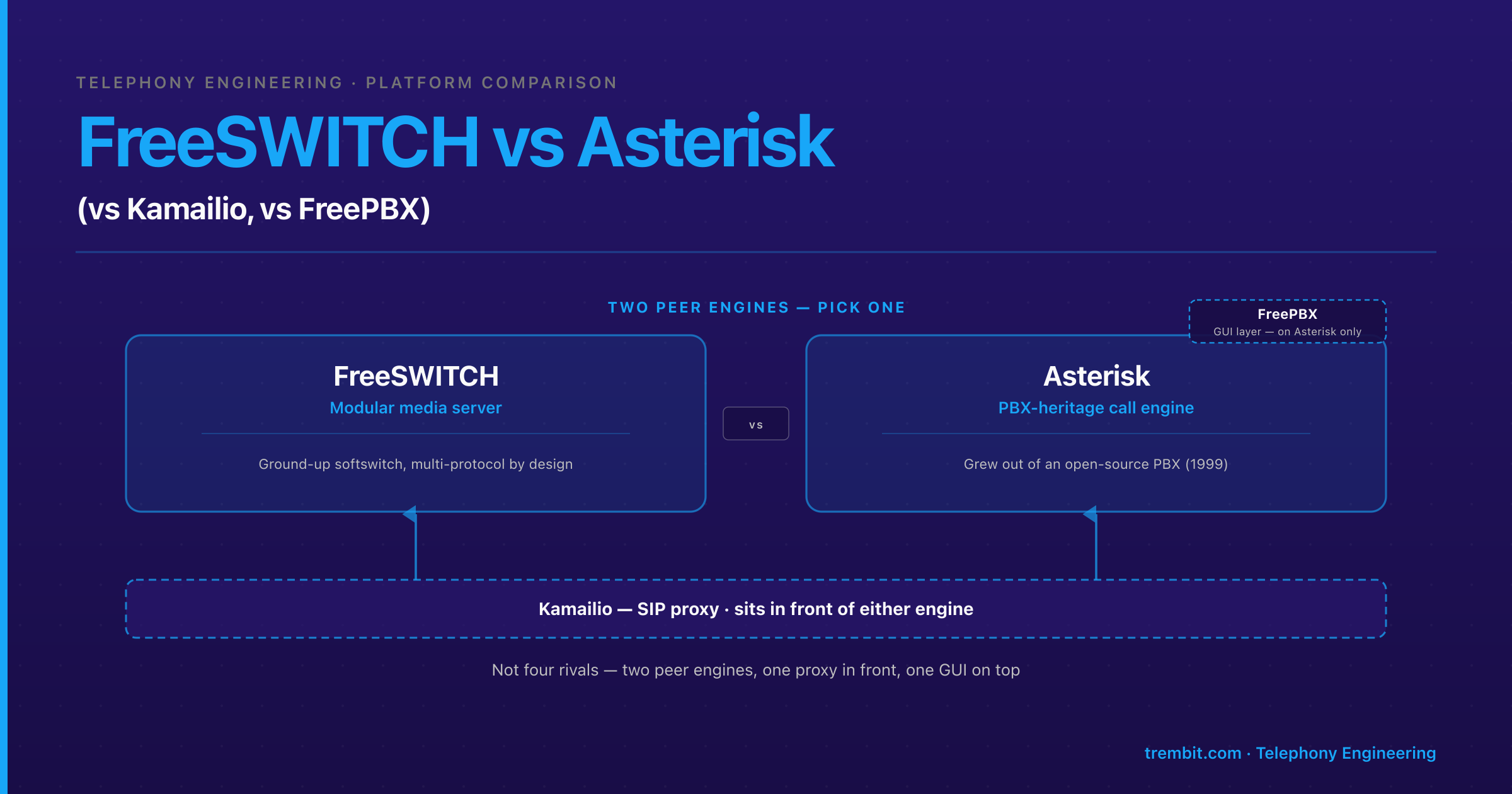
FreeSWITCH and Asterisk are both mature open-source telephony platforms designed for different jobs. Asterisk grew out of an open-source PBX — a dialplan-driven call engine with voicemail, IVR, and queues built in. FreeSWITCH was built from the ground up as a modular, multi-protocol media server and softswitch. FreePBX is not a third engine — it’s a web GUI that administers Asterisk. Kamailio is not a fourth engine — it’s a SIP proxy that sits in front of either. So this isn’t four rivals to rank; it’s two call engines to choose between, one admin layer on top of one, and one signaling proxy in front. The real decision is architecture fit: a PBX-shaped problem versus a media-server-shaped one.
Key takeaways
- This is not a four-way engine comparison. FreeSWITCH and Asterisk are the two call engines. FreePBX is a GUI/config layer on top of Asterisk. Kamailio is a SIP proxy in front of either engine. Treating all four as interchangeable alternatives is the single most common mistake in this decision.
- Asterisk (first released 1999, by Mark Spencer / Digium, now Sangoma) originated as an open-source PBX; FreeSWITCH (public 1 January 2006, created by Anthony Minessale) was designed from day one as a modular, multi-protocol media server. FreeSWITCH is an independent codebase, not an Asterisk fork.
- The threading and concurrency models differ, and it’s one of the most consequential differences for high-concurrency builds — but neither engine “auto-scales” past a single box. Both scale horizontally by putting a SIP proxy (Kamailio or OpenSIPS) in front of a fleet, not by a magic concurrency number. Be skeptical of any single “max calls” figure without a hardware and workload spec attached.
- For a real-time voice-AI stack, the deciding factor is how cleanly the engine forks live call audio in and out with low latency — FreeSWITCH via ESL + audio-fork modules, Asterisk via ARI External Media and AudioSocket. Both can do it; they expose the audio differently.
- Licensing differs and it matters for commercial products. FreeSWITCH: MPL 1.1 (permissive-leaning). Asterisk: GPLv2, with commercial dual-licensing from Sangoma. Kamailio: GPLv2+. FreePBX: GPLv3+. Verify the current license in each project’s own repository before you commit — this is exactly the kind of fact that goes stale. “
- We run FreeSWITCH in production — as a SIP proxy and PSTN bridge on an anonymized HIPAA/GDPR healthcare platform — and we also work with Asterisk and Kamailio. The right foundation depends on whether you’re solving a PBX problem or building a real-time media/voice-AI product — not on which name has more forum posts.
If you’re a business or product reader rather than a telephony engineer, skim the comparison table and jump to the decision framework — the two “when to choose” sections and the framework carry the decision without the protocol-level detail in between.
What’s the actual difference between FreeSWITCH and Asterisk?
The cleanest way to understand the difference is to look at what each project was originally for, because both still carry that DNA.
Asterisk is a PBX that grew into a platform. Mark Spencer created it in 1999 at what became Digium (acquired by Sangoma in 2018), and it was built to be an open-source private branch exchange — a business phone system. That heritage is still visible in its mental model: you describe call behavior in a dialplan (classically extensions.conf, or AEL), and the features a phone system needs — voicemail, IVR menus, call queues, conference bridges — are first-class, batteries-included citizens. If your problem is shaped like “I need a phone system, or a call center, or an IVR,” Asterisk hands you most of that out of the box. Its official documentation lives at asterisk.org. “
FreeSWITCH is a media server that can act like a PBX, not the other way around. Anthony Minessale — who had spent years contributing to Asterisk before starting FreeSWITCH in 2005 — designed it from a blank page as a modular softswitch and media server: a small stable core plus loadable mod_* modules for everything else (protocols, codecs, applications). It’s multi-protocol by design — SIP, plus WebRTC through two distinct paths: standard SIP-over-WebSocket (WSS) via mod_sofia, and the proprietary Verto (JSON-RPC) protocol via mod_verto — it’s embeddable, its dialplan is XML-driven, and it exposes a rich control channel through the Event Socket Library (ESL). FreeSWITCH doesn’t assume you’re building a phone system; it assumes you’re building something that moves real-time media, and gives you the primitives to do it. The project is stewarded today by SignalWire, and its source and license live in the signalwire/freeswitch repository. “
That difference — “PBX that became a platform” versus “media server that can be a PBX” — is the root of almost every downstream distinction in this comparison: configuration style, how each handles concurrency, and how easily each exposes raw call audio to an AI pipeline.
Is FreeSWITCH just a newer version of Asterisk?
No — and this is a persistent point of confusion, fueled by the fact that FreeSWITCH’s original author, Anthony Minessale, was a prolific Asterisk contributor before he built it. FreeSWITCH is not an Asterisk fork or an official successor. It’s an independent project with its own codebase and its own architecture, written from scratch starting in 2005 and opened to the public on 1 January 2006 specifically to address design constraints Minessale ran into with Asterisk’s architecture. Same author lineage, entirely separate code. “
How do FreeSWITCH and Asterisk compare at a glance?
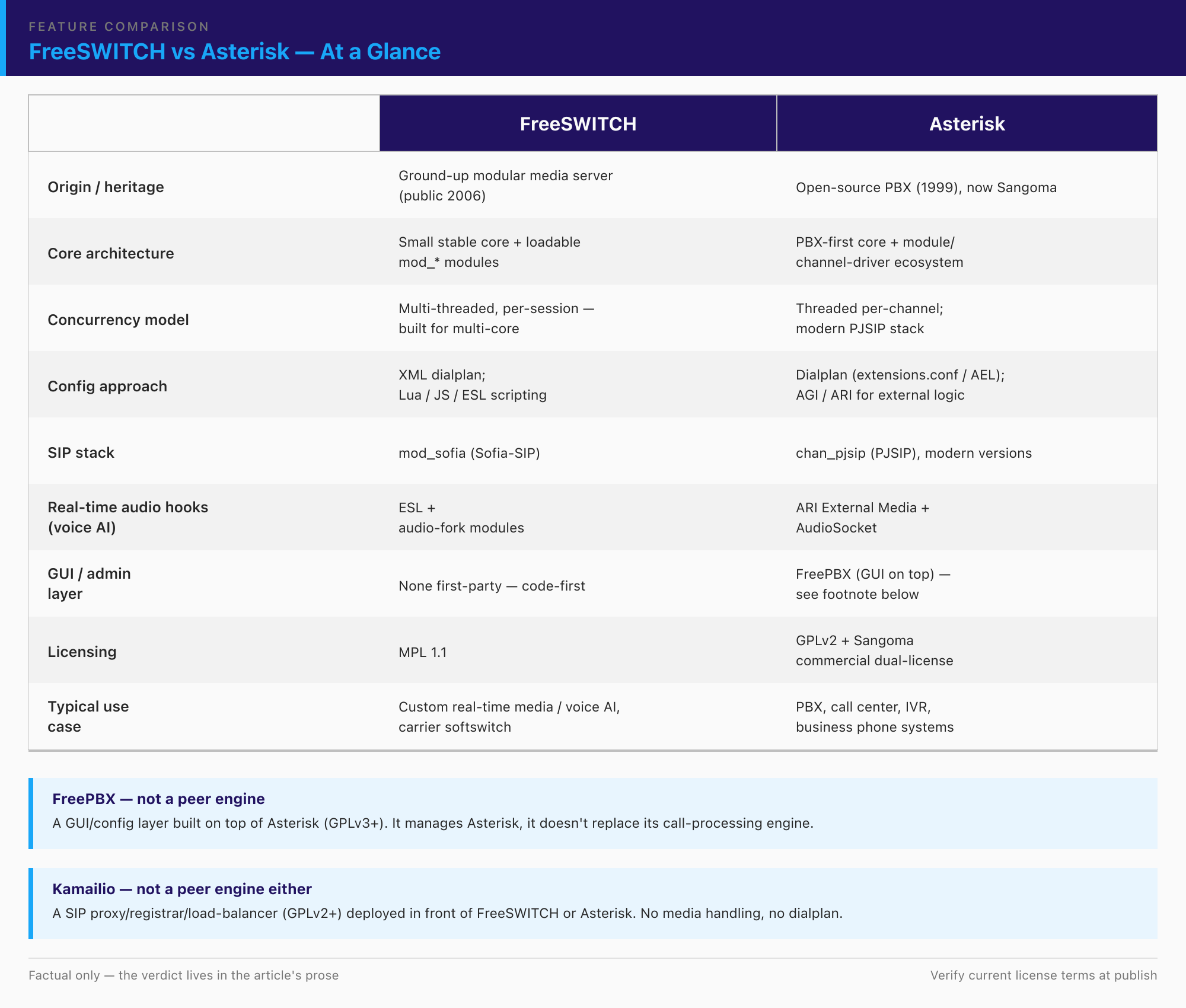
The verdict lives in the prose below; this table is the factual scaffold. Note the two footnoted rows — FreePBX and Kamailio are deliberately not given their own columns, because they don’t occupy the same layer as the two engines.
| Dimension | FreeSWITCH | Asterisk |
|---|---|---|
| Origin / heritage | Ground-up modular media server / softswitch (public 2006) | Open-source PBX (1999), now Sangoma |
| Core architecture | Small stable core + loadable mod_* modules |
Monolithic-leaning core + module/channel-driver ecosystem |
| Config approach | XML dialplan; scripting via Lua/JS/ESL | Dialplan (extensions.conf / AEL); AGI/ARI for external logic |
| Concurrency model | Multi-threaded (per-session threads) designed for multi-core from the start | Threaded (per-channel); modern PJSIP stack; historically more lock contention “ |
| SIP stack | mod_sofia (Sofia-SIP) |
chan_pjsip (PJSIP) in modern versions |
| WebRTC | Native via mod_verto / SIP-over-WS |
Supported via chan_pjsip + WebRTC config |
| Real-time audio hooks (voice AI) | ESL + audio-fork modules (mod_audio_fork / mod_audio_stream) |
ARI External Media + AudioSocket |
| GUI / admin layer | None first-party (config-first / code-first) | FreePBX (GUI on top) — see below |
| Licensing | MPL 1.1 | GPLv2 (+ Sangoma commercial dual-license) |
| Typical use case | Custom real-time media / voice-AI products, carrier softswitch | PBX, call center, IVR, business phone systems |
Footnote — FreePBX: a web GUI/config-management layer for Asterisk, not a competing engine. GPLv3+. See “What is FreePBX” below.
Footnote — Kamailio: a SIP proxy/registrar/load-balancer that sits in front of FreeSWITCH or Asterisk. GPLv2+. It doesn’t run a dialplan or handle media/RTP. See “Where does Kamailio fit” below.
(Reproduce this table as real HTML <table> markup on the page, not only inside the graphic — AI crawlers don’t reliably read text baked into images.)
How do FreeSWITCH and Asterisk compare on scale and concurrency?
This is the section where stale forum wisdom does the most damage, so here’s the careful version.
Both are threaded, but they were architected for concurrency differently. FreeSWITCH was designed for multi-core scaling from its earliest releases — it runs a thread-per-session model (built on the Apache Portable Runtime) with the explicit goal of using every core on the box. Asterisk is also multi-threaded (broadly, a thread per active channel), and modern Asterisk with the PJSIP stack is a very different beast from the Asterisk of ten years ago; the “Asterisk is single-threaded and doesn’t scale” line you’ll still find in old threads is out of date. That said, the recurring engineering consensus — which matches what we see in practice — is that FreeSWITCH tends to carry a higher per-box concurrent-call ceiling for media-heavy workloads, at the cost of a steeper learning curve. “
No honest single number exists. “How many concurrent calls can FreeSWITCH/Asterisk handle” has no answer without a hardware spec and a workload profile. Once you have both, scaling FreeSWITCH past a single box is the horizontal-scale playbook. The variables that actually move the number: codec (are you transcoding, or passing through?), whether there’s recording, transcription, or an AI audio fork on each call, DTMF/SIP signaling rate, and network conditions. A pass-through SIP proxying workload and a transcoding-plus-AI workload on the same box differ by an order of magnitude. Anyone quoting you a flat “N concurrent calls” without that context is quoting a benchmark from a machine that isn’t yours. “
Past a single box, neither engine clusters itself — that’s what the SIP proxy in front is for. This is the most important architectural point in the whole comparison, and it’s where Kamailio finally enters: to scale beyond one machine, you don’t ask FreeSWITCH or Asterisk to become a cluster, you put a SIP proxy — Kamailio or OpenSIPS — in front of a fleet of FreeSWITCH or Asterisk instances. The proxy handles registration, routing, and load distribution across the fleet and provides a stable signaling edge; each engine instance does what it’s good at (call processing and media). High-availability then becomes a proxy-and-orchestration problem (health checks, failover, session state) rather than something either engine solves natively. So “which scales better” is partly a false binary — at real scale, both engines sit behind a proxy layer. “
What is FreePBX, and how does it relate to Asterisk?
FreePBX is a web-based GUI and configuration-management layer built on top of Asterisk — written in PHP/JavaScript, maintained by Sangoma, licensed GPLv3+. It does not replace Asterisk’s call-processing engine; it manages it, generating and organizing the Asterisk configuration you’d otherwise hand-edit. Its home is freepbx.org. “
The practical reframing: “FreeSWITCH vs FreePBX” is really “a code-configured media server vs. Asterisk-with-a-web-admin-layer.” Choosing FreePBX isn’t a separate technical decision from choosing Asterisk — it’s choosing to administer Asterisk through a GUI instead of by hand.
Who it’s for: teams standing up a business phone system, PBX, or call center who want to configure extensions, trunks, IVRs, and voicemail through a web interface rather than editing dialplan files — and who value that a large ecosystem of modules and commercial support exists around it.
Who it isn’t for: teams building a custom, code-driven, real-time product. If your application logic lives in your own codebase and you’re programmatically controlling calls, a GUI admin layer adds indirection and overhead without buying you anything — you want direct access to the engine, which points you toward raw Asterisk or FreeSWITCH, not a PBX GUI.
Where does Kamailio fit — FreeSWITCH vs Asterisk vs Kamailio?
If you searched “FreeSWITCH vs Kamailio” or “FreeSWITCH vs Asterisk vs Kamailio” expecting a three-way engine shoot-out, the most useful thing this article can tell you is: it’s not a three-way comparison, because Kamailio operates at a different layer.
Kamailio is a SIP proxy, registrar, and load-balancer — a very fast, very scalable piece of SIP signaling infrastructure (GPLv2+, project home at kamailio.org). Crucially, it does not handle media/RTP and it does not run a dialplan the way FreeSWITCH and Asterisk do. It routes and proxies SIP signaling; the actual call processing and media handling happen on the engine behind it. “
In real production architectures, Kamailio is frequently deployed in front of a fleet of FreeSWITCH or Asterisk instances, distributing signaling load, providing a stable edge, and acting as a session border element. The three are not mutually exclusive — they’re routinely combined (Kamailio at the edge, FreeSWITCH or Asterisk doing the calls behind it).
So the honest guidance for the “do I need Kamailio instead of FreeSWITCH/Asterisk” question is: almost always, no. It’s a different tool for a different layer. You reach for Kamailio when your deployment has grown to a scale — or needs a signaling resilience — where a dedicated SIP proxy in front of your call engines earns its keep. If you’re a single-box deployment asking “Kamailio or FreeSWITCH,” you’re comparing a front door to a kitchen.
How do FreeSWITCH and Asterisk compare on modularity, configuration, and licensing?
Configuration philosophy. FreeSWITCH is XML-and-modules: an XML dialplan, a small stable core, and loadable mod_* modules you enable for exactly the protocols, codecs, and applications you need. It expects you to configure and extend in code (Lua, JavaScript, or via ESL). Asterisk centers on its dialplan syntax (extensions.conf / AEL) with a mature channel-driver and module ecosystem, and — through FreePBX — an optional GUI. The shorthand engineers use: FreeSWITCH rewards teams who want to build in code; Asterisk rewards teams who want telephony features configured and ready, especially through a GUI.
Ecosystem, honestly. Asterisk’s community and module ecosystem is larger and longer-running — it’s been around since 1999, it’s the default answer on most VoIP forums, and there’s simply more Stack-Overflow-grade material, more integrators, and more off-the-shelf modules for it. FreeSWITCH’s community is smaller but its protocol breadth is wider and its documentation, while historically thinner, is aimed at people building media applications rather than administering phone systems. Neither is “better” here — a bigger ecosystem means more answers to common problems; a media-first design means fewer answers but a cleaner path for uncommon, custom ones.
Licensing — verify before you commit. This genuinely matters for a commercial product, and it’s exactly the kind of fact people get wrong from memory:
| Project | License (verified 2026-08) | Practical note |
|---|---|---|
| FreeSWITCH | MPL 1.1 | Permissive-leaning; allows linking MPL components into a proprietary codebase, provided MPL-covered files stay under MPL. “ |
| Asterisk | GPLv2 (+ commercial dual-license from Sangoma) | Copyleft; Sangoma offers a commercial license for products that can’t ship under GPL. “ |
| Kamailio | GPLv2+ (some parts BSD) | Copyleft. “ |
| FreePBX | GPLv3+ | Copyleft; PHP/JS GUI over Asterisk. “ |
The MPL-vs-GPL difference is the one that occasionally drives a foundation decision: MPL 1.1 is friendlier to embedding FreeSWITCH inside a closed-source product than GPLv2 is to embedding Asterisk. If that distinction is load-bearing for your product, confirm the current license text in each repository — licenses can change, and a remembered license is not a legal basis.
Which is the better base for a real-time voice-AI stack — FreeSWITCH or Asterisk?
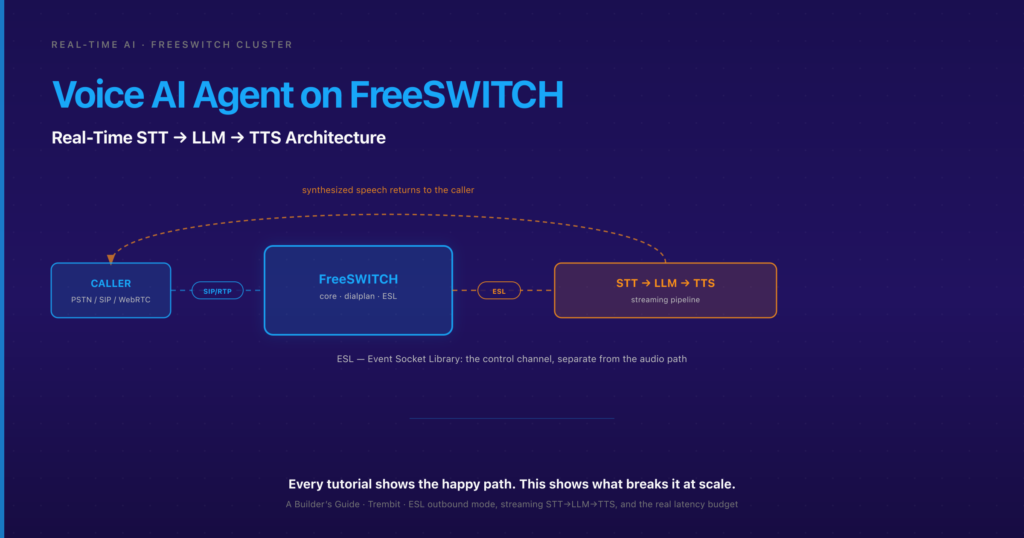
This is the 2026 buyer’s real question, so it deserves a careful, non-tribal answer. For an AI voice agent — streaming a caller’s speech to STT, running an LLM, synthesizing a reply with TTS, all in the live call path — PBX feature-completeness is almost irrelevant. The deciding factor is: how cleanly does the engine fork live call audio out to your AI pipeline and inject synthesized audio back, with the lowest possible added latency and complexity?
Both engines can do it. They expose the audio differently:
- FreeSWITCH exposes deep, low-level control of the audio path through the Event Socket Library (ESL) plus audio-fork modules (
mod_audio_fork,mod_audio_stream) that stream a session’s raw audio to an external WebSocket endpoint and accept audio back. The appeal for voice AI is directness: you’re forking media at the softswitch with relatively little overhead, and the same platform natively bridges SIP, PSTN, and WebRTC. “ - Asterisk exposes it through the ARI (Asterisk REST Interface) External Media channel and the AudioSocket protocol — a simple TCP stream of PCM audio (classically 8 kHz, 16-bit, 20 ms frames) that’s deliberately easy to wire into a Python or Node ML pipeline. AudioSocket is the more approachable on-ramp; ARI External Media gives you more control at more complexity. “
Our honest read, at the judgment level: if the product is fundamentally a real-time media application and you want the lowest-overhead, most direct control of the audio path — and you’re already bridging WebRTC and PSTN — FreeSWITCH is the stronger foundation. If you’re adding a voice agent onto an existing Asterisk/dialplan world, or your team already thinks in Asterisk, AudioSocket makes the on-ramp genuinely simpler and there’s no reason to rip out what works. Neither choice is wrong; they optimize for different starting points.
One caution from experience: the platform’s audio hook is rarely where a “laggy” voice agent actually loses its latency budget. Far more often the delay is in endpointing (deciding when the caller stopped talking), the STT/LLM/TTS round-trip, or a jitter buffer tuned for a network the agent never runs on. Picking FreeSWITCH over Asterisk won’t save you 400 ms if the endpointing is wrong — so treat the engine choice as one input to the latency budget, not the whole answer.
This section stays at the comparison/judgment level on purpose. The actual build — ESL wiring, streaming pipeline, barge-in and turn-taking, the real latency budget — is its own guide: Read next: How to Build a Voice AI Agent on FreeSWITCH. For the bigger picture, see our guide to running FreeSWITCH in production.
If you’re choosing an engine specifically to carry a voice agent, this is the decision worth a second opinion before you commit engineering months to it — it’s exactly what our real-time voice AI team pressure-tests in an architecture review.
What do engineers actually say about FreeSWITCH vs Asterisk?
People search “FreeSWITCH vs Asterisk reddit” for a reason: they want the un-marketed practitioner view, not vendor copy. Rather than fabricate quotes or thread links, here are the recurring themes that show up honestly across engineering discussions — and match what we hear from teams who’ve run both:
- “Asterisk is easier to start, FreeSWITCH is easier to scale.” The most common trade-off cited. Asterisk’s dialplan and the sheer volume of tutorials make the first working call faster; FreeSWITCH’s architecture pays off later, on concurrency and custom media work.
- Documentation is a recurring complaint on both sides — for opposite reasons. Asterisk has more material but a lot of it is stale forum wisdom from older versions. FreeSWITCH has less, and newcomers find it harder to get oriented, though what exists is aimed at builders.
- The learning curve is real and asymmetric. Teams migrating from Asterisk to FreeSWITCH consistently report a steeper initial climb, followed by “I wish we’d done this sooner” once the concurrency and media flexibility land — or “we didn’t need any of that, Asterisk was fine” when the workload was a straightforward PBX.
- Migration stories are cautionary. Ripping out a working Asterisk deployment for FreeSWITCH purely on principle is widely regarded as a mistake; the moves that go well are driven by a concrete ceiling (concurrency, custom media, multi-protocol needs), not fashion.
The signal from the community mirrors the engineering reality: neither wins in the abstract, and the “right” answer is almost always determined by the shape of the workload, not by which project has more enthusiasts.
When should you choose FreeSWITCH over Asterisk?
Choose FreeSWITCH when:
- You need multi-protocol flexibility baked into the media server itself — WebRTC-native signaling alongside SIP, not bolted on. FreeSWITCH treats this as a core concern.
- You want a lean, embeddable core you configure and extend in code, not a PBX you administer through an admin layer. Your application logic lives in your codebase and drives the engine.
- The roadmap includes real-time voice AI and you want direct, low-overhead control of the audio path (ESL + audio-fork) on a platform that already bridges SIP, PSTN, and browser.
- You’re planning for high per-box concurrency on media-heavy workloads and are willing to trade a steeper setup curve for headroom later.
- The license matters — MPL 1.1 is friendlier to embedding in a closed-source commercial product than Asterisk’s GPLv2.
When should you choose Asterisk over FreeSWITCH?
Choose Asterisk when:
- The product is fundamentally a PBX / call-center / IVR-shaped problem — voicemail, conferencing, IVR menus, call queues are exactly the built-in surface you need, and Asterisk gives you them out of the box.
- You want GUI-driven administration — FreePBX turns Asterisk into a web-managed phone system for teams that don’t want to hand-edit dialplan.
- You already have deep in-house Asterisk expertise, and the switching cost of moving to FreeSWITCH would outweigh any architectural gain. Existing expertise is a legitimate, often decisive, input.
- You’re adding a voice agent to an existing Asterisk world — AudioSocket makes the on-ramp simple, and there’s no reason to replace a working stack to get it.
- You want the larger ecosystem — more integrators, more off-the-shelf modules, more community answers for common telephony problems.
Decision framework — FreeSWITCH, Asterisk, or both (with Kamailio in front)?
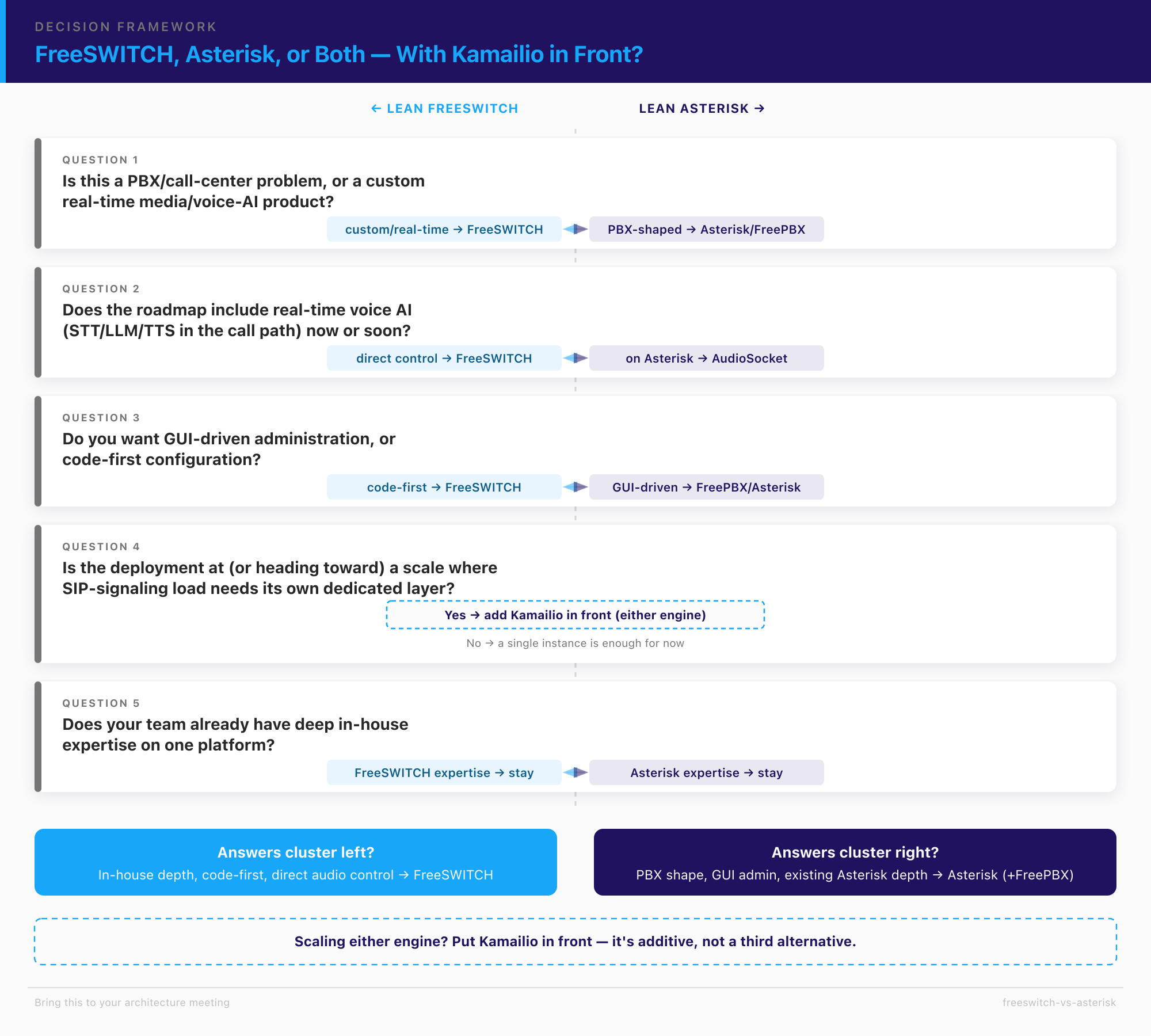
Skip the feature grid and answer these five questions about your product. They resolve the decision faster than any table:
- Is this fundamentally a PBX/call-center problem, or a custom real-time media/voice-AI product? PBX-shaped → Asterisk (likely with FreePBX). Custom real-time media → FreeSWITCH.
- Does the roadmap include real-time voice AI (STT/LLM/TTS in the call path) now or soon? If yes and you want the most direct audio control → FreeSWITCH leans ahead; if you’re extending existing Asterisk → AudioSocket keeps you there.
- Do you want GUI-driven administration or code-first configuration? GUI → FreePBX/Asterisk. Code-first → FreeSWITCH.
- Is the deployment at (or heading toward) a scale where SIP-signaling load needs its own layer? If yes → put Kamailio (or OpenSIPS) in front of whichever engine you chose. This is additive, not an alternative to the engine.
- Does your team already have deep expertise on one platform? Existing expertise changes the switching-cost math and can outweigh a marginal architectural preference.
Notice that questions 1–3 pick the engine, question 4 adds a layer in front, and question 5 is the reality check. That structure is the whole point of this article: these aren’t four options on one axis.
How we think about it — and where we run it
We work with both platforms and with the SIP-proxy layer in front of them, so we don’t have a house horse in this race. The right foundation depends on whether you’re solving a PBX problem or building a real-time media/voice-AI product — not on which name has more forum posts.
For a concrete production example from Trembit’s own work: on a HIPAA/GDPR healthcare communications platform we build for, FreeSWITCH runs in production as the SIP proxy and PSTN-bridge layer — connecting WebRTC and mobile clients with phone users and with hospital SIP conferencing systems, so a call can span a browser, a mobile app, the public phone network, and an in-hospital conference bridge inside one compliant session. (On that same platform, the real-time in-call translation runs on a separate custom Mediasoup SFU — a different problem, a different tool; see the healthcare video translation case study.) “
One honesty note, because this cluster is FreeSWITCH-centric and it would be easy to over-claim: we run real-time voice AI on FreeSWITCH at the demo/prototype level, not yet as a named production flagship. The comparison above stands on engineering fact and judgment, not on a client voice-AI claim we haven’t shipped — and we’d rather tell you that than imply otherwise.
If you’re weighing these options for a product that has to carry real-time voice, that’s a conversation worth having before you commit engineering time — see the CTA below.
Frequently asked questions about FreeSWITCH, Asterisk, Kamailio, and FreePBX
Is FreeSWITCH better than Asterisk?
Neither is better in the abstract — they were designed for different problems. FreeSWITCH is the stronger base for custom real-time media and voice-AI products and high per-box concurrency; Asterisk is the stronger base for PBX, call-center, and IVR systems where its built-in telephony features and larger ecosystem do the work for you. Match the engine to the shape of your problem.
Can FreeSWITCH replace Asterisk in an existing deployment?
Technically yes, but rarely a good idea on principle alone. Replacing a working Asterisk deployment is worth it only when you’ve hit a concrete ceiling — per-box concurrency, custom media processing, multi-protocol needs — that Asterisk can’t clear without a fight. Migrating “because FreeSWITCH is newer” is a common and expensive mistake; migrate for a specific limitation, not for fashion.
Is FreePBX built on Asterisk or is it a separate system?
FreePBX is built on Asterisk. It’s a web GUI and configuration-management layer (PHP/JavaScript, GPLv3+, maintained by Sangoma) that administers Asterisk through a browser instead of hand-edited config files. It is not a separate call engine, and “FreeSWITCH vs FreePBX” is really “FreeSWITCH vs Asterisk-with-a-GUI.”
Do I need Kamailio if I’m already running FreeSWITCH or Asterisk?
Usually not on a single-box deployment. Kamailio is a SIP proxy/load-balancer that operates at the signaling layer — it doesn’t handle media or run a dialplan. You add it when you need to distribute SIP signaling across a fleet of FreeSWITCH or Asterisk instances or want a resilient signaling edge at scale. It sits in front of your engine, it doesn’t replace it.
Which is easier to learn — FreeSWITCH or Asterisk?
Asterisk is generally easier to get started with — its dialplan model and the volume of tutorials make the first working system faster, and FreePBX removes hand-editing entirely. FreeSWITCH has a steeper initial curve that tends to pay off later on concurrency and custom media work. Easier-to-start and easier-to-scale point in opposite directions here.
Which is better for building a voice AI agent — FreeSWITCH or Asterisk?
Both work; they expose live call audio differently. FreeSWITCH gives you low-overhead, direct control via ESL and audio-fork modules and natively bridges SIP/PSTN/WebRTC — the edge if you’re building a real-time media product from scratch. Asterisk’s AudioSocket is the simpler on-ramp and the pragmatic choice if you’re adding an agent to an existing Asterisk stack. The engine is only one input to your latency budget — endpointing and the STT/LLM/TTS round-trip usually matter more.
Choosing your telephony/media-server foundation is a decision you live with for years. If you’re weighing FreeSWITCH against Asterisk — especially for a product that has to carry real-time voice AI — Trembit’s engineers review real-time voice and media architectures before you commit engineering time to one, and we tell you honestly when a PBX-shaped answer (Asterisk/FreePBX) beats a media-server one, or when a Kamailio layer is the real fix.
Book a free 30-minute architecture review: bring the specific decision you’re stuck on — engine choice, a concurrency ceiling, a voice-AI latency budget, or a stalled deployment you inherited — and we’ll pressure-test it with an engineer. No deck, no pitch. Start with our real-time voice AI and WebRTC development teams, or read our deep dive on voice AI agents on WebRTC for the transport-layer side of the same decision.