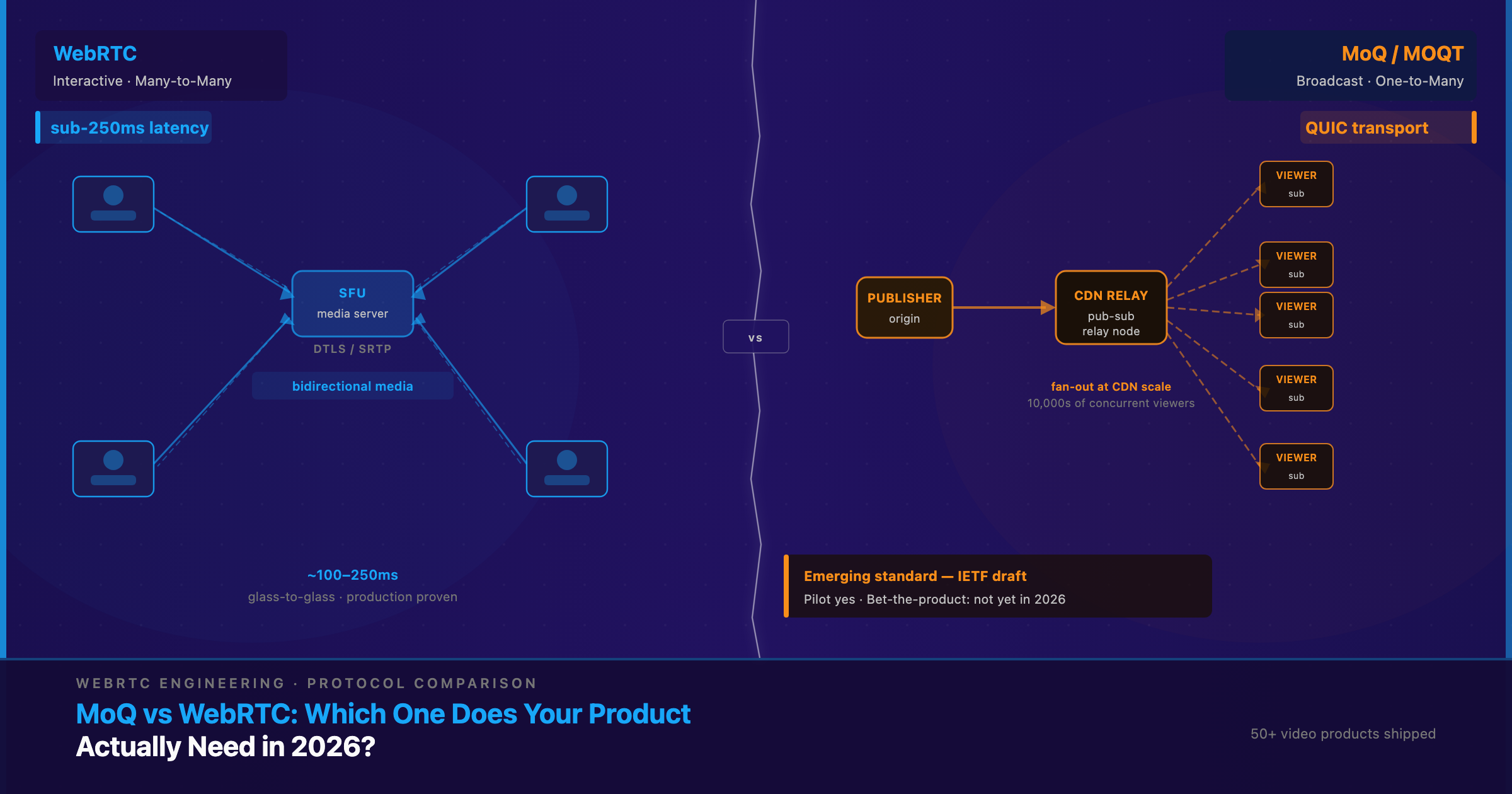
WebRTC is the browser-native protocol for interactive, two-way real-time communication — calls, telehealth, conferencing — with proven sub-250ms latency. MoQ (Media over QUIC) is an emerging IETF standard built on QUIC for scalable one-to-many streaming, unifying live, time-shifted, and on-demand delivery through a publish-subscribe relay model. They solve different problems. As of 2026 they coexist rather than compete — even MoQ’s loudest commercial backer says so.
What is MoQ (Media over QUIC), Exactly?
MoQ is an IETF effort to standardize low-latency media delivery over QUIC — the same transport layer that sits underneath HTTP/3. The core specification is Media over QUIC Transport (MOQT), defined in the internet-draft draft-ietf-moq-transport, developed by the IETF moq working group.
Architecturally, MoQ uses a publish-subscribe, client-server relay model. A publisher pushes media into a relay network — think CDN nodes — and subscribers pull from the nearest relay. This is CDN-friendly by design, which is the whole point: it lets media delivery reuse the caching and fan-out infrastructure the internet already has for web content.
The pitch is consolidation. Today, many products run WebRTC (or low-latency HLS) for the live path and HLS/DASH for on-demand replay — two protocols, two pipelines, two sets of problems. MoQ aims to collapse real-time, time-shifted, and on-demand delivery into a single protocol spanning all three. On the client side, MoQ leans on two web platform primitives: WebTransport (the QUIC-based browser API that moves the data) and WebCodecs (which encodes and decodes the media frames). Media Source Extensions (MSE) — the playback mechanism behind HLS/DASH — appears only as a fallback shim in some vendor stacks, not as a foundational MoQ dependency.
This is a genuinely different shape from WebRTC. WebRTC was designed for a browser to talk directly to another browser (or to a media server acting on their behalf) with the lowest possible latency. MoQ was designed for one source to reach many viewers at scale. Keep that distinction — it drives every decision later in this article.
Who is building MoQ?
The most visible commercial push comes from the OpenMOQ Software Consortium, founded by Red5, Akamai, CDN77, Cisco, Synamedia, and YouTube, with additional participants including Bitmovin, Qualabs, and Vindral and academic members.
Look at that list. Akamai and CDN77 are CDNs. Synamedia and Cisco are broadcast and video-infrastructure companies. YouTube is the largest one-to-many video platform on earth. This tells you exactly what problem MoQ is being built to solve first: scalable content distribution, not two-way conversation. That is not a criticism — it is a signal about where the protocol’s center of gravity sits.
Alongside the consortium, the work happens in the open at the IETF, and there are early open-source implementations (moq-rs in Rust, moq-js for the browser). These are real and improving. What does not yet exist publicly is production scale: as of mid-2026 we are not aware of a named, at-scale production deployment outside vendor betas and NAB/IBC demonstrations.
What does WebRTC do well, and where does it struggle?
WebRTC’s strengths are the reason it has been the default for interactive media for a decade:
- Browser-native. No plugin, no app install. Every major browser ships it. If you want how WebRTC works in depth, we cover it separately.
- Proven interactive latency. A well-tuned deployment routinely delivers 100–250ms glass-to-glass — the range that makes conversation feel natural.
- Security built in. Media is encrypted with DTLS/SRTP by default, not as an add-on.
- Privacy-friendly data paths. True peer-to-peer keeps media off your servers entirely, which matters for HIPAA and GDPR postures. For the trade-offs, see P2P vs SFU for telemedicine.
- A deep talent pool. You can hire for it, and you can ship and support it today.
Trembit has built 50+ WebRTC-based products — including a KBV-certified psychotherapy video platform in Germany, and rescues of failing real-time codebases other teams couldn’t stabilize — and for interactive two-way video the protocol remains the correct default. There is a fuller primer on how WebRTC works for business if you want the fundamentals.
Where WebRTC struggles is fan-out. Peer-to-peer stops scaling past a handful of participants, so real deployments route media through a Selective Forwarding Unit (SFU). SFUs work well into the hundreds of concurrent participants, but as you push toward very large one-to-many audiences, the architecture gets expensive and complex — and if you also want DVR and VOD alongside the live stream, you are now bolting a second delivery system onto a protocol that was not designed for it. That combination is precisely the gap MoQ is aiming at.
When does WebRTC’s SFU model get expensive?
The cost cliff shows up at large one-to-many scale. WebRTC is a stateful, connection-oriented protocol: each viewer holds an active connection, and the SFU forwards media to each of them. As audiences grow, you scale horizontally, cascade SFUs across regions, and pay egress on every stream. The N×M connection math that makes small group calls cheap works against you at broadcast scale.
Two honest caveats keep this in perspective:
- For most CTO-sized products — say, under ~1,000 concurrent viewers on a stream — SFU tuning is the pragmatic answer, not a protocol switch. WebRTC at that scale is well-understood engineering.
- A lot of “WebRTC is too expensive” pain is really configuration and vendor pain, not protocol pain. Before you conclude the protocol has failed you, it is worth auditing where the money actually goes. We break this down in WebRTC infrastructure costs in 2026.
The expensive scenario — tens of thousands of concurrent viewers, plus live-to-VOD unification — is real, and it is where MoQ’s story is strongest. But it is a narrower slice of products than the “is WebRTC dead?” headlines suggest.
What is the real architectural difference between MoQ and WebRTC?
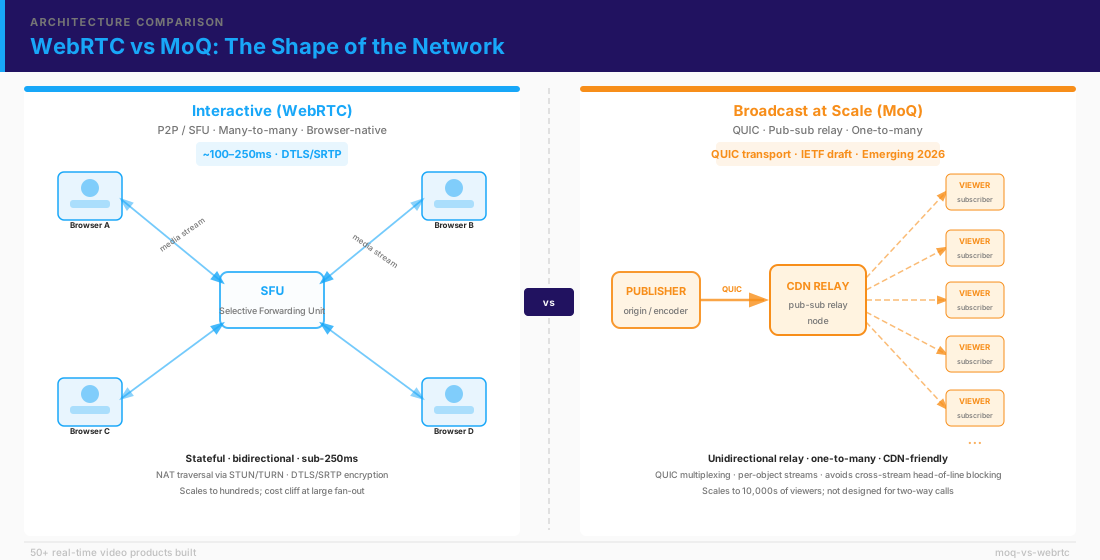
The difference is not a feature list. It is the shape of the network.
WebRTC is a many-to-many interactive architecture. Participants hold bidirectional, stateful connections. Media stays close to the edge — peer-to-peer directly, or through an SFU that mediates but does not add meaningful latency. NAT traversal is handled by STUN/TURN. The whole system is optimized to keep the round trip short so people can talk over each other and it still feels live.
MoQ is a one-to-many broadcast architecture. A publisher pushes media into a relay network; subscribers pull from the nearest relay. The connection is fundamentally unidirectional in the common case. QUIC’s stream multiplexing eliminates the cross-stream head-of-line blocking that hurts TCP-based streaming, and MoQ leans into this with a per-object stream model — a dropped packet on one media object doesn’t stall the next. (QUIC still has within-stream head-of-line blocking; MoQ works around it precisely by putting independent objects on independent streams.) It can also prioritize or drop data per-object under congestion. The system is optimized to fan out efficiently to a very large audience using CDN-style infrastructure.
The architectural consequence is the whole story: retrofitting one to do the other’s job is unnatural. Making WebRTC broadcast to 100,000 viewers means cascading SFUs and paying for it. Making MoQ carry a two-way conversation means adding round-trip signaling and interactivity that its relay model was not built for. When a vendor tells you their protocol does both equally well, that is a claim to test, not to accept.
If you want the same “shape of the network” argument applied one level down — direct connections versus a media server — our piece on P2P vs SFU for telemedicine covers it.
What about latency — does MoQ actually beat WebRTC?
This is where you should be most skeptical of anything you read, including from us.
Vendors and consortium materials describe MoQ latency in the sub-second and even sub-250ms range. Those figures are vendor claims and spec design goals — no published independent, third-party benchmark comparing MoQ and WebRTC under equivalent conditions exists as of mid-2026.
Meanwhile, WebRTC’s interactive latency is not a claim — it is a measured, deployed reality: 100–250ms glass-to-glass in well-tuned SFU deployments, every day, in production, across telehealth and conferencing. A decade of shipped deployments and independent WebRTC analysis (e.g. bloggeek.me) put this range beyond dispute.
So the correct framing is not “MoQ is faster.” It is: WebRTC achieves proven interactive latency at smaller fan-out; MoQ may achieve acceptable latency for broadcast scenarios at very large scale. Those are different jobs with different latency budgets. A 400ms broadcast delay is invisible to someone watching a live event; the same delay makes a two-way conversation unusable.
For any CTO reading this: do not switch protocols based on latency numbers that lack independent verification. When independent benchmarks appear, we will update this piece.
How mature is MoQ in 2026 — is it safe to build on?
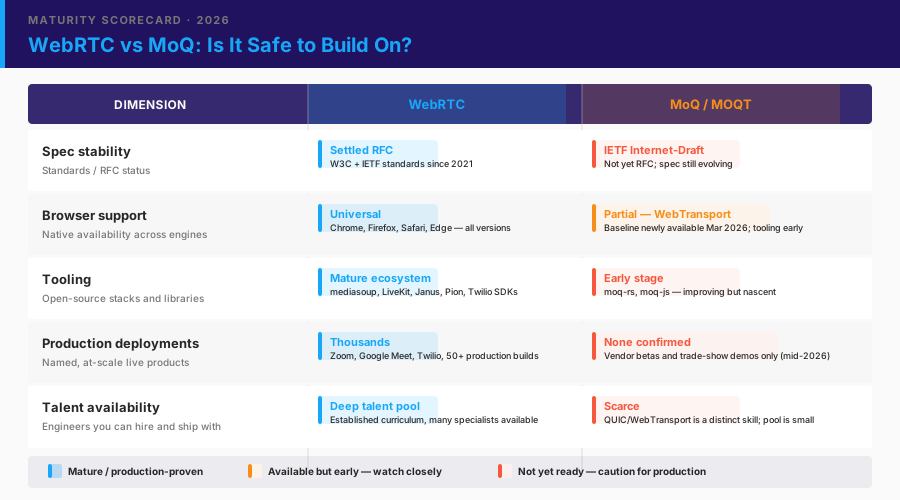
Short answer: pilot yes, bet-the-product no — yet. Here is the maturity read, dimension by dimension.
- Spec stability. MOQT is still an IETF internet-draft, with publication to the IESG targeted for late 2026. Building production on a moving draft carries real rework and lock-in risk. WebRTC, by contrast, is a settled standard.
- Browser / WebTransport support. MoQ in the browser depends on WebTransport, which reached “Baseline — newly available” status in March 2026 when Safari 26.4 shipped support (Chrome, Edge, and Firefox had it earlier).
- Two caveats bite: the ecosystem tooling on top of WebTransport is still early, and users on older iOS/Safari versions (anything before 26.4) simply don’t have it — a real deployment constraint for healthcare or enterprise products that can’t force browser updates.
- Tooling. Open-source implementations (moq-rs, moq-js) exist and are improving, but they are early-stage compared to the mature WebRTC stacks (mediasoup, LiveKit, Janus, Pion) that thousands of products ship on.
- Production deployments. No named, at-scale production deployment outside vendor betas and trade-show demos is publicly confirmed as of mid-2026.
- Talent. A WebRTC engineer is not automatically a MoQ engineer. QUIC, WebTransport, and the MoQ object model are a distinct skill set, and the pool is small today.
What a responsible pilot looks like: a scoped proof-of-concept — think a 4–8 week effort, not a re-platform — of a broadcast or DVR path on a non-critical surface, with the transport layer abstracted so you are not hard-coupled to a draft that may change; tracking the IETF working group cadence; and monitoring WebTransport rollout across your real user base. That is how you build institutional knowledge without exposing the product to spec churn.
For the full readiness scorecard and a go/no-go checklist, see our companion guide: Is MoQ ready for production in 2026?
Which protocol should your product actually use? (Decision framework)
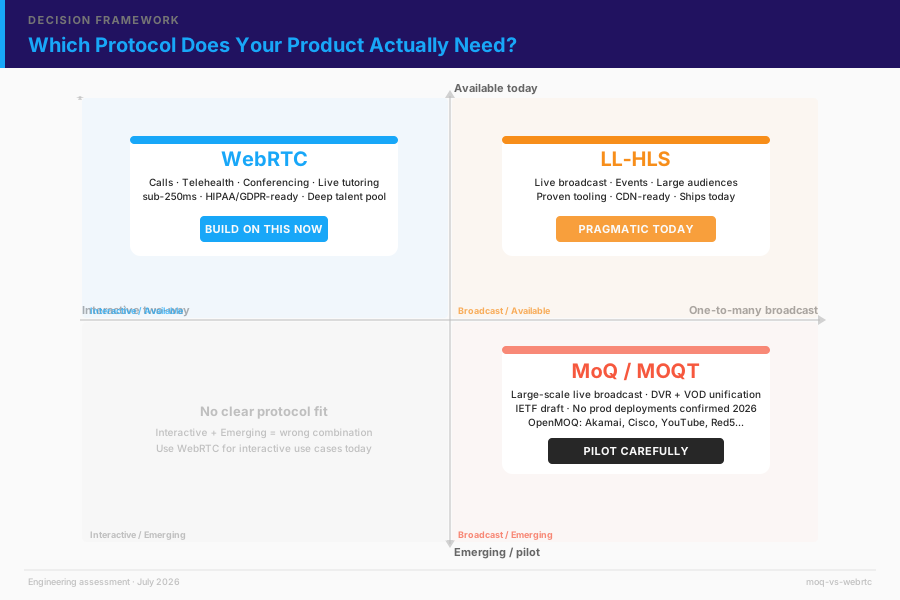
Take this to your architecture meeting. One note on our bias before you use it: Trembit builds WebRTC and doesn’t sell MoQ tooling or services — we gain nothing whichever column you land in. This is the read we’d give a friend.
Use WebRTC when:
- You need interactive two-way communication — 1:1 calls, group video, telehealth consults, live tutoring, live betting, online conferencing.
- Sub-250ms latency is a hard requirement.
- You want browser-native delivery without standing up new infrastructure.
- Regulatory posture benefits from data-path control and P2P privacy — HIPAA and GDPR, and for psychotherapy telemedicine specifically, KBV certification (which we hold, and which is rare among WebRTC teams).
- You need something you can ship, hire for, and support today.
If your build is WebRTC and the open question is which media server, our comparison of SFU options for telemedicine — Janus vs mediasoup vs LiveKit — is the next read.
Consider MoQ when (cautiously, with pilot scope):
- You are building large-scale one-to-many live broadcast — tens of thousands of concurrent viewers.
- You need to unify live streaming + DVR/time-shifted + VOD delivery in one protocol.
- Your infrastructure partners (CDN, media-server vendors) have committed, shipping MoQ support.
- You have the runway to absorb spec-evolution risk — concretely, a team that can build on a protocol which may need rework in the next 12–18 months as the spec finalizes, and the discipline to isolate the transport layer so that rework stays contained.
Wait on MoQ when:
- Independent benchmarks and production case studies don’t yet exist for your use case.
- Your product cannot absorb the risk of a moving IETF draft.
- Your team has no QUIC/WebTransport expertise and no time to build it.
- The use case is interactive (two-way) — MoQ was not designed for this, and forcing it is the wrong kind of hard.
The “you might need both” reality
The cleanest real-world architecture for many products isn’t a choice at all — it’s a split:
- WebRTC for the interactive layer — the live calls, the conversation, the interactivity.
- A broadcast layer for scale — MoQ if you have runway and appetite to pilot it, or low-latency HLS (LL-HLS) as the pragmatic answer available today while MoQ matures.
This is not a hedge. It is what the use cases demand. A live-commerce app has hosts talking (WebRTC territory) and thousands of viewers watching (broadcast territory). A virtual event has a stage and an audience. Trying to force one protocol across both jobs is how architectures get expensive and fragile. Picking the right protocol per job is how they stay clean.