Funding rounds and enterprise sales contracts share a common inflection point: the moment a potential investor or customer asks for your security documentation. For telehealth startups, this moment arrives earlier than most founders expect and reveals more than most engineering teams are prepared for.
Compliance audits and enterprise due diligence aren’t just bureaucratic exercises. They’re structured examinations of whether your platform is built on foundations that can be trusted with patient data, scaled to enterprise requirements, and sustained through incidents without catastrophic failure. A platform that passes technical evaluation but fails documentation review loses deals. A platform with impressive documentation but shallow security controls fails penetration testing. Both failures are equally disqualifying.
The startups that navigate funding rounds and enterprise procurement successfully treat compliance readiness as an engineering discipline — not a pre-sale scramble. This article outlines what auditors and enterprise security teams actually look for, and how to build a platform that passes scrutiny with confidence.
What Auditors Actually Evaluate
The first misconception is that compliance audits primarily test technical controls. They test evidence. Auditors want proof that controls exist, that they’re consistently applied, and that your organization understands why they matter.
HIPAA audits conducted by the Office for Civil Rights, SOC 2 Type II examinations, and HITRUST assessments all follow the same fundamental logic: identify required controls, request evidence of implementation, and verify that evidence is credible and current. A technically sophisticated platform with poor documentation will fail where a moderately sophisticated platform with excellent documentation succeeds.
Enterprise due diligence adds commercial dimensions. Security teams from hospital networks or insurance companies evaluating your platform want to understand your vendor relationships, your incident history, your employee security practices, and your business continuity plans. They’re assessing not just whether your platform is secure today, but whether your organization is capable of maintaining security as it grows.
Documentation Expectations: Building Your Evidence Library
Documentation for compliance purposes isn’t the same as internal technical documentation. Compliance documentation must be formal, versioned, and demonstrably current. Auditors look for specific artifacts, and their absence raises red flags regardless of your actual security posture.
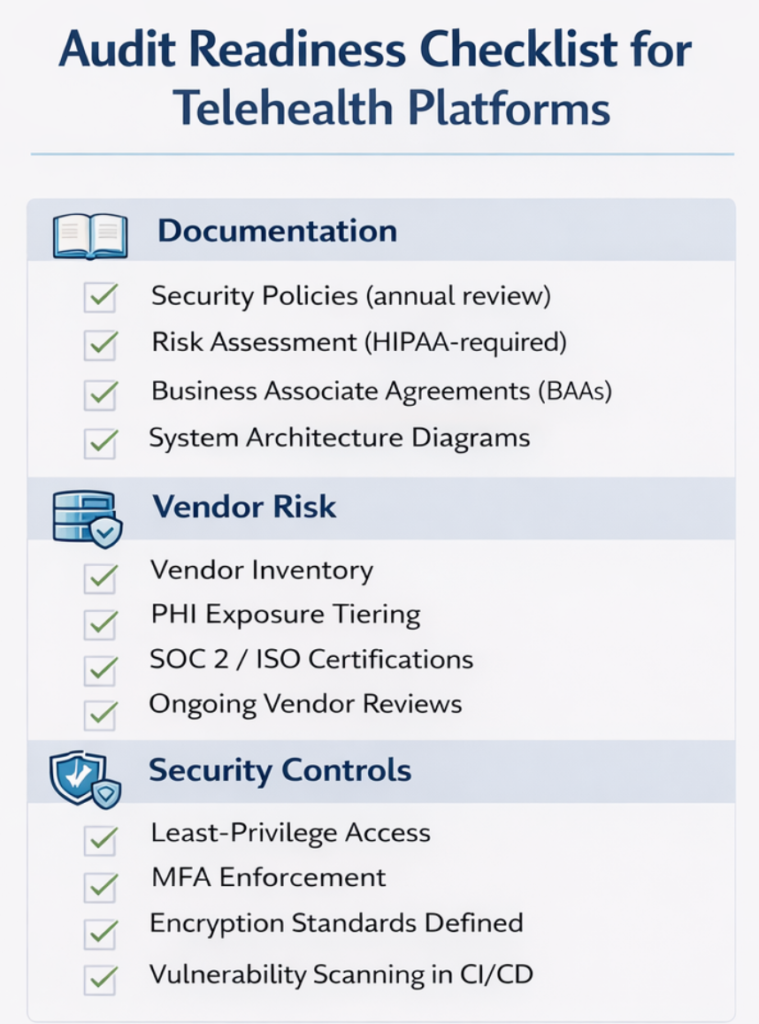
The core documentation set that every telehealth platform needs includes the following:
Security policies and procedures covering data classification, access control, incident response, and acceptable use. These policies must be written, reviewed at defined intervals (typically annually), and signed by accountable executives. Policies written two years ago and never updated signal organizational immaturity.
Risk assessment documentation demonstrating that you’ve systematically identified threats to PHI, evaluated their likelihood and impact, and implemented controls addressing identified risks. HIPAA explicitly requires risk analysis — platforms without documented risk assessments are non-compliant by definition, regardless of technical controls.
Business Associate Agreements (BAAs) with every vendor that touches PHI. This includes cloud infrastructure providers, logging services, video infrastructure vendors, AI inference providers, and any SaaS tool that processes patient data. A single vendor without a BAA creates compliance liability for your entire platform.
System architecture documentation describing how data flows through your platform, where PHI is stored and processed, and how security controls are applied at each layer. Auditors use this to identify gaps between documented architecture and actual implementation.
Training records demonstrating that all employees with PHI access receive regular security awareness training. This must include completion tracking, not just training content.
| Document Type | Review Frequency | Owner | Audit Priority |
| Security Policies | Annual minimum | CISO or CTO | Critical |
| Risk Assessment | Annual + after significant changes | Security Lead | Critical |
| Business Associate Agreements | Per vendor relationship | Legal / Compliance | Critical |
| System Architecture Diagrams | Per significant change | Engineering Lead | High |
| Incident Response Plan | Annual + after incidents | Security Lead | High |
| Employee Training Records | Ongoing | HR / Security | High |
| Penetration Test Reports | Annual minimum | Security Lead | High |
| Vendor Risk Assessments | Annual per critical vendor | Compliance | Medium |
Vendor Risk Management: Your Compliance Extends to Your Stack
Enterprise due diligence teams investigate your vendors almost as thoroughly as they investigate you. This makes sense — your platform’s security posture is limited by the weakest link in your vendor chain. A sophisticated internal security program doesn’t protect PHI that leaks through an insecure third-party analytics integration.
Vendor risk management starts with a complete inventory of every vendor that touches your platform or data. Many startups discover gaps during this exercise — logging tools implemented by individual developers, analytics integrations added during a growth sprint, or monitoring services that quietly receive request payloads containing PHI.
For each vendor touching PHI, you need a documented risk assessment covering their security certifications (SOC 2, ISO 27001, HITRUST), their subprocessor relationships, their data retention and deletion practices, their breach notification timelines, and the terms of your Business Associate Agreement.
Critical vendor relationships require ongoing oversight, not just point-in-time assessment. This means monitoring vendor security advisories, reviewing annual audit reports when available, and reassessing risk when vendors make significant infrastructure changes. Enterprise customers will ask whether you have a formal vendor review process — a spreadsheet of vendor names is not an adequate answer.
The practical structure for vendor risk management involves tiering vendors by risk level. Tier one vendors — those storing or processing PHI directly — receive the most rigorous assessment and the strictest contractual requirements. Tier two vendors — those with indirect PHI exposure — receive lighter-touch assessment. Tier three vendors — those with no PHI access — require only basic security confirmation.
Security Controls: Demonstrating Technical Depth
Auditors and enterprise security teams evaluate security controls across several domains. Documenting these controls and being able to demonstrate their implementation is the core of technical due diligence.
Access control documentation must demonstrate that PHI access follows least-privilege principles, that access is reviewed periodically, and that terminated employee access is revoked promptly. Auditors request user access reports, review recent access certifications, and look for evidence of orphaned accounts with persistent access.
Encryption documentation must specify which encryption standards are applied, where encryption is enforced, and how encryption keys are managed. Stating “we encrypt all data” isn’t sufficient — auditors want to know the algorithm, key length, key rotation frequency, and key storage mechanism.
Vulnerability management documentation must show that you systematically identify and remediate security vulnerabilities in your platform. This includes dependency scanning in your CI/CD pipeline, container image scanning, infrastructure configuration scanning, and a defined remediation timeline based on vulnerability severity.
Multi-factor authentication must be enforced for all access to systems containing PHI — both production infrastructure access by engineers and application access by clinical users. MFA exemptions require documented justification and compensating controls.
Logging and Traceability: The Audit Trail That Proves Everything
Comprehensive logging serves two compliance functions simultaneously. It provides the real-time visibility needed to detect security incidents, and it creates the historical record needed to demonstrate compliance during audits.
The logging architecture for a compliant telehealth platform must capture authentication events (successful and failed logins, MFA completions, session terminations), PHI access events (which user accessed which patient records, when, and from where), administrative events (configuration changes, permission modifications, policy updates), and system events (service starts and stops, errors, performance anomalies).
These logs must be tamper-evident — stored in systems where log entries cannot be modified or deleted without detection. HIPAA requires audit log retention for six years. Enterprise customers often ask to review log completeness and retention practices during due diligence.
The practical challenge is making logs useful without creating PHI exposure in the logging infrastructure. As covered in earlier architectural discussions, PHI must be stripped or tokenized before logs leave your secure environment. Audit logs must be detailed enough to support investigations while avoiding unnecessary PHI accumulation in logging systems.
Penetration Testing: Finding Problems Before Auditors Do
Penetration testing is both a security practice and a compliance artifact. SOC 2 Type II examinations require annual penetration testing. HITRUST certification requires it. Enterprise security teams request penetration test reports during procurement — and scrutinize them carefully.
A credible penetration test for a telehealth platform covers several distinct scopes. External network penetration testing evaluates your internet-facing attack surface — APIs, web applications, and authentication endpoints. Internal penetration testing evaluates what an attacker with initial access could reach. Application penetration testing specifically targets healthcare-relevant vulnerabilities — authorization bypasses that could expose another patient’s records, injection vulnerabilities in clinical data inputs, and insecure direct object references in patient document access.
The penetration test report itself is a compliance document. It must come from a credible third-party firm (not internal security teams), must be dated within the past twelve months, and must include a remediation status section showing that identified findings were addressed. A penetration test report showing critical findings without documented remediation raises more concerns than no penetration test at all.
Incident Response Planning: Demonstrating Operational Maturity
Enterprise customers and investors evaluate incident response plans because incidents are inevitable. The question isn’t whether your platform will experience a security event — it’s whether your organization can respond effectively when one occurs.
A credible incident response plan for a telehealth platform includes clearly defined incident classifications (what constitutes a security incident versus a performance incident), specific roles and responsibilities for incident response team members, step-by-step response procedures for common incident types (ransomware, data breach, service disruption), communication templates for notifying affected patients and regulators, and documented timelines meeting HIPAA’s 60-day breach notification requirement.
The plan must be tested. Tabletop exercises — structured simulations where the response team walks through hypothetical incidents — demonstrate that the plan is understood and executable, not just documented. Annual tabletop exercises should be recorded and reports retained for audit purposes.
Enterprise due diligence teams often ask: “Have you ever experienced a security incident, and how did you respond?” A confident, factual answer demonstrating systematic response and organizational learning is far more credible than a denial of any prior incidents. Organizations that have experienced and competently handled incidents are often more trustworthy than those claiming perfect security records.
Building Audit Readiness as Engineering Practice
At Trembit, we work with telehealth startups at exactly this inflection point — platforms that have built impressive products but face their first serious compliance examination and need to close the gap between engineering sophistication and compliance readiness.
Our approach integrates compliance preparation into engineering workflows rather than treating it as a parallel effort. Security controls are documented as they’re built. Risk assessments are updated when architecture changes. Vendor risk management happens as vendors are onboarded, not during pre-audit preparation. Penetration testing is scheduled annually, not triggered by procurement requirements.
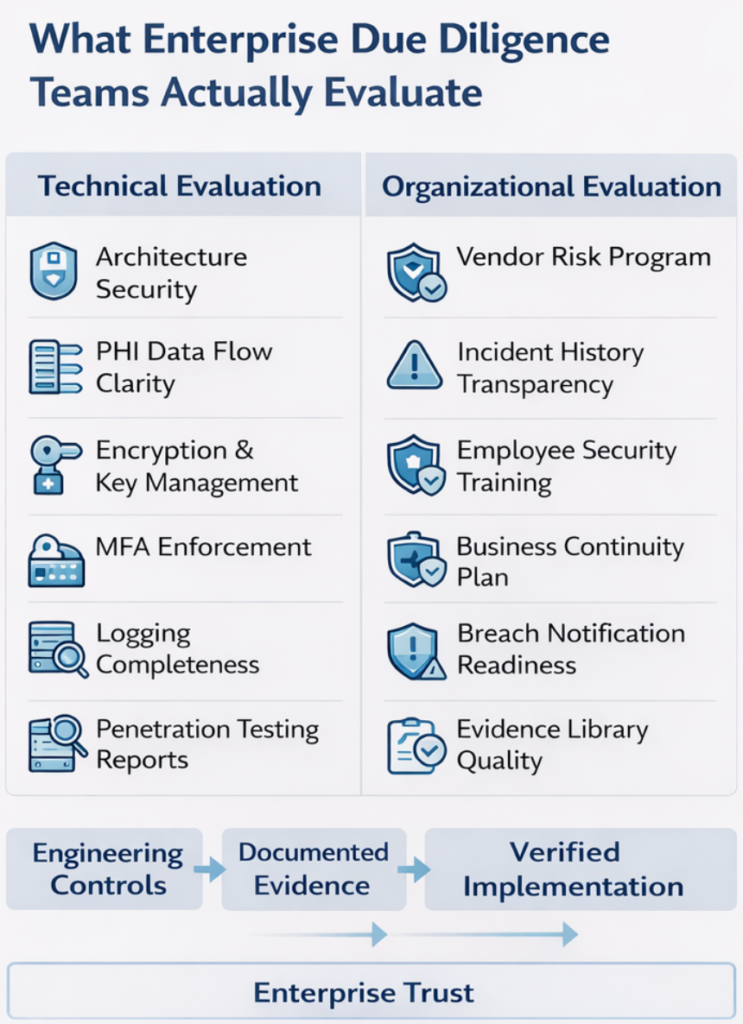
This integration means that compliance readiness is a continuous state rather than a periodic sprint. When an enterprise procurement team requests your security documentation, you share a well-maintained library of current artifacts — not a collection of documents hastily assembled in the two weeks before a deadline.
The startups that close enterprise deals fastest and raise funding rounds most smoothly are those that treat compliance as a product requirement. Patient data protection isn’t a regulatory burden that slows innovation — it’s the foundation of trust that makes enterprise healthcare relationships possible. Building that foundation deliberately, from early in your platform’s development, is the most valuable infrastructure investment a telehealth startup can make.