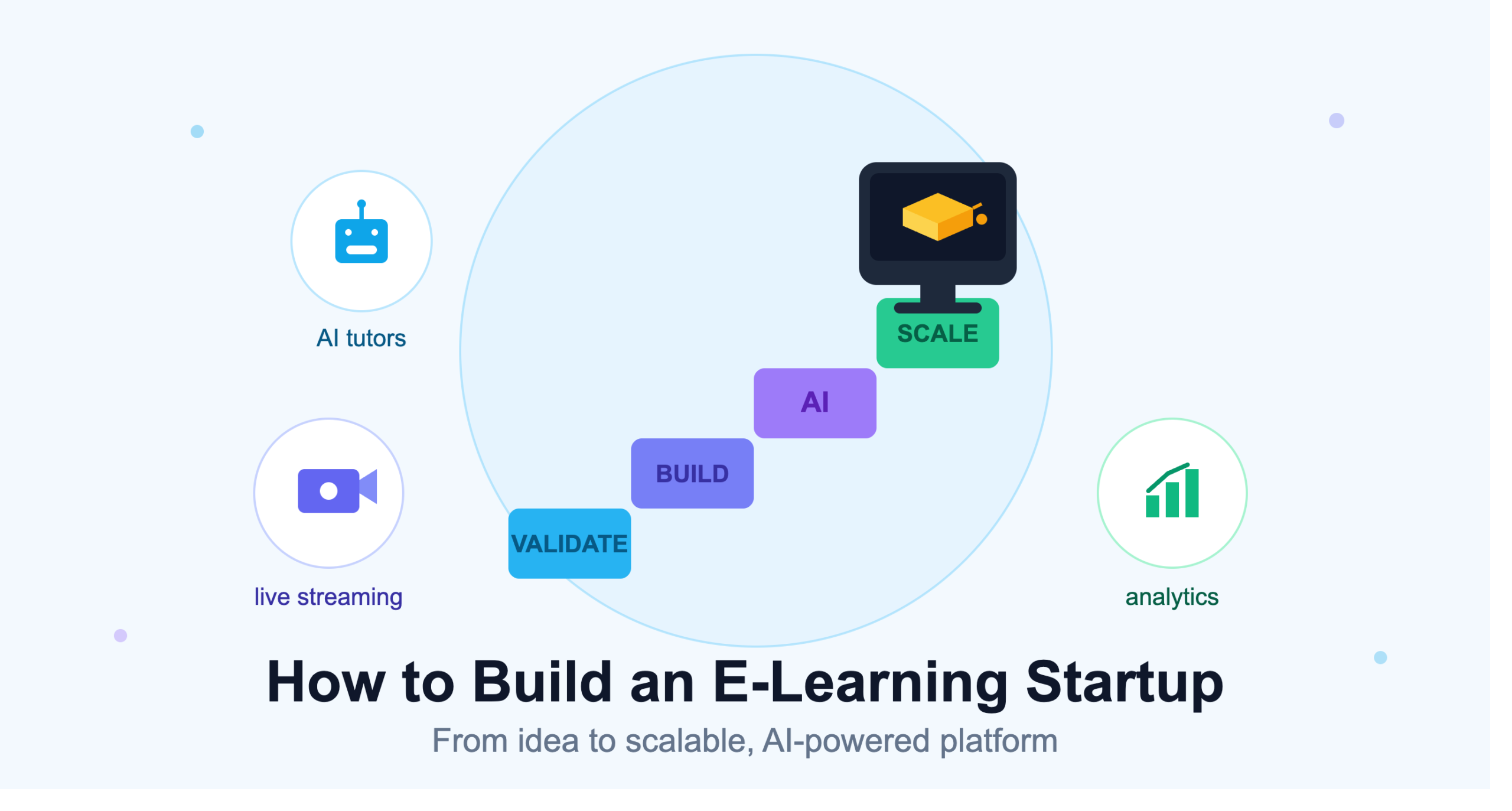
Why E-Learning Is at a Turning Point
The maturing EdTech ecosystem: post-COVID consolidation and AI acceleration
The post-pandemic surge in EdTech innovation is giving way to a phase of consolidation and maturity. What began as a rush to digitize classrooms has grown into a need for platforms that deliver measurable learning value and scalable business growth. Startups launching in 2025–2026 face a landscape that values product depth, scalability, and seamless AI integration.
If you are building the platform itself, our guide to custom LMS development in 2026 walks through the architecture and build decisions.
AI adoption is accelerating. Learning platforms now use machine learning to personalize content, optimize engagement, and forecast performance. Startups that treat AI as a strategic foundation,not just a feature, will define the next era.
Key global trends shaping the industry (AI tutors, real-time collaboration, hybrid learning)
Three technological shifts are redefining the learning experience:
- AI tutors and conversational learning bots are becoming mainstream, delivering individualized assistance and feedback at scale.
- Real-time collaboration tools are revolutionizing the way students and instructors interact, facilitating seamless teamwork, peer review, and live discussions.
- Hybrid learning ecosystems are now the norm, merging digital convenience with human connection to serve a more flexible, global learner base.
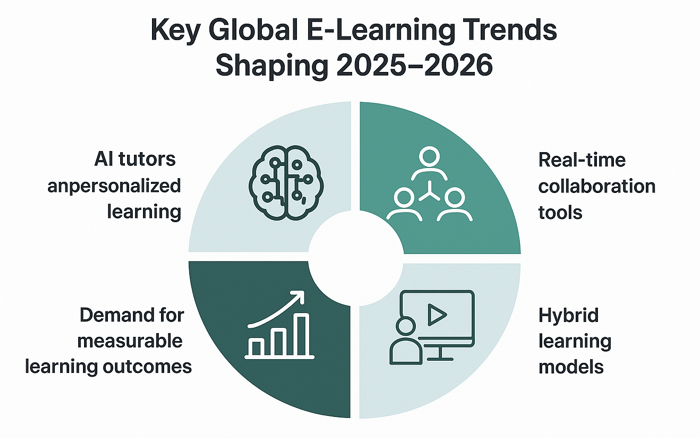
Together, these trends create opportunities for startups that can blend engagement, analytics, and accessibility into cohesive learning experiences.
Why investors now demand measurable learning outcomes, not just engagement
Investor expectations have evolved. Engagement metrics — once the core of startup pitches — no longer suffice. Today’s investors prioritize evidence of real learning impact, such as skill acquisition, retention, and certification outcomes. Platforms that use data to prove improvement in learner performance are better positioned to attract funding and scale sustainably.
In this context, a startup’s tech strategy becomes inseparable from its value proposition. Data infrastructure, AI readiness, and measurable outcomes are no longer “nice-to-have” — they are the core metrics of success.
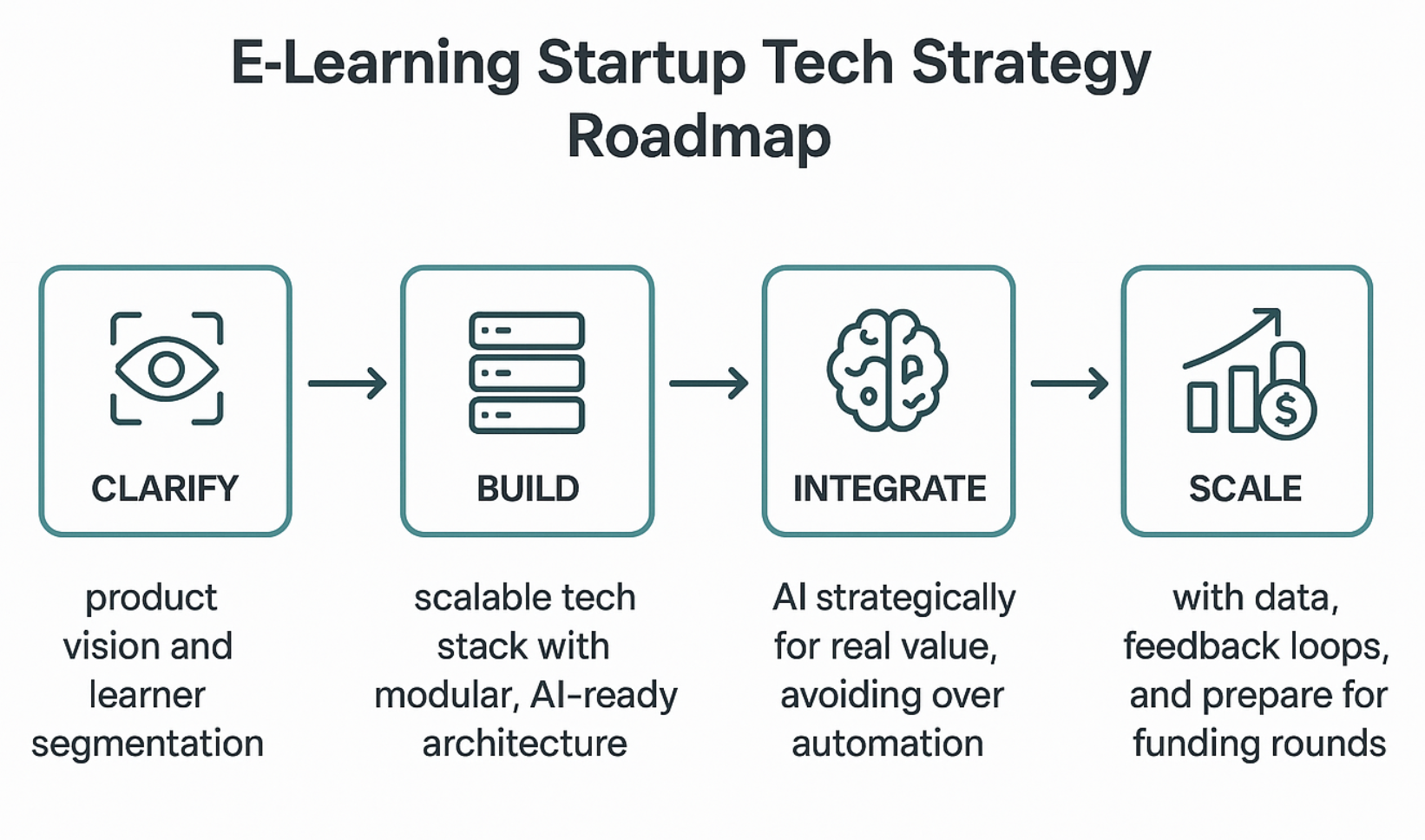
Step 1 — Clarify Your Product Vision and Target Learner
Every impactful e-learning product starts with clarity: a well-defined mission and a precisely understood audience.
Define the educational gap your product solves
Successful EdTech startups identify a real, specific problem. Are you addressing professional upskilling, K-12 curriculum gaps, or corporate compliance training? Understanding your educational gap allows you to deliver not just courses, but outcomes that align with user intent and institutional needs.
How to segment your target audience: B2C learners, enterprises, schools, or training institutions
| Segment | Primary needs & pain points | Must-have product features | Success metrics (what customers care about) |
| 2C learners (individuals) | Flexibility, quick wins, affordability, engaging UX | Mobile-first UI, bite-sized courses, gamification, progress tracking | Completion rate, NPS, daily/weekly active users |
| Enterprises | Skill verification, compliance, L&D integration | SCORM/xAPI, SSO/SSO, HRIS/LMS integrations, centralized reporting | Time-to-complete, compliance rate, employee performance lift |
| Schools (K-12 / higher ed) | Curriculum alignment, teacher tools, privacy | Curriculum mapping, teacher dashboards, assessment tools, parental reporting | Test score improvement, teacher adoption, attendance |
| Training institutions & cert providers | Certification throughput, content reuse | Exam engines, certificate issuance, modular content, proctoring | Pass rates, repeat enrollment, employer placement rate |
Each segment brings unique technical and pedagogical requirements:
- B2C learners: prioritize self-paced learning, gamification, and user experience.
- Enterprises: require compliance tracking, analytics dashboards, and integration with HR systems.
- Schools: value curriculum alignment, teacher support, and student data security.
- Training institutions: demand certification management and modular content delivery.
Aligning business goals with pedagogical outcomes
The most successful startups treat educational results and business results as one. If your revenue model depends on retention or subscription renewal, your pedagogy must drive measurable learner success. A strong alignment between learning impact and business KPIs ensures both sustainability and credibility.
Step 2 — Validate the Idea Before Writing a Single Line of Code
In an increasingly competitive landscape, speed without validation is a risk. Before building your MVP, confirm that the market truly needs what you plan to create.
Conducting lean market research and user interviews
Engage directly with learners, instructors, and organizational stakeholders. Ask what challenges they face and how they define “value.” Use lightweight surveys, interviews, and quick experiments to test assumptions early — before development begins.
Building a clickable prototype or concept demo
A visual, interactive prototype communicates your idea far better than a slide deck. It enables early feedback, investor buy-in, and clearer technical scoping for your team.
Common validation mistakes early-stage founders make
- Skipping direct user interviews and relying on assumptions.
- Building complex features before confirming user demand.
- Collecting feedback but failing to act on it.
Validation isn’t a stage — it’s a culture of continuous learning that underpins sustainable growth.
Step 3 — Build a Scalable Tech Strategy, Not Just an MVP
As the product vision solidifies, technology decisions must anticipate future growth. The MVP is a milestone — not the finish line.

Why choosing the right tech stack matters for long-term scaling
Your tech stack should evolve with your users. Cloud-native infrastructure, modular design, and scalable architectures help prevent costly rebuilds as you expand. Choosing the right frameworks early on ensures performance, security, and agility.
| Layer | Example choices / tech notes | Why it matters | Priority |
| Infrastructure | Cloud (AWS/GCP/Azure), managed DBs, CDN, infra-as-code | Scalable, secure, cost-managed ops | High |
| Backend | Microservices, GraphQL/REST API, auth (OAuth2/JWT) | Flexibility, independent scaling | High |
| Data & AI | Data lake/warehouse, feature store, model infra (TF/PyTorch), MLOps | Turns usage into personalized value | High |
| Media & Streaming | WebRTC for live, HLS/DASH for VOD, adaptive bitrate | Low-latency, reliable video learning | High |
| Frontend | React/Vue + PWAs, mobile (Flutter/React Native or native) | UX, accessibility, offline support | High |
| Analytics & Observability | Event tracking (xAPI), monitoring, A/B testing | Measure impact and iterate | High |
| Security & Compliance | Encryption, role-based access, GDPR/FERPA checklist | Trust and legal readiness | High |
| DevOps & CI/CD | Automated pipelines, tests, blue/green deploys | Faster iterate + safe releases | Medium |
| Integrations | LTI/xAPI, SSO, payment gateways, HRIS connectors | Enterprise adoption & monetization | Medium |
Modular architecture for learning platforms (LMS, LXP, microservices)
- LMS (Learning Management System): centralizes course delivery and tracking.
- LXP (Learning Experience Platform): curates personalized learning paths.
- Microservices: allow independent feature scaling and faster innovation cycles.
Building AI-readiness into your architecture from day one
AI integration should be planned, not patched. Prepare your platform to ingest data ethically, structure it effectively, and apply it intelligently through personalized recommendations, adaptive testing, or predictive analytics. Startups that build with AI-readiness by design will innovate faster and scale smarter.
Step 4 — Integrate AI Intelligently, Not Hastily
AI is both a competitive advantage and a potential pitfall. Its implementation must be strategic and aligned with learning value.
AI as a strategic differentiator: personalization, analytics, and automation
Used wisely, AI amplifies human teaching. It can personalize learning content, identify skill gaps, automate routine tasks, and deliver actionable insights to educators. The real impact comes from augmented intelligence—AI systems that empower, not replace, human educators.
How to decide which AI features add real value (vs. hype)
Prioritize AI features that directly enhance outcomes: adaptive assessments, learning path optimization, real-time emotion or engagement tracking, and predictive analytics. Avoid “AI-washing” — features that sound impressive but lack measurable educational benefit.
| AI Feature | Direct learner value | Data/time to validate | Risk / mitigation | Recommendation |
| Adaptive assessments (dynamic quizzes) | High — targets gaps, increases mastery | Modest (item bank + response data) | Risk: mis-scaling adaptive algos → start small, human review | ✅ Pilot |
| Personalized content recommendations | High — increases completion | Requires content tagging + behavioral signals | Bias/relevance risk → add human curator loop | ✅ Phased |
| AI tutor / chatbot | Medium-High — 24/7 support but limited pedagogy | Needs conversation logs, intent models | Hallucination risk → restrict to FAQs & scripted flows | ✅ Conservative rollout |
| Emotion/engagement detection (video/audio) | Medium — can flag disengagement | High data/labels + privacy concerns | Privacy & false positives → opt-in, use aggregate signals | ⚠️ Cautious |
| Auto-grading (essays, code) | High for scaling evaluation | Requires labeled rubrics and training | Accuracy/appeal risk → hybrid (AI + human) | ✅ Hybrid |
| Generative content (course drafts) | Medium — speeds content creation | Moderate | Copyright / quality issues → human oversight | ✅ With guardrails |
Common pitfalls when founders over-automate too early
Automation without context can alienate learners or create sterile user experiences. Build AI features gradually, validate their effect, and keep human empathy at the core of learning interactions.
Step 5 — Choose the Right Development Path
Execution defines whether your idea reaches the market effectively. Selecting the right development model, internal or external, determines both speed and quality.
In-house vs. outsourcing: when and why to partner with an expert team
- In-house: offers control and cultural alignment but demands larger budgets and longer timelines.
- Outsourcing: accelerates development, brings niche expertise, and optimizes cost-efficiency.
Evaluating outsourcing partners: technical depth, communication, industry fit
A strong partner should demonstrate not only technical excellence but also domain fluency in education technology. Look for teams with proven experience in LMS, video streaming, or AI integration—where nuances in pedagogy meet software engineering.
How to maintain product ownership while leveraging external development
Even when outsourcing, maintain strategic ownership. Set transparent communication processes, define KPIs, and ensure joint decision-making. True partnerships extend beyond delivery — they share accountability for long-term success.
Step 6 — Scale with Data and Feedback
Scaling isn’t just about adding users — it’s about improving continuously. The best e-learning products grow smarter with every learner interaction.
Continuous learning loops: collect → analyze → iterate
Establish a feedback infrastructure that captures behavioral data, performance metrics, and qualitative insights. Use this data to refine content, interfaces, and teaching models.
Using analytics to refine UX and improve course effectiveness
Analytics help identify friction points, drop-off patterns, and success drivers. Apply them to optimize the learner journey, elevate engagement, and increase course completion rates.
Preparing for Series A/B with data-driven storytelling
When approaching investors, let your data narrate the impact — user retention trends, improved learner outcomes, and technical scalability. These insights form the foundation of a compelling funding narrative.
| Metric | Why it matters | Practical benchmark (early-stage startups) |
| Course completion rate | Measures actual learning, not just clicks | 20–40% (varies by course length) |
| 30/90-day retention | Product stickiness & learning continuity | 15–30% (30d), 10–20% (90d) |
| Skill uplift / assessment improvement | Learning efficacy (pre/post) | +20–40% on focused micro-courses |
| NPS / CSAT | Learner satisfaction — virality signal | NPS 30+ is strong |
| Time-to-value (avg time to visible learning outcome) | Speed at which learners see progress | <4 weeks for micro-credentials |
| LTV : CAC | Business sustainability | >3 (aim to improve over time) |
| System SLOs (uptime, latency) | Product reliability for live sessions | 99.9% uptime, <500ms typical API latency |
| Data readiness (events per user/week) | Ability to power AI & analytics | ≥50 meaningful events/user/week |
Final Thoughts — Founders Who Think Long-Term Win
Why tech strategy is now business strategy
In 2025–2026, an e-learning startup’s technology roadmap is indistinguishable from its business plan. Scalability, interoperability, and measurable outcomes drive both profitability and educational credibility.
Lessons from startups that survived the first AI wave
Those who endured the initial AI hype cycle share a common trait: disciplined execution. They built adaptable systems, focused on value-driven features, and measured impact relentlessly.
Trembit’s closing insight: building AI + streaming-powered learning platforms for scale
At Trembit, we’ve seen firsthand how scalable architecture and AI-driven interactivity transform educational platforms. Our expertise in real-time streaming, analytics, and intelligent automation helps startups evolve from promising ideas to platforms that make learning measurable, engaging, and lasting.