Telehealth has moved from a “nice-to-have” innovation to a core component of modern healthcare delivery. Patients now expect remote consultations, secure video calls, and seamless access to their medical data — without compromising privacy or safety. For healthcare providers and digital health startups, this creates a critical challenge: how to scale telehealth solutions while maintaining the highest standards of security and regulatory compliance.
This is where experience, architecture decisions, and the right technology partner make all the difference.
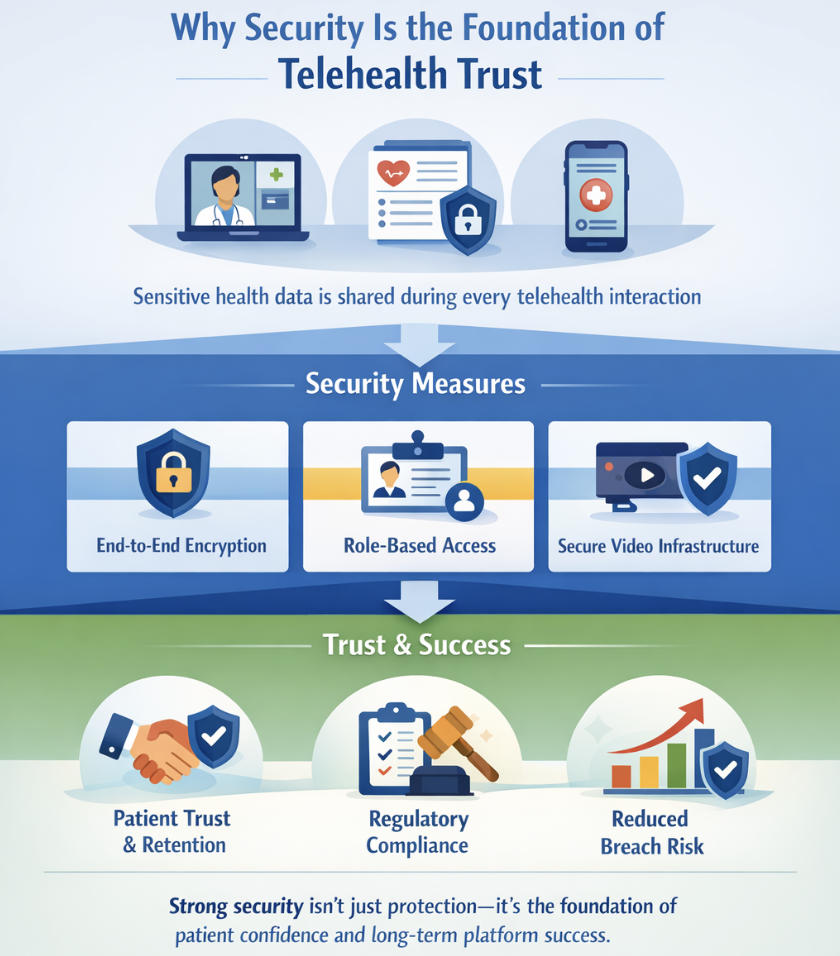
Why Security Is the Foundation of Patient Trust
In telehealth, trust is built long before the first virtual appointment begins. Patients share highly sensitive personal and medical information, often across borders and devices. Any weakness in data protection can lead to reputational damage, legal penalties, and, most importantly, a loss of patient confidence.
Secure telehealth platforms are not defined by a single feature. They are the result of security-by-design thinking, where encryption, access control, monitoring, and compliance are embedded into the system from day one rather than added later as patches.
For healthcare organizations, investing in secure infrastructure is no longer just a regulatory requirement — it is a competitive advantage.
Navigating Regulatory Complexity: HIPAA, GDPR, and Beyond
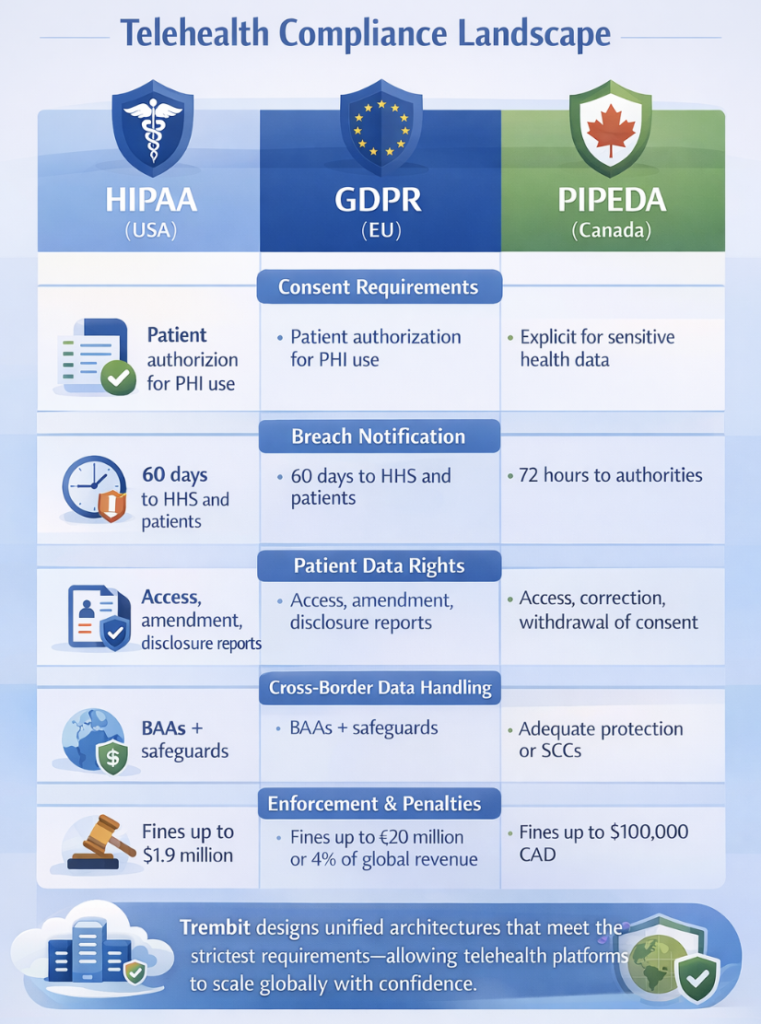
Telehealth solutions often operate across multiple regions, each with its own data protection framework. The most common regulations include:
- HIPAA (USA) – focuses on protecting electronic Protected Health Information (ePHI) through technical, administrative, and physical safeguards.
- GDPR (EU) – emphasizes explicit consent, data minimization, transparency, and strong user rights.
- PIPEDA (Canada) – balances flexibility with accountability, particularly around consent and cross-border data transfers.
Complying with one regulation is challenging enough. Supporting multiple frameworks simultaneously requires deep technical expertise and careful system design. This is why successful telehealth platforms rely on unified architectures that meet the strictest requirements by default, allowing them to scale globally without re-engineering core systems.
Practical Security Measures That Make a Real Difference
High-performing telehealth platforms consistently implement the following practices:
End-to-End Encryption
All data, video streams, messages, files, and records must be encrypted both in transit and at rest. Modern platforms rely on strong protocols such as TLS 1.3 and AES-256 to protect sensitive information from interception or leaks.
Role-Based Access Control
Not every user needs access to the same data. Doctors, nurses, administrators, and patients should only see what is relevant to their role. This significantly reduces the risk of internal breaches and human error.
Audit Logs and Monitoring
Security is not static. Continuous monitoring and detailed audit logs help detect unusual behavior early and provide transparency during compliance reviews or incident investigations.
Secure WebRTC Infrastructure
Video communication is at the heart of telehealth. Properly configured WebRTC solutions — with controlled signaling, secure media servers, and optimized TURN/STUN usage — ensure both low latency and strong protection.
From Compliance to Confidence: Building for Scale
Meeting regulatory requirements is only the starting point. The real goal is to build telehealth systems that are resilient, scalable, and future-proof.
As platforms grow, they must support:
- Increasing numbers of concurrent video sessions
- Integration with EHR/EMR systems
- Cross-border data flows
- New features such as AI-assisted diagnostics or remote monitoring
Each of these adds complexity and potential risk if not designed correctly from the beginning.
Trembit: A Reliable and Experienced Technology Partner
Trembit has extensive experience designing and building secure, high-performance telehealth and healthcare platforms for global clients. The team understands that in healthcare, there is no room for shortcuts.
By combining deep WebRTC expertise, cloud-native architectures, and a strong understanding of healthcare compliance, Trembit helps organizations:
- Build telehealth systems that align with HIPAA, GDPR, and other data protection frameworks
- Deliver stable, low-latency video communication at scale
- Embed security into the core architecture, not as an afterthought
- Confidently expand into new markets without compromising patient trust
Trembit’s approach is practical, transparent, and focused on long-term reliability — qualities that make them a trusted partner for healthcare providers, startups, and enterprises alike.
Conclusion: Security as a Strategic Advantage
In telehealth, security is not just about avoiding fines or passing audits. It is about earning and maintaining trust — from patients, partners, and regulators. Organizations that invest in secure, compliant, and scalable systems are better positioned to grow, innovate, and deliver high-quality care remotely.
With the right technical foundation and an experienced partner like Trembit, telehealth platforms can move beyond basic compliance and turn security into a true business advantage.