Most WebRTC testing content covers one problem: Does the call work? Functional tests, load tests, and network simulation — the engineering discipline of verifying that audio and video flow reliably between participants.
In healthcare, that’s half the job.
The other half is compliance: does the call handle PHI correctly? Does your recording pipeline store data where it’s supposed to? Does your session token expire when it should? Does your platform behave correctly when a patient revokes consent mid-session? These aren’t edge cases — they’re the scenarios that appear in HIPAA audit findings and OCR investigation reports.
No competitor has written the article that combines both angles into a complete testing framework for healthcare WebRTC. WebRTC.ventures covers the technical testing discipline well. Nobody covers how compliance requirements translate into automated test cases. That’s the gap this article fills.
Trembit has built and reviewed testing infrastructure for telehealth platforms ranging from early-stage products preparing for their first HIPAA audit to enterprise platforms handling millions of visits annually. The framework here reflects what actually catches problems before they become incidents.
Why Healthcare WebRTC Testing Is Different
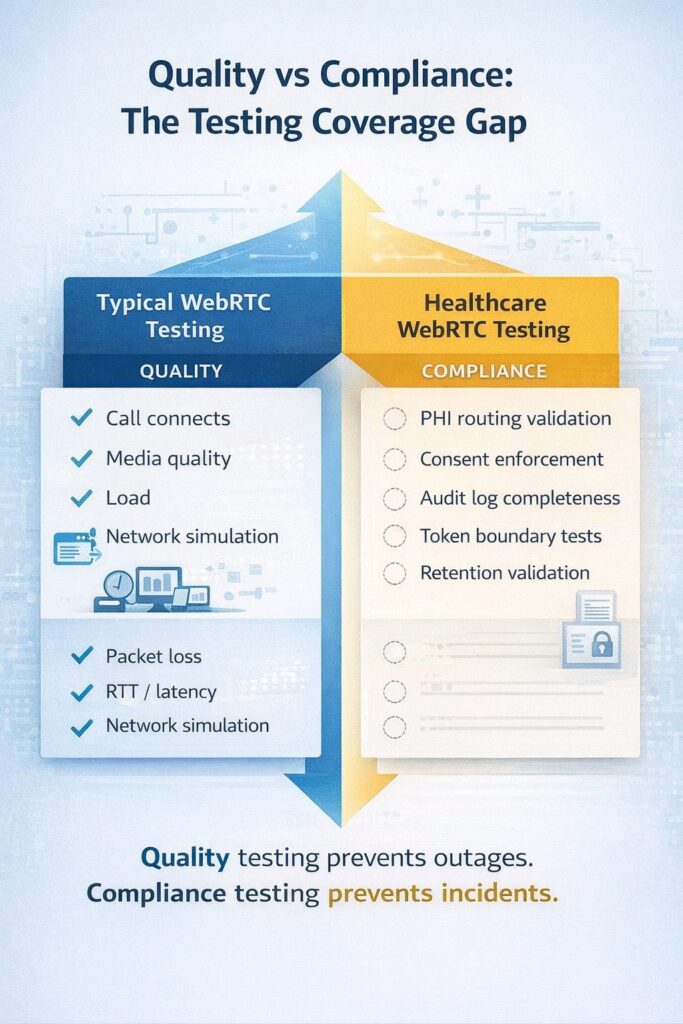
A generic WebRTC testing approach validates that calls connect, media flows, and the system handles load. A healthcare WebRTC testing approach validates all of that — plus a set of compliance behaviors that have no equivalent in consumer or enterprise communications:
PHI handling in media pipelines. Recording, transcription, and AI processing pipelines all touch audio and video that may contain protected health information. Tests need to verify that PHI reaches only authorized destinations, is encrypted in transit and at rest, and is retained only for permitted durations.
Session authorization boundaries. A telehealth session should be accessible only to the authorized patient and provider. Tests need to verify that session tokens can’t be reused, shared, or escalated — and that expired, or revoked tokens are rejected at every layer, not just the API.
Audit log completeness. HIPAA requires that access to PHI be logged. For a telehealth platform, that means every session starts, every participant joins, every recording access, and every AI processing event needs an audit trail. Tests need to verify that audit logs are written correctly, completely, and tamper-evidently.
Consent enforcement. Platforms that collect patient consent for AI processing, recording, or data sharing need to verify that consent state is enforced throughout the session lifecycle — including when consent is withdrawn mid-session.
Graceful degradation without PHI exposure. When infrastructure fails — AI pipeline goes down, recording service unavailable, SFU overloaded — the failure path must not expose PHI or leave sessions in an inconsistent state. Tests need to exercise failure paths explicitly.
The Four Testing Layers for Healthcare WebRTC
A complete healthcare WebRTC testing framework covers four distinct layers, each requiring different tools and each catching different failure modes.
Layer 1: Functional WebRTC Testing
Verifying that calls work as expected under controlled conditions
This is the layer most teams have some coverage of. The goal is to verify call setup, media quality, and session lifecycle behavior using automated browser-based test clients.
Core test cases:
- Call establishment between two participants (success path)
- Call establishment with one participant on a restricted network (TURN relay path)
- Participants join and leave without disrupting other participants.
- Session recovery after transient network interruption
- Correct codec negotiation across browser/device combinations
- Device permission handling — camera and microphone grant and denial
- Call termination initiated by each participant role (patient, provider, admin)
Tools: Playwright or Puppeteer with WebRTC extensions for browser automation; a headless Chrome test client that can publish synthetic audio/video tracks; your SFU’s testing SDK if available (LiveKit has good test client support).
Healthcare-specific additions to functional testing:
- Verify that session tokens issued to one participant cannot be used by a different participant.
- Verify that a session created for patient A cannot be joined using patient B’s credentials.
- Verify that sessions expire at the correct time and cannot be rejoined after expiry.
Layer 2: Network Condition Testing
Verifying quality and behavior under realistic adverse conditions
Telehealth patients connect from home networks, rural broadband, mobile data, and VPNs. Your test suite needs to verify call behavior under the network conditions your actual patient population experiences — not just the fast, stable network in your CI environment.
Network simulation test cases:
- 2% packet loss (barely perceptible degradation threshold)
- 5% packet loss (audible artifacts begin)
- 10% packet loss (call becomes clinically unusable)
- 200ms RTT (acceptable)
- 500ms RTT (noticeable delay)
- Bandwidth constrained to 500 kbps (below standard video bitrate)
- Network interruption and recovery (30-second complete dropout)
- Asymmetric conditions (good uplink, degraded downlink — common on home networks)
Tools: tc (Linux traffic control) for network simulation in CI; Chrome’s built-in network throttling via DevTools Protocol for browser-based tests; Toxiproxy for service-level network fault injection.
Healthcare-specific additions:
- Verify that graceful degradation to audio-only triggers correctly under bandwidth constraints
- Verify that the provider is notified when the patient connection quality drops below the clinical usability threshold.
- Verify that the session is preserved (not terminated) during network interruption and recovery.
Layer 3: Compliance Behavior Testing
Verifying that PHI is handled correctly throughout the session lifecycle
This is the layer most WebRTC testing frameworks don’t have. Every test case in this layer maps directly to a HIPAA requirement or a common audit finding.
PHI handling test cases:
- Verify that recording files are written to the correct, BAA-covered storage destination and not to any intermediate or logging location.
- Verify that recording files are encrypted at rest (check storage metadata, not just configuration)
- Verify that transcripts generated by STT pipelines are not persisted in log files, error messages, or monitoring systems.
- Verify that session metadata (participant identifiers, join/leave timestamps) is written to the audit log with the correct format and completeness.
- Verify that audit log entries cannot be deleted or modified via the application API
- Verify that AI processing pipeline outputs (notes, transcripts, summaries) are stored in the EHR/designated clinical system and not in intermediate AI vendor storage beyond the permitted retention period.
Session authorization test cases:
- Verify that a session token cannot be used after the session end time.
- Verify that a session token cannot be used by a different IP address if IP binding is configured.
- Verify that a revoked token is rejected within the configured propagation window (test this at the SFU level, not just the API level)
- Verify that a provider cannot join a patient’s session using their own credentials if they are not the assigned provider.
- Verify that session room names/IDs are not enumerable (sequential IDs that allow room discovery are a common finding)
Consent enforcement test cases:
- Verify that the recording does not start when patient consent for recording has not been obtained.
- Verify that the AI processing pipeline does not receive audio when the patient has declined AI consent.
- Verify that mid-session consent withdrawal stops recording/AI processing within the configured maximum latency window.
- Verify that the consent state is persisted correctly and survives session reconnection.
Data retention test cases:
- Verify that session recordings are automatically deleted after the configured retention period.
- Verify that deletion is complete — verify at the storage level, not just the application level.
- Verify that retention policy enforcement survives infrastructure restarts and deployments.
Layer 4: Load and Scalability Testing
Verifying behavior under production-scale concurrent load
Load testing for healthcare WebRTC has one healthcare-specific requirement that generic load testing doesn’t: you need to verify compliance behaviors under load, not just performance. An AI pipeline that correctly withholds processing for non-consented patients at 10 concurrent sessions may fail to enforce that correctly at 500 concurrent sessions if the consent state lookup has a race condition.
Load test scenarios:
- Baseline concurrent sessions: your current peak plus 50% headroom
- Spike scenario: 2x normal peak over 5 minutes (Monday morning clinic open)
- Sustained high load: 150% of normal peak for 60 minutes
- Session churn: rapid session creation and teardown (simulates end-of-day clinic close)
Tools: k6 with WebRTC extensions; custom load test clients using your SFU’s SDK; Gatling for signaling server load.
| Test Layer | Primary Tools | Runs In CI | Frequency | Healthcare Priority |
| Functional WebRTC | Playwright + headless Chrome | Yes | Every PR | High |
| Network condition | tc / Toxiproxy + browser automation | Yes (staging) | Daily | High |
| Compliance behavior | Custom + API test framework | Yes | Every PR | Critical |
| Load + scalability | k6 / Gatling + SFU SDK | Staging only | Weekly + pre-release | High |
The Compliance Test Cases Most Teams Are Missing
In Trembit’s experience reviewing telehealth platform testing infrastructure, these are the specific gaps that show up most consistently — and that cause the most problems when they’re discovered in audits rather than tests:
SFU-level token validation. Most teams test that their API rejects invalid tokens. Far fewer tests than the SFU itself — the media server — rejects connections from clients presenting invalid or expired tokens. If your API validates tokens but your SFU accepts any connection, the API check is security theater.
Recording destination verification at the infrastructure level. Application-level tests verify that the recording API is called with the right parameters. Infrastructure-level tests verify that the actual bytes end up in the right storage bucket, encrypted, with the right access policy. These are different tests, and both are necessary.
Audit log completeness under failure conditions. Most audit log tests verify that events are logged on the success path. Fewer tests that audit log entries are written correctly when the session fails mid-call, when the AI pipeline goes down, or when a participant is forcibly removed. Incomplete audit logs under failure conditions are a common finding.
AI pipeline consent bypass via direct API access. If your AI processing pipeline is accessible via an internal API, test that it rejects requests for sessions where the patient hasn’t consented — not just that your application layer enforces consent before calling the API. Defense in depth means the AI pipeline enforces consent itself.
Building the Testing Pipeline: Practical Implementation
Structuring the four testing layers into a CI/CD pipeline that doesn’t slow down deployment:
On every pull request (fast, ~5 minutes): Functional call establishment tests, session authorization tests, consent enforcement tests, audit log completeness tests — the compliance-critical subset that must pass before any code merges.
On every merge to main (medium, ~20 minutes): Full functional test suite, network condition tests at the most critical impairment levels (5% packet loss, 500ms RTT), full compliance behavior test suite.
Nightly in staging (thorough, ~90 minutes): Full network condition matrix, load tests at baseline and spike scenarios, data retention verification, cross-browser/device matrix, recording pipeline end-to-end verification including storage encryption check.
Pre-release gate: Full load test suite, including compliance behavior under load, penetration test of session authorization boundaries, and manual review of audit log output format against HIPAA audit trail requirements.
What Trembit Builds for Healthcare Testing Infrastructure
Testing infrastructure is one of the less glamorous parts of a telehealth platform build — and consistently one of the most valuable. Trembit’s approach to healthcare WebRTC projects includes compliance test coverage as a first-class deliverable, not an afterthought.
We’ve seen what happens when it’s treated as an afterthought: a compliance audit that finds incomplete audit logs six months before a Series B, a penetration test that discovers SFU-level token bypass the week before a health system go-live, a HIPAA breach notification triggered by transcripts persisted in a logging system nobody remembered was in the pipeline.
The automated test suite that catches these issues costs a fraction of what the incidents cost. And unlike a security audit or a penetration test, it runs on every deployment — catching regressions before they reach production.
If your telehealth platform’s test suite covers call quality but not compliance behavior, Trembit can help you build the layer that’s missing.
Talk to us about healthcare WebRTC testing.