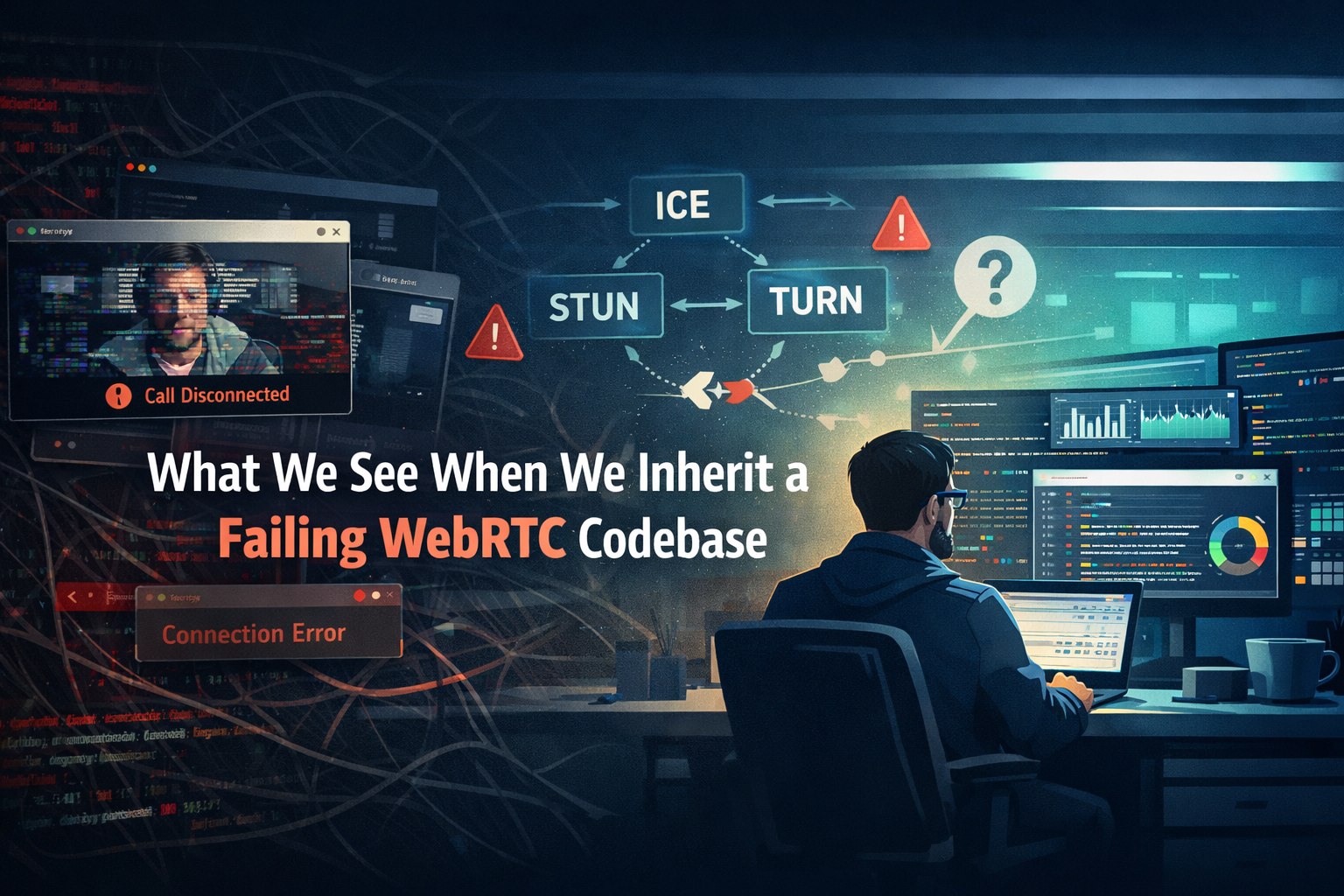
You’ve built a real-time communication feature that includes video calls, screen sharing, and live collaboration. It worked in the demo. But now users are dropping calls, mobile devices fail to connect, and your engineering team has spent three sprints chasing ghosts in a codebase nobody fully understands anymore.
This is the moment many CTOs reach out to us.
At Trembit, we’ve inherited WebRTC projects in various states of distress. Some were built fast under deadline pressure. Others accumulated technical debt over the years of feature additions. A few were simply handed off from a team that no longer exists.
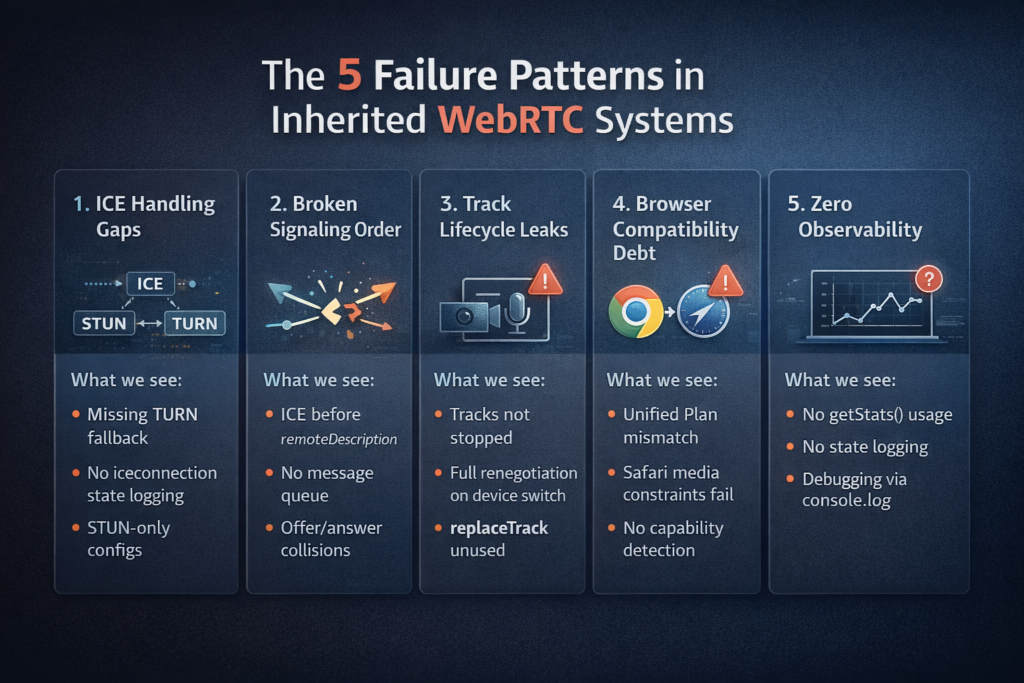
What’s striking is how often we see the same five patterns. Recognizing them early is the difference between a focused rescue and an endless spiral of regression fixes.
Why WebRTC Breaks in Ways That Are Hard to Debug
WebRTC is deceptively approachable. The browser APIs are well-documented, demos are plentiful, and a basic peer-to-peer call is achievable in a weekend. But production WebRTC is a different beast.
It sits at the intersection of networking, media encoding, browser internals, and distributed state management. A bug might only surface on a specific cellular network, behind a symmetric NAT, when more than four participants join, or on a particular version of Safari. Most teams don’t discover these failure modes until real users hit them.
That’s the core problem: WebRTC fails silently, unpredictably, and at the edges — exactly where manual testing doesn’t go.
The Top 5 Patterns We Find
Pattern 1: ICE Handling Done Halfway
ICE (Interactive Connectivity Establishment) is the protocol that negotiates the network path between peers. Most failing codebases implement the “happy path” — the direct connection that works over a local network — and skip or mishandle the fallback logic.
What we see:
- TURN server credentials are hardcoded or missing entirely
- The ICE candidate gathering started before the remote description was set.
- No handling for icefailed or iceconnectionstatechange events
- STUN-only configurations that silently fail behind corporate firewalls
How we fix it: We audit the full ICE state machine and implement proper fallback logic: STUN → TURN UDP → TURN TCP → TURN TLS. We also add structured logging to iceconnectionstatechange and connectionstatechange so failures become visible in monitoring rather than just showing up as user complaints.
Pattern 2: Signaling That Assumes Perfect Order
WebRTC requires a signaling channel (usually WebSocket) to exchange offers, answers, and ICE candidates. The spec is silent on transport — it’s your job to handle ordering, retries, and race conditions.
What we see:
- ICE candidates sent before the remote description is applied, causing them to be silently dropped
- No queue for out-of-order signaling messages
- Signaling channel reconnection logic that doesn’t re-sync WebRTC state
- Offer/answer collisions in multi-party sessions are left unhandled.
How we fix it: We implement a signaling queue with deferred ICE candidate application, and add collision detection using the “perfect negotiation” pattern introduced in modern WebRTC specs. Reconnection logic is made explicit: if the signaling channel drops, the WebRTC connection state is audited before resuming.
Pattern 3: No Media Track Lifecycle Management
Audio and video tracks have a lifecycle: they’re created, attached to peer connections, potentially replaced (e.g., camera switch, screen share), and eventually stopped. Failing codebases treat this as an afterthought.
What we see:
- Tracks are not stopped when a call ends, leaving camera/microphone indicators on
- replaceTrack not used — instead, full renegotiation triggered for every device switch
- Sender and receiver objects leaked across multiple call sessions.
- No handling for track mute/unmute events from the remote peer
How we fix it: We map the full track lifecycle per session and enforce cleanup on every exit path: user hangup, connection failure, and page unload. We also implement proper replaceTrack flows to eliminate unnecessary renegotiations that cause brief audio/video interruptions.
Pattern 4: Browser and Device Compatibility Gaps
WebRTC has been in browsers for over a decade, but implementation differences between Chrome, Firefox, and especially Safari are significant — and they shift with every browser release.
What we see:
- Unified Plan vs. Plan B SDP format mismatches (a common Safari/Chrome incompatibility)
- getUserMedia constraints that work in Chrome and silently fail in Safari
- No fallback for browsers where getDisplayMedia is unsupported
- iOS Safari quirks around audio context state and background tab behavior are completely unaddressed
How we fix it: We introduce an adapter layer (typically webrtc-adapter plus custom shims) and build a device/browser compatibility matrix based on actual user traffic. We add explicit capability detection rather than browser sniffing, and establish a regression test suite that runs against multiple browser targets in CI.
Pattern 5: Observability Is Nonexistent
This is the one that compounds every other problem. Without visibility into what’s happening in production, every bug is an investigation that starts from zero.
What we see:
- No use of RTCPeerConnection.getStats() — the built-in telemetry API that exposes bitrate, packet loss, jitter, and codec details
- No logging of state transitions (signalingState, iceConnectionState, connectionState)
- Errors swallowed in catch blocks with console.log(“error”)
- No ability to distinguish “user had bad network” from “our code failed.”
How we fix it: We instrument the full WebRTC stats pipeline — polling getStats() at regular intervals and shipping key metrics (packet loss %, round-trip time, audio level, connection state transitions) to whatever observability stack the team already uses. This alone often cuts investigation time by 70%.
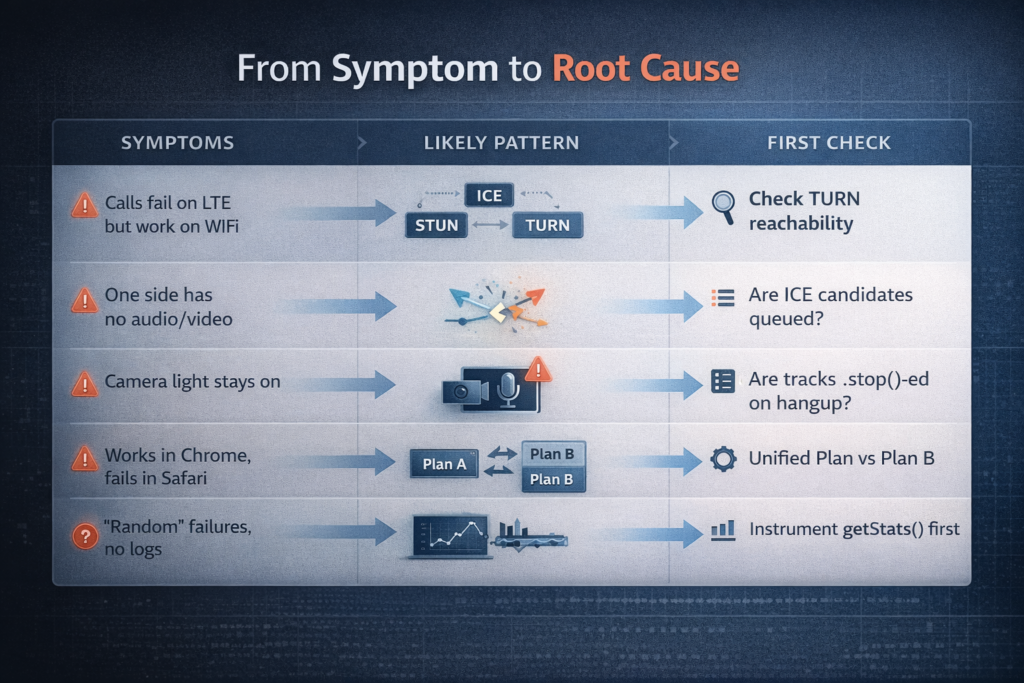
A Quick Reference: Symptoms to Root Causes
| Symptom | Likely Pattern | First Thing to Check |
| Calls fail on mobile/LTE but work on WiFi | ICE / TURN | Is the TURN server configured and reachable? |
| One side has no audio/video | Signaling race | Are ICE candidates queued until remote desc is set? |
| Camera light stays on after call ends | Track lifecycle | Are all tracks explicitly .stop()-ed on hangup? |
| Works in Chrome, broken in Safari | Browser compat | Unified Plan vs. Plan B SDP negotiation |
| “It randomly fails” with no pattern | No observability | Instrument getStats() and state transitions first |
What a Real Rescue Looks Like
When Trembit takes over a distressed WebRTC project, the first two weeks are always spent on diagnostics. We don’t start rewriting — we instrument. Adding telemetry and structured logging to an existing codebase costs a day and immediately reveals whether you have an ICE problem, a signaling problem, or a media problem.
From there, fixes become targeted rather than speculative. We’ve seen teams spend months on the wrong problem because they were debugging with console.log and user reports instead of connection state data.
The five patterns above rarely appear in isolation. A codebase with broken ICE handling almost always has missing observability — that’s how the ICE problem survived so long. Track lifecycle bugs are frequently paired with signaling race conditions. They reinforce each other.
Is Your WebRTC Project in This State?
If you’re reading this and nodding at more than two of these patterns, your codebase is likely one bad browser update away from a serious incident.
Trembit specializes in real-time communication systems — video conferencing, collaborative tools, live streaming infrastructure, and WebRTC rescue engagements. We’ve worked with teams across fintech, telehealth, edtech, and enterprise SaaS who needed someone who knew exactly where to look.
If you’re a CTO or engineering leader dealing with a WebRTC system that’s become a liability rather than a feature, reach out to Trembit. We’ll start with a focused technical assessment and tell you plainly what we find.
Trembit is a software engineering company focused on real-time systems, WebRTC, and product rescue for venture-backed and growth-stage companies.