The telehealth industry faces a critical challenge: artificial intelligence promises transformative capabilities in clinical documentation, patient triage, and predictive analytics, yet HIPAA regulations weren’t designed with large language models in mind. With fines reaching $1.5 million per violation category annually, the stakes are existential.
Healthcare organizations watch competitors announce AI features while their own legal teams halt innovation. But this isn’t a binary choice. The organizations succeeding in 2026 understand that secure AI integration requires architecting systems where innovation and compliance coexist by design.
Why Traditional Integration Approaches Fail
Most telehealth platforms treat AI like any other feature: connect the service, pipe in the data, ship it. This fails catastrophically with systems processing Protected Health Information (PHI).
AI systems operate under fundamentally different paradigms than traditional software. They’re probabilistic rather than deterministic, often run in multi-tenant cloud environments, and generate logs and cache artifacts that can inadvertently expose PHI long after patient interactions end. Traditional HIPAA compliance strategies assume you control the entire stack. With AI, you’re frequently integrating third-party models where you don’t control training data, inference infrastructure, or the complete processing pipeline.
LLM Isolation Strategies: Building Secure Boundaries
The first principle of HIPAA-compliant AI integration is isolation — creating architectural boundaries that prevent PHI from reaching systems you don’t fully control.
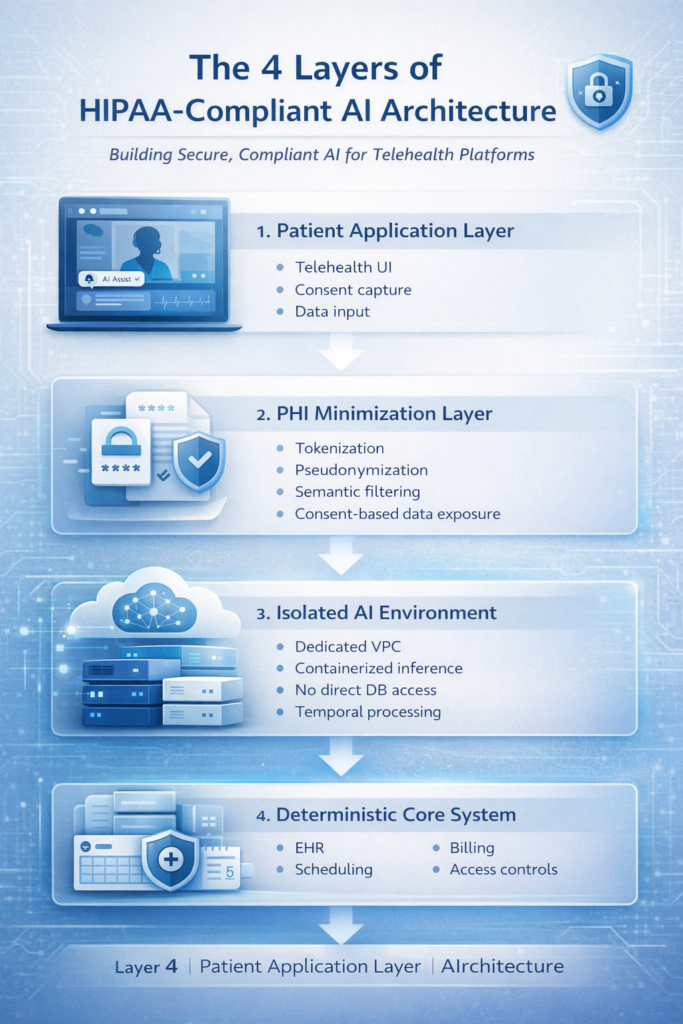
Network-level isolation involves running AI models in network-segregated environments. Your LLM infrastructure operates in a separate Virtual Private Cloud with strict ingress and egress controls. Your patient-facing application runs in one security zone, AI processing in another, more restricted zone, with an API gateway between them handling all data transformation and sanitization.
Process-level isolation means AI processes run with minimal privileges. Utilize container orchestration with pod security policies to restrict what AI workloads can access. Your LLM inference containers shouldn’t have network access to your patient database or permanent storage write capabilities.
Temporal isolation ensures PHI exists in your AI environment only for the task duration, then is cryptographically wiped. Container-based architectures make this natural — spin up a fresh container for each task, destroy it immediately after.
PHI Minimization Layers: Engineering Data Boundaries
HIPAA’s minimum necessary standard requires limiting PHI access to the minimum needed. With AI, this becomes both more critical and more complex.
Tokenization and pseudonymization replace direct identifiers before data reaches AI systems. Names become tokens like PATIENT_7F3A, dates become relative offsets like DAY_+14, and locations become generalized regions. This requires a secure token vault — a separate service handling bidirectional mapping with HSM protection for keys.
Semantic filtering addresses context-based identification. A patient described as “the 34-year-old female software engineer from Portland treated for postpartum depression last March” is effectively identified without explicit identifiers. Specialized models trained to detect contextual PHI analyze text before it reaches your primary AI system, identifying and generalizing information that could enable re-identification.
Dynamic consent boundaries adjust data exposure based on specific AI use cases and patient consent preferences. A symptom checker needs different information from clinical documentation. Your PHI minimization layer consults a consent management system before preparing data for AI processing.
On-Premise vs. Cloud Models: The Deployment Decision
The deployment choice carries profound implications for HIPAA compliance, cost, and capability.
On-premise deployment provides maximum control — you determine network architecture, encryption, access controls, and auditing. Challenges include significant capital expenditure on specialized hardware, ongoing infrastructure costs, and the need for AI expertise. You’re also responsible for model updates, security patches, and scaling.
Cloud deployment with dedicated instances offers cloud convenience with enhanced isolation. Providers like AWS Bedrock, Azure OpenAI Service, and Google Vertex AI run models in single-tenant environments. You gain scalability and model access without infrastructure complexity, but need strong Business Associate Agreements ensuring data isn’t used for training and instances are truly isolated.
Multi-tenant cloud services like OpenAI’s API require aggressive de-identification before any data reaches them. This works well for capabilities not requiring actual PHI — chatbots answering general health questions or generating educational content.
Hybrid architectures use different deployment models for different risk levels. High-risk operations handling identifiable PHI run on-premise or in dedicated instances. Lower-risk functions with de-identified data leverage multi-tenant services for cost efficiency.
| Deployment Model | Control Level | Cost Profile | Best Use Cases |
| On-Premise | Maximum | High CapEx, Moderate OpEx | Core clinical systems, high PHI exposure |
| Dedicated Cloud | High | Moderate CapEx, Higher OpEx | Scalable clinical applications |
| Multi-Tenant Cloud | Lower | Low CapEx, Low OpEx | Patient education, non-PHI workflows |
| Hybrid | Variable | Optimized across tiers | Enterprise deployments balancing cost and security |
Logging and Redaction Strategies: Visibility Without Violation
Comprehensive logging is essential for security monitoring and HIPAA audit trails, but logs containing PHI become compliance liabilities.
Structured logging with field-level control enables automatic redaction of sensitive fields before logs are persisted. Design application logging to exclude PHI from the start — log metadata necessary for operational monitoring, not entire request objects containing patient data.
Dynamic redaction based on context adjusts log content based on destination and access. Logs for internal SIEM systems might retain tokenized identifiers for session correlation. Logs sent to external services undergo aggressive redaction, retaining only required metadata.
Intelligent sampling reduces log volume for high-volume AI interactions while maintaining oversight. Log every error and security event, but sample only a percentage of successful routine operations. Sampling rates can be dynamic but must be deterministic and tamper-resistant.
Separate audit and operational logs with different governance. HIPAA-required audit logs tracking PHI access must be comprehensive, tamper-evident, and retained for six years. Operational logs have shorter retention and broader engineering access.
The Deterministic Core + AI Augmentation Pattern
One of the most powerful patterns for HIPAA-compliant AI is separating critical business logic from AI enhancement.
Critical logic remains deterministic — patient data access controls, clinical decision-making, prescription routing, and billing use traditional, predictable code. AI augmentation wraps around this core, enhancing user experience without making critical decisions.
For example, appointment scheduling uses traditional logic for availability, authorization, and booking confirmation. AI suggests optimal times, generates personalized reminders, or provides conversation prompts — but doesn’t control the actual scheduling logic.
Human-in-the-loop validation creates safety layers when AI touches clinical workflows. AI can suggest, summarize, or draft, but qualified humans must review and approve before actions affect patient care or PHI storage. An AI-generated clinical note must be physician-reviewed before becoming part of the medical record.
Graceful degradation ensures AI failures don’t compromise core healthcare delivery. If your LLM service fails, appointment scheduling still works without smart suggestions. Physicians can write notes traditionally if documentation AI has issues.
Real-World Implementation Examples
Conversational Triage Assistant
A compliant triage chatbot architecture starts with explicit patient consent acknowledging AI interaction. During conversation, the chatbot runs in a dedicated environment with no direct database access. Patient inputs are immediately tokenized, with only medical content and tokens sent to the LLM.
LLM-generated recommendations pass through a rules engine validating alignment with clinical protocols before display. Edge cases trigger human nurse review. Final transcripts are de-tokenized and stored in audit logs with cryptographic signing. The AI system retains no permanent record.
Clinical Documentation Automation
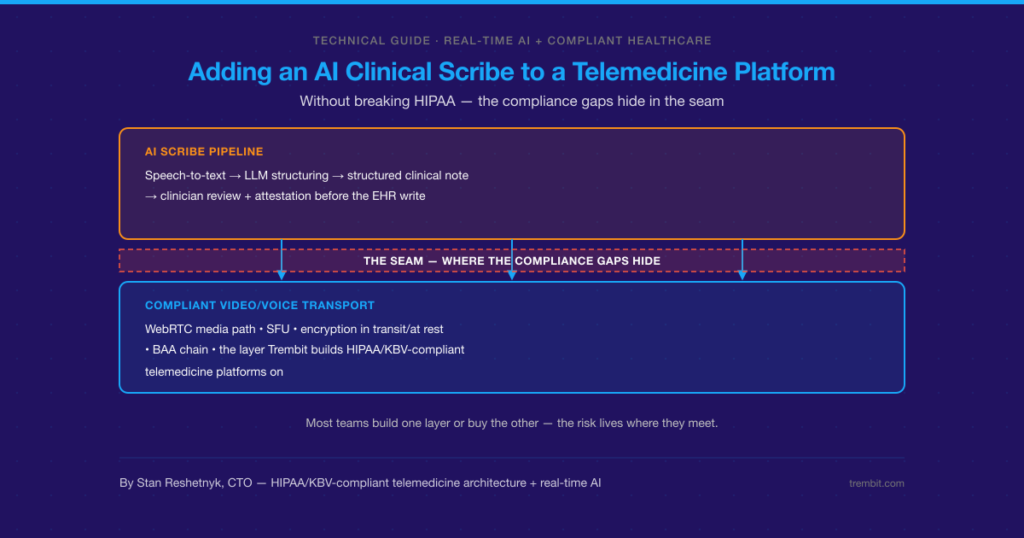
After a telehealth visit, audio is processed by speech-to-text on a dedicated HIPAA-compliant infrastructure. Transcripts undergo PHI minimization — dates become relative references, family member names are generalized. The minimized transcript goes to a clinical documentation LLM, generating a structured draft note.
The draft is de-tokenized and presented to the physician within the EHR. The physician reviews, edits, and signs. Only the physician-approved final version becomes part of the medical record. Original audio, transcript, and draft have separate retention policies.
Predictive Analytics for Care Management
Analytics pipelines run entirely within controlled infrastructure. Patient data is immediately pseudonymized after extraction. Predictive models analyze patterns using tokens, not identities. High-risk predictions trigger care management workflows where managers see de-tokenized patient information within existing PHI-access-controlled tools.
The AI operates on patterns and tokens. Only at the final step, within systems already designed for PHI access, does identity get restored for human action.
Defense in Depth: Layering Security Controls
HIPAA compliance requires multiple overlapping protection layers:
- Perimeter defenses preventing unauthorized infrastructure access through firewalls, VPNs, and API authentication
- Data transformation layers implementing tokenization, pseudonymization, and semantic filtering
- Model isolation ensures AI workloads access only the necessary systems through containers and network segmentation.
- Encryption protects data in transit (TLS) and at rest (volume encryption)
- Access controls implementing least privilege principles.
- Monitoring and alerting, detecting anomalous behavior, and unusual access patterns
- Incident response procedures defining notification, isolation, and breach protocols
Each layer provides independent protection, ensuring single failures don’t compromise patient data.
Partnership for Healthcare Compliance
Implementing these architectural patterns requires expertise in both healthcare technology and regulatory compliance. At Trembit, we design and deploy AI-enhanced telehealth systems that balance innovation with strict HIPAA requirements.
Our process begins with understanding your specific use cases, risk profile, and operational constraints. From there, we design a tailored architecture that enables AI capabilities while staying fully within your compliance boundaries.
We don’t believe in one-size-fits-all solutions. A small telehealth startup operates differently from a national enterprise platform. Mental health services have distinct requirements compared to urgent care providers.
That’s why our teams build systems aligned with your real-world needs — covering HIPAA-compliant cloud architecture, secure LLM integration, and the regulatory documentation necessary to support audits and long-term scalability.
The Path Forward
AI integration into telehealth isn’t optional — patient expectations, competitive pressure, and genuine care benefits drive adoption forward. The question isn’t whether to integrate AI, but how to do it responsibly.
The patterns outlined here reflect current HIPAA regulations, guidance from the HHS Office for Civil Rights, and real-world healthcare production deployments. They are designed to balance strong security with practical usability — and regulatory compliance with meaningful innovation.
As AI capabilities evolve, these patterns will adapt. New architectures might enable better on-device processing. Advances in homomorphic encryption could enable computation on encrypted data. Federated learning might allow training without centralizing patient data.
But fundamental principles remain constant: minimize PHI exposure, implement defense in depth, maintain human oversight for critical decisions, and build auditable systems. The telehealth platforms thriving in 2026 and beyond master this balance — harnessing AI’s power while maintaining the trust essential in healthcare through thoughtful architecture, careful implementation, and partnership with teams understanding both technology and regulatory landscapes.
The future of healthcare is intelligent, connected, and patient-centric. With the right approach, it’s also secure and compliant.