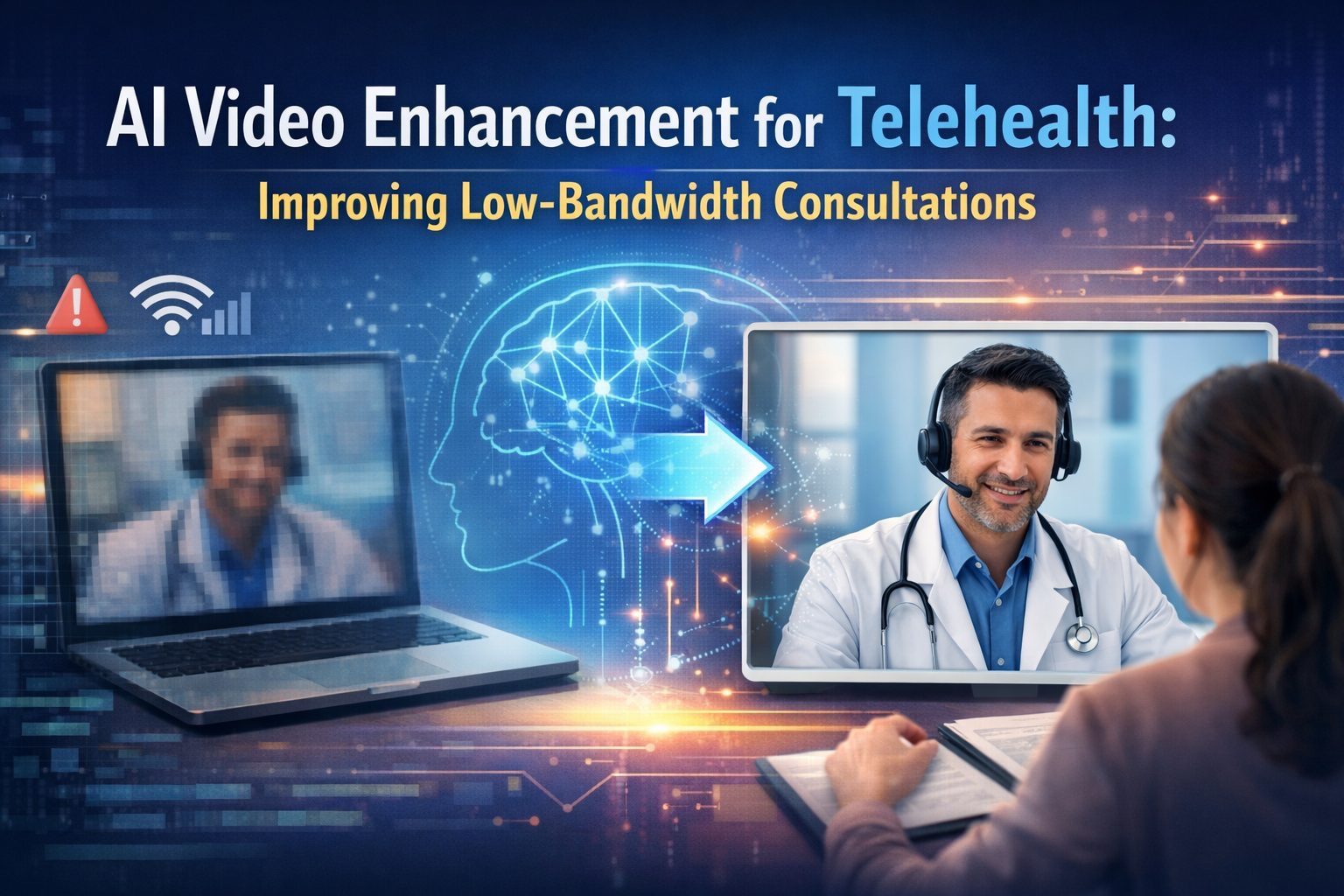
Telehealth has become a cornerstone of modern healthcare delivery. Since the pandemic accelerated its adoption, millions of patients worldwide now rely on video consultations for everything from routine check-ups to specialist referrals. Yet one persistent challenge continues to undermine the quality of these interactions: poor video quality caused by low or unstable internet connections.
Pixelated faces, frozen frames, and distorted audio are not just frustrating — they can be clinically dangerous. A dermatologist who cannot clearly see a skin lesion, or a cardiologist who misses a subtle facial sign of distress, faces real diagnostic limitations. Artificial intelligence is changing that.
In this article, we explore how AI-powered video enhancement technologies are transforming low-bandwidth telehealth consultations, what specific tools are available, and how healthcare organizations can implement them effectively.
The Bandwidth Problem in Telehealth
Standard HD video conferencing requires 1.5–4 Mbps of stable bandwidth. In practice, many patients — particularly those in rural areas, elderly populations, and underserved communities — connect on far less. A consultation happening over 500 Kbps or a congested mobile network will produce video that is choppy, blurry, and unreliable.
This is not a fringe issue. According to the Federal Communications Commission, over 21 million Americans lack access to broadband internet. Globally, the gap is even wider. For telehealth platforms built to serve broad populations, low bandwidth is the norm, not the exception.
Traditional solutions — such as asking patients to upgrade their connection or reducing video resolution — shift the burden onto the user and degrade the consultation experience. AI offers a fundamentally different approach: enhance the video in real time, regardless of connection quality.
How AI Video Enhancement Works
Modern AI video enhancement leverages several machine learning techniques operating in concert. Here is a breakdown of the core technologies:
1. Super-Resolution (SR) Upscaling
Super-resolution algorithms use deep neural networks — typically convolutional neural networks (CNNs) or transformer-based architectures — to reconstruct high-quality video frames from low-resolution inputs. Instead of simply stretching pixels, the AI infers what the image should look like based on training across millions of video samples.
In a telehealth context, SR can upscale a degraded 240p stream to appear as sharp as 720p, improving the clinician’s ability to observe skin tone, eye movement, and other visual diagnostic cues.
2. Frame Interpolation and Motion Prediction
Dropped frames caused by packet loss produce the dreaded “frozen” or stuttering video. AI-based frame interpolation generates synthetic intermediate frames by predicting motion between two existing frames. The result is a smooth, continuous video even when the underlying stream has significant gaps.
3. Denoising and Artifact Removal
Compression artifacts — blocky distortions introduced by codecs like H.264 under low bitrate — are a major source of diagnostic degradation. Deep learning denoising models, such as those based on DnCNN or transformer denoisers, can remove these artifacts in real time while preserving medically relevant detail.
4. Background Segmentation and Stabilization
AI can cleanly separate the subject from the background even on low-quality video, reducing visual clutter and improving focus on the patient. Combined with electronic image stabilization, this dramatically improves perceived video quality without requiring additional bandwidth.
AI Enhancement Technologies at a Glance
The table below summarizes the key AI techniques and their clinical relevance:
| Technology | What it does | Critical benefit |
| Super-Resolution | Reconstructs high-resolution frames from low-res input | Enables visual diagnosis of skin, eyes, and facial signs |
| Frame Interpolation | Generates missing frames to smooth video | Eliminates stuttering that disrupts patient assessment |
| Artifact Removal | Strips compression noise from video | Reveals true image detail for accurate diagnosis |
| Background Segmentation | Isolates patient from environment | Reduces visual distraction, improves focus |
| Image Stabilization | Corrects shaky or drifting video | Improves readability of patient movements and tremors |
Real-World Impact: What Healthcare Providers Are Seeing
Organizations that have integrated AI video enhancement into their telehealth platforms report measurable improvements across several dimensions:
- Increased diagnostic confidence: Clinicians report being more comfortable making assessments when video quality is consistent and clear.
- Reduced consultation abandonment: Patients are significantly less likely to drop off a call or reschedule when the connection feels stable.
- Broader patient reach: Platforms that function well on low bandwidth can extend care to rural, elderly, and mobile-only patients who were previously underserved.
- Higher patient satisfaction scores: Survey data from telehealth platforms consistently show that video quality is one of the top drivers of patient satisfaction.
- Lower support burden: Fewer technical complaints mean less strain on IT and patient support teams.
Implementation Considerations
Integrating AI video enhancement into an existing telehealth infrastructure requires careful planning. Key considerations include:
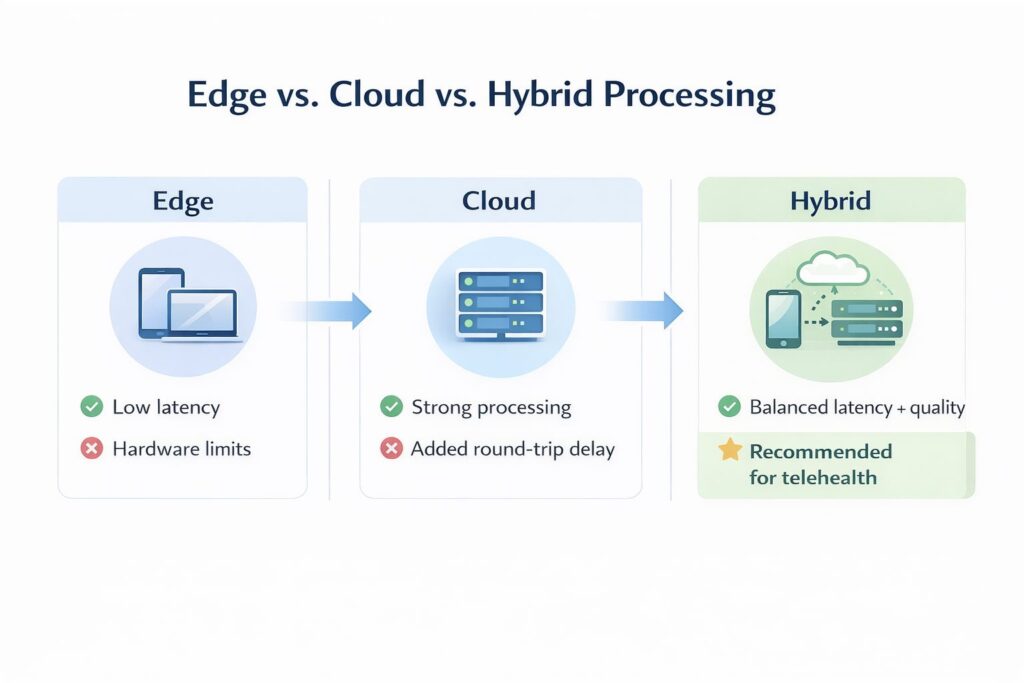
Processing Location: Edge vs. Cloud
AI enhancement can run on the user’s device (edge processing), on a server (cloud processing), or in a hybrid model. Edge processing minimizes latency but requires capable hardware. Cloud processing is more powerful but introduces round-trip delay. For telehealth, a hybrid approach — where lightweight models run on-device and heavier processing occurs in the cloud for post-session review — often yields the best results.
HIPAA and Data Privacy Compliance
Any AI system processing patient video must comply with HIPAA in the United States, GDPR in Europe, and applicable local regulations. This means ensuring that video streams processed by AI models are not stored without consent, that data is encrypted in transit and at rest, and that the AI vendor has signed a Business Associate Agreement (BAA) where required.
Integration with Existing Platforms
Most telehealth platforms are built on WebRTC or proprietary video SDKs. AI enhancement layers need to integrate cleanly with these systems — typically via a middleware layer or SDK plugin — without introducing unacceptable latency or breaking existing workflows.
Checklist for Evaluating an AI Video Enhancement Solution
| Requirement | Why it matters |
| Real-time processing with < 100ms latency | Delays above this threshold disrupt natural conversation flow |
| HIPAA/GDPR-compliant data handling | Patient video is protected health information |
| WebRTC or SDK compatibility | Must integrate with your existing platform architecture |
| Graceful degradation on older devices | Should not crash or freeze on low-spec patient hardware |
| Model explainability and auditability | Clinical environments require transparent AI behavior |
| Vendor provides ongoing model updates | New compression codecs and network conditions require adaptive models |
Why Trembit Is the Right Partner for AI-Enhanced Telehealth
Building AI video enhancement into a healthcare platform is not a plug-and-play exercise. It requires deep expertise in machine learning engineering, healthcare compliance, real-time video infrastructure, and product development — often simultaneously.
Trembit is a software development company specializing in complex, technology-forward products across healthcare, fintech, and enterprise applications. With extensive experience building telehealth platforms and integrating AI capabilities, Trembit brings together the technical depth and domain knowledge that healthcare organizations need to implement AI video enhancement successfully.
Working with Trembit means:
- Custom AI model selection and fine-tuning tailored to your specific use case and patient population
- Full compliance architecture ensuring your solution meets HIPAA, GDPR, and any applicable regional requirements
- Seamless integration with your existing video infrastructure — whether you are using WebRTC, Twilio, Daily, or a proprietary SDK
- Ongoing support and model maintenance as technology evolves
- A collaborative, transparent development process with regular milestones and clear communication
Whether you are building a telehealth platform from the ground up or enhancing an existing one, Trembit has the expertise to make AI video enhancement a competitive differentiator — not a development headache.
Conclusion
Low bandwidth should not mean low-quality care. AI video enhancement is a proven, deployable technology that can dramatically improve the telehealth experience for patients and clinicians alike — closing the quality gap between an in-person and virtual consultation.
As telehealth continues to expand into underserved populations and complex clinical use cases, the organizations that invest in AI-powered video infrastructure today will be best positioned to deliver on the promise of accessible, high-quality digital health tomorrow.
Ready to explore what AI video enhancement could look like for your platform? Reach out to Trembit to start the conversation.