By Maryna Poplavska, Head of Project Managers · 27 October 2026
Video dating app development is not a swipe app with a video button bolted on. The moment two strangers meet on a live call instead of a chat thread, the hard parts move: from recommendation logic to real-time media, from moderating content after the fact to safety decisions taken before and during a call. This guide walks through what that costs you in architecture — the call path, the translation layer, the billing clock and the trust layer. Most examples come from a video-first dating product Trembit built from the first specification to a working MVP, subtitles and all. The billing sections describe what the specification sets out, not a production configuration.
Key takeaways
- A video-first dating product is a real-time media product. The engineering centre of gravity is the call — setup, presence, media quality, what happens when either side drops — not the feed.
- The translation layer belongs in the room, not in the client. An agent joins the call as a participant, transcribes and translates, and publishes subtitles back to both sides — which keeps the client thin.
- Trust and safety is architecture. Verification, screening media before it publishes and a reporting path with a reason attached belong in the data model, not a later sprint. The one piece that did arrive late here — a region-aware age check — was scoped at about twelve hours and recorded at sixteen, and our reading is that it stayed that cheap because onboarding had not been written around a single jurisdiction.
- Meter money off call state, never off a client timer. As specified here, the billing clock is part of the media architecture: one authority settles on the first end event it can trust, a tick has to be keyed to the session, and the rounding rule is decided before you ship rather than discovered in a support ticket.
The architecture, translation-agent and trust-layer sections are the technical core. If you are scoping a build rather than designing one, skip to “How do you know the MVP actually works?” and “What to get right before you start”.
What makes a video-first dating app different from a swipe app?
The product case is not technical: people are tired of typing. Text-first dating puts weeks of messaging between two people and the five minutes of conversation that actually tell them whether there is anything there. Video-first moves that conversation to the front — a live call as the first interaction, not the reward for surviving a chat.
The engineering case follows from one word: synchronous. A swipe app is asynchronous, so nothing breaks in front of the user. In a video product every weakness is visible while two people are looking at each other, which has three consequences:
Connection setup is a product feature. From “accept” to “I can see you” spans signalling, media negotiation and room provisioning, and a slow one reads as a broken app.
Presence has to be accurate. A stale “online” badge is cosmetic in a swipe app; in a video product it sends a user into a call with someone who is not there. It also sets the felt speed of the product: a member waits for a suitable person to be available, not for a ranking algorithm to finish, so matching is only ever as fast as the presence data underneath it.
Safety decisions become real-time decisions. You cannot review a live call the way you review a posted photo; the controls must exist before it starts and be reachable during it.
Two product decisions then set the architecture. The first is language: a pool that spans countries produces pairs who are interested in each other and share no language, and most products quietly shrink themselves by constraining the pool. The alternative, taken here, is to keep it wide and solve language inside the call. The second is that the product is designed to be metered, with the earning side proving identity before any money reaches it — members are matched with a host rather than browsing a directory, and the design has them paying for connected minutes from a prepaid balance while the host accrues against that same clock. Where money is meant to move every sixty seconds of a live session, verification, age assurance and metering cannot be features bolted on later.
What does the architecture look like?
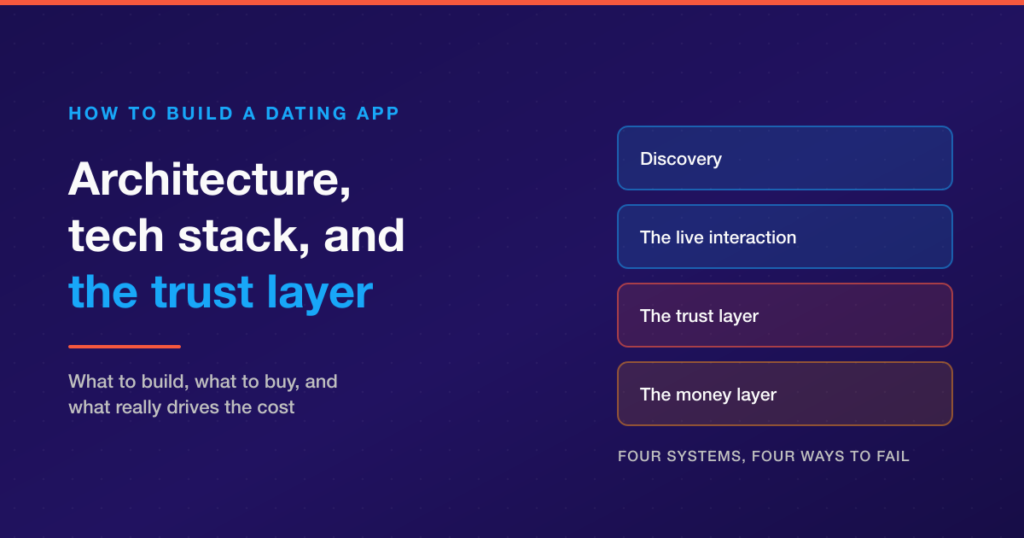
The system has three planes: discovery (profiles, matching, the queue, and the chat that follows a match), the call (real-time media and presence), and the trust layer (verification, moderation, reporting). They are worth keeping separable, in our view: the call plane carries the real-time constraints and should not be coupled to product logic that changes weekly. For the stack piece by piece and what to build versus buy, see how to build a video dating app.
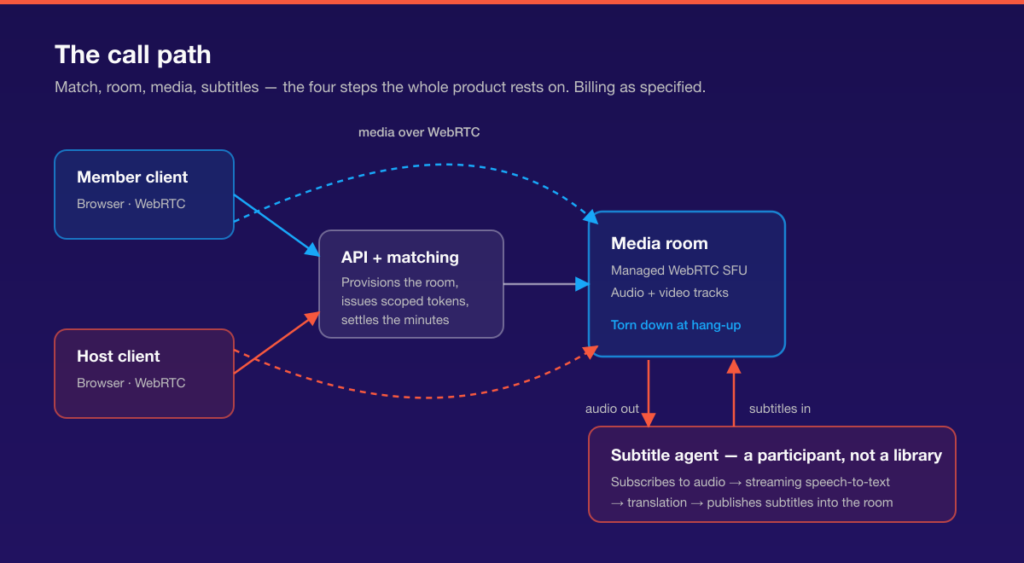
The call path itself is short by design:
A member starts a search and is matched with a host; the backend provisions a room and issues both participants scoped access tokens.
Both clients join and publish audio and video over WebRTC — a split standard worth knowing when you buy it: the browser API is a W3C specification, while the transport and security underneath it are IETF work (ICE in RFC 8445, DTLS-SRTP in RFC 5764, JSEP in RFC 9429, which obsoleted RFC 8829).
A translation agent joins the same room as a non-visible participant, subscribes to the audio tracks, and publishes subtitles back to both clients.
When the call ends, the room is torn down and the session is settled — as specified, metered per-minute billing tied to call state rather than to a client-side timer.
Who bills for what, and off which clock. As specified: the member’s prepaid balance is debited, the host’s earnings ledger credited, and both move off one authority, the server, which settles on the first end-or-grace-expiry event — a hang-up from either side, or a heartbeat that stops. As specified, billing is bound to the session, and inside it a periodic tick meters the minutes rather than a single subtraction at teardown, because a prepaid product has to be able to end a call when the balance runs out rather than discover the shortfall afterwards. Never a timer in the browser, which a user can pause, spoof or lose to a dead battery.
The user-facing half of that rule matters as much as the accounting half. As specified, the member is warned while the balance is running low and there is still time to do something about it, and the call is only dropped once the money is actually gone. A metered call that dies mid-sentence with no warning reads as a bug rather than as a billing rule, and the difference between those two readings is a support ticket and a refund request.
Two failure modes decide whether that holds. Neither is in the specification and neither is behaviour we can report here — both are what we would require. The duplicate is the easy one: a tick has to be keyed to the session, or a retried webhook and a refreshed tab each charge again. The event that never arrives is harder — webhook delivery is not a guarantee, so something has to reconcile against the platform’s own record of the room rather than only listening, or a lost event is a free call. The specification rounds: a coin is debited at the start of each minute, so a half-minute call costs a whole one. It settles the hang-up case outright — the running minute is not refunded, because a spent minute is delivered and only unspent purchased coins are refundable. It is less clear about a dropped connection, where two sentences say billing stops at the last elapsed minute; our reading is that the coin already taken is not reversed. It does settle which event decides. Payouts are a separate, slower path: as specified, earnings accrue continuously and money leaves only after identity verification clears.
Concretely: the application runs on Cloud Run, with Cloud SQL for PostgreSQL as the system of record and a managed Redis for the job queue. Authentication, realtime presence and web hosting sit on Firebase; profile photos and moderation evidence live in Cloudflare R2; live one-to-one audio and video run on LiveKit Cloud rather than a hand-built media server. That shape is the part worth copying.
Two of those choices carry more weight than the rest. The platform’s own compute runs in the EU (europe-west1). Our advice is to decide that early: a dating product holds identity documents, moderation evidence and payout data, and moving a live platform between regions later is a migration nobody budgets for. Be precise about what that buys, though: the moment you add managed services, residency stops being a region flag on your own services and becomes a chain of sub-processor commitments — the identity vendor, the moderation vendor and the media platform each have to be configured and contracted for it. That is a procurement exercise as much as an architectural one, and it is far cheaper to run before launch than after. And buying the media layer rather than building it: a managed platform brings SDKs, room lifecycle and agent tooling a team would otherwise write and own forever, against per-minute cost that scales with usage — the trade-off we set out in LiveKit vs mediasoup, and at the level of the media server options themselves for teams that do want to run their own. For an MVP, buying that layer and spending senior hours on the product is the right side of the trade.
If you are weighing the same build, this is a conversation we have in dating app development projects — the call plane is where a cheap decision gets expensive. It is not our first: an earlier geosocial video dating platform we built ran private video rooms on a different media layer and a different cloud, load-tested for thousands of concurrent sessions.
How does live AI translation work inside a 1:1 call?
The translation feature is a participant in the room, not a library in the app. A subtitle agent joins the call, subscribes to each speaker’s audio, streams it to Google Cloud Speech-to-Text, translates through Google Cloud Translation, and publishes the text back into the room as data the clients render as subtitles. The live path asks the recogniser to infer the language rather than naming one. LiveKit’s agents framework exists for this shape of workload: a programmatic participant that joins a call and does work on the media.
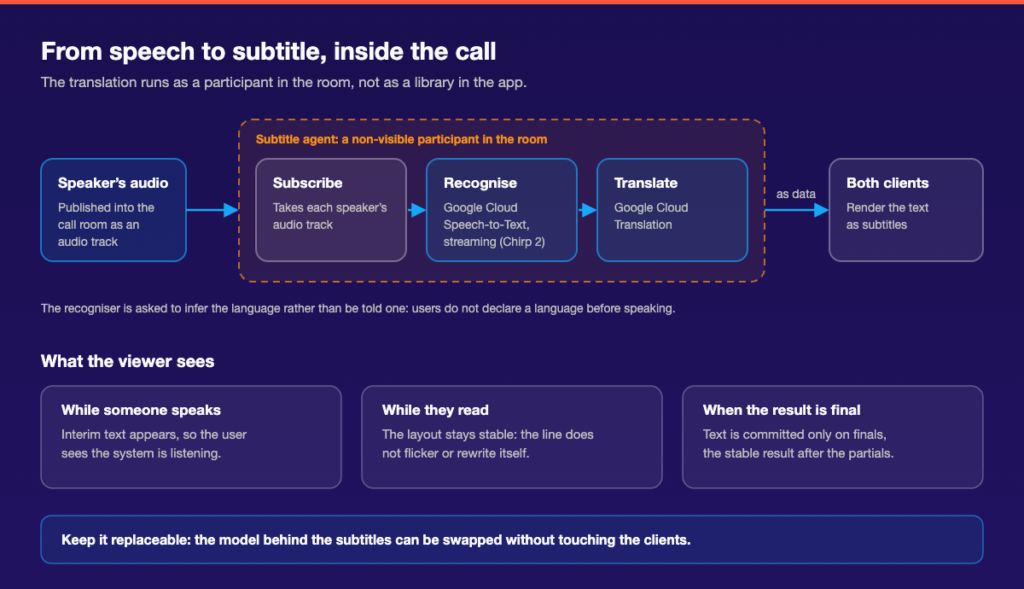
Three details decide whether it feels good or cheap:
Interim versus final results. A streaming recogniser emits partial hypotheses that change as more audio arrives, then a stable final. Render every interim update verbatim and the subtitle line flickers and rewrites itself while the user is reading it; what works is showing interim text so the user sees the system is listening, while holding the layout stable and committing only on finals. The model here is Google’s Chirp 2, which is available only through the Speech-to-Text v2 API, which supports streaming recognition.
Language detection has to be quick and forgiving — users do not declare a language before speaking, and bilingual speakers switch mid-sentence.
The latency budget is the whole feature. Capture, recognition, translation and delivery each cost time, and the acceptable total is set by conversation, not by a benchmark: subtitles that land after the other person has started replying are worse than none, because the reader is now behind. The design target in the specification is under 1.2 seconds at p95 within the primary EU region, measured from the end of speech to the caption — a target, not a number measured in production. Where that budget goes, and whether a speech-to-speech model should replace the transcribe-then-translate chain, we have written up separately in STT vs speech-to-speech for real-time translation — that piece is the architecture argument; this one is a build that took one side of it.
Why trust and safety is architecture, not a feature
On a dating platform, safety work is not a compliance chore to clear before launch. It is a set of structural decisions that cost almost nothing at design time and a great deal once real users are on the platform. Here they sit in four places:
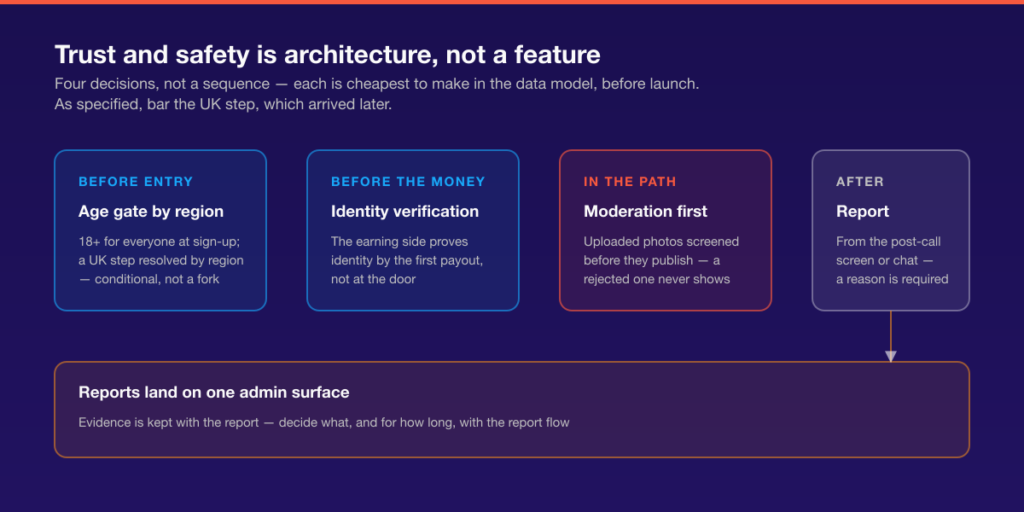
Verification gates the money, not the door — everyone confirms they are 18+ at sign-up, and the side that earns proves identity with a document check paired with a live selfie: at sign-up if it happens then, and otherwise before the first payout. Putting the hard gate on the money rather than on entry keeps sign-up cheap, and it means your data model has to carry unverified-but-active as a real state, on our reading. For how the check itself works and where it fails, see why most liveness-detection systems fail on dating apps.
Age assurance that is region-aware. The platform is 18+ everywhere, and where a market demands more, the check is a configurable onboarding step rather than a global one — UK users meet an age check at sign-up that other markets do not get. Hard-code one jurisdiction’s rule and you re-engineer onboarding the first time you enter another market.
Moderation before delivery, not after. Photos are screened by a commercial classifier before anyone sees them — profile photos before they publish, and photos sent in chat before they are delivered — so a rejected one never lands. The ordering is the point: post-hoc moderation means the harm has landed and you are writing an apology. The harder version of this — moderating live frames rather than a file at rest — is in our AI content moderation write-up, and is a case this build did not attempt.
Reporting and evidence. As specified: reporting from the post-call screen or from chat with a reason required, and evidence kept with the report, so a decision rests on a record rather than a memory. Decide what is retained and for how long at the same time as the report flow — a reporting path with no retention rule behind it is, in our view, a queue of claims nobody can check.
None of this is exotic. What matters is that three of the four were in the specification — so the data model carries report state, and media has a moderation status before a delivery status. The region-aware age check was not. It arrived later as a change — scoped at about twelve hours and recorded at sixteen; our reading is that it stayed that cheap because onboarding had not been written around one jurisdiction.
How do you know the MVP actually works?
Not from a staging environment, and not from a number. A video product fails in the ways that matter only on real networks and real devices, which is why a round on real users’ own connections belongs in the plan before release rather than after it.
Be wary of anyone who answers this question with a latency figure at this stage: an early number describes the conditions it was taken in, not the product at scale. The honest answer is a list — the things that never reproduced in the office, and what each turned out to be. That is what the round is for, and budgeting for it afterwards is how teams end up without one.
What to get right before you start
Write the out-of-scope list before the feature list. Every stakeholder arrives with a feature and most of them are good. Naming what you are not building is the only thing that reliably turns a good idea into phase two instead of into the MVP.
Keep the AI feature replaceable. Speech models change faster than the rest of the stack. The agent-in-the-room pattern lets the model behind the subtitles be swapped without touching the clients — a boundary that costs nothing to draw at the start and is expensive to introduce later.
Decide what a minute is before you bill for one. Every metered product eventually meets the call that dropped at 0:59, and the answer has to be a rule written down in advance, not a patch shipped after the first angry support ticket.
FAQ
What is video dating app development, and how is it different from building a regular dating app? It is the development of a dating product whose primary interaction is a live video call rather than chat, which turns the core system into a real-time media system — and moves safety controls from “review it after it is posted” to “decide before and during a live call”.
Can live translation really work inside a video call? Yes, with the right architecture and honest expectations. A room agent transcribes and translates speech and publishes subtitles back to both participants. It is not simultaneous human interpretation, and the experience depends more on latency and stable subtitle rendering than on raw model accuracy.
How do you bill for a call that drops mid-minute? By deciding the rule before you ship. In the specification behind this build the server settles on the first end event it can trust — a hang-up, or a heartbeat that stops — not a timer in the client. It settles the hang-up case outright: the running minute stays paid, because a spent minute is delivered and only unspent purchased coins are refundable. It is less clear about a dropped connection, and our reading there is that the coin already taken is not reversed.
Talk to a team that has built one
If you are building a video-first product — dating, social, or anything where two strangers meet on a live call — bring the decision you are stuck on: the media platform choice, the translation latency budget, the trust layer, or how to phase an MVP that will not need rewriting in year two. Trembit specialises in real-time video and voice, and this is a free 30-minute call with an engineer from the team: no deck, no pitch. Tell us what you are building and we will put the right engineer on the call.