By Maryna Poplavska, Head of Project Managers · 26 October 2026
Most guides on how to build a dating app describe a matching feed, a chat screen and a payment integration. That answer is complete only until the product’s core interaction is a live video call — at which point you are building a real-time media system with a dating product attached, and most of the hard parts move somewhere the feature list never mentions. This guide covers the decisions in the order you have to make them: what a dating product is actually made of, which layers to build and which to buy, what has to be in the trust layer before launch, and what genuinely drives the cost. The examples come from a video-first dating platform we built to a working MVP in about three months of development; the client is not named.
Key takeaways
- A dating product is four systems, not one. Discovery, the interaction, the trust layer and the money layer each have their own failure modes, and the last two are what founders underestimate.
- Buy the media layer, build the trust layer. Real-time infrastructure is a solved commodity you can rent; your verification, moderation and reporting logic is product-specific and is what you will be judged on.
- The trust layer is not a launch checklist item, it is a data-model decision. Report state, moderation status before delivery status, and a region-shaped onboarding step have to exist before the first user does.
- Cost follows usage and jurisdictions, not features. Minutes of live media, verifications, moderated items and the number of markets you operate in drive the bill; the feature list barely moves it.
What are you actually building when you build a dating app?
Four systems, which fail in four different ways.
Discovery is profiles, matching, the queue and the chat that follows a match. It is the part every founder has already designed in their head, and the part that changes most often after launch.
The interaction is whatever two people actually do together — messages in a text-first product, a live call in a video-first one. Choosing video moves this from a store-and-forward problem to a real-time one, and everything expensive follows from that single choice: the browser API is a W3C standard but the connectivity underneath it is IETF work (ICE and friends), and that layer is where “it works on my laptop” stops being true.
The trust layer is verification, age assurance, moderation, reporting and the evidence trail behind them. In a dating product this is not a compliance chore attached to the end; it is the reason people stay or leave, and it is the part regulators ask about.
The money layer is how value moves — subscriptions, credits, per-minute charges, payouts. It looks like an integration and behaves like a distributed-systems problem the moment charging is tied to something live.
A useful test at the start: for each of the four, ask what happens at three in the morning when it breaks. If you can answer for discovery but not for the other three, the plan is not finished.
Which parts do you build, and which do you buy?
As a rule of thumb for this kind of product: most of the infrastructure is rentable, and the judgement rarely is.
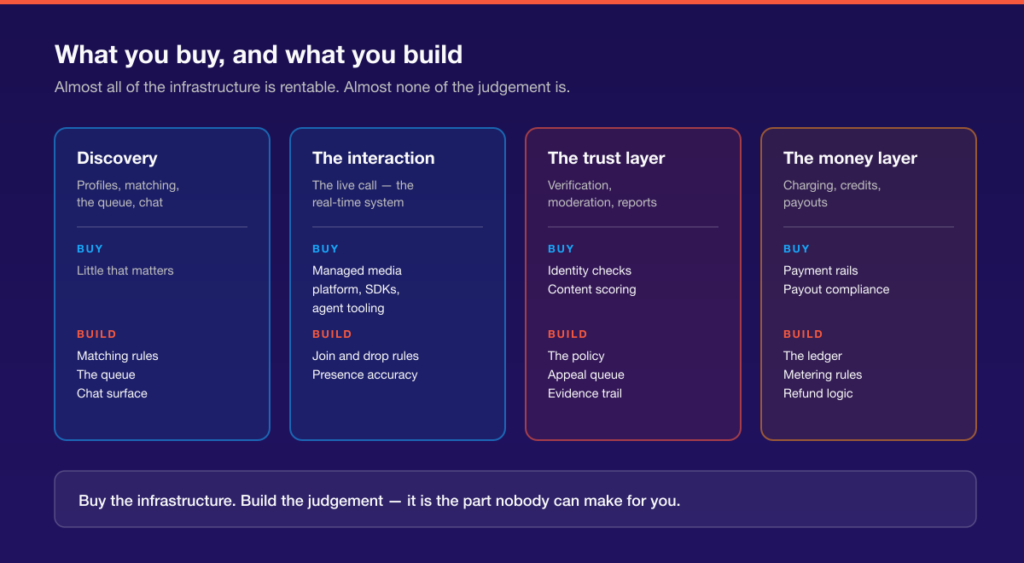
Buy the media layer. Running your own media server is a real option and occasionally the right one, but it is a commitment to operating infrastructure forever — capacity, relays, upgrades, an on-call rotation for a class of failure your product team cannot debug. A managed real-time platform gives you SDKs, room lifecycle and agent tooling on day one, priced per minute of usage. The trade sits between engineering time you spend once and a bill that grows with success; we walk through that calculation in LiveKit vs mediasoup, which argues the comparison is not dollars against dollars, and through the self-hosted options themselves in our guide to dating video app development with a WebRTC media server and, for one worked example of the self-hosted route, in building a video dating app on Jitsi.
Buy identity verification and content moderation. Both are vendor categories with real products behind them. We have built a custom moderation engine before, so this is not a claim that it cannot be done — our reading is that the category is mature and that the failure modes of a home-built one show up in front of users rather than in tests. What you cannot outsource is the policy: what a failed check does to an account, who reviews an appeal, how long evidence is kept. And note what a photo check does not cover — a live call is a different problem, and a vendor that screens uploads is not watching conversations. Nor is a content classifier the same as known-CSAM hash-matching and the reporting that goes with it; both need their own path before members can send each other images.
Buy the payment rails too. Card processing, payouts and the compliance around them are a provider’s business, not yours.
Build the trust logic, the matching and the ledger. Not the payment rails — the rules on top of them: what a minute costs, what a failed check does to an account, who is matched with whom. These encode decisions nobody can make for you, and they are where the product’s character lives.
Build nothing twice. The specification’s out-of-scope section is what keeps this list short, and in our experience of dating app development it is the cheapest page anyone writes.
What does a working stack look like?
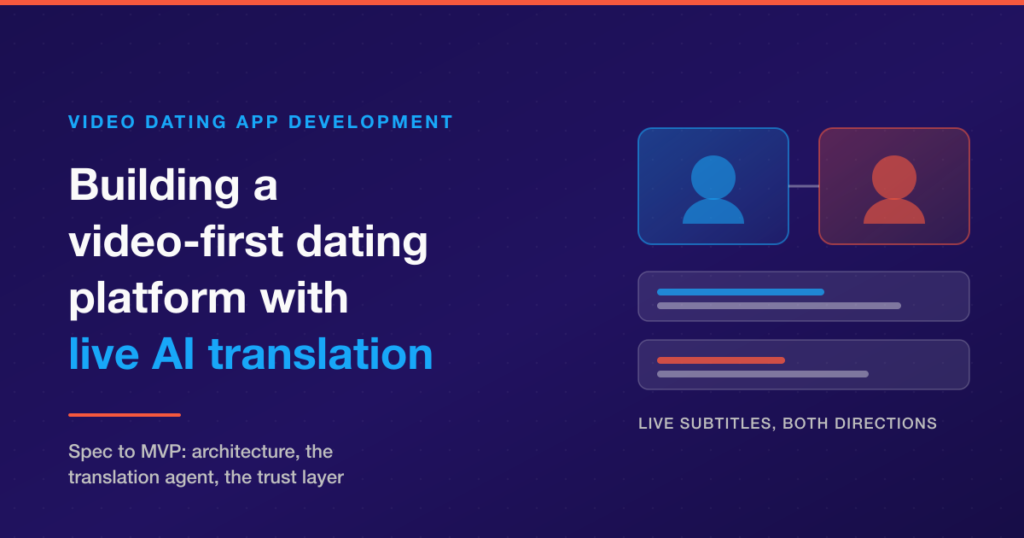
Grouped by the job each piece does, this is the shape of a live video-first dating platform, running entirely on managed services. It is the stack we would pick for this shape of product, and the whole table is ours — not an inventory of one build. The platform behind this guide is where the shape comes from, and its media layer, object storage and image moderation are as listed. For the other rows we describe what we would choose, not what shipped. For the platform this shape comes from, see building a video-first dating platform with live AI translation.
| Job | What runs it | Why we would choose it (ours) |
|---|---|---|
| Live audio and video | A managed WebRTC platform (LiveKit Cloud) | One-to-one calls do not justify operating a media server; the SDKs and the agent framework are the real purchase |
| API, background worker, media agents | Cloud Run | Request work and long-lived agents scale on different curves, so we would keep them as separate services; the alternatives are a vendor’s own agent hosting, or a cluster you run yourself — and an MVP team should not be staffing the last of those |
| System of record | Cloud SQL for PostgreSQL | Relational, because the trust layer is relational: reports, states, evidence, ledgers |
| Presence, sessions, queues and jobs | Managed Redis | Presence is read constantly and written on every connect and drop; a row in the system of record would put that write load on your database. The same tier keeps deferred work off the request path. Note what it does not cover here: the photo check is fail-closed, so nothing is visible until it has been scored and moderation gates publication |
| Payments and payouts | A payment provider, not your code | Card handling, payouts and the compliance around them are bought; what you build is the ledger that decides what to charge |
| User media and moderation evidence | Cloudflare R2 | Object storage with no egress fee, separate from the database |
| Identity and age assurance | A specialist vendor — a document check plus a live selfie | A vendor category, not a build; what you own is the policy behind it and what a failed check does |
| Image moderation | A commercial image-moderation API | Same reasoning, plus a scoring threshold you tune rather than a model you train |
| Live translation | Google Cloud Speech-to-Text v2 (Chirp 2) and Cloud Translation, driven by an agent in the room | Streaming recognition with a separate translation call — not one chain: the recogniser can translate speech itself, but its documented sample for that is the synchronous method. The model stays swappable because the agent, not the client, owns it |
| Frontend | Next.js, React, TypeScript as a static export | Keeps the client thin: the room and the agent do the work |
Two decisions inside that table are worth more than the row they sit in.
Pick your region before you pick your vendors. A dating product holds identity documents, moderation evidence and payout records, so where the data lives is a design-time decision, not a deployment setting — and it does not stop at your own services. Every managed vendor you add is another processor whose region you have to configure and then write into a contract, which makes residency a procurement exercise as much as an engineering one. Cheap to get right before launch; a migration nobody plans for afterwards.
Keep the model replaceable. Speech and vision models move faster than anything else in the stack, so the boundary that matters is whether swapping one means shipping a new client. It should not. The architecture that buys you that, and the choice between transcribe-then-translate and speech-to-speech, are argued in STT vs speech-to-speech for real-time translation.
What has to be in the trust layer before you launch?
Not “in the roadmap”. In the data model, before the first real user.
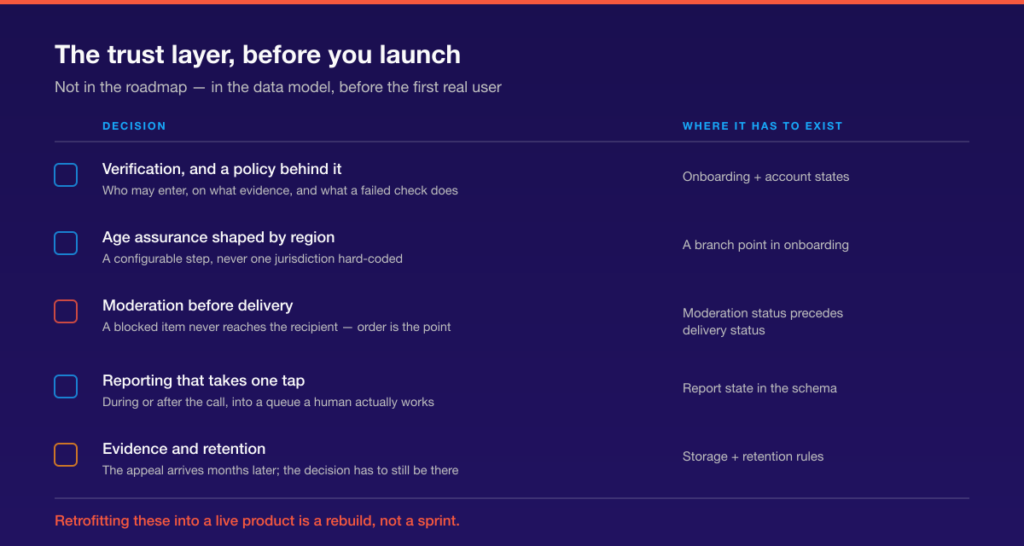
Verification, and a policy behind it. Who may enter the pool, on what evidence, and what a failed check does. The vendor is the easy half. For how liveness detection works and where it fails, see why most liveness-detection systems fail on dating apps; the policy half is yours.
Age assurance shaped by region. Obligations differ by market, so the check belongs in onboarding as a configurable step, not as a global rule. Hard-code one jurisdiction and you re-engineer onboarding the first time you enter another.
Our age assurance guide walks through what the UK Online Safety Act actually requires.Moderation before delivery rather than after. For user-to-user media in a dating context we would always screen on the way through, so a blocked item never reaches the recipient. Post-hoc moderation means the harm has already landed and you are writing an apology; the moderation pipeline shape is the same whichever vendor scores the image.
Reporting that takes one tap, during or after the interaction, feeding a queue a human actually works.
Evidence and retention. An appeal arrives months later. If the decision, the item and the timestamps were not kept, you cannot answer it — and neither can your lawyer.
The reason this belongs at design time is structural: media needs a moderation status before it has a delivery status, the schema has to carry report state, and onboarding needs somewhere to put a region-dependent step. Retrofitting those into a live product is a rebuild, not a sprint.
What actually drives the cost?
Dating app development cost is usually the question that opens these conversations, and the only honest answer starts with the drivers rather than a number — we have written separately about what it costs to make a dating app in the general case. For a video-first product, four things move the bill, and none of them is on a wireframe.
Minutes of live media. A managed platform bills the minutes an end user spends connected, so cost scales with engagement — the thing you are trying to maximise. A product where people talk for an hour has a different economic shape from one where they talk for ninety seconds, and that shape should be modelled before launch, not discovered in the first invoice.
Per-event vendor fees. Verifications and moderated items are usually priced per call to the vendor (ours). That ties two line items to signup volume and to how much media users share, which are both growth metrics. On a managed media platform the bill moves with plan tier, concurrency caps and data transfer too, not minutes alone. Only the plan fee is fixed; budgeting the rest as a fixed monthly cost is the classic mistake.
The trust layer’s engineering. In our experience the vendor fees are rarely the expensive half. The admin console, the appeal workflow, the retention rules and the queue someone staffs are weeks of work that no feature list ever carries, and they cannot be cut without cutting the product’s defensibility.
Jurisdictions. Every additional market can add an age-assurance obligation, a data-residency question and a legal review. Cost here scales with the number of places you operate, not with users.
What barely moves the bill, in our experience: the number of screens, the matching algorithm’s sophistication, and most of the feature list arguments a team will have in month two.
What belongs in the MVP, and what can wait?
Ship the loop end to end: a person can be verified, be discovered, start a live interaction that works on a real network, be charged correctly for it, and report someone. Anything that is not on that path is phase two, including most of what will be argued about hardest.
Two things should not be deferred even though they look deferrable. The first is metering correctness — if money moves per minute, the rules for a dropped call and a depleted balance are cheaper to write down before launch than to reconcile afterwards. The second is the evidence trail, because it cannot be backfilled.
And validate on real networks, not in staging. A round with real users on their own connections is how you find the failures that do not reproduce in an office.
Where teams get this wrong
Treating the trust layer as launch work. The error we meet most often, and in our experience the most expensive, because the fix is structural.
Building the media layer to save money. The saving can be real, but it arrives late and is paid for in an operational burden most early teams have not staffed for (ours).
Designing the billing rules after shipping billing. At any real volume, metering edge cases stop being rare events, and each one you did not decide in advance tends to become a refund someone issues by hand.
Confusing a demo with a product. Two people on a call is an afternoon’s work. Two strangers on a call, verified, moderated, billed, and able to report each other, is the product.
FAQ
How do you build a dating app that uses live video instead of chat? By treating it as a real-time media system first. You rent the media layer, put the interaction on WebRTC, keep presence accurate because it sets the product’s felt speed, and build the trust and money layers around the live call rather than after it.
Should we build our own video infrastructure? Usually not at the start. A managed platform gives you SDKs and room lifecycle immediately and prices per minute; self-hosting becomes interesting when your usage makes that bill bigger than the cost of operating media infrastructure yourself — a calculation worth doing before launch rather than after.
What does a dating app cost to build? There is no honest single number, but there is an honest list of drivers: minutes of live media, per-verification and per-moderation vendor fees, the engineering behind the trust layer, and the number of jurisdictions you operate in. Model those four and the range follows from your own assumptions rather than from someone else’s project.
How long does an MVP take? It depends on scope, but the sequence matters more than the calendar: a specification with a real out-of-scope list, then a prototype that answers the experience questions, then the build. The platform behind this guide took about three months of development after that groundwork.
Talk to a team that has built one
Four decisions stand between an idea and a dating product that survives its first thousand users: what you buy, what you build, what goes in the trust layer, and what you leave out of the MVP. If it would help to pressure-test those against a build that has already been through them, our engineers will spend thirty minutes on it, against what we learned building an earlier geosocial video dating platform — “private WebRTC rooms at scale — thousands of concurrent 1:1 video sessions”. No charge and no deck. Tell us what you are building.